
BuddhistCatholicContemplativeEvangelicalGeneral ChristianHinduJewishLatter-day SaintMuslimNew VisionsProgressive Christian
Beliefs
- Buddhist
- Catholic
- Contemplative
- Evangelical
- General Christian
- Hindu
- Jewish
- Latter-day Saint
- More Voices
- Muslim
- New Visions
- Pagan
- Progressive Christian
Topics
- Religion News
- Food and Religion
- Sports and Religion
- Religious Art
- Religious Music and Entertainment
- Religious Events
- History and Religion
- Style and Religion
- Politics and Religion
- Women in Religion
- Recreation Outdoors and Religion
- Business Finance and Religion
- Careers Workplace and Religion
- Education and Religion
- Family Parenting and Religion
- Health Fitness and Religion
- Home and Religion
- Relationships and Religion
- Technology and Religion
- Travel and Religion
Columnists
- Buddhist Columnists
- Business Finance and Religion Columnists
- Careers Workplace and Religion Columnists
- Catholic Columnists
- Contemplative Columnists
- Education and Religion Columnists
- Evangelists Columnists
- Family Parenting and Religion Columnists
- General Christian Columnists
- Health Fitness and Religion Columnists
- Hindu Columnists
- History and Religion Columnists
- Home and Religion Columnists
- Jewish Columnists
- More Voices Columnists
- Latter Day Columnists
- Muslim Columnists
- New Visions Columnists
- Nonreligious Columnists
- Pagan Columnists
- Politics and Religion Columnists
- Progressive Columnists
- Recreation Outdoors and Religion Columnists
- Relationships and Religion Columnists
- Religion News Columnists
- Religious Art Columnists
- Religious Events Columnists
- Religious Music and Entertainment Columnists
- Sports and Religion Columnists
- Style and Religion Columnists
- Technology and Religion Columnists
- Travel and Religion Columnists
- Women in Religion Columnists
Resource Library
- 2026 Calendar
- Library of World Religions
- The 100 Most Holy Places on Earth
- Patheos Answers
- Podcasts
- Videos
- Faith Leaders Database
- Anglican Episcopalian
- Bahai
- Baptist
- Buddhism
- Christianity
- Confucianism
- Eastern Orthodoxy
- Hinduism
- Holiness and Pentecostal
- ISKCON
- Islam
- Judaism
- Lutheran
- Methodist
- The Church of Jesus Christ of Latter-day Saints
- New Age
- Paganism
- Presbytarian and Reformed
- Protestantism
- Religion Behind the Scenes
- Roman Catholic
- Scientology
- Shia Islam
- Sikhism
- Sufism
- Sunni Islam
- Taoism
- Zen
- See all religions
Research Tools
 Ad-Free & Subscriber Log-In Subscription Support
Ad-Free & Subscriber Log-In Subscription Support
Follow Patheos 

- Trending:
- Forgiveness
- |
- Marriage
- |
- Consciousness
- |
- Death Penalty
- |
- Election
- |
- Halloween
 Bad Catholic
- Home
- Catholic
- How to Die a Damn Good Story
How to Die a Damn Good Story
Last updated on: May 31, 2014 at 11:53 am by Marc
How to Die a Damn Good Story 2014-05-31T11:53:18-04:00 Marc
Patheos Explore the world's faith through different perspectives on religion and spirituality! Patheos has the views of the prevalent religions and spiritualities of the world.

Part 1 of a terribly depressing series.
I wish to die a damn good story. I want to carve out for myself a meaningful slice of existence. I want to leave, along with a good-looking corpse, a coherent narrative that says something, not a garble of unconnected life-events fading unresolved into nothingness as the blood dries. I’d like to be a story, and this is more than a daydream of me-as-Sherlock, man-as-protagonist. This is suicide prevention.
The desire for life to be a good story makes the unbearable bearable. The best example of this is in mankind’s most ridiculous response to the presence of human suffering: That’s life, man. C’est la vie. Shit happens.
What an odd sort of solace! We are saying, in essence, “This thing you cannot stand is part of an existence comprised by its nature of things you cannot stand. Your family died? You’ll never love again? That’s what life is. You are living an existence in which families die and hearts get broken, and as such, your current pain was inevitable and will reoccur, as it will for everyone performing this terrifying shuffle-forth. Feel better.”
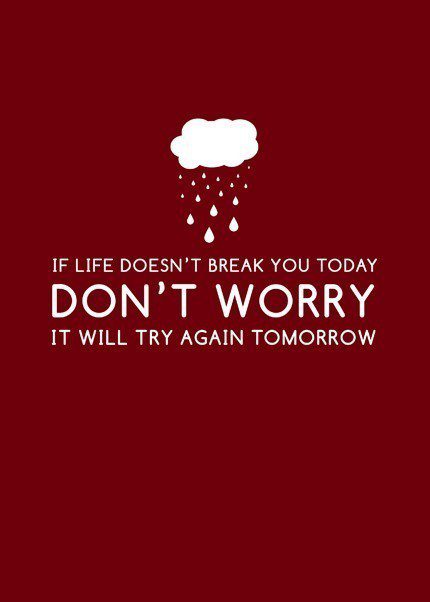
But — and this is where things get wonderfully bizarre — we can and do find comfort in the fact that particular tragedies are part of an overall thing we call “life.” The pathetically inadequate words will continue to stiffen spines and staunch leaky eyes, for contained however tactlessly and brusquely in the phrase “that’s life” is the consideration of narrative over event, an appeal to story over unconnected fact. It is a zooming out from the part to the whole. Suffering, considered in itself, is unbearable. Considered as a thread woven into the entire fabric of life, it becomes bearable. The tragedy, considers in itself, contains no possibility of comfort. The loved one is dead, the house is destroyed, the child in pain, and nothing is OK. The tragedy you grow from, the tragedy that teaches, in short, the tragedy considered as part of a meaningful narrative stretching towards completion, towards some total meaning which contains your tragedy but is not limited to it — this contains the possibility of comfort. An appeal to the entirety of life comforts a particular evil because even particular evils settle into some sort of sense when placed into a context of other events and better times, as related to a life which is not wholly evil, but rather moves forward to a final meaning. The worse is bearable if it is part of a story we are willing to read to the end.
But though the evil we suffer can be comforted, the evil we do is infinitely, qualitatively worse. I’m speaking of sin, the unspeakable phantasm of modernity, ever-present, ever-denied, ever limited to the ranks of pedophilia and Nazism for the comfort of white people wishing to do nothing at all and simultaneously feel good about it. Sin, that existential fact we try, try, and try again to render a religious concept relegated to the guilty, slut-shamed internal lives of churchgoers — a fact we nevertheless taste the copper of every day. We cannot understand sin unless we understand the desire for life to be a consistent narrative.
For what is sin? Sin is less like a black mark against our names and more like walking into our home to find our family has grown bat wings. It is that which ought not be, dwelling within us by our own perverse permission. It is absurdity. Our sins present themselves as loose-ends, ought-nots that cannot be fit with the content of our existence. Our sins — locked in our memory, our history, our consciences, our relationships, and our entire state of being — are irreconcilable oddities that niggle and gnaw against our lives for the simple fact that they are not of our lives. They are foreign cells, not-me’s within me, absurdities all and nauseating. We do what we hate, we hurt the one’s we love, we indulge the shameful until we cannot feel the shame, and you hardly need me to remind you of the fact. We say we “are not our true selves” when we sin, and this means the following: That which is not our true selves becomes a part of ourselves. Sins are principles of contradiction. We sin, and thereby contain an absence, like hell-bound and miserable doughnuts.
Sin then, is a poorly-written and inexcusable break in the consistency of our existence, one that works directly against our desire for our lives to be, at the end of all things, good stories. Sin is Harry Potter killing himself in the third chapter of the second book, the end. We do what we ought not do, and thereafter live with an absurdity embedded into the flesh of our existence, an ought-not-be, a part that was never supposed to be part of our story — and now is.
No appeal to life is adequate here. No one says c’est la vie to the man who murders his brother. Sin is definitively that which ought not be part of our life story, and thus no consideration of narrative over event will absolve the event. To be in sin is to be without the possibility of a finally meaningful existence. To be in sin is to live an incoherent narrative. To be in sin and to live with past sins is to live a story with loose-ends, a fragmented garble that contains that which ought-not-be and ought-never-have-been. The desire to die a damn good story is impossible to satisfy on the condition of indwelling sin, just as Crime and Punishment could never be the miracle of a narrative that it is if the third chapter contained a disco dance-off between Raskolnikov and Sonya.
Thus, if the desire to die a good story is real, something must be done about sin.
Previous Post

October 14, 2013
A Possible Anthropological Origin of the Duck-face
Next Post
November 6, 2013 The Ethical Necessity of Time Travel
Browse Our Archives
Select a Category Another Look Atheism Bad Catholics Beauty Communio Crookedhart Destupidification Exiting the Culture Wars Gender Theory That Doesn't Suck How To Language Liturgy! Love One Another Marriage Equality Modesty Music Objectification pop culture Poverty Sacraments Sex Technology The Best Religion in the World The Erotic Phenomenon Time Uncategorized Virtue Ethics That Don't Suck Winning the Culture Wars
Select a Month January 2017 December 2016 November 2016 October 2016 July 2016 June 2016 April 2016 March 2016 February 2016 January 2016 December 2015 November 2015 October 2015 September 2015 August 2015 July 2015 June 2015 May 2015 March 2015 February 2015 January 2015 June 2014 May 2014 April 2014 March 2014 February 2014 January 2014 December 2013 November 2013 October 2013 September 2013 August 2013 July 2013 June 2013 May 2013 April 2013 March 2013 February 2013 January 2013 December 2012 November 2012 October 2012 September 2012 August 2012 July 2012 June 2012 May 2012 April 2012 March 2012 February 2012 January 2012 December 2011 November 2011 October 2011 September 2011 August 2011 July 2011 June 2011 May 2011 April 2011 March 2011 February 2011 January 2011 December 2010 November 2010 October 2010 September 2010 August 2010
Follow Us!
TAKE THE
Religious Wisdom Quiz
Who said: "Therefore, since we have a great high priest who has ascended into heaven, Jesus the Son of God, let us hold firmly to the faith"?
Select your answer to see how you score.
Peter John Paul James
Related posts from Bad Catholic
Towards a New Argument Against Pornography


Why Millennials Want to Change the World

The Communist That Lives With Me Responds: "Your...
TRENDING AT PATHEOS Catholic

Rejecting Doom: Christian Hope And Human Action
Christianity is a religion of hope. We are to have hope and...

It’s What Comes From Within Which Matters
One of the most difficult things for us to understand is why...

Why I Choose the Eucharist Over the Sermon
Choose the Eucharist, Not the Sermon What are we supposed to get...

5 Design Elements Found in Spiritually Rooted Homes
Putting Spirituality Into Home Decor Our homes are more than our living...

Credo: A Story of God Told with the...
About 10 years ago, I began to imagine a personal "Credo" that...

The Anatomy of Divine Revelation in Catholic Thought
The claim that God has made Himself known to human beings is...
view all Catholic blogs
Ad-Free & Subscriber Log-In Subscription Support
- About Us
- 2026 Calendar
- Videos
- Podcasts
- Library of World Religions
- Faith In Media Tracker
- Advertise With Us
- Write for Us
- Privacy Policy
- Terms of Service
- Do Not Sell My Data
- Contact Us
- Radiant Digital
- Manage Newsletter Subscriptions
- Unsubscribe From Notifications
- Sitemap
Copyright 2008-2026, Patheos. All rights reserved.
Subscription Support Ad-Free & Subscriber Log-In
Follow Patheos