
BuddhistCatholicContemplativeEvangelicalGeneral ChristianHinduJewishLatter-day SaintMuslimNew VisionsProgressive Christian
Beliefs
- Buddhist
- Catholic
- Contemplative
- Evangelical
- General Christian
- Hindu
- Jewish
- Latter-day Saint
- More Voices
- Muslim
- New Visions
- Pagan
- Progressive Christian
Topics
- Religion News
- Food and Religion
- Sports and Religion
- Religious Art
- Religious Music and Entertainment
- Religious Events
- History and Religion
- Style and Religion
- Politics and Religion
- Women in Religion
- Recreation Outdoors and Religion
- Business Finance and Religion
- Careers Workplace and Religion
- Education and Religion
- Family Parenting and Religion
- Health Fitness and Religion
- Home and Religion
- Relationships and Religion
- Technology and Religion
- Travel and Religion
Columnists
- Buddhist Columnists
- Business Finance and Religion Columnists
- Careers Workplace and Religion Columnists
- Catholic Columnists
- Contemplative Columnists
- Education and Religion Columnists
- Evangelists Columnists
- Family Parenting and Religion Columnists
- General Christian Columnists
- Health Fitness and Religion Columnists
- Hindu Columnists
- History and Religion Columnists
- Home and Religion Columnists
- Jewish Columnists
- More Voices Columnists
- Latter Day Columnists
- Muslim Columnists
- New Visions Columnists
- Nonreligious Columnists
- Pagan Columnists
- Politics and Religion Columnists
- Progressive Columnists
- Recreation Outdoors and Religion Columnists
- Relationships and Religion Columnists
- Religion News Columnists
- Religious Art Columnists
- Religious Events Columnists
- Religious Music and Entertainment Columnists
- Sports and Religion Columnists
- Style and Religion Columnists
- Technology and Religion Columnists
- Travel and Religion Columnists
- Women in Religion Columnists
Resource Library
- 2026 Calendar
- Library of World Religions
- The 100 Most Holy Places on Earth
- Patheos Answers
- Podcasts
- Videos
- Faith Leaders Database
- Anglican Episcopalian
- Bahai
- Baptist
- Buddhism
- Christianity
- Confucianism
- Eastern Orthodoxy
- Hinduism
- Holiness and Pentecostal
- ISKCON
- Islam
- Judaism
- Lutheran
- Methodist
- The Church of Jesus Christ of Latter-day Saints
- New Age
- Paganism
- Presbytarian and Reformed
- Protestantism
- Religion Behind the Scenes
- Roman Catholic
- Scientology
- Shia Islam
- Sikhism
- Sufism
- Sunni Islam
- Taoism
- Zen
- See all religions
Research Tools
 Ad-Free & Subscriber Log-In Subscription Support
Ad-Free & Subscriber Log-In Subscription Support
Follow Patheos 

- Trending:
- Forgiveness
- |
- Marriage
- |
- Consciousness
- |
- Death Penalty
- |
- Election
- |
- Halloween
 Bad Catholic
- Home
- Catholic
- How Not to Despair or A Kierkegaardian Analysis of Typhoon
How Not to Despair or A Kierkegaardian Analysis of Typhoon
Last updated on: August 12, 2013 at 8:53 am by Marc
How Not to Despair or A Kierkegaardian Analysis of Typhoon 2013-08-12T08:53:42-04:00 Marc
Patheos Explore the world's faith through different perspectives on religion and spirituality! Patheos has the views of the prevalent religions and spiritualities of the world.
 All I really want to do with my life is convince you that the indie-rock group Typhoon are a) awesome and b) channeling the philosophy of Soren Kierkegaard, but to do this I first have to explain humanity’s desire for goodness and the concept of despair. It’s an odd route round, but what else are you going to do, your job? Right then.
Homo sapiens — may they be fruitful and multiply — experience a desire to be themselves. This is utterly strange. Rocks, trees and bacterium are laughing at us for the fact. No rock is concerned with being the rock that it is. No dolphin, I assume, feels the daily weight of not being itself. We do not observe identity crisises in the non-personal world. But people, people want to be themselves.
And it’s not simply that we desire to be ourselves in the same way we might experience the pressing desire for an early lunch. Our claim is more absurd: We ought to be ourselves, and not only this, but others ought to be themselves as well. Thus I will, in shame, admit that “I wasn’t being myself.” Thus I will, in judgment, remark that “she is not being her self.”
We ought to be ourselves. Who would disagree? Human beings are those beings who experience a certain obligation upon their own existence. My existence comes with the obligation to be myself, and is thus set apart from every non-personal existence in the universe, which contains no obligation to be what it is. Things already are what they are. People must become who they are.
We experience “becoming ourselves” as a moral obligation, but we are all of us in darkness, fumbling blindly through an unhelpful universe. How are we supposed to become ourselves? It sounds like a tautology, like a bad joke, and it’s precisely from this obscurity that Kyle Morton of Typhoon writes:
It’s a desert mirage that you follow,
it will disappear and relocate the moment you approach,
and in the distance it changes color and form.
What was here, a single cigarette, now is a life that isn’t yours.
http://www.youtube.com/watch?v=mZoGcnxrzkI
How often “who we are” is just a figment of our imagination, “a desert mirage” we follow that, upon reaching, becomes a stale disappointment. We say that who we ought to be is “a doctor” or “a writer,” and as long as we are working to become these things, we are happy, for we may entertain the illusion that a career is an adequate description of who we are in our entirety. But at the end of our years of education, when we have finally “become” an engineer or a social worker, we are met with same obligation: Become yourself. How pitiful it seems, in the face of the question of whether we are ourselves (which is precisely the question we face on our deathbed), to hold up “doctor” or a “lawyer” as our answer, as if to say “See, who I am is this occupation!” We pursue labels to this same end, to avoid the question of whether we have met our existential obligation. If we are a liberal or conservative or traditionalist or a radical then “who we are” has been happily confused with “things we do.” Or we may try to avoid the obligation entirely by annihilating the parts of ourselves that feel this obligation most strongly — our sense of shame, our desire to know the truth, our desire for modesty, etc. We may pursue a life of fame or wealth so as to build our identity within a puffed-up sense of prestige. Really, there’s no end to human mediocrity, to our unflagging efforts at sidestepping the ultimate obligation of human existence — to become ourselves.
This was Kierkegaard’s thesis in The Sickness Unto Death, that despair is not being the self who we are, that is, not being ourselves. Whether we are aware that we are not being ourselves is irrelevant — it is still despair. This is why Typhoon’s lyrics are so unflinchingly dark. They are filled with an awareness of despair. They are aware that we pile up thing upon thing to create some semblance of complete existence, and thereby never fulfill the most obvious project of human existence — to become who we are. This is most apparent in the song — you guessed it — “The Sickness Unto Death,” which it takes its name from Kierkegaard’s famous work of existential psychology:
You tried so hard to make people remember you for something you were not,
and if they so remember you then something else will certainly get forgotten.
Life is for the living
I’ve heard tell that it is why we are young
in the morning sun
you take every year as it comes
but when your life is over
all those years fold up like an accordion
they collapse just like a broken lung.
Now I’ve only got one organ left and this old bag of bones it is failing me
I try to tell people that I’m dying only they don’t believe me.
They say we’re all dying, that we’re all dying
but if you are dying, why aren’t you scared?
Why aren’t you scared,
like I’m scared?
I read somewhere that when you face eternity
you face it alone
not matter what you thought
or what you had
or you had not
unless you put yourself in God
but tell me God, O where did you go?
Really, I never would have thought it possible to slip this work into a song, but with Typhoon, all things are possible.
To call despair by its name is a rejection of despair, and the rejection of despair is hope, and Typhoon’s music is ultimately and explosively hopeful. Their song, “The Sickness Unto Death,” ending with the repetition “Eternity will smile on me,” gives way into “The Honest Truth,” in which we are given so much goodness that I can’t help but shuffle them awkwardly into the ethicists, though they look odd next to The Avett Brothers. Their song “The Honest Truth” begins where “The Sickness Unto Death” ends, with the repetition of “eternity will smile on me,” establishing itself as Morton’s answer to the previously raised angst over how he can possibly reject despair and become the self he is. The answer is unabashedly Kierkegaardian…
Be kind to all of your neighbors
‘cuz they’re just like you…
and you’re nothing special
unless they are too.
…as a wonderful reference to his religious work, Works of Love. But more than this, Morton tells us “You’re gonna piss and moan / You let the devil in your home.” This archaic idea of demon expulsion is even better expressed in their music video, in which Morton goes after a basement dwelling belzebub with a baseball bat.
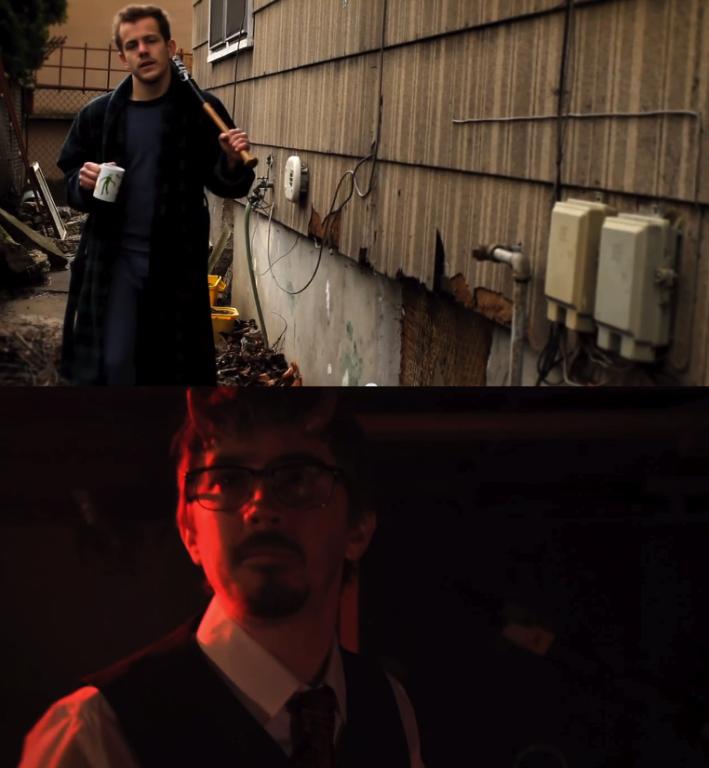
But damn it, Satan slaying is precisely the answer to the problem of being who we are. When the Disney Channel tells us to “be ourselves,” it neuters and declaws the issue, making the superhuman effort to puncture the malaise of despair a mere matter of whim-following, of a fashionable non-conformity and individualism. In short, our current culture’s grave instruction to “just be yourself” removes the act of “being yourself” from the moral sphere and places it in the emotive sphere. What they really mean is be what feels like being yourself. What Kierkegaard makes clear, and what the new ethicists seem to be dancing around every time they write, is that being yourself and being good are synonymous. Now I risk myself here. This is not an expressed “conclusion” in Morton’s lyrics. Nevertheless, I believe it is the only possible conclusion.
Doing good is doing what is proper, what fits us, not just emotively, but ontologically. This is, after all, our basic experience of “doing the right thing,” that it is proper and appropriate to ourselves (and our neighbors who are “just like” us). Now if doing good is doing what is proper for us to do, it follows that in the act of doing good we become who we properly are, revealed to ourselves in truth. Consider a shoddy analogy. If what is proper to art is that it exist beautifully, for its own sake, then art that exists solely for use — like pornography — is not truly art. Only by “doing” what is proper to itself is a thing revealed as being what it is. Pornography is nude art in despair. Sinfulness is a human being in despair. Only by doing the good — what is (ontologically) proper — do we become who we are.
This, remember, is how the desire to be ourselves is experienced, as a moral imperative which says we ought to be ourselves. When we do what we ought, we are doing what is right — what is good. It is good to be ourselves, and I believe that we could — in this instance — say to be yourself is to be good, and all else illusion. Charles Taylor says that we give our identity, our answer to the question “who are you,” by expressing the good to which we are oriented. Who we are is revealed by our relation to the good.
What’s needed to “face eternity” and to be who we are in all authenticity is not a following of our whims and urges, which is the essence of popular music, but to piss, moan and expunge the devil from our home with a bat, which is the essence of Typhoon. What’s needed is the end of sin. This, again, is present in the Kierkegaard that Morton references, when he says that despair is just another name for sin. To be good is to reject sin, and sin is despair, and despair is not being yourself, and thus to be good is to reject all false selves, all sinful selves — all those parts that pretend to be the whole of us — in favor of the self that you truly are — and this is being good. Being good is the answer to despair.
I need to listen to Typhoon’s new album a hundred more times before I fit it into this overwrought analysis, but I cannot help but believe that this desire to be good, so complexly presented throughout the albums “Hunger and Thirst” and “A New Kind of House,” recieves its best and most idiotic expression in the album “White Lighter”:
I will be good though my body be broken!
I will be good though my body be broken!
I will be good, may I want for nothing at all.
Their new album is available for streaming on NPR, and all of you should buy it, twice, in lieu of just sending these people checks.
Previous Post

August 10, 2013
Typhoon and the Goodness Revolution
Next Post
August 12, 2013 The Egoism of God
Browse Our Archives
Select a Category Another Look Atheism Bad Catholics Beauty Communio Crookedhart Destupidification Exiting the Culture Wars Gender Theory That Doesn't Suck How To Language Liturgy! Love One Another Marriage Equality Modesty Music Objectification pop culture Poverty Sacraments Sex Technology The Best Religion in the World The Erotic Phenomenon Time Uncategorized Virtue Ethics That Don't Suck Winning the Culture Wars
Select a Month January 2017 December 2016 November 2016 October 2016 July 2016 June 2016 April 2016 March 2016 February 2016 January 2016 December 2015 November 2015 October 2015 September 2015 August 2015 July 2015 June 2015 May 2015 March 2015 February 2015 January 2015 June 2014 May 2014 April 2014 March 2014 February 2014 January 2014 December 2013 November 2013 October 2013 September 2013 August 2013 July 2013 June 2013 May 2013 April 2013 March 2013 February 2013 January 2013 December 2012 November 2012 October 2012 September 2012 August 2012 July 2012 June 2012 May 2012 April 2012 March 2012 February 2012 January 2012 December 2011 November 2011 October 2011 September 2011 August 2011 July 2011 June 2011 May 2011 April 2011 March 2011 February 2011 January 2011 December 2010 November 2010 October 2010 September 2010 August 2010
Follow Us!
TAKE THE
Religious Wisdom Quiz
What does "Nazareth" mean?
Select your answer to see how you score.
Branch Star Gift Light
Related posts from Bad Catholic

Towards a New Argument Against Pornography
How to Know That You Are Beautiful

Death, Split Selves, and Demons: The Dopest Album...

TRENDING AT PATHEOS Catholic

Rejecting Doom: Christian Hope And Human Action
Christianity is a religion of hope. We are to have hope and...

It’s What Comes From Within Which Matters
One of the most difficult things for us to understand is why...

Why I Choose the Eucharist Over the Sermon
Choose the Eucharist, Not the Sermon What are we supposed to get...

5 Design Elements Found in Spiritually Rooted Homes
Putting Spirituality Into Home Decor Our homes are more than our living...

Credo: A Story of God Told with the...
About 10 years ago, I began to imagine a personal "Credo" that...

The Anatomy of Divine Revelation in Catholic Thought
The claim that God has made Himself known to human beings is...
view all Catholic blogs
Ad-Free & Subscriber Log-In Subscription Support
- About Us
- 2026 Calendar
- Videos
- Podcasts
- Library of World Religions
- Faith In Media Tracker
- Advertise With Us
- Write for Us
- Privacy Policy
- Terms of Service
- Do Not Sell My Data
- Contact Us
- Radiant Digital
- Manage Newsletter Subscriptions
- Unsubscribe From Notifications
- Sitemap
Copyright 2008-2026, Patheos. All rights reserved.
Subscription Support Ad-Free & Subscriber Log-In
Follow Patheos