
BuddhistCatholicContemplativeEvangelicalGeneral ChristianHinduJewishLatter-day SaintMuslimNew VisionsProgressive Christian
Beliefs
- Buddhist
- Catholic
- Contemplative
- Evangelical
- General Christian
- Hindu
- Jewish
- Latter-day Saint
- More Voices
- Muslim
- New Visions
- Pagan
- Progressive Christian
Topics
- Religion News
- Food and Religion
- Sports and Religion
- Religious Art
- Religious Music and Entertainment
- Religious Events
- History and Religion
- Style and Religion
- Politics and Religion
- Women in Religion
- Recreation Outdoors and Religion
- Business Finance and Religion
- Careers Workplace and Religion
- Education and Religion
- Family Parenting and Religion
- Health Fitness and Religion
- Home and Religion
- Relationships and Religion
- Technology and Religion
- Travel and Religion
Columnists
- Buddhist Columnists
- Business Finance and Religion Columnists
- Careers Workplace and Religion Columnists
- Catholic Columnists
- Contemplative Columnists
- Education and Religion Columnists
- Evangelists Columnists
- Family Parenting and Religion Columnists
- General Christian Columnists
- Health Fitness and Religion Columnists
- Hindu Columnists
- History and Religion Columnists
- Home and Religion Columnists
- Jewish Columnists
- More Voices Columnists
- Latter Day Columnists
- Muslim Columnists
- New Visions Columnists
- Nonreligious Columnists
- Pagan Columnists
- Politics and Religion Columnists
- Progressive Columnists
- Recreation Outdoors and Religion Columnists
- Relationships and Religion Columnists
- Religion News Columnists
- Religious Art Columnists
- Religious Events Columnists
- Religious Music and Entertainment Columnists
- Sports and Religion Columnists
- Style and Religion Columnists
- Technology and Religion Columnists
- Travel and Religion Columnists
- Women in Religion Columnists
Resource Library
- 2026 Calendar
- Library of World Religions
- The 100 Most Holy Places on Earth
- Patheos Answers
- Podcasts
- Videos
- Faith Leaders Database
- Anglican Episcopalian
- Bahai
- Baptist
- Buddhism
- Christianity
- Confucianism
- Eastern Orthodoxy
- Hinduism
- Holiness and Pentecostal
- ISKCON
- Islam
- Judaism
- Lutheran
- Methodist
- The Church of Jesus Christ of Latter-day Saints
- New Age
- Paganism
- Presbytarian and Reformed
- Protestantism
- Religion Behind the Scenes
- Roman Catholic
- Scientology
- Shia Islam
- Sikhism
- Sufism
- Sunni Islam
- Taoism
- Zen
- See all religions
Research Tools
 Ad-Free & Subscriber Log-In Subscription Support
Ad-Free & Subscriber Log-In Subscription Support
Follow Patheos 

- Trending:
- Forgiveness
- |
- Marriage
- |
- Consciousness
- |
- Death Penalty
- |
- Election
- |
- Halloween
 Bad Catholic
- Home
- Catholic
- Eyeball the Enemy
Eyeball the Enemy
Last updated on: July 7, 2013 at 10:36 pm by Marc
Eyeball the Enemy 2013-07-07T22:36:25-04:00 Marc
Patheos Explore the world's faith through different perspectives on religion and spirituality! Patheos has the views of the prevalent religions and spiritualities of the world.
 Eye-contact is a fascinating phenomenon. With our beloved, it is a delight. With a stranger walking down the hall, it is unbearable. This leads to the exciting game by which I — knowing full well that I am about to cross paths with the aforementioned stranger — pretend not to know it at all. I keep my head down, fascinated — for some inexplicable reason — with the movement of my feet, and only at the last moment look up, make eye-contact, and acknowledge the other’s presence with my most imperceptibly subtle combination of grunt and nod, then woosh — we have passed each other. I usually feel as if I have narrowly avoided something awful.
Eye-contact is a contact of the person, the subject, the unique, unrepeatable consciousness — the inexplicable, unknowable I of the girl standing in front of us. This explains why our parents told us to “look him in the eye,” for it is a look that acknowledges the other person in fullness. This explains why, when men become enamored with a particular curve of a particular woman, they are told “my eyes are up here,” and are helpfully guided back into relation with the person they are communicating with and away from an objectified version of the same.
But why? Why does eye-contact amount to I-contact? It is a truism to say “the eyes are the window to the soul,” which is precisely the same as saying “the eyes are the windows to the person,” but the cynic in me wants to respond, “no, the eyes are the windows to the dark of the vitreous gel behind the pupil.”
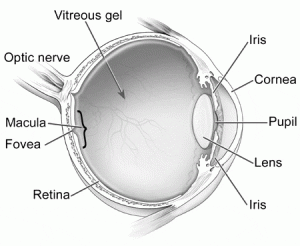
And yes, I looked that up for the sake of the post.
Through my eyes I perceive the world. This perception is mine. No other person in the universe occupies the same space as I do and no other person sees the same “angle” of the Cosmos. This fact — that the perception of my eyes is always, at any moment, unique to me — speaks directly to the very nature of human existence. Human existence is a first-person experience of reality. No one else has my experience.
Eye-contact, then, is a mutual meeting by which I perceive you as a unique perceiver. Not only this, but in the same instance, you perceive me as a unique perceiver. Eye-contact is mysterious because it is an acknowledgment of a profound mystery — that you inhabit a perspective and an experience that I can never inhabit, and I inhabit my own. It acknowledges the dignity of the human person because it can never subsume first-person experience into anything less. It can never say “oh, you’re just a stranger,” or a “face in the crowd.” These statements pretend that the person’s existence and experience is “just like” another’s, but when we perceive someone as a unique, unrepeatable perspective in the Cosmos, subsumption into a “common perspective” becomes ridiculous. An unrepeatable perspective cannot be “just like” another.
Perhaps this is why, when someone offers us an insult that generalizes us, calling us an “egoist,” a “slut,” or an “asshole,” we often rejoin with the wonderfully intense demand to “look me in the eye and say that again,” or better yet, “say it to my face.” What we seem to mean, consciously or otherwise, is “acknowledge that I am a unique, ungroupable, unrepeatable existence, and then try and label me into a generally disdained group-existence.”
Perhaps this is why eye-contact can be frightening. It is far easier to exist as a general idea than to exist as the subject that you are. It is easier to exist as part of a crowd. It is easier to exist as a stranger. We spoke of this earlier in our discussion of labels — how much easier it is to simply accumulate a list of labels, to be generalized into a host of different groups. I’ll be pro-life, heterosexual, a hipster, caucasian — Christian, even — and thereby understandable to myself and all others. But a single second of eye-contact obliterates us, strips us back to our core, for by it we are acknowledged beyond all groups as the unrepeatable human person we are, in the very moment that the other appears to us in precisely the same way (which can be equally scary if were previously comfortable to think of him as part of a crowd, as a citizen, as a stranger, etc.).

It occurs to me now that eye-contact is most essential in moments of love and hate. That it exists as a necessity between lovers, friends and family makes sense: Love is directed towards the person. We want to love the beloved for who she is, and we want to be loved for who we are. Within the erotic, eye-contact is an embodiment of the bittersweet strive to fully contemplate the mystery of the beloved, to fully know, and indeed, to fully become the other, until the two can say “we are one” — an impossible task, as far as this life is concerned, except, perhaps, in the creation of a child, that third who bears testimony to the union of the two.
But hate? Why lock eyes in hatred? Why do we “get in each other’s faces” and “stare each other down?”
Karol Woltiya said that the opposite of love is not hate, but use, and to this I would add that hatred is actually — phenomenologically speaking — extremely close to love, and it is precisely its closeness that makes it so agonizing, as being outside of a locked bathroom is closer to relief than being in a car, and yet all the more agonizing for the proximity. How swiftly the lovers, after an unforgivable offense, shift to an unbearable hatred of each other. How swiftly male enemies turn hatred into love, becoming inseparable friends during the same recess they broke into a fistfight. How similar the experiences of having a lover and an arch-enemy. We think about both all the time, distracted from normal life by their presence, flustered by their nearness. Our heart beats, our blood-boils, and above all, we are filled with the sense of demand, that something must be done, that this person — lover or enemy — must be confronted.
I think this similarity arises from the fact that hatred is not an ignoring of another’s subjectivity. It is not an act of objectification. Dislike and use may be, but hatred is hatred precisely because it hates the person. It acknowledges the unique, unrepeatable subjectivity of a particular person — and wishes him dead.
The presence of eye-contact within the act of hatred makes a twisted sort of sense. It takes the guise of love only so it can come close enough to spit at the innermost person. In the glare of hatred I impose my unique, unrepeatable perspective as diametrically opposed to the perspective of the other. I acknowledge that there will never be another him, not out of any respect for the mystery of his subjectivity, but because only then can I fully oppose his very being. “Whosoever hateth his brother is a murderer,” (1 John 3:15) yes, for murder extinguishes a unrepeatable existence.
Hatred is diabolical. The devil does not dislike God, nor did he hate an objectified concept he believed God to be, rather, he rejected God in the fullness of his presence. He hates God. Similarily, the devil does not objectify mankind. He is under no illusion that we are just faces in a crowd or names on a Facebook page. The devil knows we are unique, unrepeatable subjects — and he hates us as such.
Both hatred and love make eye contact, because both hatred and love strive to perceive the other as a unique perceiver, the self that they are and none other. Both shoot their arrows at the core of the person. I think this makes a little more sense out of Christ’s baffling statement: “I wish you were either cold or hot. So, because you are lukewarm, neither hot nor cold, I will spit you out of my mouth.” (Revelation 3:15) Somehow, a hostile hatred of God is closer to love than a bored and boring apathy, for it strives — at the very least — to meet his gaze and live.
Previous Post

June 24, 2013
Virtue is an Experience of Reality
Next Post
July 16, 2013 Dear Gordon Gee
Browse Our Archives
Select a Category Another Look Atheism Bad Catholics Beauty Communio Crookedhart Destupidification Exiting the Culture Wars Gender Theory That Doesn't Suck How To Language Liturgy! Love One Another Marriage Equality Modesty Music Objectification pop culture Poverty Sacraments Sex Technology The Best Religion in the World The Erotic Phenomenon Time Uncategorized Virtue Ethics That Don't Suck Winning the Culture Wars
Select a Month January 2017 December 2016 November 2016 October 2016 July 2016 June 2016 April 2016 March 2016 February 2016 January 2016 December 2015 November 2015 October 2015 September 2015 August 2015 July 2015 June 2015 May 2015 March 2015 February 2015 January 2015 June 2014 May 2014 April 2014 March 2014 February 2014 January 2014 December 2013 November 2013 October 2013 September 2013 August 2013 July 2013 June 2013 May 2013 April 2013 March 2013 February 2013 January 2013 December 2012 November 2012 October 2012 September 2012 August 2012 July 2012 June 2012 May 2012 April 2012 March 2012 February 2012 January 2012 December 2011 November 2011 October 2011 September 2011 August 2011 July 2011 June 2011 May 2011 April 2011 March 2011 February 2011 January 2011 December 2010 November 2010 October 2010 September 2010 August 2010
Follow Us!
TAKE THE
Religious Wisdom Quiz
Who said, "Even though I walk through the valley of the shadow of death, I will fear no evil"?
Select your answer to see how you score.
David Moses Paul Job
Related posts from Bad Catholic


Why Millennials Want to Change the World

What Photography Does to Unborn Children

TRENDING AT PATHEOS Catholic

The Parable Of The Sower And The Word...
One of Christ’s most famous parables is that of the sower who...

Rejecting Doom: Christian Hope And Human Action
Christianity is a religion of hope. We are to have hope and...

Why I Choose the Eucharist Over the Sermon
Choose the Eucharist, Not the Sermon What are we supposed to get...

5 Design Elements Found in Spiritually Rooted Homes
Putting Spirituality Into Home Decor Our homes are more than our living...

Credo: A Story of God Told with the...
About 10 years ago, I began to imagine a personal "Credo" that...

The Anatomy of Divine Revelation in Catholic Thought
The claim that God has made Himself known to human beings is...
view all Catholic blogs
Ad-Free & Subscriber Log-In Subscription Support
- About Us
- 2026 Calendar
- Videos
- Podcasts
- Library of World Religions
- Faith In Media Tracker
- Advertise With Us
- Write for Us
- Privacy Policy
- Terms of Service
- Do Not Sell My Data
- Contact Us
- Radiant Digital
- Manage Newsletter Subscriptions
- Unsubscribe From Notifications
- Sitemap
Copyright 2008-2026, Patheos. All rights reserved.
Subscription Support Ad-Free & Subscriber Log-In
Follow Patheos