
BuddhistCatholicContemplativeEvangelicalGeneral ChristianHinduJewishLatter-day SaintMuslimNew VisionsProgressive Christian
Beliefs
- Buddhist
- Catholic
- Contemplative
- Evangelical
- General Christian
- Hindu
- Jewish
- Latter-day Saint
- More Voices
- Muslim
- New Visions
- Pagan
- Progressive Christian
Topics
- Religion News
- Food and Religion
- Sports and Religion
- Religious Art
- Religious Music and Entertainment
- Religious Events
- History and Religion
- Style and Religion
- Politics and Religion
- Women in Religion
- Recreation Outdoors and Religion
- Business Finance and Religion
- Careers Workplace and Religion
- Education and Religion
- Family Parenting and Religion
- Health Fitness and Religion
- Home and Religion
- Relationships and Religion
- Technology and Religion
- Travel and Religion
Columnists
- Buddhist Columnists
- Business Finance and Religion Columnists
- Careers Workplace and Religion Columnists
- Catholic Columnists
- Contemplative Columnists
- Education and Religion Columnists
- Evangelists Columnists
- Family Parenting and Religion Columnists
- General Christian Columnists
- Health Fitness and Religion Columnists
- Hindu Columnists
- History and Religion Columnists
- Home and Religion Columnists
- Jewish Columnists
- More Voices Columnists
- Latter Day Columnists
- Muslim Columnists
- New Visions Columnists
- Nonreligious Columnists
- Pagan Columnists
- Politics and Religion Columnists
- Progressive Columnists
- Recreation Outdoors and Religion Columnists
- Relationships and Religion Columnists
- Religion News Columnists
- Religious Art Columnists
- Religious Events Columnists
- Religious Music and Entertainment Columnists
- Sports and Religion Columnists
- Style and Religion Columnists
- Technology and Religion Columnists
- Travel and Religion Columnists
- Women in Religion Columnists
Resource Library
- 2026 Calendar
- Library of World Religions
- The 100 Most Holy Places on Earth
- Patheos Answers
- Podcasts
- Videos
- Faith Leaders Database
- Anglican Episcopalian
- Bahai
- Baptist
- Buddhism
- Christianity
- Confucianism
- Eastern Orthodoxy
- Hinduism
- Holiness and Pentecostal
- ISKCON
- Islam
- Judaism
- Lutheran
- Methodist
- The Church of Jesus Christ of Latter-day Saints
- New Age
- Paganism
- Presbytarian and Reformed
- Protestantism
- Religion Behind the Scenes
- Roman Catholic
- Scientology
- Shia Islam
- Sikhism
- Sufism
- Sunni Islam
- Taoism
- Zen
- See all religions
Research Tools
 Ad-Free & Subscriber Log-In Subscription Support
Ad-Free & Subscriber Log-In Subscription Support
Follow Patheos 

- Trending:
- Forgiveness
- |
- Marriage
- |
- Consciousness
- |
- Death Penalty
- |
- Election
- |
- Halloween
 Bad Catholic
- Home
- Catholic
- Getting a Little More Detailed with the Contraception/Abortion Connection
Getting a Little More Detailed with the Contraception/Abortion Connection
Last updated on: June 3, 2013 at 7:39 pm by Marc
Getting a Little More Detailed with the Contraception/Abortion Connection 2013-06-03T19:39:06-04:00 Marc
Patheos Explore the world's faith through different perspectives on religion and spirituality! Patheos has the views of the prevalent religions and spiritualities of the world.
Scott Alexander recently published a critique of a post of mine. He argues against the idea that there is a positive correlation between contraceptive use and abortion. The man is far more educated in this field than I am — I can only venture into the soul-sucking scene of statistics if I mutter “you’re screwing this up, you’re screwing this up,” in a self-soothing fashion — and he certainly cuts my argument down to size. I think he misses a few crucial details, though. I want to address them so the discussion continues, because honestly, I’m growing a little sick of the mantras on either side, the obviously shaky “contraception reduces abortions” and the equally in-need-of-qualification “contraception leads to abortions.” A little dialogue may bring a little certainty.
Alexander starts by showing some love for the principle of risk compensation, which holds that if we introduce a technology that lowers our risk of pregnancy — like condoms or oral contraceptives — we’ll feel more comfortable engaging in the act which leads to pregnancy in the first place, namely, sexy sex. This compensation could very well undo all the noble work of our rubbers and hormones — or it could make things worse. Says Alexander:
So if these contraceptive methods make people about ten times more willing to have sex when they don’t want pregnancy – not at all hard to imagine! – they could raise the unintended pregnancy rate and therefore the abortion rate.
So we’re in some sort of agreement that the unintended pregnancy reducing power of contraception may be limited by the fact that the provision of contraception, with its promise of “safety,” inspires more people to have sex than would have without the provision of contraception. Moving to a pro-contraception argument, he points out that the teenage birth-rate declined between 1960 and 1970.
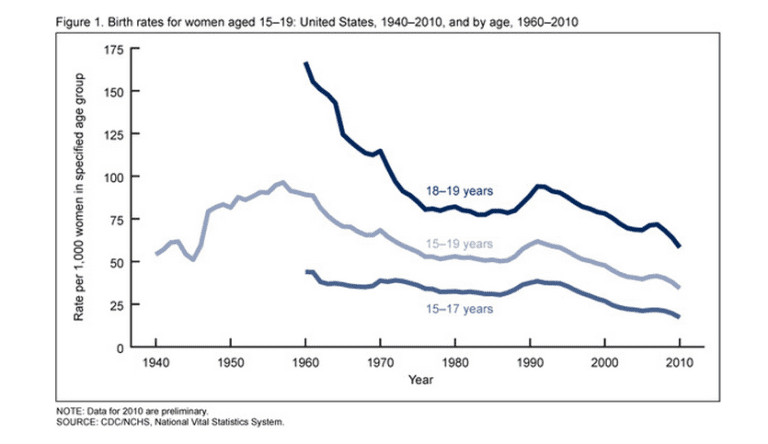
We notice an especially sharp decline around 1960, the year the Pill was introduced. Abortion wasn’t legalized until the 70s and was pretty uncommon before then, so we can leave it out of this analysis and say that it sure looks like the invention of a new form of contraception decreased pregnancies.
Alexander counts this as a “point” for the contraception-lowers-abortions spiel, but I’m not so sure, and I’d love to hear Alexander address my ambivalence. What his data shows is not the reduction of teen pregnancies (though they might have been reduced) but the reduction of teen birth rates. This is important, because while abortion cannot reduce pregnancy rates, abortion can — and does — reduce birth rates, and I’d like to make an argument that it may have been abortion, and not just Pill use, that caused the teen birth rate to drop.
It’s true that abortion wasn’t legalized until 1973, in Roe v. Wade. But if we look at the events leading up to Roe v. Wade, a clear pattern emerges: The increased liberalization of abortion laws and the growing advocacy for legal abortion (indicative of a social change which would find abortion more morally acceptable).
For instance, in 1959 the American Law Institute (ALI) proposed a new code that would legalize abortion for reasons including the mental or physical health of the mother, pregnancy due to rape and incest, and fetal deformity. By 1966 Mississippi had liberalized their abortion laws, and by 1967 California, Colorado and North Carolina had taken up the ALI’s new penal code. By 1969 they were joined by Georgia, Maryland, Arkansas, Delaware, Kansas, New Mexico and Oregon, and in the meantime, President Johnson publicly called for a repeal of all abortion laws. This pre-Roe trend of liberalization culminated in 1970, when Hawaii, New York, Alaska and Washington repealed their abortion laws and allowed abortion on demand.
The time between 1960-Roe, the time the Pill was introduced and began its proliferation, was also a time of increasing political, legal, and social acceptance of abortion. (This is hardly surprising. (Roe v. Wade didn’t come out of nowhere.)) The numbers show a similar story, and it’s here I really begin to doubt “the Pill decreased teen pregnancies (and thus abortions) between 1960-1973” narrative, or at very least begin hankering for all sorts of distinctions, qualifications, etc.
We didn’t have the sexy CDC surveillance that we have now, so take the following sources as loose indicators of a trend of increasing abortions between 1960 and Roe. A survey of hospitals found a 5-fold increase in abortions between 1963-1968.
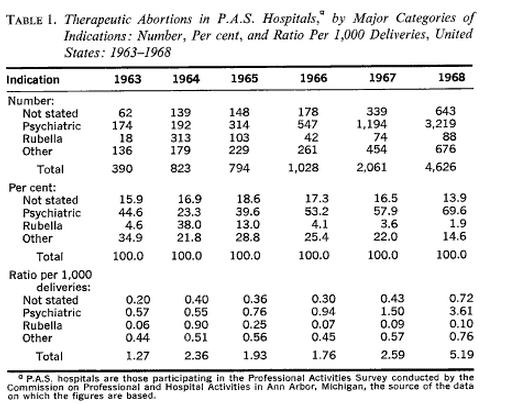
And the CDC reports that by 1972, the year before Roe, well, squint at it yourself:

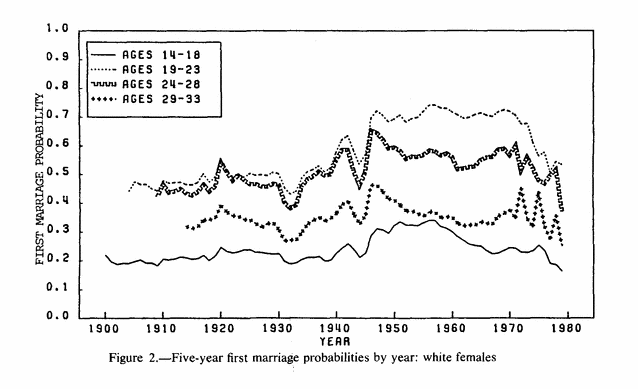
So the abortion rate was 13 per 1000 women in 1972, more than double its rate just 2 years prior. (2) If those hospital surveys are remotely accurate (and if we’re going to error on the side of contraception being the bees knees), we’re look at a very substantial increase in reported abortions between 1960 and Roe. Again, this is hardly controversial. It’d be odd if the law establishing the United States as a country permitting abortion wasn’t preceded by a rise in and acceptance of abortion. But if this is the case, what are we to make of Alexander’s ruling out of abortion as a major factor reducing teen birth rates between 1960-1970? It seems premature. Especially considering that teenage marriages (14-18) were decreasing in popularity during this same period, a decrease which probably brought its own (minor) reduction to the teen pregnancy rate:
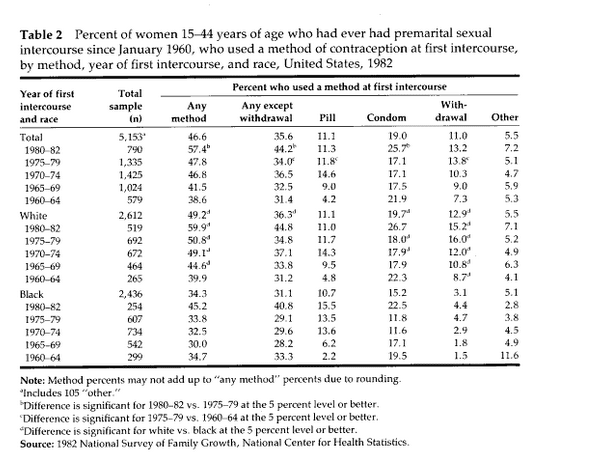
If there was a massive increase in contraception use alongside the (relatively) mild increase in abortion, I might be more willing to agree and say yes, it was contraception that reduced teen birth rates, not abortion, but the 1960-1970 increase in contraceptive use was unremarkable. The study “First Premarital Use of Contraception” published in Studies in Family Planning took data from the National Survey of Family Growth and found that contraceptive use at first premarital intercourse was 38.6% at the beginning of the 1960’s and just 41.5% by the end. Granted, use was getting more effective, as Pill use went from 4.2% to 9.0%, but given that this increase in Pill use rose simultaneously with an increase in abortion between 1960-1970, it seems unlikely that we can say “it was just the Pill,” especially if we take the principle of risk compensation seriously, which Scott Alexander seems to.
All of this to say, no, I don’t think the “pro-contraceptive argument” gets a point for teen birth-rate reductions between 1960 and Roe, not without the aid of a subsequent rise in abortion, which is ultimately my point, that a rise in contraceptive use and a rise in the incidence of abortion go hand in hand. To put it another way, the increased acceptance, provision, and use of the Pill probably helped lower that teen birth rate, but it also created a demand for abortion, which also lowered the teen birth rate. That Scott Alexander seems to agree with, and we’ll talk about in the next post.
Previous Post

June 3, 2013
A Primer for Philosophy & Education
Next Post
June 3, 2013 The Contraception/Abortion Connection: Part Two
Browse Our Archives
Select a Category Another Look Atheism Bad Catholics Beauty Communio Crookedhart Destupidification Exiting the Culture Wars Gender Theory That Doesn't Suck How To Language Liturgy! Love One Another Marriage Equality Modesty Music Objectification pop culture Poverty Sacraments Sex Technology The Best Religion in the World The Erotic Phenomenon Time Uncategorized Virtue Ethics That Don't Suck Winning the Culture Wars
Select a Month January 2017 December 2016 November 2016 October 2016 July 2016 June 2016 April 2016 March 2016 February 2016 January 2016 December 2015 November 2015 October 2015 September 2015 August 2015 July 2015 June 2015 May 2015 March 2015 February 2015 January 2015 June 2014 May 2014 April 2014 March 2014 February 2014 January 2014 December 2013 November 2013 October 2013 September 2013 August 2013 July 2013 June 2013 May 2013 April 2013 March 2013 February 2013 January 2013 December 2012 November 2012 October 2012 September 2012 August 2012 July 2012 June 2012 May 2012 April 2012 March 2012 February 2012 January 2012 December 2011 November 2011 October 2011 September 2011 August 2011 July 2011 June 2011 May 2011 April 2011 March 2011 February 2011 January 2011 December 2010 November 2010 October 2010 September 2010 August 2010
Follow Us!
TAKE THE
Religious Wisdom Quiz
What does "Malachi" mean in Hebrew?
Select your answer to see how you score.
The anointed one Holy one Strength of the Lord My messenger
Related posts from Bad Catholic

Towards a New Argument Against Pornography


Why Millennials Want to Change the World

The Communist That Lives With Me Responds: "Your...
TRENDING AT PATHEOS Catholic

Rejecting Doom: Christian Hope And Human Action
Christianity is a religion of hope. We are to have hope and...

It’s What Comes From Within Which Matters
One of the most difficult things for us to understand is why...

Why I Choose the Eucharist Over the Sermon
Choose the Eucharist, Not the Sermon What are we supposed to get...

5 Design Elements Found in Spiritually Rooted Homes
Putting Spirituality Into Home Decor Our homes are more than our living...

Credo: A Story of God Told with the...
About 10 years ago, I began to imagine a personal "Credo" that...

The Anatomy of Divine Revelation in Catholic Thought
The claim that God has made Himself known to human beings is...
view all Catholic blogs
Ad-Free & Subscriber Log-In Subscription Support
- About Us
- 2026 Calendar
- Videos
- Podcasts
- Library of World Religions
- Faith In Media Tracker
- Advertise With Us
- Write for Us
- Privacy Policy
- Terms of Service
- Do Not Sell My Data
- Contact Us
- Radiant Digital
- Manage Newsletter Subscriptions
- Unsubscribe From Notifications
- Sitemap
Copyright 2008-2026, Patheos. All rights reserved.
Subscription Support Ad-Free & Subscriber Log-In
Follow Patheos