
BuddhistCatholicContemplativeEvangelicalGeneral ChristianHinduJewishLatter-day SaintMuslimNew VisionsProgressive Christian
Beliefs
- Buddhist
- Catholic
- Contemplative
- Evangelical
- General Christian
- Hindu
- Jewish
- Latter-day Saint
- More Voices
- Muslim
- New Visions
- Pagan
- Progressive Christian
Topics
- Religion News
- Food and Religion
- Sports and Religion
- Religious Art
- Religious Music and Entertainment
- Religious Events
- History and Religion
- Style and Religion
- Politics and Religion
- Women in Religion
- Recreation Outdoors and Religion
- Business Finance and Religion
- Careers Workplace and Religion
- Education and Religion
- Family Parenting and Religion
- Health Fitness and Religion
- Home and Religion
- Relationships and Religion
- Technology and Religion
- Travel and Religion
Columnists
- Buddhist Columnists
- Business Finance and Religion Columnists
- Careers Workplace and Religion Columnists
- Catholic Columnists
- Contemplative Columnists
- Education and Religion Columnists
- Evangelists Columnists
- Family Parenting and Religion Columnists
- General Christian Columnists
- Health Fitness and Religion Columnists
- Hindu Columnists
- History and Religion Columnists
- Home and Religion Columnists
- Jewish Columnists
- More Voices Columnists
- Latter Day Columnists
- Muslim Columnists
- New Visions Columnists
- Nonreligious Columnists
- Pagan Columnists
- Politics and Religion Columnists
- Progressive Columnists
- Recreation Outdoors and Religion Columnists
- Relationships and Religion Columnists
- Religion News Columnists
- Religious Art Columnists
- Religious Events Columnists
- Religious Music and Entertainment Columnists
- Sports and Religion Columnists
- Style and Religion Columnists
- Technology and Religion Columnists
- Travel and Religion Columnists
- Women in Religion Columnists
Resource Library
- 2026 Calendar
- Library of World Religions
- The 100 Most Holy Places on Earth
- Patheos Answers
- Podcasts
- Videos
- Faith Leaders Database
- Anglican Episcopalian
- Bahai
- Baptist
- Buddhism
- Christianity
- Confucianism
- Eastern Orthodoxy
- Hinduism
- Holiness and Pentecostal
- ISKCON
- Islam
- Judaism
- Lutheran
- Methodist
- The Church of Jesus Christ of Latter-day Saints
- New Age
- Paganism
- Presbytarian and Reformed
- Protestantism
- Religion Behind the Scenes
- Roman Catholic
- Scientology
- Shia Islam
- Sikhism
- Sufism
- Sunni Islam
- Taoism
- Zen
- See all religions
Research Tools
 Ad-Free & Subscriber Log-In Subscription Support
Follow Patheos 

- Trending:
- Advent
- |
- Forgiveness
- |
- Thanksgiving
- |
- Election
- |
- Seasonal Holidays
- |
- Marriage
 Bad Catholic
- Home
- Catholic
- Catholic. Nuff Said.
Catholic. Nuff Said.
Last updated on: June 12, 2013 at 4:05 pm by Marc
Catholic. Nuff Said. 2013-06-12T16:05:39-04:00 Marc
Patheos Explore the world's faith through different perspectives on religion and spirituality! Patheos has the views of the prevalent religions and spiritualities of the world.
When I modify the word “Catholic” with some preceding description — be it traditional Catholic, liberal Catholic, or faithful Catholic — I do a disservice to the Catholic Church. Perhaps there are times when a concise modification is good, true, and beautiful, but on the off-chance that you — like me — are doing your Catholicism wrong, have a reason to quit your modifying: It’s usually a reaction which unintentionally gives credence to the thing reacted against.
I used to call myself a conservative Catholic, because there’s only so many times a man can hear Nancy Pelosi say that her “Catholic faith” urges her to support abortion before he’s flipping tables, setting himself on fire, and otherwise striving to make a distinction between what Pelosi understands of the Catholic faith and what he knows it to be. Similarly, I am often tempted to call myself a liberal Catholic in reaction to those who frame Catholicism as a branch of the Republican party, a defender of capitalism, the death penalty, nuclear bombs, and traditional American values (which, one assumes, does not include lynching Catholics.)

Land that I loooooovvvee
But labels that express one half of an established dichotomy grant their opposite an equal validity. By claiming myself “conservative,” I am not saying that pulling a Pelosi and ignoring the teaching of the Church is wrong. I’m saying it’s liberal. Publicly supporting the murder of the unborn becomes an expression of liberal Catholicism, when in reality, it is an eloquent expression of not being Catholic at all.
So too with the proud label of “liberal Catholic.” By claiming it, we carve a ghetto within the Catholic Faith, baptizing those who are quite simply not being Catholic in regards to war or Just Wage as conservative Catholics, thus granting their heresies equal validity. Declaring yourself as a liberal Catholic allows the conservative Catholic to exist — quite comfortably — as your opposite, and thus the Church ceases to bring offense to the world, for it has slipped into the dichotomy of American politics, in which the infinitely passionate declarations of “right” and “wrong” are replaced with “sides.”
The Catholic Church transcends the idiocy of both liberals and conservatives by transcending the very language of liberalism and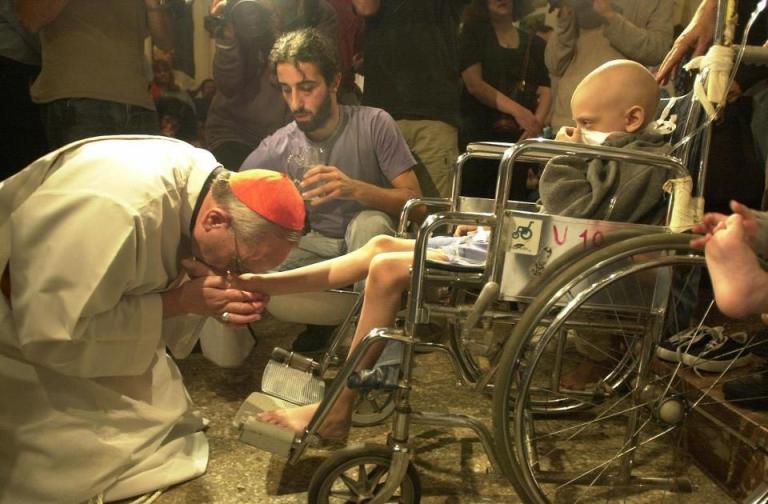 conservatism, claiming — with their founder, Jesus Christ — that there is one faith, a faith that frustrates everyone as Pope Francis frustrates everyone, simultaneously declaring a love for the poor, an intolerance of unjust economic schemes, and an opposition to the objectification of children within gay marriage and IVF. Far better than giving the world an opportunity to subsume you into a political label is to be Catholic. Then, when Pelosi begins posing, you have — as a Catholic, not as a conservative Catholic — the opportunity to explain that Catholicism, naked without shame and preceding adjectives, is a faith lived insofar as we “believe and profess all that the holy Catholic Church teaches, believes and proclaims to be revealed by God,” and that — shock and terror — the Catholic Church has written these revelations down in the finalized language of authority, so we can all check up on whether or not support for abortion is Catholic, successfully ignoring the liberal/conservative dichotomy that makes this country stupid.
Now, the modifiers “faithful” and “orthodox” that hang like mullets behind the word “Catholic” are useful when attempting to distinguish for the press — who cannot fathom that Church doctrine is not determined by American opinion polls — the difference between a woman who goes to church and the woman who hasn’t seen the inside of a church since she burnt her bra in the pew; to explain to them that a person may claim the title “Catholic” and simultaneously have nothing to do with the Catholic Church. But as a personal modifier of Catholicism, such words are stupid. You relinquish your claim on “faithful Catholic” the moment you watch porn. You are unorthodox at the precise moment you snap at your children. “Faithful” can scarcely be upheld as a modifier until you’re dead, buried, and canonized. “Trying to be faithful,” maybe, but again, attaching this modifier to Catholicism undermines the fact that striving for faithfulness is implied in simply being Catholic, lending itself to the false idea that there are other types of Catholic to be.
This is also true of the labels that reference our liturgical preferences. A Catholic who loves the extraordinary form of the Mass loves an authentic reality of the Catholic faith. His love for the extraordinary form is part of being Catholic, for the extraordinary form comes to him from the heart of the Catholic Church. To move from this authentic love-affair with the Catholic Church to the label “traditional” is — I think — an injustice. First of all, the label lends itself to a denial of what the extraordinary form of the Mass is — a present reality, lived and breathed by the Church here and now. (I understand the desire to “promote” the extraordinary form as “being in contact with the rich history of the Church,” “praying the Mass most of the Saints prayed” but the value of the Mass is in its present reality, as being precisely what it is, not what it reminds us of.)
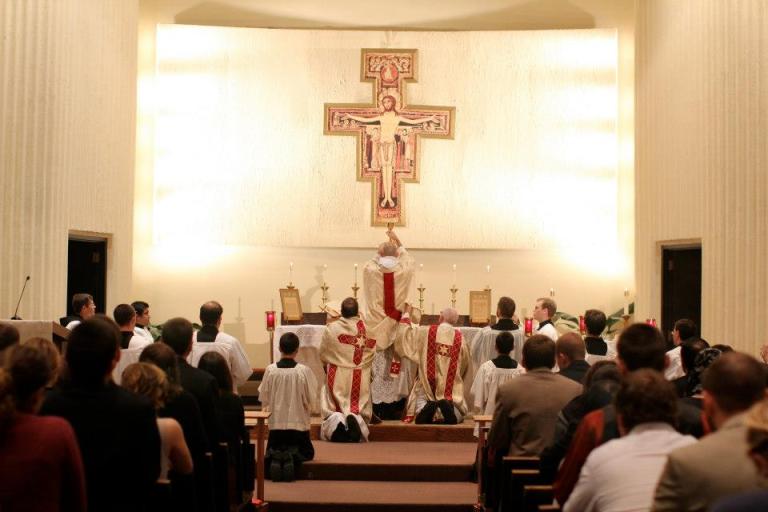
Secondly, such gleefully accepted labeling has precisely the same effect as the liberal/conservative dichotomy. By giving up on being Catholic qua Catholic and expressing ourselves as such in favor of an easy, you-know-what-I-mean-by-traditional route, we allow its opposite label to be just that — another label and another option.
This phenomenon achieves a heightened expression at the Franciscan University of Steubenville, in which there is a sharp, and often painstakingly expressed distinction between traditional Catholics and charismatic Catholics. Such a distinction actually works directly against the intentions of so-called traditional Catholics, for by insistence upon its label, they make the actions of so-called charismatic Catholics simply the actions of an equally possible label.
Thus, even though The Sacred Congregation Of Rites instructs that, if secular instruments are to be used in the liturgy, “they are to be played with such seriousness, and religious devotion that every suggestion of raucous secular music is avoided, and the devotion of the faithful is fostered,” and even though the General Instruction for the Roman Missal clearly states that “sacred silence also, as part of the celebration, is to be observed at the designated times” and that “the main place should be given, all things being equal, to Gregorian chant, as being proper to the Roman Liturgy,” these rules are often ignored. Why? Because instead of being expressed as fundamentally, authoritatively, and timelessly Catholic, these instructions are couched in the language of “traditional” Catholicism, as a rallying cry of a particular faction that can be easily ignored precisely as a faction. Which is, of course, ridiculous. It’s not “traditional” to follow the GIRM. It’s Catholic.
It occurs to me that any limiting modification on the word Catholic is a contradiction in terms. Catholic means universal. If saying I am a traditional universal means I am not a charismatic universal, I’ve negated the term universal, in which there can be no factions, or else it wouldn’t be, you know, universal. Labeling the word universal is a little like quantifying infinity into multiple parts: “You take the first half of infinity, I’ll take the second.” It doesn’t work, and worse than that, it cleverly avoids the discussion of what it means to be “Catholic, nuff said.”
The constructive killing of labels in no way promotes a homogeneity about the faith. Catholicism blossoms in a explosion of expressions, in a plethora of spiritualities, a multitude of philosophical languages — whether thomist, personalist, phenomenological, or existentialist — and a cornucopia of devotions, prayers, forms, rites, and rituals. The Catholic faith is true, but because this truth is universal — expressing the reality of the entire Cosmos and every man’s place in it — assent to the Catholic faith is a leap of the entire, subjective person into reality itself. Catholicism cannot be homogenous any more than you and your neighbor can be homogenous, for God’s love calls you and your neighbor to Catholicism in your infinite uniqueness.
Killing your labels will not homogenize the Church, but valuing them over Catholicism will, for labels are limitations upon the Universal Faith. I fear the urge to label Catholicism bubbles from our doubt that Catholicism really is enough, the universal This, all things visible and invisible, to which not a word can be added. But be not afraid: God has given us the Catholic Church, and the Catholic Church is enough.
Previous Post

April 15, 2013
Why the Church Would be so Ridiculous as to Oppose IVF
Next Post
May 10, 2013 Is Female Purity Bullshit?
Browse Our Archives
Select a Category Another Look Atheism Bad Catholics Beauty Communio Crookedhart Destupidification Exiting the Culture Wars Gender Theory That Doesn't Suck How To Language Liturgy! Love One Another Marriage Equality Modesty Music Objectification pop culture Poverty Sacraments Sex Technology The Best Religion in the World The Erotic Phenomenon Time Uncategorized Virtue Ethics That Don't Suck Winning the Culture Wars
Select a Month January 2017 December 2016 November 2016 October 2016 July 2016 June 2016 April 2016 March 2016 February 2016 January 2016 December 2015 November 2015 October 2015 September 2015 August 2015 July 2015 June 2015 May 2015 March 2015 February 2015 January 2015 June 2014 May 2014 April 2014 March 2014 February 2014 January 2014 December 2013 November 2013 October 2013 September 2013 August 2013 July 2013 June 2013 May 2013 April 2013 March 2013 February 2013 January 2013 December 2012 November 2012 October 2012 September 2012 August 2012 July 2012 June 2012 May 2012 April 2012 March 2012 February 2012 January 2012 December 2011 November 2011 October 2011 September 2011 August 2011 July 2011 June 2011 May 2011 April 2011 March 2011 February 2011 January 2011 December 2010 November 2010 October 2010 September 2010 August 2010
Follow Us!
TAKE THE
Religious Wisdom Quiz
Who sang after crossing the Red Sea?
Select your answer to see how you score.
Miriam Sarah Rebekah Deborah
Related posts from Bad Catholic

5 Things We Should Think About Before We...
Death, Split Selves, and Demons: The Dopest Album...

How I Learned to Stop Worrying and LOVE...
Women Swiftly Running Out Of Things That Aren't...
TRENDING AT PATHEOS Catholic

The Kingdom Of God In Ordinary Life And...
The kingdom of God is all around us; it is in us...

How Discretion Guides Us Away From Extremes
Prudence is an important virtue for all of us. While we should...

If Baptism Washes Away Sin, Why Do Catholics...
The seven sacraments stand as the foundation of Catholic ecclesial life. The...

The Power of Setting a Good Example
Remember last August when the Chicago White Sox hosted a "Pope Hat...

A Catholic Critique of Biblical Unitarianism
If the statistics are to be believed, Unitarianism is rising worldwide. Although...

How Grandma Tourism Helps Grandparents Live Their Vocation
Grandma, The New Travel Influencer What started as a nostalgia-inspired social media...
view all Catholic blogs
Ad-Free & Subscriber Log-In Subscription Support
- About Us
- 2026 Calendar
- Videos
- Podcasts
- Library of World Religions
- Faith In Media Tracker
- Advertise With Us
- Write for Us
- Privacy Policy
- Terms of Service
- Do Not Sell My Data
- Contact Us
- Radiant Digital
- Manage Newsletter Subscriptions
- Unsubscribe From Notifications
- Sitemap
Copyright 2008-2026, Patheos, part of the Radiant Digital network of media brands. All rights reserved.
Subscription Support Ad-Free & Subscriber Log-In
Follow Patheos