
BuddhistCatholicContemplativeEvangelicalGeneral ChristianHinduJewishLatter-day SaintMuslimNew VisionsProgressive Christian
Beliefs
- Buddhist
- Catholic
- Contemplative
- Evangelical
- General Christian
- Hindu
- Jewish
- Latter-day Saint
- More Voices
- Muslim
- New Visions
- Pagan
- Progressive Christian
Topics
- Religion News
- Food and Religion
- Sports and Religion
- Religious Art
- Religious Music and Entertainment
- Religious Events
- History and Religion
- Style and Religion
- Politics and Religion
- Women in Religion
- Recreation Outdoors and Religion
- Business Finance and Religion
- Careers Workplace and Religion
- Education and Religion
- Family Parenting and Religion
- Health Fitness and Religion
- Home and Religion
- Relationships and Religion
- Technology and Religion
- Travel and Religion
Columnists
- Buddhist Columnists
- Business Finance and Religion Columnists
- Careers Workplace and Religion Columnists
- Catholic Columnists
- Contemplative Columnists
- Education and Religion Columnists
- Evangelists Columnists
- Family Parenting and Religion Columnists
- General Christian Columnists
- Health Fitness and Religion Columnists
- Hindu Columnists
- History and Religion Columnists
- Home and Religion Columnists
- Jewish Columnists
- More Voices Columnists
- Latter Day Columnists
- Muslim Columnists
- New Visions Columnists
- Nonreligious Columnists
- Pagan Columnists
- Politics and Religion Columnists
- Progressive Columnists
- Recreation Outdoors and Religion Columnists
- Relationships and Religion Columnists
- Religion News Columnists
- Religious Art Columnists
- Religious Events Columnists
- Religious Music and Entertainment Columnists
- Sports and Religion Columnists
- Style and Religion Columnists
- Technology and Religion Columnists
- Travel and Religion Columnists
- Women in Religion Columnists
Resource Library
- 2026 Calendar
- Library of World Religions
- The 100 Most Holy Places on Earth
- Patheos Answers
- Podcasts
- Videos
- Faith Leaders Database
- Anglican Episcopalian
- Bahai
- Baptist
- Buddhism
- Christianity
- Confucianism
- Eastern Orthodoxy
- Hinduism
- Holiness and Pentecostal
- ISKCON
- Islam
- Judaism
- Lutheran
- Methodist
- The Church of Jesus Christ of Latter-day Saints
- New Age
- Paganism
- Presbytarian and Reformed
- Protestantism
- Religion Behind the Scenes
- Roman Catholic
- Scientology
- Shia Islam
- Sikhism
- Sufism
- Sunni Islam
- Taoism
- Zen
- See all religions
Research Tools
 Ad-Free & Subscriber Log-In Subscription Support
Ad-Free & Subscriber Log-In Subscription Support
Follow Patheos 

- Trending:
- Forgiveness
- |
- Marriage
- |
- Consciousness
- |
- Death Penalty
- |
- Election
- |
- Halloween

- Home
- Religious Music & Entertainment
- Searching for Jesus: A Q&A with Risen’s Joseph Fiennes
Searching for Jesus: A Q&A with Risen’s Joseph Fiennes
Last updated on: February 18, 2016 at 3:57 pm by Deborah Arca
Searching for Jesus: A Q&A with Risen’s Joseph Fiennes 2016-02-18T15:57:10-07:00 Deborah Arca
Patheos Explore the world's faith through different perspectives on religion and spirituality! Patheos has the views of the prevalent religions and spiritualities of the world.
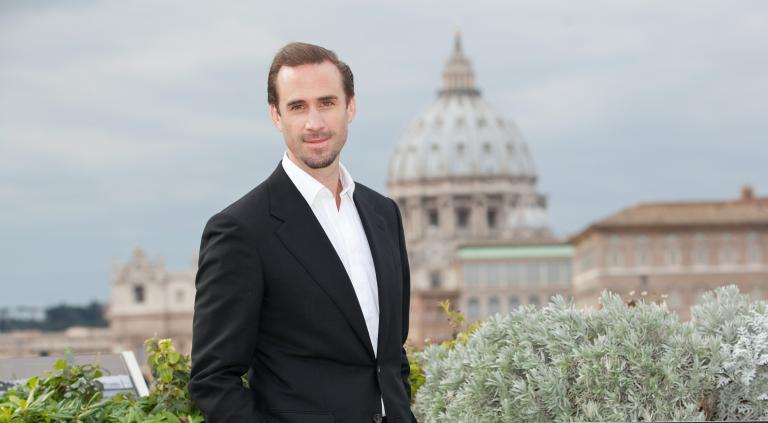
Rome, Italy – February 3, 2016: Joseph Fiennes attends RISEN photocall overlooking Vatican City.
“If I was to take anything away personally from making this film, it’s the concept of redemption and forgiveness and second chances. The second chance for Clavius resonates with me, and I think it might for a lot of people.” — Joseph Fiennes, who plays Roman Military Tribune Clavius in the new movie, Risen
What would it be like to be the Roman military official assigned to find the body of Jesus after it disappears from the tomb after the Crucifixion? Especially, if like the fictional character of Clavius in the new movie Risen, you’re a skeptic, conditioned to follow orders, and certain the body has got to be somewhere?
This is the premise of Risen, a new film from Sony Pictures opening this weekend about the epic biblical story of the Resurrection and the weeks that follow it, as seen through the eyes of an unbelieving high-ranking Roman military tribune. In the style of a true-crime detective novel, Risen presents a compelling cinematic experience, full of mystery, and questions, and whodunits — for the believer and non-believer alike — about the “manhunt that changed the course of history.”
Risen stars Joseph Fiennes, the award-winning actor from Shakespeare in Love, as Clavius, the Roman Military Tribune assigned to find the missing body of Jesus in order to prevent an uprising in Jerusalem. Clavius’ journey inevitably leads him into territory he isn’t entirely prepared for, physically, mentally, or spiritually as he comes closer and closer to the risen Christ.
We spoke with Mr. Fiennes this week about his attraction to the project, how he prepared mentally and physically for the role, and what it was like meeting the Pope earlier this month.
Patheos: What drew you to the role of Clavius and this project overall?
Fiennes: I was essentially given a script and starting reading it, and it wasn’t until about page 30 that I suddenly realized this might be a biblical story, because it read like a detective story. It was like a film noir. And that was a really good way in for me. I thought, this is fresh. And then I put the script down and I thought, even better, it’s a movie that depicts the life of Christ that doesn’t end on that most depressing point of the Crucifixion. It takes us and gives us the final equation, if you like, which few films, if any, have ever tackled, in terms of the Resurrection and then the Ascension. So I thought, this is really compelling and I feel really uplifted by this, and it’s a fresh angle and perspective.
Then I got a meeting with our veteran director Kevin Reynolds. We met at an airport lounge in Madrid and spoke for a number of hours and it was the first time that I can remember that a director just offered me a job in the room there and then. We spoke at length about how we wanted to position this film, in terms of being respectful of our audience but at the same time making it cinematic and engaging for cinephiles as well as for non-believers.
How did you prepare for the role of Clavius, mentally and physically? Was there a certain spiritual preparation for this role, as well?
Well, I looked at it really just through the eyes of Clavius, a Roman Tribune. In many ways, he is spiritual — he prays to his set of Gods, under Roman theology. He probably prayed to Mars.
But me, myself, I just felt I needed to prepare physically and condition myself into the military mindset of that time and age. I read some books and found out that gladiators had lent a lot of their techniques to the Roman army. So I found online a gladiator school where they train novices like myself. But they’re more interesting than that — they call themselves “physical archeologists.” They go and collect information from murals, sculptures, and paintings that depict Roman military warfare, and they breathe life into it from those depictions. So they bring a bit of their imagination but they remain true to the information and the research. And they physicalize it.
So I learned a great deal about what it might have been to be a Roman soldier in that time. And what I found out essentially was that the way they fought was like a brutal surgical machine, this economic brain that would take over parts of the world. They were unforgiving and brutal. It was kind of a like a brutal Swiss clock the way it operated.
So that was my way in. That and working with a detective. I’ve got a couple of kids and I’m terrible at interrogating them when they’re naughty, so I thought, how am I going to interrogate as a Roman soldier? So I asked a detective to help me out. He was wonderful. Those were my ways in and they kind of worked.
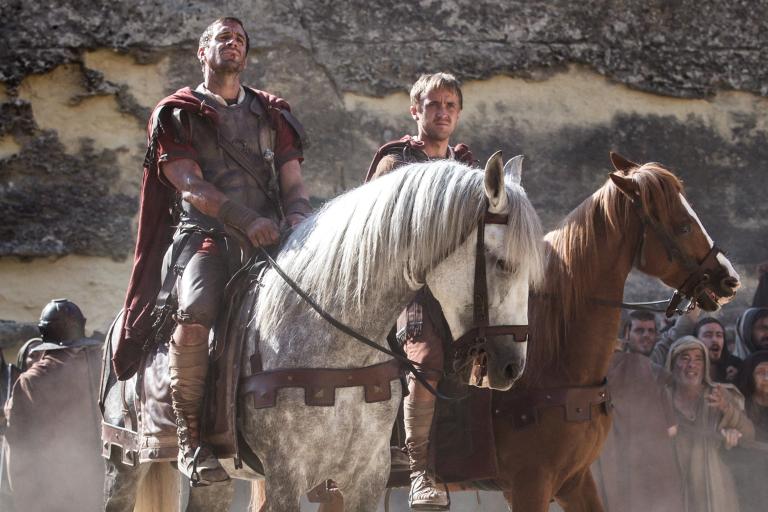
Clavius (Joseph Fiennes) and Lucius (Tom Felton) at the crucifixion of Yeshua. Calvary. Image courtesy of Rosie Collins
What was the most challenging part of portraying Clavius?
Here’s one thing about Clavius — you might not like him. This was the big difficulty for me — how could I be part of this death squad, be this man who oversees the crucifixion of Christ? How will an audience come along with me? That was the big challenge for me. I mean, why would they?
I felt that, if we didn’t like him, there had to be some thread that we could identify with and allow us to go on the journey with him… and that for me was that he was a man of truth. He searched for the truth and was true in what he did under the instruction of Pontius Pilate. But I hope that for an audience they would lock onto the idea, here’s a man with integrity. Now he may be conditioned differently from all of us, but he had a sense of moral duty. That was the component I wanted to explore and draw upon.
And then that duty gets confounded and confused with a new set of rules. He can’t break down the disciples in the interrogation. He’s up against something. And then he has this irrevocable moment when he goes to arrest them and there’s a man in the room that shouldn’t be there… and then his world is turned upside down.
But I love that journey of de-conditioning in order to take on a new form of understanding.
Right. And I love, too, that it gives us, the audience, an opportunity to empathize with a character that we may not have been very sympathetic towards before. As a Christian, the Roman Tribune is the enemy! But you needed the audience to care about Clavius, so you ended up opening that character up for us, as well.
That was the challenge. It’s making all these people, even the less-likable characters, human. They become more scary or more complex when you make them human. If I look at brilliant films, such as the performances in Schindler’s List, it’s very real, it’s scary. Spielberg got his actors to do the opposite, the Indiana Jones idea of a Nazi; you’ve made them fully-fledged and they’re more terrifying than the cardboard cut-out because they’re human. I think that’s what we’re trying to do in Risen; make these characters more authentic, and then take the audience on the journey.
What was one of the most enjoyable aspects of playing Clavius?
Most enjoyable, weirdly, both as a character and as an actor, was hanging out with the disciples! Because in preparation, I excluded myself from any of them, especially Yeshua. I wouldn’t have eye contact or any kind of contact with them. They wouldn’t exist for me, nor I for them, probably, while we were shooting. So we remained in character during the filming, so that when we came to cross paths as characters, it was great — as an actor, as well — to share that energy, which was much more upbeat and jovial. They were a very tight unit off-set.
So it was lovely to finally go on a trip with them through the desert and on the sea, and get away from Rome and the military and the kind of suffocating sense of duty and uniforms (of leather)! That was lovely. It was almost like Clavius sheds his armor as he goes on this trip to investigate further this new revelation. I felt both a stripping down of his uniform and his conditioning that led to a kind of ease with this new group.
There was an enjoyment of being in their company after being in the company of death and war.
Was your own faith or belief changed as a result of playing Clavius?
If I was to take anything away personally from playing this character — and you don’t have to be religious to understand this – I think it’s the concept of redemption and forgiveness and second chances. The second chance for Clavius resonates with me and I think it might for a lot of people. Whether a believer or a nonbeliever, this is a hugely enriching component of our evolution, the ability to forgive. Christ forgives Clavius in our story and that was something that stayed with me.
Also, that sense that if you believe in anything, it shifts in and out of focus, the intensity of that belief and that confidence, and I think that Clavius is a little bit of an everyman for us in that regard. He gets to witness the resurrection first-hand and yet he still turns around and asks, is Yeshua a magician, or does he have a twin brother, and how did he do that? And I guess there’s always that part of me, this intellectual side, that we have to almost shut down that voice in our head and tune into that quiet of the greater consciousness, if you like.
There’s been a lot of discussion leading up to the film — as there always is when a biblical story is made into a movie — as to the accuracy of the story and how true it stays to the text. Clavius, for instance, is a fictional character not found in the Bible. How do you think faith viewers will react to that and to the balance that you all aimed to strike in the film around that issue?
I know that our writers, directors and producers have worked hard and diligently with church ministers and faith-based communities in being absolutely respectful of scripture as close as they felt they could, as well as obviously building a film around it. If you don’t want to move away from scripture, then stay with it as a piece of parchment in your hand, but as soon as you get into film, it’s an adaption by virtue of cameras and lenses and lights and casting, and it’s always going to be a little bit different that one has in one’s mind from reading the bible.
But taking that into account, I think there’s been a really lovely balance, and we’ve sought to ask, how do we bring an audience in? How do we invite a new audience and a new generation into this beautiful narrative? So I think inventing a character such as Clavius allows a little bit of distance to the story, without it being too suffocating or overbearing or overtly religious. You get to come in gently to the story.
The movie is clearly aimed at a faith-based audience, but I’m hearing you say that it’s not just for Christians…
No! I would like to think it’s not aimed at any one group. I think it’s aimed at everyone. For me, it would be a huge success if the auditorium was filled with a diverse community. We have so many films that are either so revisionist they switch certain members off, or they become deeply conservative and preachy. For me, here might be the first time that we get a movie which is a pure cinematic experience, which is true and respectful of scripture, and at the same time, is a beautiful piece of entertainment that can be engaging on the conversation of faith, on the story of Christ, and also a huge, high production value movie.
Last question — you got to meet the Pope earlier this month in Rome. What was that like?
Yeah, it was amazing. It was a moving experience. The Pope is an incredibly modern man. I love that he carries his own suitcase to the airplane. I love the idea that he doesn’t stay in the Pope’s palatial palace, but in a very humble dwelling. To me, he’s a man of the people. He’s deeply connected spiritually; I felt that when I met him. He has a great generosity and a sense of great authenticity.
It was very special, and it was lovely that he blessed my family. It was a really beautiful end to what was a very brutal beginning with the gladiators the year before. So to end full circle with the Pope was all that I could ask for.
RISEN opens nationwide Friday, February 19, 2016 — click here to purchase tickets!
Click here for more reviews and conversation at the Patheos Movie Club.
Joseph Fiennes Photo Credit: Luca Dammicco – © 2016 CTMG. All Rights Reserved.
Previous Post

February 17, 2016
Risen: Not Just Another Bible Movie
Next Post
March 16, 2016 Measuring Success: One Woman’s Counter-Cultural Path
Browse Our Archives
Select a Category Artist Interviews Christian Music Movie Reviews Movie Trailers Movies Television Uncategorized
Select a Month March 2026 August 2023 July 2023 June 2022 May 2022 February 2022 September 2021 August 2021 July 2021 April 2021 March 2021 February 2021 December 2020 October 2020 September 2020 July 2020 May 2020 February 2020 January 2020 December 2019 October 2019 April 2019 March 2019 February 2019 August 2018 July 2018 June 2018 May 2018 March 2018 January 2018 November 2017 October 2017 September 2017 August 2017 June 2017 May 2017 April 2017 February 2017 January 2017 December 2016 November 2016 October 2016 August 2016 July 2016 June 2016 March 2016 February 2016 August 2014 May 2014 April 2014 March 2014 October 2013 May 2013 April 2013 September 2012 August 2012 July 2012
TAKE THE
Religious Wisdom Quiz
I fell from a third-story window during a long sermon and died. But I was raised back to life. Who am I?
Select your answer to see how you score.
Tabitha Dorcas A young man Eutychus
Related posts from Backstage Pass

New Documentary Examines Unique Challenges Facing the Christian...
Military Widow Fights to Keep the Faith in...
WATCH: Patheos Exclusive Sneak Peek of 'The Magnificent...

Ben-Hur Opens Today! Star Jack Huston Shares What...
TRENDING AT PATHEOS Religious Music & Entertainment

"Les Diabolique" and Transgression
Alongside something like Arrival, Vertigo, or Charade, Les Diaboliques is a...

"The Plague Dogs" and Mortality
So, flashback to the late 70s, early 80s. Walt Disney Studios is...

With the recent and highly successful release of Christopher Nolan’s epic film,...

"L'avventura" and Human Weakness
Today's piece is going to be a little different for a few...

I first want to apologize for not posting or writing anything. I'm...

I've engaged in the multi-year project of reading through the Church Fathers,...
view all Religious Music & Entertainment blogs
Ad-Free & Subscriber Log-In Subscription Support
- About Us
- 2026 Calendar
- Videos
- Podcasts
- Library of World Religions
- Faith In Media Tracker
- Advertise With Us
- Write for Us
- Privacy Policy
- Terms of Service
- Do Not Sell My Data
- Contact Us
- Radiant Digital
- Manage Newsletter Subscriptions
- Unsubscribe From Notifications
- Sitemap
Copyright 2008-2026, Patheos. All rights reserved.
Subscription Support Ad-Free & Subscriber Log-In
Follow Patheos