
BuddhistCatholicContemplativeEvangelicalGeneral ChristianHinduJewishLatter-day SaintMuslimNew VisionsProgressive Christian
Beliefs
- Buddhist
- Catholic
- Contemplative
- Evangelical
- General Christian
- Hindu
- Jewish
- Latter-day Saint
- More Voices
- Muslim
- New Visions
- Pagan
- Progressive Christian
Topics
- Religion News
- Food and Religion
- Sports and Religion
- Religious Art
- Religious Music and Entertainment
- Religious Events
- History and Religion
- Style and Religion
- Politics and Religion
- Women in Religion
- Recreation Outdoors and Religion
- Business Finance and Religion
- Careers Workplace and Religion
- Education and Religion
- Family Parenting and Religion
- Health Fitness and Religion
- Home and Religion
- Relationships and Religion
- Technology and Religion
- Travel and Religion
Columnists
- Buddhist Columnists
- Business Finance and Religion Columnists
- Careers Workplace and Religion Columnists
- Catholic Columnists
- Contemplative Columnists
- Education and Religion Columnists
- Evangelists Columnists
- Family Parenting and Religion Columnists
- General Christian Columnists
- Health Fitness and Religion Columnists
- Hindu Columnists
- History and Religion Columnists
- Home and Religion Columnists
- Jewish Columnists
- More Voices Columnists
- Latter Day Columnists
- Muslim Columnists
- New Visions Columnists
- Nonreligious Columnists
- Pagan Columnists
- Politics and Religion Columnists
- Progressive Columnists
- Recreation Outdoors and Religion Columnists
- Relationships and Religion Columnists
- Religion News Columnists
- Religious Art Columnists
- Religious Events Columnists
- Religious Music and Entertainment Columnists
- Sports and Religion Columnists
- Style and Religion Columnists
- Technology and Religion Columnists
- Travel and Religion Columnists
- Women in Religion Columnists
Resource Library
- 2026 Calendar
- Library of World Religions
- The 100 Most Holy Places on Earth
- Patheos Answers
- Podcasts
- Videos
- Faith Leaders Database
- Anglican Episcopalian
- Bahai
- Baptist
- Buddhism
- Christianity
- Confucianism
- Eastern Orthodoxy
- Hinduism
- Holiness and Pentecostal
- ISKCON
- Islam
- Judaism
- Lutheran
- Methodist
- The Church of Jesus Christ of Latter-day Saints
- New Age
- Paganism
- Presbytarian and Reformed
- Protestantism
- Religion Behind the Scenes
- Roman Catholic
- Scientology
- Shia Islam
- Sikhism
- Sufism
- Sunni Islam
- Taoism
- Zen
- See all religions
Research Tools
 Ad-Free & Subscriber Log-In Subscription Support
Ad-Free & Subscriber Log-In Subscription Support
Follow Patheos 

- Trending:
- Forgiveness
- |
- Marriage
- |
- Consciousness
- |
- Death Penalty
- |
- Election
- |
- Halloween

- Home
- Muslim
- Politics and Religion
- Brexit: Neither an Apocalypse nor an Emancipation
Brexit: Neither an Apocalypse nor an Emancipation
Last updated on: June 28, 2016 at 6:07 am by Aziz Poonawalla
Brexit: Neither an Apocalypse nor an Emancipation 2016-06-28T06:07:11-06:00 Aziz Poonawalla
Patheos Explore the world's faith through different perspectives on religion and spirituality! Patheos has the views of the prevalent religions and spiritualities of the world.
This is a guest post by Conrad Barwa.
As a long-time UK resident it is with some concern and disappointment that I watched the news of the Leave campaign having won the Brexit referendum. More alarming has been the hyperbolic statements and reactions by both sides, especially Bremain being the losing one to the result of the vote; in this it reflected the tenor of the campaign which was characterised by a lot of heated propaganda and falsehoods along with fear-mongering and appeals to emotion over reason. I would here, however, like to present an optimistic or at least meliorist interpretation of what has happened in contrast to the frankly quite silly reactions you will be hearing and seeing in the media both mainstream and social. I have seen Brexit being compared to leading Britain to a scenario akin to “Children of Men” or “V for Vendetta” other popular memes will list the lengthy apocalyptic outcomes that have occurred as a consequence of Brexit such as £350 billion being wiped off the stock market or the single largest decline in the value of Sterling for several decades [1].
These are, I argue for the most part severe over-reactions. Brexit has imposed costs both political, social and economic, this cannot be denied and these costs were either completely pooh-pahed or underplayed by the Leave campaign (so much so when faced with overwhelming evidence from economists and other public policy specialists on the costs of Brexit, one of the leading political lights behind the Leave campaign, Michael Gove [2], could only respond with the comment that “the British people are sick of experts”). The real damage is in the political and it will be hard to tell with any degree of real precision how exactly this plays out over the next two years. There is of course the more significant social concern about racism, xenophobia and Islamophobia which is ever present and visible in Britain but also which apart from the first two, did not play a role in Brexit. It is wrong to reduce the Leave campaign behind Brexit as simply being motivated by racism alone, though it significantly was driven by anti-immigrant sentiment in which race did play a part. Even if one does argue, which it is possible to do so, that the Brexit campaign was racist-driven, it definitely does not follow from this that all who voted for it were racist. And not a few have shown some buyer’s remorse.
The economic aspect is easier to deal with and simpler as, people forget that the British economy being basically a capitalist one will not collapse over-night, some adjustment costs are inevitable such as a decline in the currency and stock markets (in part a correction to an over-valuation betting on Bremain as the City pushed equity and sterling too high and when traders closed out positions an over-correction was inevitable) which are in any case flexible upwards; more importantly will be impacts on trade, investment and migration all of which depends on how Brexit is negotiated with the EU and how accommodating the EU is. In a best case scenario, retaining membership of the Common Market, with free movement of goods and labour should mitigate most of the costs (Iceland and Norway being non-EU members but still enjoying Common Market membership, set a precedent for this). This will require a skilful handling and reasonable attitudes on both sides. Should the EU decide to make things difficult or the British government appoint bunglers to the negotiating team and the divorce become an acrimonious rather than an amicable one, then significant economic costs will continue well beyond the short-run.
More damaging and far more important in many ways is the political and social fallout and costs. Much has been said about how this was a vote generally driven purely by anti-immigrant sentiment, racism etc. This is an incorrect interpretation for several reasons. In my view the exiters can be broken into two main categories: the first group are the frankly racist and xenophobic who don’t want foreigners in the country and dislike immigration of any kind and have the usual animus towards ethnic minorities in their midst the second category and in my opinion by far the largest consist of a more assorted bunch of elements varying from those who wanted ‘sovereignty’ back from the EU and felt national sovereignty exercised through the Westminster parliament was being eroded by the EU in Brussels, those who feared that continued membership of the EU was leading to an inevitable (and undesirable) political union, those who felt that EU interference in British affairs was too high and finally those who resided in the areas which experienced high levels of deindustrialisation, blighted by long-term unemployment and stagnant incomes, who had not benefited from the economic growth of the last two decades and who had suffered disproportionately from the severe austerity packages imposed by the last two governments.
One also needs to understand the specificity of Euroscepticism in British politics. For reasons that require more space and time that I have here to go into, Euroscepticism has been an existential bugbear for the Tory party from the early 1990s onwards and has caused no end of headaches for Tory leaders and Prime Ministers from then on. John Major, faced a continual running battle with the Eurosceptic wing of the party while PM in the 1990s, due to his small majority in Parliament which allowed the Euro-sceptics to hold him hostage at key points and get their agenda advanced. It was this pattern that David Cameron followed as PM, when he promised the referendum on the In/Out for EU membership back in January 2013, when he was heading a Conservative-Liberal Democrat coalition. At the time preparing for a general election that nobody was sure of winning, he needed the support of the right-wing of his party much of whom were deeply antagonistic towards Europe. It conceded as a sop to this part of the party to ensure their whole-hearted support for the election campaign and was part of the Tory party manifesto; however at the time it did not receive much prominence during the election campaign and was not what, psephologists call a major ‘doorstep issue’. As Martin Schulz commented, “a whole continent is taken hostage because of an internal fight in the Tory party.”
In retrospect given the rise of UKIP, an extremely right-wing (some might say Far Right party) who ostensibly had taking the UK out of Europe as their main political programme should have given warning signs to this complacency. UKIP also became, in somewhat of a running theme a banner under which various discontented malcontents, who objected to various things from Green policies, womens’ rights, presence of ethnic minorities, business regulation, LGBT rights, excessive political correctness etc. the list goes on. In the regional European elections where turnout was low, UKIP scored notable successes especially in the deindustrialised regions of the north and the midlands. Rising fear of UKIP pressurised the Tory party to move more aggressively to the right on Europe but far more importantly by cottoning on to the issue of immigration – particularly playing on fears of uncontrolled migration from Eastern European states to the UK, its leader Nigel Farage [3] catapulted to the national stage included a heavily publicised television debate with the then Deputy Prime Minister and leader of the Liberal Democratic party in the governing coalition Nick Clegg. The debate and subsequent television appearance allowed Farage to present the case for an exit from the EU that would appeal to all those in the ‘exit’ camp from the frankly racist to those who disliked Brussel’s control and influence and those who could place displaced resentment for their socio-economic problems, in reality caused by globalisation and inadequate policies by the British state onto the EU. Clegg did attempt to do the one thing very few British politicians have openly done and that is argue the positive case for immigration and the benefits it brings. All too often a defensive posture taken by most politicians seeks to demonstrate how they are controlling or limiting migration to assuage fears of in Margaret Thatcher’s famous and ominous phrase, having public services “swamped” by needy immigrants [4].
That this flies in the face of facts, such that key sectors like London’s hospitality industry and restaurant business rely heavily on unskilled but hard-working immigrant labour and that key public services themselves such as the much loved and valued National Health Service (NHS) easily the most beloved of public institutions and Labour’s crowning achievement to the public sector in providing a collective commitment to taxpayer funded healthcare (also amongst the top 10 employers of workers globally) is itself heavily dependent on skilled medically trained professionals from abroad [5] (so much so that on his last visit to the UK, Nelson Mandela had to plead with the then PM Tony Blair to prevent the NHS from poaching South African nurses [6] from that country where there was an urgent shortfall of healthcare professionals to deal with AIDS crisis and the substantial number of HIV+ patients that needed care). Any visit to an NHS hospital and even the private sector will show this. However, British politicians have consistently failed to make this case, in this they are not too dissimilar to their colleagues in other OECD countries that are facing labour shortages and using immigrants to plug the gaps.
Another crucial factor was the disillusionment with policymaking elites, over the issue of immigration, this can be traced back to the decision of the Labour government in 2004 not to apply any restrictions on the movement of workers from the new accession states in that year to the EU of Poland, the Baltic states, Czech republic, Slovakia, Hungary and Slovenia. The insistence of the British government at the time that there would be no significant migration or flood of workers from the new accession states proved to be quite inaccurate as famously admitted by the former Home Secretary Jack Straw in 2013 substantial levels of migration did occur – mainly to the benefit of the British economy but this fatally undermined belief in the public utterances of politicians and policymakers on the topic of immigration and allowed the worst in the imagination, stoked by various political entrepreneurs, notably of course but not limited to UKIP, about the lack of control over the borders the UK had and the spectre of unlimited mass migration into the country [7]. Later attempts such as the fixing of immigration targets by David Cameron’s administration after 2010 were similarly disbelieved – rightly so, as his political advisor revealed such a target was deemed impossible to implement as long as Britain remained in the EU. Subsequent failure to meet annual immigration targets exposed the inability of the government to do what it said it was going to do, in a very visible fashion, and many commentators pointed out that no immigration ceiling could be imposed while EU membership with its guarantee of freedom of movement of labour was a reality.
The genius, if it can be called that of UKIP and much of the Leave campaign is to combine both the racist dislike of immigrants, Islamophobia and the more xenophobic wing of English nationalism with the broader dislike of the EU, resentment of Brussels and fears of a loss of sovereignty and control of borders – a sample of exiters’ views can be found here. As is clear, its not possible to reduce all Brexit voters to just racist white nationalists. A further break-up of the voting patterns shows this as many regions and cities that voted to leave such as Birmingham and the West Midlands are not only very multi-cultural but also contain substantial numbers of British Asians. In a further twist it should also be noted that it was precisely those regions that are most closely entwined with the EU that voted most strongly against it. In the words of one observer:
“England, though not Scotland or Northern Ireland, has voted to leave the European Union. What the Remain campaign never quite realised was that Brexit, the campaign to leave, was never about the EU; it wasn’t even really about immigration; it was about foreigners. But the government’s own position was fatally compromised because it was unable to confront the use of xenophobia.
The campaigning use of immigration was to identify an enemy, exaggerated and partly imagined as enemies always are in this familiar political tactic, who could be blamed for longer waiting lists in the NHS, overcrowded class rooms in schools, reduction in public services. The government could never say these worsening of the conditions of the people were not because of immigration but because of its own old-fashioned economic liberal policy of austerity.”
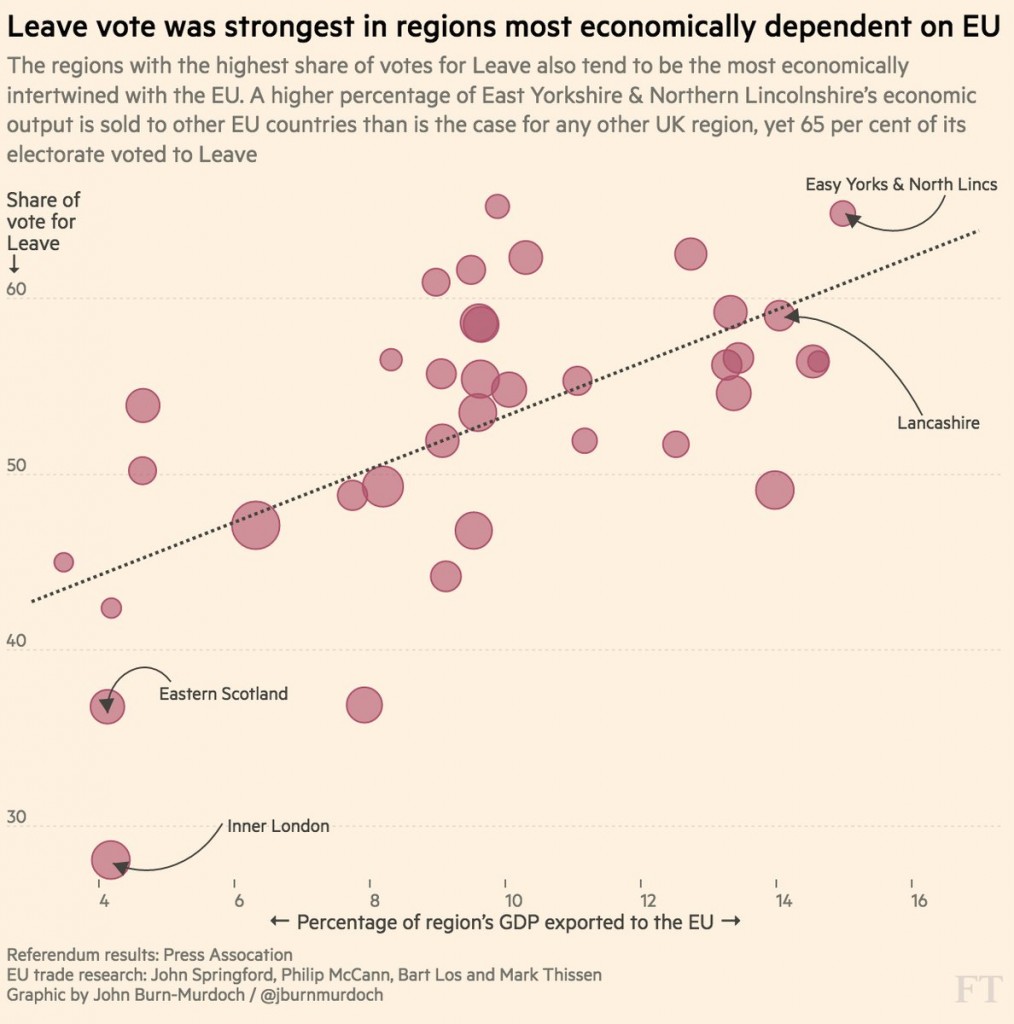
Concerns over the presence of Eastern European immigrants undeniably played a part in some of these regions decision to vote Leave, as this examination of the borough of Boston in South Lincolnshire which recorded the highest margin to leave with a margin of 75.6%. Thus success of the Leave campaign’s fear-mongering over uncontrolled immigration from EU states, mainly from Eastern Europe had an impact on discussions over the referendum as this world cloud of terms used by the Leave campaign on social media illustrates:
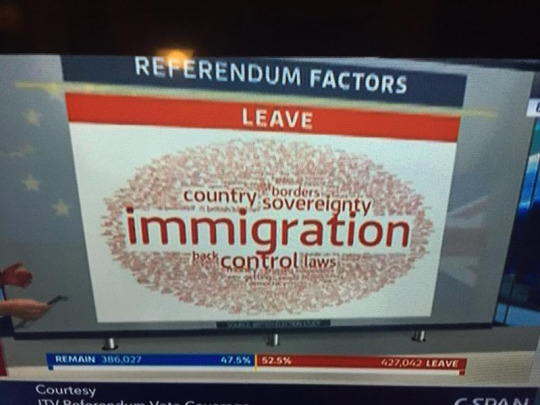
However neither too much nor too little should be made of right-wing racism as a decisive factor behind Brexit. As shown earlier the demand for the referendum owed much to concessions to internal Tory divisions over Europe which were ideological in nature and preceded the period of substantial immigration from Europe into the UK and much of the ressentiment against immigrants that was generated was due to displaced anxiety by those bypassed by the sustained period of growth from the 2000s onwards and was directed at European immigrants rather than Asian or African ones, or indeed Muslims. Without the support of this larger second contingent the Leave campaign would never have been able to win the referendum – as relying on purely a racist, anti-immigrant sentiment vote bank and platform would not have yielded anywhere a majority. As one of the more balanced analysts has pointed out:
“This was a democratic referendum, allowing citizens to decide whether the European Union remains an effective vehicle for our interests and values – or whether we can better pursue them from the outside. It was a debate about how these island nations best engage in the world – both within Europe and beyond it. It is unlikely to be a vote to cut ourselves off from Europe or the world, as we continue to cooperate with our NATO allies.
It was not a vote about whether we want to live in 2016 or to bring back the pre-EEC Britain – of pounds, shillings and pence before the currency was decimalised. It was not a vote which can or should reverse the enormous social changes we have seen to the position of women, to black and Asian Britons, or to gay people in British society.
It is dangerous to confuse a democratic referendum with a culture war in British society.”
Yet at the same time, it does raise concerns that the racist segment and sentiment that drove much of the campaign, while being a minority opinion would become emboldened and its baleful influence underplayed by the mainstream media. It here that we must distinguish that while the intent of many who voted for Leave was not racist, the effect has been to largely increase both the visibility and morale of racism and racists:
“The racists have successfully articulated a broad anti-establishment sentiment – originating in class injuries, regional decline, postindustrial devastation, generational anxieties, etc. – along bigoted, national chauvinist lines. The vote cannot be reduced to racism and nationalism – but that is the primary way in which it has been organised and recruited and directed, and that is the primary way in which the outcome will be experienced. That this was achieved so soon after the fascist murder of a centre-left, pro-immigrant MP, is stunning in a way. It says something about the truculence of some of the chauvinism on display. It says something about the profound sense of loss which a reasserted ‘Britishness’ is supposed to compensate for.”
This clearly is a concern and plenty of stories have been publicised showing how this ugly xenophobic sentiment has been in display in public, a taste of which can be found here, as well as the impetus that Brexit has given to right-wing anti-EU parties elsewhere in the EU, most notably Le Front National headed by Marie Le Pen to demand a similar referendum on a “Frexit” and Geert Wilder’s anti-immigrant party in the Netherlands. Of course the latter demands are driven less by fear of excessive migration from poorer eastern EU member states and more by an ideological opposition to the EU and chafing against the restrictions that EU regulations and conventions places on both their coming to power and what they can achieve should they do so. The undercurrent of hostility towards mainly Muslim ethnic minorities and Islam by the National Front in France in particular is unmistakable. However to implement such a referendum they would have to hold office first, and Marie Le Pen has stated that she would institute such a referendum to be held in the first three years of her presidency. This will of course depend on her party being able to win such an election in France. From this, while it is possible to say that not all those who voted for Brexit are “little Englander” racists or Islamophobes; the consequences and effects of such a vote has been undoubtedly to embolden such groups and individuals, despite their being a minority of both those who voted Leave and within their respective societies.
A more notably humane and thoughtful response to Brexit and one which sought to reassure the 1 million EU nationals working and living in London was by the city’s first Muslim mayor, Sadiq Khan, who said:
“I want to send a particular message to the almost one million Europeans living in London, who make a huge contribution to our city – working hard, paying taxes and contributing to our civic and cultural life. You are welcome here. We value the enormous contribution you make to our city and that will not change as a result of this referendum.”
To sum up, in this short piece I have sought to demonstrate several propositions as a corrective to much of the narrative that is being shaped on the reasons driving Brexit, its impact and what it means from a social and political point of view. These are:
- The political impetus Brexit has its roots in British Tory politics that date back to the late 1980s and not in fears of mass immigration or race. This is important to note because the referendum was conceded on these grounds, driven by internal Tory party politics, not an external anti-immigration movement.
- Much of the rhetoric in the campaign has been influenced by an extreme version of Europhobia that went through several avatars before finding several ‘hot button’ issues such as immigration and lack of control over border and a notional loss of national sovereignty. Much of this was utilised by far right movements and parties such as UKIP, aided by a very rabid, right-wing, Eurosceptic print tabloid media.
- The inability of politicians and key policymakers to counter these arguments and present a positive case for migration as well as a realistic picture of the real impact and benefits that migration was having on the British economy ceded much of the rhetorical and ideological ground to the right-wing anti-immigrant ideologues both within and without the political system. Furthermore, continual attempts to downplay or publicly commit to controlling immigration, led to a loss of faith in the ability of the government to do so and to regard most mainstream politicians’ statements on the topic with complete disbelief and cynicism by many sections of the public.
- While much of the force behind the Leave campaign was driven by racism; not all who voted Leave, and I would argue not even most who did, could be categorised as racist. Exiters were split into several camps and many who voted to Leave were driven by concerns other than uncontrolled immigration such as: a dislike of the EU, fear of further political integration, resentment at perceived excessive interference in public from Brussels, perception of EU structures being undemocratic and unaccountable and a displaced anger from being left behind in the last couple of decades of economic growth and social prosperity due to changes in the structure of the economy and the impact of globalisation. Without the support of the latter, it would not have been possible for Brexit to have won and while much of the drive and rhetoric behind the Leave campaign was either hostile towards immigration and immigrants as well as in some cases being unabashedly racist, by itself such a section of opinion simply would not have had the numbers to form a majority in a direct referendum.
- Despite this, the actual effects and consequences of Brexit will undoubtedly lead to more explicit displays of racism, anti-immigrant sentiment and Islamophobia by the racist and xenophobic sections of society. This should be neither over-emphasised or understated. The referendum was not a rejection of values of tolerance, social integration or an endorsement of racism, though undoubtedly some will see it in this light and use it to push their own agendas. It is a more complex phenomenon than that, though undoubtedly elements of this were present throughout and are a social reality today, just as they were before the referendum ever became an issue. Similarly, as before the extreme and racist right-wing remain, for the moment, a minority within British society. A vocal minority that exercises disproportionate influence on public discourse, but a minority nonetheless. Fears that Britain has suddenly turned into a racist, fascist island overnight, are unfounded.
- While many will interpret Brexit to suit their own ends and world-views, it is necessary to exercise caution and understand that Brexit cannot be reduced to a single explanatory cause. It should also be remembered that nearly half the country voted to remain within the EU and did so vehemently and are wedded to best of the European ideal revealing a significant fault line within the British polity but also pointing to the limits of exclusionary and anti-EU politics.
[1] A good example is this completely over the top Esquire article http://www.esquire.com/news-politics/news/a46143/why-brexit-bad-for-britain/
[2] A former Education Secretary and Secretary for Justice, from a journalistic background, Gove became notorious for his ill-advised forays into education and legal reform which most experts regard as disastrous.
[3] An excellent analysis of Nigel Farage and what he represents can be found here http://www.leninology.co.uk/2014/03/theres-something-about-nigel.html?m=1
[4] For more on how code words like ‘’swamped’’ and ‘swarm’’, used by David Cameron to describe the refugees in Calais destroy public discourse see https://www.theguardian.com/uk-news/2014/oct/27/swamped-and-riddled-toxic-phrases-wreck-politics-immigration-michael-fallon The anti-immigrant right-wing in the UK has consistently used such terminology popularised in the tabloid press to demonise and scapegoat, asylum-seekers and economic migrants into the UK.
[5] The scale of the dependence has been a cause of alarm, as comments by the independent Migration Advisory Committee made here show http://www.ft.com/cms/s/0/d00ee740-f1e8-11e5-9f20-c3a047354386.html#axzz4Cdfu4SRk
[6] http://news.bbc.co.uk/1/hi/health/2513933.stm
[7] It was Gordon Brown’s famous description of a 65 year old Labour supporter, Gillian Duffy, as a ‘bigoted woman’ when she challenged him over immigration on the campaign trail in the 2010 general election that is held to have been one of the turning points that lost Labour the election. http://www.theguardian.com/politics/2010/apr/28/gordon-brown-bigoted-woman
Conrad Barwa is a UK Resident based in London. He works as a Development Economist specialising in financial governance in emerging markets.
Previous Post

June 24, 2016
Brexit: Don't Panic
Next Post

July 19, 2016 The Sparkling Twilight of the GOP
Browse Our Archives
Select a Category Aziz For America Uncategorized
Select a Month December 2018 November 2018 October 2018 August 2018 July 2018 April 2018 November 2017 October 2017 July 2017 June 2017 April 2017 March 2017 February 2017 January 2017 December 2016 November 2016 July 2016 June 2016 March 2016 February 2016 January 2016 December 2015 November 2015 October 2015 June 2014 April 2014 March 2014 September 2013 July 2013 November 2012 October 2012 September 2012 August 2012 July 2012 June 2012 May 2012
Follow Us!
TAKE THE
Religious Wisdom Quiz
Who was David's military commander and nephew?
Select your answer to see how you score.
Benaiah Ittai Abishai Joab
Related posts from Aziz for America

I voted today, for tomorrow #VOTE

the question of representation
TRENDING AT PATHEOS Muslim

25 Years Later: How Much Has Changed for...
As we approach the 25th anniversary of September 11th, I’ve found myself...

Podcast: Third Spaces & The Rise of Yemeni...
In the latest episode of The Artistic Foodies Podcast, hosts Abbas...

HalalFest Picks: Best 60 Halal Spots for Super...
Back in 2016, I came up with a list of 29...

Unity Is America’s Strength — Division Is Its...
by Hidayatullah Ahsan When Valentina Gomez, a Republican candidate for Congress in...

Zohran Mamdani and New York’s Fight Against Islamophobia
This past June, against all odds, Zohran Mamdani won the Democratic primary...

What the Fourth of July Means to a...
As we mark another Fourth of July, millions of Americans will celebrate...
view all Muslim blogs
Ad-Free & Subscriber Log-In Subscription Support
- About Us
- 2026 Calendar
- Videos
- Podcasts
- Library of World Religions
- Faith In Media Tracker
- Advertise With Us
- Write for Us
- Privacy Policy
- Terms of Service
- Do Not Sell My Data
- Contact Us
- Radiant Digital
- Manage Newsletter Subscriptions
- Unsubscribe From Notifications
- Sitemap
Copyright 2008-2026, Patheos. All rights reserved.
Subscription Support Ad-Free & Subscriber Log-In
Follow Patheos