
BuddhistCatholicContemplativeEvangelicalGeneral ChristianHinduJewishLatter-day SaintMuslimNew VisionsProgressive Christian
Beliefs
- Buddhist
- Catholic
- Contemplative
- Evangelical
- General Christian
- Hindu
- Jewish
- Latter-day Saint
- More Voices
- Muslim
- New Visions
- Pagan
- Progressive Christian
Topics
- Religion News
- Food and Religion
- Sports and Religion
- Religious Art
- Religious Music and Entertainment
- Religious Events
- History and Religion
- Style and Religion
- Politics and Religion
- Women in Religion
- Recreation Outdoors and Religion
- Business Finance and Religion
- Careers Workplace and Religion
- Education and Religion
- Family Parenting and Religion
- Health Fitness and Religion
- Home and Religion
- Relationships and Religion
- Technology and Religion
- Travel and Religion
Columnists
- Buddhist Columnists
- Business Finance and Religion Columnists
- Careers Workplace and Religion Columnists
- Catholic Columnists
- Contemplative Columnists
- Education and Religion Columnists
- Evangelists Columnists
- Family Parenting and Religion Columnists
- General Christian Columnists
- Health Fitness and Religion Columnists
- Hindu Columnists
- History and Religion Columnists
- Home and Religion Columnists
- Jewish Columnists
- More Voices Columnists
- Latter Day Columnists
- Muslim Columnists
- New Visions Columnists
- Nonreligious Columnists
- Pagan Columnists
- Politics and Religion Columnists
- Progressive Columnists
- Recreation Outdoors and Religion Columnists
- Relationships and Religion Columnists
- Religion News Columnists
- Religious Art Columnists
- Religious Events Columnists
- Religious Music and Entertainment Columnists
- Sports and Religion Columnists
- Style and Religion Columnists
- Technology and Religion Columnists
- Travel and Religion Columnists
- Women in Religion Columnists
Resource Library
- 2026 Calendar
- Library of World Religions
- The 100 Most Holy Places on Earth
- Patheos Answers
- Podcasts
- Videos
- Faith Leaders Database
- Anglican Episcopalian
- Bahai
- Baptist
- Buddhism
- Christianity
- Confucianism
- Eastern Orthodoxy
- Hinduism
- Holiness and Pentecostal
- ISKCON
- Islam
- Judaism
- Lutheran
- Methodist
- The Church of Jesus Christ of Latter-day Saints
- New Age
- Paganism
- Presbytarian and Reformed
- Protestantism
- Religion Behind the Scenes
- Roman Catholic
- Scientology
- Shia Islam
- Sikhism
- Sufism
- Sunni Islam
- Taoism
- Zen
- See all religions
Research Tools
 Ad-Free & Subscriber Log-In Subscription Support
Ad-Free & Subscriber Log-In Subscription Support
Follow Patheos 

- Trending:
- Forgiveness
- |
- Marriage
- |
- Consciousness
- |
- Death Penalty
- |
- Election
- |
- Halloween

- Home
- Muslim
- Politics and Religion
- Decoupling religious identity: A Muslim Response to Brian McLaren
Decoupling religious identity: A Muslim Response to Brian McLaren
Last updated on: January 13, 2015 at 1:53 pm by Aziz Poonawalla
Decoupling religious identity: A Muslim Response to Brian McLaren 2015-01-13T13:53:33-07:00 Aziz Poonawalla
Patheos Explore the world's faith through different perspectives on religion and spirituality! Patheos has the views of the prevalent religions and spiritualities of the world.
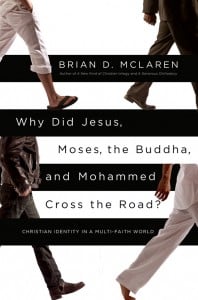
image courtesy of press images provided by publishers of “Why Did Jesus, Moses, the Buddha, and Mohammad Cross the Road”
This post is part of an inter-faith discussion on Brian McLaren’s new book Why Did Jesus, Moses, the Buddha and Mohammed Cross the Road?, hosted at the Patheos Book Club.
Brian McLaren is an evangelical Christian pastor with a deep interest in interfaith outreach and dialogue. This book is probably the culmination of his life’s work in that regard, and in it he seeks to build a foundation on which Christians can effectively communicate with other faiths. The target audience for this book are not Muslims, Hindus and Jews, but his fellow Christians. He seeks to transform the model for interaction of Christians with non-Christians from an oppositional, hostile stance to a benevolent, cooperative one in order to achieve shared goals. As he puts it, this is a “shared journey”, not prosletyzation:
[It] is not the call to convert from your religion to mine. It is, rather, the invitation for both of us to seek a deeper conversion that begins in our deepest religious identity and transforms all of life.
McLaren’s book falls into what I like to think of as the Engineer Monk category: a focus on outcomes and alliances, with absolutely no intention of compromise on theology. That’s something I really respect, and what is usually lacking from more liberal attempts at interfaith dialogue that only seek to affirm commonalities of faith in the broadest (and most useless) terms. I think the best singular example of an Engineer Monk was Pastor Rick Warren, who spoke at the ISNA conference in 2009. From the transcript:
Now I was asked to speak to you about how Muslims and Christians can work closer together for the greater good, in our world. And I will tell you that I am not interested in interfaith dialogue, I am interested in interfaith projects. There is a big difference. Talk is very cheap. And you can talk and talk and talk and not get anything done. Love is something you do. It is something that we do together. Love is a verb. Now as the two largest faiths on this planet, Muslims and Christians, we must lead in this. We must lead.
Warren’s full remarks at ISNA go into quite explicit detail about what specifically he thinks Muslims and Christians should do for and with each other, and I certainly hope McLaren has an opportunity to review that speech and comment on how it meshes with his vision in the book.
Another example worth mentioning of the Engineer Monk is the book “Between Allah and Jesus” by Peter Kreeft. The purpose of this book was to force a debate within Christianity, not about how it relates to other faiths but to try and gain inspiration from Islam’s adherents’ zeal and apply that to Christianity. The book is structured as a dialogue between various students at a university, a muslim and an evangelical Christian among them. I engaged in a cross-blog dialogue with “Jazz Theologian” Robert Gelinas about this book; here are two excerpts (one, two) from the book and my response to each.
What McLaren is trying to do is to combine aspects of both Warren’s and Kreeft’s approaches. Early on, he introduces a model of Christian identity as a linear axis, ranging from “Weak/Benign” at one end and “Strong/Hostile” at the other. He then rejects that model for a new one that adds “Strong/Benevolent” as a perpendicular axis. I found this discussion (in Part 1 of the book, entitled The Crisis of Christian Identity) to be quite resonant with issues of Muslim identity in the west as well. There is a similar need to add a benevolence dimension to our existing axis of strength vs weakness, so we can decouple hostility from strength.
The recent response of Muslims overseas to the various insults against the Prophet SAW is a great example of the utility of this model for identity. Western muslims are caught in a bind*. How do we express our Strength; ie our belief in our Prophet and our deep grievous hurt at the insults to him, without compromising our Benevolence; our adherence and deep belief in freedom of speech? (Because freedom of speech is inextricably entwined with the very freedom of religion that permits Muslims in America to be more free in their pursuit of Deen than anywhere else in the world). If we can conceive our identity as perpendicular to that same hostile/benign axis, then we aren’t forced to choose between two equally unpalatable reactions to this kind of provocation.
There’s a lot more in the book to comment on and appreciate, but I’ll save that for later entries in this cross-blog discussion. I do look forward to hearing McLaren’s thoughts on how Warren’s speech and Kreeft’s book fit (at least the excerpts linked above) fit into his broader argument. And how he feels about being called an Engineer Monk 🙂 (Hopefully, in the spirit of praise in which it was intended!)
*specifically, Bateson’s Double-bind.
Previous Post

September 11, 2012
transcript: President Obama's remarks on 11th anniversary of 9-11
Next Post
October 15, 2012 a Muslim American meets Paul Ryan
Browse Our Archives
Select a Category Aziz For America Uncategorized
Select a Month December 2018 November 2018 October 2018 August 2018 July 2018 April 2018 November 2017 October 2017 July 2017 June 2017 April 2017 March 2017 February 2017 January 2017 December 2016 November 2016 July 2016 June 2016 March 2016 February 2016 January 2016 December 2015 November 2015 October 2015 June 2014 April 2014 March 2014 September 2013 July 2013 November 2012 October 2012 September 2012 August 2012 July 2012 June 2012 May 2012
Follow Us!
TAKE THE
Religious Wisdom Quiz
What prophet, along with Zechariah, encouraged the rebuilding of the Temple?
Select your answer to see how you score.
Elijah Haggai Malachi Obadiah
Related posts from Aziz for America

I voted today, for tomorrow #VOTE

TRENDING AT PATHEOS Muslim

25 Years Later: How Much Has Changed for...
As we approach the 25th anniversary of September 11th, I’ve found myself...

Podcast: Third Spaces & The Rise of Yemeni...
In the latest episode of The Artistic Foodies Podcast, hosts Abbas...

HalalFest Picks: Best 60 Halal Spots for Super...
Back in 2016, I came up with a list of 29...

Unity Is America’s Strength — Division Is Its...
by Hidayatullah Ahsan When Valentina Gomez, a Republican candidate for Congress in...

Zohran Mamdani and New York’s Fight Against Islamophobia
This past June, against all odds, Zohran Mamdani won the Democratic primary...

What the Fourth of July Means to a...
As we mark another Fourth of July, millions of Americans will celebrate...
view all Muslim blogs
Ad-Free & Subscriber Log-In Subscription Support
- About Us
- 2026 Calendar
- Videos
- Podcasts
- Library of World Religions
- Faith In Media Tracker
- Advertise With Us
- Write for Us
- Privacy Policy
- Terms of Service
- Do Not Sell My Data
- Contact Us
- Radiant Digital
- Manage Newsletter Subscriptions
- Unsubscribe From Notifications
- Sitemap
Copyright 2008-2026, Patheos. All rights reserved.
Subscription Support Ad-Free & Subscriber Log-In
Follow Patheos