
BuddhistCatholicContemplativeEvangelicalGeneral ChristianHinduJewishLatter-day SaintMuslimNew VisionsProgressive Christian
Beliefs
- Buddhist
- Catholic
- Contemplative
- Evangelical
- General Christian
- Hindu
- Jewish
- Latter-day Saint
- More Voices
- Muslim
- New Visions
- Pagan
- Progressive Christian
Topics
- Religion News
- Food and Religion
- Sports and Religion
- Religious Art
- Religious Music and Entertainment
- Religious Events
- History and Religion
- Style and Religion
- Politics and Religion
- Women in Religion
- Recreation Outdoors and Religion
- Business Finance and Religion
- Careers Workplace and Religion
- Education and Religion
- Family Parenting and Religion
- Health Fitness and Religion
- Home and Religion
- Relationships and Religion
- Technology and Religion
- Travel and Religion
Columnists
- Buddhist Columnists
- Business Finance and Religion Columnists
- Careers Workplace and Religion Columnists
- Catholic Columnists
- Contemplative Columnists
- Education and Religion Columnists
- Evangelists Columnists
- Family Parenting and Religion Columnists
- General Christian Columnists
- Health Fitness and Religion Columnists
- Hindu Columnists
- History and Religion Columnists
- Home and Religion Columnists
- Jewish Columnists
- More Voices Columnists
- Latter Day Columnists
- Muslim Columnists
- New Visions Columnists
- Nonreligious Columnists
- Pagan Columnists
- Politics and Religion Columnists
- Progressive Columnists
- Recreation Outdoors and Religion Columnists
- Relationships and Religion Columnists
- Religion News Columnists
- Religious Art Columnists
- Religious Events Columnists
- Religious Music and Entertainment Columnists
- Sports and Religion Columnists
- Style and Religion Columnists
- Technology and Religion Columnists
- Travel and Religion Columnists
- Women in Religion Columnists
Resource Library
- 2026 Calendar
- Library of World Religions
- The 100 Most Holy Places on Earth
- Patheos Answers
- Podcasts
- Videos
- Faith Leaders Database
- Anglican Episcopalian
- Bahai
- Baptist
- Buddhism
- Christianity
- Confucianism
- Eastern Orthodoxy
- Hinduism
- Holiness and Pentecostal
- ISKCON
- Islam
- Judaism
- Lutheran
- Methodist
- The Church of Jesus Christ of Latter-day Saints
- New Age
- Paganism
- Presbytarian and Reformed
- Protestantism
- Religion Behind the Scenes
- Roman Catholic
- Scientology
- Shia Islam
- Sikhism
- Sufism
- Sunni Islam
- Taoism
- Zen
- See all religions
Research Tools
 Ad-Free & Subscriber Log-In Subscription Support
Ad-Free & Subscriber Log-In Subscription Support
Follow Patheos 

- Trending:
- Forgiveness
- |
- Marriage
- |
- Consciousness
- |
- Death Penalty
- |
- Election
- |
- Halloween
 A Word to the Witch
- Home
- Pagan
- Teaching a Witch, Part 2: Classroom, coven, or apprentice?
Teaching a Witch, Part 2: Classroom, coven, or apprentice?
Last updated on: March 20, 2015 at 11:03 am by Sara Amis
Teaching a Witch, Part 2: Classroom, coven, or apprentice? 2015-03-20T11:03:59-05:00 Sara Amis
Patheos Explore the world's faith through different perspectives on religion and spirituality! Patheos has the views of the prevalent religions and spiritualities of the world.
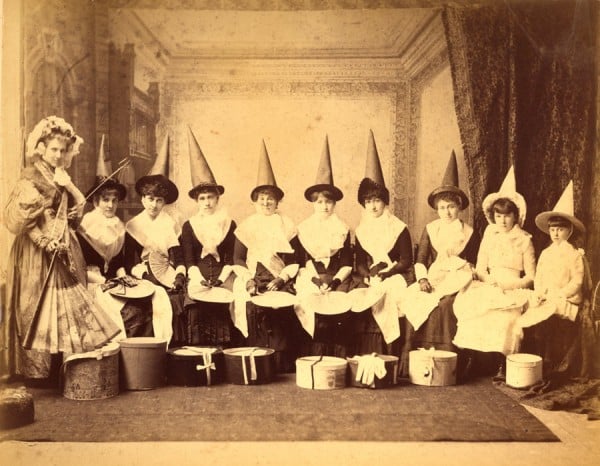
Nine Witches (source Haunting Visions Stock)
This is the second in my series on being a Pagan teacher; in the first one, I talked a little about how to be an effective teacher. Today, I want to talk about different models of teaching and their uses.
Let me begin by reiterating that I teach for my day job. I have also experienced the workshop/classroom model for teaching Pagan and witchcraft topics as both a teacher and a student and I received my Faery training under an apprenticeship type one-on-one model, and have taught my own students in a combination of apprenticeship and coven teaching depending on what was going on at the time.
The classroom or workshop model
Fundamentally, this means that you have a number of students and one or two teachers, and the relationship between teacher and student is limited in time and space. That is, they interact mostly in the classroom setting, with a variable amount of individual consultation outside of it, and once the term of the class is ended there is no presumption of a relationship beyond that.
The classroom model is good for imparting mainly intellectual information, or specific skills that can be practiced within the constraints of the course. It is also an efficient way to maximize resources…either in terms of making sure more people get access to a particular teacher or (if the teacher is being paid) ensuring that the teacher gets a reasonable wage at an equally reasonable rate of tuition for the students.
The classroom structure inherently creates more of a hierarchy than the other types, relatively speaking. This in itself is neither good nor bad, but is a tendency to be aware of, especially if your stated values are otherwise. The frequent internal fights I witnessed in Reclaiming about who was or was not deemed a “teacher”…and who got paid…I believe are traceable in part to the structurally hierarchical tendencies of workshops and Witch Camp straining against the anti-hierarchical sensibility of the tradition as a whole. A classroom model also creates emotional distance, which is useful to me as a college instructor, but as a means of teaching emotionally intense spiritual subjects may be counterproductive.
Apprenticeship
An apprentice is something like a student and something like an assistant; learning comes from both discussion and practice, often in partnership with the teacher, and it easily (almost inevitably) spills over into a personal friendship. This approach is generally far less structured, which can be both an advantage and a disadvantage. The down side is that sometimes major topics get skipped because they just didn’t happen to come up; the up side is that the practice is very much integrated into daily life and the student sees the teacher’s practice in action, not just in theory or by self-report. This is the most supportive form of the teacher-student relationship, and that level of support is essential for some of the shamanic and ecstatic types of practice. It is also the most time-intensive, on both the student and teacher’s part.
Teaching in covens
In practice this is often a combination of the two, both structurally and in a kind of linear progression; that is, a coven may have “outer court” classes which are taught by coven members to a group, then as students advance they wind up working with a teacher one-on-one. In a tradition like Faery where there is only one initiation and several initiates may be part of a coven, each initiate may have a student under his or her supervision for individual work combined with group ritual and other activities. Ideally coven-teaching is the best of both worlds; in practice I could see the potential for screwed-up interpersonal dynamics finding a foothold or being exacerbated. I will say that in my own personal experience that for any witchcraft beyond the most basic “this is how to cast a circle, here’s the Wheel of the Year, let’s talk about directions and elements” kind of information, the closer the teaching model is to apprenticeship, the more functional it tends to be. There also needs to be a clear path forward for students, and a clear understanding of who is responsible for what.
Generally speaking, the more intellectual and dry the information you are conveying, and the less expectation you have of any relationship beyond the term of the course, the better a classroom or workshop model will suit. The more intense and volatile the training, the more an apprenticeship or coven model is necessary; this is why the principles listed on the Faery Tradition website include “We recognize that Faery is highly transformative and extremely experiential, requiring closer attention and responsibility than workshops, seminars, or intensives provide.”
From both the teacher and student’s perspectives, knowing what your goals are (both short term and long term) is vital. How much support and attention from the teacher do you need/are you able to give? I have seen people struggling with the emotional fallout of practices learned via a book or a relatively inaccessible workshop teacher, sometimes to their detriment; in my own experience I have found that approach too ungrounded for anything energetically intense. There are also potential pitfalls for the teacher: in an interview for the article “The Teacher Will Appear” by Christine Hoff Kramer and Sierra Black which appeared in Witches and Pagans #25; I made the observation that “in group situations people are much, much more likely to project their shadow stuff onto me than they are in situations where we have a more organic and personal relationship.” Obviously, I don’t think a classroom model is inherently bad; I teach in a classroom every week. I have also given my share of Pagany workshops and talks. I do think that for both teacher and student understanding the limits and advantages of a given approach will help to avert difficulties and make sure the education you are seeking happens.
Previous Post

March 16, 2015
Ostara and the Green Muse
Next Post

March 23, 2015 The Unrespected Voice
Browse Our Archives
Select a Category Book review Earth Matters Earthly Rites Faery thoughts Fur and Feather History of witchcraft Natural Reflections Nature in the News Pagan Education Pagan music Pagans in politics Restorying the Sacred Science & Spirit teaching witchcraft Terminology and Philosophy The Sacred in Suburbia Uncategorized
Select a Month May 2017 November 2016 May 2016 April 2016 December 2015 November 2015 October 2015 September 2015 August 2015 June 2015 May 2015 April 2015 March 2015 February 2015 January 2015 December 2014 October 2014 September 2014 August 2014 July 2014 January 2014 December 2013 August 2011 June 2011 April 2011 May 2010
Follow Us!
TAKE THE
Religious Wisdom Quiz
Who gave Jesus gifts of gold, frankincense, and myrrh?
Select your answer to see how you score.
Wise men Fishermen Shepherds Disciples
Related posts from A Word to the Witch


Announcement: Sacred Lands and Spiritual Landscapes Book Now...

TRENDING AT PATHEOS Pagan

I was recently chatting with someone on Instagram. She asked me what...

While there are many people who share their results, the end of...

On July 23, I saw Christopher Nolan's The Odyssey which is Homer’s...

As I write this two big events have just finished up. One...

Restoring the Watershed of Divine Love
Perhaps cooperation is not something we manufacture through legislation, ideology, or moral...

Many UUs don’t pray because of bad experiences in a previous religion,...
view all Pagan blogs
Ad-Free & Subscriber Log-In Subscription Support
- About Us
- 2026 Calendar
- Videos
- Podcasts
- Library of World Religions
- Faith In Media Tracker
- Advertise With Us
- Write for Us
- Privacy Policy
- Terms of Service
- Do Not Sell My Data
- Contact Us
- Radiant Digital
- Manage Newsletter Subscriptions
- Unsubscribe From Notifications
- Sitemap
Copyright 2008-2026, Patheos. All rights reserved.
Subscription Support Ad-Free & Subscriber Log-In
Follow Patheos