
BuddhistCatholicContemplativeEvangelicalGeneral ChristianHinduJewishLatter-day SaintMuslimNew VisionsProgressive Christian
Beliefs
- Buddhist
- Catholic
- Contemplative
- Evangelical
- General Christian
- Hindu
- Jewish
- Latter-day Saint
- More Voices
- Muslim
- New Visions
- Pagan
- Progressive Christian
Topics
- Religion News
- Food and Religion
- Sports and Religion
- Religious Art
- Religious Music and Entertainment
- Religious Events
- History and Religion
- Style and Religion
- Politics and Religion
- Women in Religion
- Recreation Outdoors and Religion
- Business Finance and Religion
- Careers Workplace and Religion
- Education and Religion
- Family Parenting and Religion
- Health Fitness and Religion
- Home and Religion
- Relationships and Religion
- Technology and Religion
- Travel and Religion
Columnists
- Buddhist Columnists
- Business Finance and Religion Columnists
- Careers Workplace and Religion Columnists
- Catholic Columnists
- Contemplative Columnists
- Education and Religion Columnists
- Evangelists Columnists
- Family Parenting and Religion Columnists
- General Christian Columnists
- Health Fitness and Religion Columnists
- Hindu Columnists
- History and Religion Columnists
- Home and Religion Columnists
- Jewish Columnists
- More Voices Columnists
- Latter Day Columnists
- Muslim Columnists
- New Visions Columnists
- Nonreligious Columnists
- Pagan Columnists
- Politics and Religion Columnists
- Progressive Columnists
- Recreation Outdoors and Religion Columnists
- Relationships and Religion Columnists
- Religion News Columnists
- Religious Art Columnists
- Religious Events Columnists
- Religious Music and Entertainment Columnists
- Sports and Religion Columnists
- Style and Religion Columnists
- Technology and Religion Columnists
- Travel and Religion Columnists
- Women in Religion Columnists
Resource Library
- 2026 Calendar
- Library of World Religions
- The 100 Most Holy Places on Earth
- Patheos Answers
- Podcasts
- Videos
- Faith Leaders Database
- Anglican Episcopalian
- Bahai
- Baptist
- Buddhism
- Christianity
- Confucianism
- Eastern Orthodoxy
- Hinduism
- Holiness and Pentecostal
- ISKCON
- Islam
- Judaism
- Lutheran
- Methodist
- The Church of Jesus Christ of Latter-day Saints
- New Age
- Paganism
- Presbytarian and Reformed
- Protestantism
- Religion Behind the Scenes
- Roman Catholic
- Scientology
- Shia Islam
- Sikhism
- Sufism
- Sunni Islam
- Taoism
- Zen
- See all religions
Research Tools
 Ad-Free & Subscriber Log-In Subscription Support
Ad-Free & Subscriber Log-In Subscription Support
Follow Patheos 

- Trending:
- Forgiveness
- |
- Marriage
- |
- Consciousness
- |
- Death Penalty
- |
- Election
- |
- Halloween
 A Word to the Witch
- Home
- Pagan
- Grimoire of the Thorn-Blooded Witch by Raven Grimassi (Book Review)
Grimoire of the Thorn-Blooded Witch by Raven Grimassi (Book Review)
Last updated on: October 13, 2014 at 8:19 am by Sara Amis
Grimoire of the Thorn-Blooded Witch by Raven Grimassi (Book Review) 2014-10-13T08:19:06-05:00 Sara Amis
Patheos Explore the world's faith through different perspectives on religion and spirituality! Patheos has the views of the prevalent religions and spiritualities of the world.
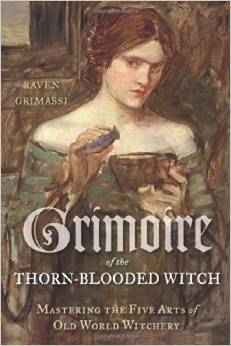
Raven Grimassi describes this book as an attempt to codify or distill what he calls the “roots” of Old World witchcraft: “The magical tradition presented in this book is ever ancient and ever new.” That is to say, he is presenting a “cohesive system” of magic based on his own experiences in Witchcraft and some encounters with various plant spirits as teachers, and asserts that this kind of direct relationship with otherworldly beings and what he calls “the magic of the Greenwood” is where witchcraft originally came from anyway.
So far, so promising. I am in agreement with this idea in principle. I have some reservations about the execution of it here, which may be a matter of taste. My biggest objection is that I don’t think it’s actually possible to uncouple witchcraft and magic from culture…we humans are cultural beings, it’s what we do, our evolutionary gig as it were, and it shapes our thinking in all things will-we or nil-we. Attempting to sidestep the problem doesn’t tend to solve it, in my experience. I also think that human culture as an aggregate is far richer and more complex than what any one individual can produce (that, after all, is its purpose) and therefore that by attempting to universalize you are apt to lose a great deal in translation. That isn’t to say that there are not connections to be made, and Raven Grimassi describes the experience of moving from a very culturally-identified practice to a more universal one as transformative and deepening. I don’t dispute that it worked that way for him; my concern here is that a beginner will find that the lack of grounding in culture, history, or a community of practitioners is an obstacle to moving past the beginner stage. Since this is a book meant to start people on a deeper path, I see that as a problem.
On the other hand, the book does provide some advantages which many other books suitable for beginners lack. Though Grimassi is careful to point out that the system presented in this book does not fit the definition of “Traditional Witchcraft,” he does say that there are strong similarities. I would be more inclined to describe the relationship as “mostly unacknowledged influence” but I am cranky about such things. In any case, one big virtue of Grimoire of the Thorn-Blooded Witch is that it is the closest thing to an accessible, usable primer or introduction to Traditional Witchcraft I have seen. It’s certainly far more readable than books on Traditional Witchcraft generally are. A beginner who doesn’t have a teacher from an actual TW lineage handy, or who wants to get the feel of it before going deeper, would probably find this book useful. I would recommend supplementing with some solid history (by which I mean books written by actual historians), folklore, and older source material on witchcraft to balance its flaws.
And it does have flaws. One is the tendency to use sweeping declarations and passive voice (“In Old World Witchery this is known as…”) which tend to obscure the source of the ideas; it’s hard therefore to know where Grimassi is coming from or to orient oneself in them. Another and more serious one is that the reader is directed to start working with plant spirits by establishing a blood-pact with “She of the Thorn-Blooded Rose” without any previous contact, meditations, or connections. (Those come after). This strikes me as the spirit-work equivalent of a bar hookup. As that is more or less how I met my ex-husband…well, it wasn’t so much a bar as a science fiction convention…I can’t say it’s always a disaster. But I will say that like most twenty-year-olds I was notably lacking in common sense. And while we did wind up getting married, we also wound up getting divorced. What I’m saying is, you are taking your chances and maybe it would be better to sit down with this Thorn-Blooded She and have a nice chat and some tea. Get to know each other first. I personally would do the work with the recommended sigil and rose, etc. first and then try to establish a closer connection, which reverses the order in the book.
Verdict: Worth reading if you are a beginner, but don’t rely on it by itself. And exercise some prudence.
Previous Post

September 25, 2014
Our Nimue Is Different
Next Post

October 20, 2014 Talking to My Ancestors at Samhain: Religion In A Crisis
Browse Our Archives
Select a Category Book review Earth Matters Earthly Rites Faery thoughts Fur and Feather History of witchcraft Natural Reflections Nature in the News Pagan Education Pagan music Pagans in politics Restorying the Sacred Science & Spirit teaching witchcraft Terminology and Philosophy The Sacred in Suburbia Uncategorized
Select a Month May 2017 November 2016 May 2016 April 2016 December 2015 November 2015 October 2015 September 2015 August 2015 June 2015 May 2015 April 2015 March 2015 February 2015 January 2015 December 2014 October 2014 September 2014 August 2014 July 2014 January 2014 December 2013 August 2011 June 2011 April 2011 May 2010
Follow Us!
TAKE THE
Religious Wisdom Quiz
What does "Jezebel" mean in Hebrew?
Select your answer to see how you score.
Queen of the people The Lord reigns Daughter of Baal Unexalted
Related posts from A Word to the Witch

Book Review: Asfidity & Madstones, A Further Ramble...

Book Review: Jane Eyre's Sisters by Jody Gentian...

Book Review: Planetary Aspects, an astrological guide to...
Review: A Pagan Anti-Capitalist Primer by Alley Valkyrie...
TRENDING AT PATHEOS Pagan

When we talk about Greek religion, we often begin with the dodekatheion—the...

I was recently chatting with someone on Instagram. She asked me what...

While there are many people who share their results, the end of...

On July 23, I saw Christopher Nolan's The Odyssey which is Homer’s...

As I write this two big events have just finished up. One...

Restoring the Watershed of Divine Love
Perhaps cooperation is not something we manufacture through legislation, ideology, or moral...
view all Pagan blogs
Ad-Free & Subscriber Log-In Subscription Support
- About Us
- 2026 Calendar
- Videos
- Podcasts
- Library of World Religions
- Faith In Media Tracker
- Advertise With Us
- Write for Us
- Privacy Policy
- Terms of Service
- Do Not Sell My Data
- Contact Us
- Radiant Digital
- Manage Newsletter Subscriptions
- Unsubscribe From Notifications
- Sitemap
Copyright 2008-2026, Patheos. All rights reserved.
Subscription Support Ad-Free & Subscriber Log-In
Follow Patheos