
BuddhistCatholicContemplativeEvangelicalGeneral ChristianHinduJewishLatter-day SaintMuslimNew VisionsProgressive Christian
Beliefs
- Buddhist
- Catholic
- Contemplative
- Evangelical
- General Christian
- Hindu
- Jewish
- Latter-day Saint
- More Voices
- Muslim
- New Visions
- Pagan
- Progressive Christian
Topics
- Religion News
- Food and Religion
- Sports and Religion
- Religious Art
- Religious Music and Entertainment
- Religious Events
- History and Religion
- Style and Religion
- Politics and Religion
- Women in Religion
- Recreation Outdoors and Religion
- Business Finance and Religion
- Careers Workplace and Religion
- Education and Religion
- Family Parenting and Religion
- Health Fitness and Religion
- Home and Religion
- Relationships and Religion
- Technology and Religion
- Travel and Religion
Columnists
- Buddhist Columnists
- Business Finance and Religion Columnists
- Careers Workplace and Religion Columnists
- Catholic Columnists
- Contemplative Columnists
- Education and Religion Columnists
- Evangelists Columnists
- Family Parenting and Religion Columnists
- General Christian Columnists
- Health Fitness and Religion Columnists
- Hindu Columnists
- History and Religion Columnists
- Home and Religion Columnists
- Jewish Columnists
- More Voices Columnists
- Latter Day Columnists
- Muslim Columnists
- New Visions Columnists
- Nonreligious Columnists
- Pagan Columnists
- Politics and Religion Columnists
- Progressive Columnists
- Recreation Outdoors and Religion Columnists
- Relationships and Religion Columnists
- Religion News Columnists
- Religious Art Columnists
- Religious Events Columnists
- Religious Music and Entertainment Columnists
- Sports and Religion Columnists
- Style and Religion Columnists
- Technology and Religion Columnists
- Travel and Religion Columnists
- Women in Religion Columnists
Resource Library
- 2026 Calendar
- Library of World Religions
- The 100 Most Holy Places on Earth
- Patheos Answers
- Podcasts
- Videos
- Faith Leaders Database
- Anglican Episcopalian
- Bahai
- Baptist
- Buddhism
- Christianity
- Confucianism
- Eastern Orthodoxy
- Hinduism
- Holiness and Pentecostal
- ISKCON
- Islam
- Judaism
- Lutheran
- Methodist
- The Church of Jesus Christ of Latter-day Saints
- New Age
- Paganism
- Presbytarian and Reformed
- Protestantism
- Religion Behind the Scenes
- Roman Catholic
- Scientology
- Shia Islam
- Sikhism
- Sufism
- Sunni Islam
- Taoism
- Zen
- See all religions
Research Tools
 Ad-Free & Subscriber Log-In Subscription Support
Ad-Free & Subscriber Log-In Subscription Support
Follow Patheos 

- Trending:
- Forgiveness
- |
- Marriage
- |
- Consciousness
- |
- Death Penalty
- |
- Election
- |
- Halloween
 A Word to the Witch
- Home
- Pagan
- What’s Traditional Witchcraft?
What’s Traditional Witchcraft?
Last updated on: July 22, 2014 at 2:03 pm by Sara Amis
What’s Traditional Witchcraft? 2014-07-22T14:03:14-05:00 Sara Amis
Patheos Explore the world's faith through different perspectives on religion and spirituality! Patheos has the views of the prevalent religions and spiritualities of the world.
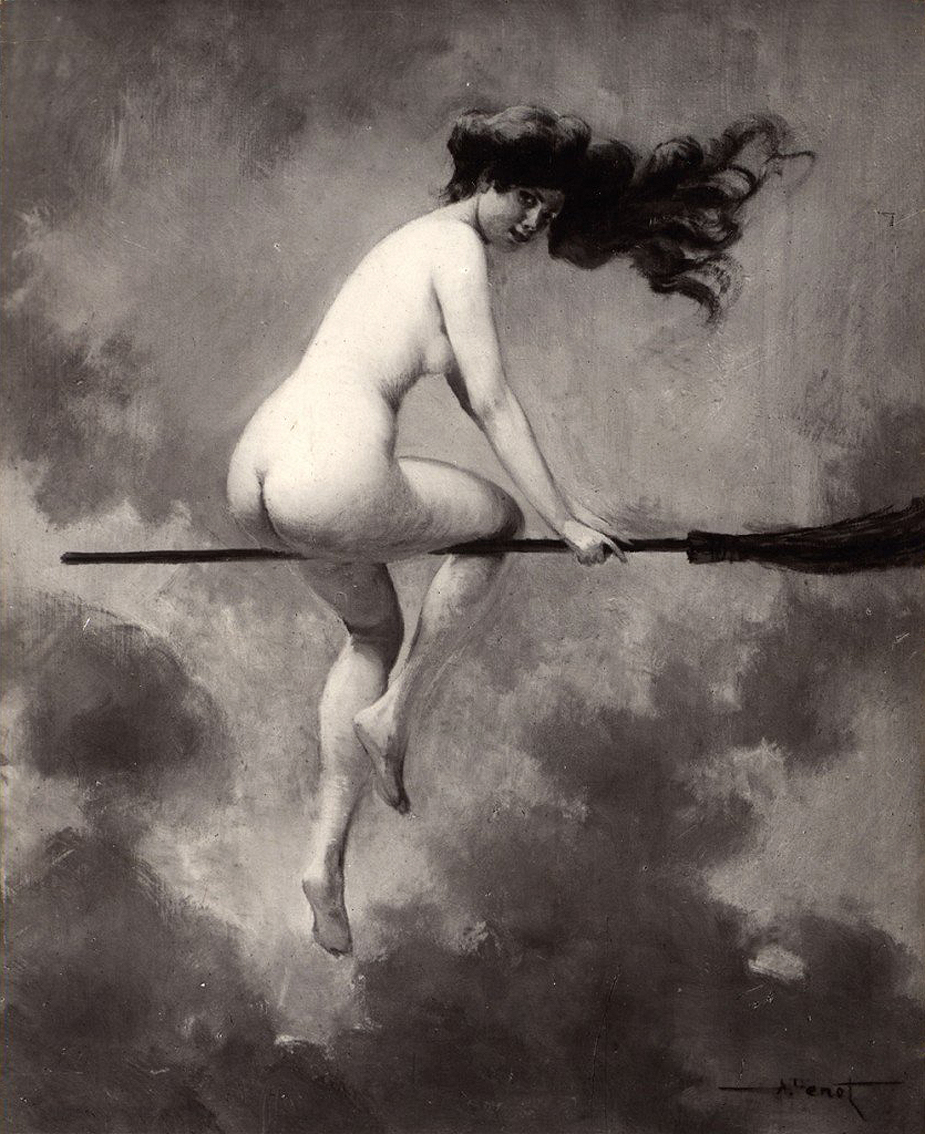
Départ pour le Sabbat by Albert Joseph Pénot
This blog, I am told, is meant to be about traditional witchcraft. Or Traditional Witchcraft. It says it right there in the tag line. However, that immediately prompts a question, which is…what do you mean by that? Janson Mankey entered the fray not too long ago, and quoted yours truly among others. I’ve since considered the matter further, in light of what I actually intend to be writing. I want you to know that I considered starting out by posting a clip of the song “Tradition!” from Fiddler On the Roof, but decided against it. You’re welcome.
The first thing I want to establish is that terms can have multiple meanings. Go look through my favorite repository of arcane knowledge some time, the Oxford English Dictionary (no, really, y’all, it has a HISTORICAL THESAURUS); it’s full of ’em. However, that doesn’t mean that like Humpty Dumpty in Alice’s Adventures Through the Looking Glass, you can just make a word mean whatever you want. Language is used to communicate. As a corollary, words mean what people use them to mean, not what someone thinks they’re “supposed” to. Attempts to trammel language hardly ever actually work. (Don’t tell the French).
You could just use the term “Traditional Witchcraft” to mean “a lineaged tradition of religious witchcraft,” ie any tradition that requires initiation to be considered a full-fledged member. However, that is functionally very close to meaning all religious witchcraft traditions, as it would leave out only groups like Reclaiming in which initiation is optional. “Initiatory witchcraft traditions” is much clearer if you want to make the distinction.
As mentioned by Jason, British Traditional Wicca groups have used the term to differentiate themselves from “neo-Wiccan” traditions that are often eclectic and do not have a direct link to Gardnerian Wicca. (And which are often more influenced by New Age thinking, per Helix’s definition). However, it seems to me that “British Traditional Wicca” works just fine for that. In any case, I don’t have strong objections to this definition so long as it’s clear in context what you are talking about, but I personally am unlikely to use it.
Another definition is “non-Gardnerian-influenced initiatory witchcraft traditions,” a group which includes Anderson Faery, the Clan of Tubal-Cain, the Cultus Sabbati, 1734, and the like. These traditions, while distinct, do have some similarities of theology, practice, and what one might call sensibility, and it’s useful to be able to group them together in a way that doesn’t just define them as “not Wicca.”
However, that can leave out another important group, which I would call little “t,” little “w” traditional witches. This includes practitioners of hoodoo, rootwork, cunning craft, curandismo, stregheria, and all of the other folk magic practices throughout the world. Interestingly, this group is both probably the most numerous and the one with the most solid claim to a lengthy history. When we speak of “witchcraft” before the 20th century, we mean folk magicians of this type. There’s not much evidence that any of the modern witchcraft lineages existed before 1930. That doesn’t mean for sure that they didn’t, but when you’re speaking of history, it is important to distinguish between what you can prove and what you can’t.
There is a strong and often fruitful relationship between “capital W” Witches, and “little w” traditional witches…but the overlap is far from exact, and while there is a kinship there is also a certain amount of tension. Traditional witches in Europe and English-speaking North America who practice hoodoo, pow wow, et cetera, are more often than not Christian, and while the traditions themselves have (some) pre-Christian origins (the evidence for that will be a topic for future posts) during the intervening centuries they have become heavily syncretized with Christianity. Traditions from elsewhere in the Americas likewise, though the influences from indigenous American and African belief systems are generally more visible. Religious Witchcraft when it draws on these traditions (as it often does) generally is at some pains to buff off the Christian gloss. It’s tempting to believe that we are just restoring practices to their original glory, and in some cases it doesn’t take much effort. However, we should remember that in order to find that presumed originality we have to hopscotch over the work and beliefs of many generations. As an ancestor-reverencing sort of witch, I’m wary of doing that in too much haste.
Another source of tension is class difference. In the Early Modern period in Europe, you had roughly two kinds of people using magic…upper-class literate men doing Hermetic magic out of grimoires, who were often also clergy, and lower-class men and women doing cunning-craft and the like. The former used expensive tools, rare spices, books (which were precious) and were usually in pursuit of some “high magic” goal such as the betterment of their souls. The latter were often poor (or at most yeomen farmer class), used whatever materials they had to hand, and their goals were generally though not exclusively pragmatic…healing the sick, finding lost items, and so forth.
As a consequence of the Occult Revival of the late 19th century (a mostly upper class phenomenon) and its influence on the development of the modern Pagan religious movement, Traditional Witchcraft can sometimes have a tendency to look more like the grimoire-wielding magister than the cunning man or woman. Expensive hand-bound books are beautiful, but they are also an economic bar, and the emphasis on self-development plus the need for at least a middle-class income to support it occasionally puts the self-described Traditional Witch in closer company with other Pagans and the New Age, and further from folk practice, than it would like to believe. Meanwhile the folk traditions keep plugging along under the radar. Far from dying out, they are where they have always been…in the backwaters, among the poor and marginalized, hidden in plain sight usually. Sometimes it can seem like these two sorts of witches exist on completely different planets, and in the future I plan to explore some of their differences in sensibility and worldview, as well as their rich, evocative confluences.
I am both a lineaged, initiated “Traditional Witch” and a folk-magic, yarb-gathering “traditional witch;” nor am I alone. Sitting on the boundary is a fine witchly occupation. The view from here is pretty good.

“The Storyteller” in Buckhead, Atlanta, Georgia stalks some tourists. Photo by Sara Amis
Previous Post

January 17, 2014
Poison in the Heart of the World
Next Post

July 23, 2014 Failure is not an option
Browse Our Archives
Select a Category Book review Earth Matters Earthly Rites Faery thoughts Fur and Feather History of witchcraft Natural Reflections Nature in the News Pagan Education Pagan music Pagans in politics Restorying the Sacred Science & Spirit teaching witchcraft Terminology and Philosophy The Sacred in Suburbia Uncategorized
Select a Month May 2017 November 2016 May 2016 April 2016 December 2015 November 2015 October 2015 September 2015 August 2015 June 2015 May 2015 April 2015 March 2015 February 2015 January 2015 December 2014 October 2014 September 2014 August 2014 July 2014 January 2014 December 2013 August 2011 June 2011 April 2011 May 2010
Follow Us!
TAKE THE
Religious Wisdom Quiz
Who was the scribe and priest that led a second group back to Jerusalem?
Select your answer to see how you score.
Ezra Mordecai Nehemiah Zerubbabel
Related posts from A Word to the Witch

Historical Witchcraft, Shamanism and the Modern Witch
TRENDING AT PATHEOS Pagan

When we talk about Greek religion, we often begin with the dodekatheion—the...

I was recently chatting with someone on Instagram. She asked me what...

While there are many people who share their results, the end of...

On July 23, I saw Christopher Nolan's The Odyssey which is Homer’s...

As I write this two big events have just finished up. One...

Restoring the Watershed of Divine Love
Perhaps cooperation is not something we manufacture through legislation, ideology, or moral...
view all Pagan blogs
Ad-Free & Subscriber Log-In Subscription Support
- About Us
- 2026 Calendar
- Videos
- Podcasts
- Library of World Religions
- Faith In Media Tracker
- Advertise With Us
- Write for Us
- Privacy Policy
- Terms of Service
- Do Not Sell My Data
- Contact Us
- Radiant Digital
- Manage Newsletter Subscriptions
- Unsubscribe From Notifications
- Sitemap
Copyright 2008-2026, Patheos. All rights reserved.
Subscription Support Ad-Free & Subscriber Log-In
Follow Patheos