
BuddhistCatholicContemplativeEvangelicalGeneral ChristianHinduJewishLatter-day SaintMuslimNew VisionsProgressive Christian
Beliefs
- Buddhist
- Catholic
- Contemplative
- Evangelical
- General Christian
- Hindu
- Jewish
- Latter-day Saint
- More Voices
- Muslim
- New Visions
- Pagan
- Progressive Christian
Topics
- Religion News
- Food and Religion
- Sports and Religion
- Religious Art
- Religious Music and Entertainment
- Religious Events
- History and Religion
- Style and Religion
- Politics and Religion
- Women in Religion
- Recreation Outdoors and Religion
- Business Finance and Religion
- Careers Workplace and Religion
- Education and Religion
- Family Parenting and Religion
- Health Fitness and Religion
- Home and Religion
- Relationships and Religion
- Technology and Religion
- Travel and Religion
Columnists
- Buddhist Columnists
- Business Finance and Religion Columnists
- Careers Workplace and Religion Columnists
- Catholic Columnists
- Contemplative Columnists
- Education and Religion Columnists
- Evangelists Columnists
- Family Parenting and Religion Columnists
- General Christian Columnists
- Health Fitness and Religion Columnists
- Hindu Columnists
- History and Religion Columnists
- Home and Religion Columnists
- Jewish Columnists
- More Voices Columnists
- Latter Day Columnists
- Muslim Columnists
- New Visions Columnists
- Nonreligious Columnists
- Pagan Columnists
- Politics and Religion Columnists
- Progressive Columnists
- Recreation Outdoors and Religion Columnists
- Relationships and Religion Columnists
- Religion News Columnists
- Religious Art Columnists
- Religious Events Columnists
- Religious Music and Entertainment Columnists
- Sports and Religion Columnists
- Style and Religion Columnists
- Technology and Religion Columnists
- Travel and Religion Columnists
- Women in Religion Columnists
Resource Library
- 2026 Calendar
- Library of World Religions
- The 100 Most Holy Places on Earth
- Patheos Answers
- Podcasts
- Videos
- Faith Leaders Database
- Anglican Episcopalian
- Bahai
- Baptist
- Buddhism
- Christianity
- Confucianism
- Eastern Orthodoxy
- Hinduism
- Holiness and Pentecostal
- ISKCON
- Islam
- Judaism
- Lutheran
- Methodist
- The Church of Jesus Christ of Latter-day Saints
- New Age
- Paganism
- Presbytarian and Reformed
- Protestantism
- Religion Behind the Scenes
- Roman Catholic
- Scientology
- Shia Islam
- Sikhism
- Sufism
- Sunni Islam
- Taoism
- Zen
- See all religions
Research Tools
 Ad-Free & Subscriber Log-In Subscription Support
Ad-Free & Subscriber Log-In Subscription Support
Follow Patheos 

- Trending:
- Forgiveness
- |
- Marriage
- |
- Consciousness
- |
- Death Penalty
- |
- Election
- |
- Halloween
 A Witch's Ashram
- Home
- Pagan
- Broken Gods: A Book Review
Broken Gods: A Book Review
Last updated on: June 20, 2015 at 9:14 am by Niki Whiting
Broken Gods: A Book Review 2015-06-20T09:14:45-08:00 Niki Whiting
Patheos Explore the world's faith through different perspectives on religion and spirituality! Patheos has the views of the prevalent religions and spiritualities of the world.
Patheos – the overarching home of Patheos Pagan – does book clubs and anyone from any channel is able to join it. Most of the books don’t interest me, but this month I decided to try one of the books. Broken Gods: Hope, Healing, and the 7 Longings of the Human Heart, is by Gregory K. Popcak, PhD., a Catholic, therapist, and fellow blogger at Patheos (Faith on the Couch).
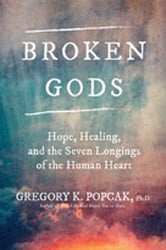 I’ll admit the title intrigued me. I wondered what a Christian could be intimating by “Gods.” The blurb suggested Popcak would be discussing the idea of divinization. One of the things I studied extensively in graduate school was theological anthropology (who are we? what is the nature of the human person? what is our purpose? etc) and the early Church Fathers. The concept of divinization is central to both of those studies. It’s been years since I looked at this topic. What would I see in this topic now?
Let’s get the obvious out of the way first: I am not the target audience of this book. This book is for Christians, specifically middle class, mainstream entrenched Christians. I am not that.
Much of the book repeats the general frame and tone that the Christian self-help books I read in the ’90’s had. I guess not much has changed. There are sweeping generalizations about what people want and what is best and healthy for persons; none of it sitting well with me. There is the mingling of neuroscience language and psychological words to attempt a bit of academic gravitas. There is the speaking about others’ experience. (“But atheists like Carter are lost in pessimism without even knowing it.” p.9) The book is divided up into seven chapters, following the seven deadly sins and what needs they mask. Each chapter ends with prayers and reflection points. Again, I feel like if you’ve read one Christian self-help book, you’ve read them all.
Reading the chapter on justice left a bad taste in my mouth, especially in the wake of high profile racial tension in the United States. Popcak describes the “divine longing for justice” as the “foundation for our natural expectation that everything should work infinitely better than it does” (p. 87). Injustice is discussed in terms of “big and small offenses” and “frustrated expectations.” There is no mention of actual, systemic injustice in this world. And all of injustice is diminished with the theology of the Fall – you know, everything’s just worse since then. Again, this kind of writing smacks of mollycoddling middle class Christians, rather than making them uncomfortable talking about actual injustice and suffering.
This middle class connection is made all the stronger when Popcak talks about work in the chapter on trust. God was a good “boss” in the Garden of Eden; our work was “dignified, profitable” (p. 120). Later on that same page he talks about how work ideally makes us feel accomplished and helps us “to become everything we are created to be.” Going on, he says: “Toil is, essentially, work stripped of our trust that the things we are asked to do are not beneath us…” So, in the garden no one had to scoop poop? Hard work is toil? There’s a lot to unpack here, conflating hard work with toil with indignity. But just in case you were nervous, because you might have a full savings account, we are reminded that saving money and being “financially blessed” isn’t bad. Do Christians still need this pointed out? Apparently so.
And since I’m a Pagan let me not fail to point out that Popcak confuses New Age and Neo-Paganism, and insults us by saying that “the modern neo-pagan [sic] fails to worship anyone…. besides himself.” p.11. So much for academic gravitas.
But not everything is awful. In his chapter on peace, Popcak makes a great point when he talks about the apathy of sloth. Peace isn’t the absence of conflict. “It is one thing if through thoughtful prater, careful discernment, and responsible consultation we consciously decide that it would be better to leave something alone. It is another thing to simply fail to consider the question in the first place out of a desire to avoid trouble.” (p. 110)
What is most interesting and unique about this book is Popcak’s focus on divinization. It is a little acknowledged aspect of Christian theology, but one that I find incredibly important and liberating. The Eastern Orthodox tradition has developed this concept most fully and, in my experience, brings it out more than the Western Christian tradition. Popcak, as a Roman Catholic, is perfectly situated to bring this concept to greater modern attention. He uses quotes from Papal writings, various saintly mystics, and ancient liturgies. The entire book is squarely situated in the broader Christian tradition – and I appreciate that.
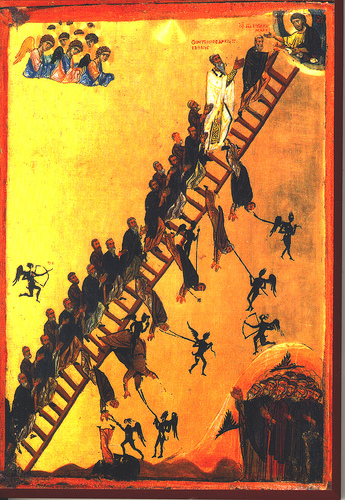
Icon of the Ladder of Divine Ascent
Divinization, theosis, is the process of becoming a god. This is one of the goals and promises of Christianity. Yes! Christians ideally not just become like their god, but become gods. Now, it’s important to note the distinction between big G God and little g god in Christianity. For me, there is little distinction. The Christian mystics and Church Fathers all acknowledge that the goal of Christianity is perfection – not perfection in the sense that I will do every perfectly, that I will attain some Platonic ideal of being human. Rather, perfection is union so complete with their God that they become gods themselves. I think this is an incredibly beautiful theological idea and this idea is present (more or less) in the traditions I practice now.
I do believe that we are gods. Each and every one of us. I believe in the immanence of animating spirit, that every thing has the spark of the divine within it. This is one of the tenets of Christianity I took deeply to heart and have found reflected in nearly every mystic tradition I have studied. Taking seriously this theological claim, as well as my own lived experience, has led me more deeply into a panentheistic polytheistic animism. What this understanding of divinization and the inherent divinity of all things leads to next is profound relationship.
My favorite chapter in Broken Gods, hands down, was the chapter on communion. Intimate interdependence is the bedrock of human relationship and Popcak not only grasps that, but also understands the necessity of boundaries (chastity in his terms) in creating and safeguarding healthy relationships. I was particularly impressed with this bit:
” ‘All my relationships aren’t sexual.’ Of course they are. While not every relationship is genital in the sense that every relationship involves sexual intercourse, every relationship is sexual – in the broadest sense of the word – because every relationship involves both the sharing of oneself with another and generativity, that is, the creation of something that is bigger than oneself and potentially outlives the self.” (p. 171)
At the end of the book he mentions St John of the Cross’s “ladder of divine love.” I relate so strongly to this bit of mystic wisdom. The first stage of the way is purgative. We remove all that binds us and hinders us on our ascent. Next is the illumination and a “total reorientation of our desire,” where “we no longer experience our desires as a distraction.” I am so fully and completely on this part of the ladder. For so many years I thought my desires were out of place, making me unable to function in the world and society. Outwardly I was functioning fine, more or less, but the internal cost was incredibly high. Now, I see that my desires were not out of place or “weird;” I am merely myself and embracing my longings has actually set my life in order.
Popcak goes on: “Up to now, we’ve been afraid we would lose ourselves if we got too close to the fire. Now we’re finding that the more we are consumed by the fire, the more ‘ourselves,’ the more authentic we become.” (p. 179) I embrace the fire. I have prayed for the refining fire since I was 12 years old. It is the heart of the mystic yearning.
For Christians with no background in the Church Fathers or Christian mystics, this book might be a good way to introduce their ideas. Non-Christians have no need of this book at all, but instead I encourage everyone to go to the source. Read the Cappadocian Fathers (Saints Basil the Great, Gregory the Theologian, and Gregory of Nyssa), St. John of the Cross, and the work of Vladimir Lossky.
As we approach the longest day of the year (in the Northern Hemisphere), may you embrace the fire! Jump in!
Previous Post

June 18, 2015
What We're Reading
Next Post
June 26, 2015 Why I Am Not a Christian
Browse Our Archives
Select a Category Alaska altar altars Ana Ancestors Anderson witchcraft Arddu Bhairava Biography bodies books Christianity Christmas community current events death Delphic Maxims Dhumavati dual observance Durga Faery family life feminism Feri Feri tradition Feri witchcraft food ganesha gratitude Guest Post guru health Hinduism holidays Jesus Kali Lakshmi land links magic Many Gods West movie review movies music my heart mystery myth Navratri Orthodoxy pagan pagan culture paganism pantheacon parenting Place politics polytheism practice pratice prayer Red Goddess review ritual sacred arts Samhain Saraswati Shinto Shiva singing Star Goddess Tantra tarot the Gods theory Uncategorized values virgin mary wales washington winter witchcraft year in review yoga
Select a Month September 2015 August 2015 July 2015 June 2015 May 2015 April 2015 March 2015 February 2015 January 2015 December 2014 November 2014 October 2014 September 2014 August 2014 July 2014 June 2014 May 2014 April 2014 March 2014 February 2014 January 2014 December 2013 November 2013 October 2013 September 2013 August 2013 July 2013 June 2013 May 2013 April 2013 March 2013 February 2013 January 2013 December 2012 November 2012 October 2012 September 2012 August 2012 July 2012 June 2012 May 2012 April 2012 March 2012 February 2012 January 2012 December 2011 November 2011 October 2011 September 2011 August 2011 July 2011 June 2011
Follow Us!
TAKE THE
Religious Wisdom Quiz
According to Romans, how does faith come?
Select your answer to see how you score.
From the Holy Spirit By reading Scripture By hearing the word Through prayer
Related posts from A Witch's Ashram

So Long, and Thanks for All the Clicks


Polytheism, Politics, Discomfort, and Growth

TRENDING AT PATHEOS Pagan

I was recently chatting with someone on Instagram. She asked me what...

While there are many people who share their results, the end of...

On July 23, I saw Christopher Nolan's The Odyssey which is Homer’s...

As I write this two big events have just finished up. One...

Restoring the Watershed of Divine Love
Perhaps cooperation is not something we manufacture through legislation, ideology, or moral...

Many UUs don’t pray because of bad experiences in a previous religion,...
view all Pagan blogs
Ad-Free & Subscriber Log-In Subscription Support
- About Us
- 2026 Calendar
- Videos
- Podcasts
- Library of World Religions
- Faith In Media Tracker
- Advertise With Us
- Write for Us
- Privacy Policy
- Terms of Service
- Do Not Sell My Data
- Contact Us
- Radiant Digital
- Manage Newsletter Subscriptions
- Unsubscribe From Notifications
- Sitemap
Copyright 2008-2026, Patheos. All rights reserved.
Subscription Support Ad-Free & Subscriber Log-In
Follow Patheos