
BuddhistCatholicContemplativeEvangelicalGeneral ChristianHinduJewishLatter-day SaintMuslimNew VisionsProgressive Christian
Beliefs
- Buddhist
- Catholic
- Contemplative
- Evangelical
- General Christian
- Hindu
- Jewish
- Latter-day Saint
- More Voices
- Muslim
- New Visions
- Pagan
- Progressive Christian
Topics
- Religion News
- Food and Religion
- Sports and Religion
- Religious Art
- Religious Music and Entertainment
- Religious Events
- History and Religion
- Style and Religion
- Politics and Religion
- Women in Religion
- Recreation Outdoors and Religion
- Business Finance and Religion
- Careers Workplace and Religion
- Education and Religion
- Family Parenting and Religion
- Health Fitness and Religion
- Home and Religion
- Relationships and Religion
- Technology and Religion
- Travel and Religion
Columnists
- Buddhist Columnists
- Business Finance and Religion Columnists
- Careers Workplace and Religion Columnists
- Catholic Columnists
- Contemplative Columnists
- Education and Religion Columnists
- Evangelists Columnists
- Family Parenting and Religion Columnists
- General Christian Columnists
- Health Fitness and Religion Columnists
- Hindu Columnists
- History and Religion Columnists
- Home and Religion Columnists
- Jewish Columnists
- More Voices Columnists
- Latter Day Columnists
- Muslim Columnists
- New Visions Columnists
- Nonreligious Columnists
- Pagan Columnists
- Politics and Religion Columnists
- Progressive Columnists
- Recreation Outdoors and Religion Columnists
- Relationships and Religion Columnists
- Religion News Columnists
- Religious Art Columnists
- Religious Events Columnists
- Religious Music and Entertainment Columnists
- Sports and Religion Columnists
- Style and Religion Columnists
- Technology and Religion Columnists
- Travel and Religion Columnists
- Women in Religion Columnists
Resource Library
- 2026 Calendar
- Library of World Religions
- The 100 Most Holy Places on Earth
- Patheos Answers
- Podcasts
- Videos
- Faith Leaders Database
- Anglican Episcopalian
- Bahai
- Baptist
- Buddhism
- Christianity
- Confucianism
- Eastern Orthodoxy
- Hinduism
- Holiness and Pentecostal
- ISKCON
- Islam
- Judaism
- Lutheran
- Methodist
- The Church of Jesus Christ of Latter-day Saints
- New Age
- Paganism
- Presbytarian and Reformed
- Protestantism
- Religion Behind the Scenes
- Roman Catholic
- Scientology
- Shia Islam
- Sikhism
- Sufism
- Sunni Islam
- Taoism
- Zen
- See all religions
Research Tools
 Ad-Free & Subscriber Log-In Subscription Support
Ad-Free & Subscriber Log-In Subscription Support
Follow Patheos 

- Trending:
- Forgiveness
- |
- Marriage
- |
- Consciousness
- |
- Death Penalty
- |
- Election
- |
- Halloween
 A Witch's Ashram
- Home
- Pagan
- God is Not Either/Or, God/dess is Both/And
God is Not Either/Or, God/dess is Both/And
Last updated on: June 3, 2015 at 3:31 pm by Niki Whiting
God is Not Either/Or, God/dess is Both/And 2015-06-03T15:31:07-08:00 Niki Whiting
Patheos Explore the world's faith through different perspectives on religion and spirituality! Patheos has the views of the prevalent religions and spiritualities of the world.
An inelegant Catholic priest over on Patheos’ Catholic channel has listed Twelve Reasons Why You Can’t Call God “Mother.” You know I can’t let that rest, especially because his reasons are dodgy on a variety of levels.
I refuse to break down his argument piece by piece (who has time? not this non-Christian), but instead let me offer some thoughts from an unpublished doctoral paper of mine, which was to be the crux of my dissertation. This paper analyzed the works of Mark Miravalle and his efforts to establish Mary as the Co-Redemptrix as a Fifth Marian Dogma, and the ideas of Tina Beattie, particularly in her book, God’s Mother, Eve’s Advocate. The footnotes haven’t transferred in the cut and paste, so if you would like sources or additional reading, please contact me.
This essay was situated from within the Christian tradition and from a monotheistic framework. While my personal spirituality has since deviated, I stand by my ideas presented here.
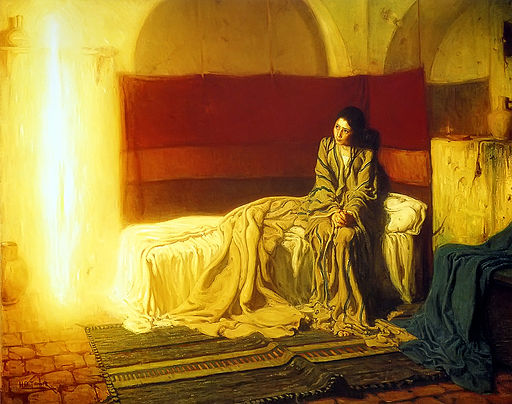
Tanner’s Annunciation
In order to experience full participation in the life of the Catholic Church, as well as in the larger world beyond the confines of the Church and Christianity, not only in its liturgical and administrative life, but in its symbolic and spiritual life, women need to see their experiences and bodily presence valued and given weight beyond empty words and gestures. The first step in fully embracing women’s experiences, according to Beattie, is to stop polarizing Mary and Eve. Beattie says ‘…women need Eve as well as Mary in the Christian narrative, not as symbols of the opposition between good and evil but as symbols of the complex realities of being a woman sometimes a mother.’ Miravalle chooses to play Mary and Eve against each other. The result leaves Mary as the only woman exalted in a hierarchy of male thinkers, Church Fathers, popes and male deities.
Mary cannot represent women’s redemption alone, as if she exists in a vacuum. ‘As long as Mary is understood only in relation to Christ, she belongs within the community of “men-amongst-themselves” in a way which leads to the symbolic exclusion of women.’ Mary cannot be defined only in terms of other men – handmaiden of, servant to, mother of, wife of. Mary and women’s redemption must exist in communion with other women; otherwise women have no place and no part in the salvation narrative unless they attach themselves to masculine figures. This denies the mutual interdependency that exists among relational beings and makes certain people and classes of people (here we are writing about women) subordinate to and dependent upon male authority. The patriarchy, ‘men-amongst-themselves,’ is strengthened when women are in isolation from one another.
……
Jesus and Mary are each both paradox and mystery, both containers of the Uncontainable. Jesus in his flesh miraculously contains the fullness of Divinity, yet Mary by carrying Jesus in her womb contains the fullness of the Divine within her, too. Mary as Co-redemptrix, along with Jesus, would represent fullness of body and spirit, male and female, active and passive, both as icons of the Divine – not as polarity but as embracing all of humanity and creation. Seeing Mary as Co-redemptrix asks the Christian to shift one’s understanding of salvation from economic exchanges, rendered judgments, or substitutionary atonement, and see salvation as restoration: restoration of our inherent divinity, our relationship with God/dess, the created world, and one another.
Both Jesus and Mary are necessary as redeemers for three reasons. The first is that our culture and the Christian Church place a level of normativity, preference and privilege on the male person. In order to restore the dignity of women and establish symbols of power and divinity that reflect more of humanity, Mary as co-redeemer is a step in the right direction. Secondly, by embracing what has been considered the Other for so long, the female form, the physical body and other expressions of Otherness can be embraced as part of the life of the divine. In this paper I am thinking primarily of non-normative expressions of gender and sexuality, as well the general lived experiences of women, but other expressions of Otherness are included. Thirdly, if God is neither male nor female then there is nothing wrong or erroneous with using divine feminine language or imagery in our discussions of God/dess, nor is there any reason to keep women from holding spiritual and liturgical leadership in the Church. Tradition can be a barrier erected by patriarchal figures of authority, excluding women from fully participating in the life of the Church, restricting women’s expression of self, and hindering a fuller understanding of God/dess. The insistence on an all-male trinity, an all-male priesthood, and only using masculine God-language makes an idol out of God/dess and idolizes masculinity. If all sexes and genders are free to see themselves in God/dess and to see God/dess in themselves then eventually we can and must move beyond patriarchy and gender essentialism.
Miravalle says that ‘[c]lear awareness of the plan of salvation is only possible when we understand our need for a redeemer, and for a co-redemptrix by recognizing our own sin.’ But a complete theology of Mary as the Co-redemptrix would lead one to see that, as Beattie states, ‘…the disordering of the relationship between the sexes, the self-divinization of the male in his identification with God and the exclusion of woman from godlikeness and therefore from personhood, is the first consequence of the fall and thus marks the beginning of patriarchy.’ If salvation is about the restoration of relationship this challenges much of the Church’s authority and self-narrative. If women are restored to full relationship with one another and with God/dess, must we continue put up with a story that continues to tell us women are guilty? That we are less than full icons of God/dess and therefore not appropriate as priests? If we are restored, must we capitulate to an authority that would deny us the fullness of our restoration? If we are redeemed and restored relationally then we can participate fully – no role is beyond us merely for the reason that we are women.
God/dess ‘descends’ into created matter in the form of Jesus, Mary ‘ascends’ to divinity by embracing the Divine. Both are God/dess. The incarnation of God/dess and the divinization of humanity create a relationship that is far more cooperative and active than passive and submissive. Both Mary and Jesus are divine; both reveal what humanity can look like when divinized, that is, aligned with God/dess. This does not distance Mary from creation any more than the incarnation distances Jesus from God/dess. A Mary, ‘subordinate and dependent,’ ‘unnecessary,’ like the one Miravalle advocates for, and out of communion with her sisters (Eve and other women) can have no actual redemptive agency; she is merely a witness, one of many, perhaps worthy of more honor and respect for having birthed Jesus. The title of Co-redemptrix is therefore empty and the proposed dogma is pointless. By placing Mary in relationship with Eve and other women, highlighting the restored relationship women have with God/dess as seen through the Annunciation and Nativity, and by restoring Eve’s reputation as Woman Redeemed, Mary becomes a symbol of embodied redemption for women and, I propose, for others marginalized by the institutional Church.
Previous Post

June 1, 2015
Shinto Blessings
Next Post

June 4, 2015 On Turning 40
Browse Our Archives
Select a Category Alaska altar altars Ana Ancestors Anderson witchcraft Arddu Bhairava Biography bodies books Christianity Christmas community current events death Delphic Maxims Dhumavati dual observance Durga Faery family life feminism Feri Feri tradition Feri witchcraft food ganesha gratitude Guest Post guru health Hinduism holidays Jesus Kali Lakshmi land links magic Many Gods West movie review movies music my heart mystery myth Navratri Orthodoxy pagan pagan culture paganism pantheacon parenting Place politics polytheism practice pratice prayer Red Goddess review ritual sacred arts Samhain Saraswati Shinto Shiva singing Star Goddess Tantra tarot the Gods theory Uncategorized values virgin mary wales washington winter witchcraft year in review yoga
Select a Month September 2015 August 2015 July 2015 June 2015 May 2015 April 2015 March 2015 February 2015 January 2015 December 2014 November 2014 October 2014 September 2014 August 2014 July 2014 June 2014 May 2014 April 2014 March 2014 February 2014 January 2014 December 2013 November 2013 October 2013 September 2013 August 2013 July 2013 June 2013 May 2013 April 2013 March 2013 February 2013 January 2013 December 2012 November 2012 October 2012 September 2012 August 2012 July 2012 June 2012 May 2012 April 2012 March 2012 February 2012 January 2012 December 2011 November 2011 October 2011 September 2011 August 2011 July 2011 June 2011
Follow Us!
TAKE THE
Religious Wisdom Quiz
Who did Joseph eventually forgive and provide for in Egypt?
Select your answer to see how you score.
Potiphar His brothers His captors Pharaoh
Related posts from A Witch's Ashram

Polytheism, Politics, Discomfort, and Growth

TRENDING AT PATHEOS Pagan

When we talk about Greek religion, we often begin with the dodekatheion—the...

I was recently chatting with someone on Instagram. She asked me what...

While there are many people who share their results, the end of...

On July 23, I saw Christopher Nolan's The Odyssey which is Homer’s...

As I write this two big events have just finished up. One...

Restoring the Watershed of Divine Love
Perhaps cooperation is not something we manufacture through legislation, ideology, or moral...
view all Pagan blogs
Ad-Free & Subscriber Log-In Subscription Support
- About Us
- 2026 Calendar
- Videos
- Podcasts
- Library of World Religions
- Faith In Media Tracker
- Advertise With Us
- Write for Us
- Privacy Policy
- Terms of Service
- Do Not Sell My Data
- Contact Us
- Radiant Digital
- Manage Newsletter Subscriptions
- Unsubscribe From Notifications
- Sitemap
Copyright 2008-2026, Patheos. All rights reserved.
Subscription Support Ad-Free & Subscriber Log-In
Follow Patheos