
BuddhistCatholicContemplativeEvangelicalGeneral ChristianHinduJewishLatter-day SaintMuslimNew VisionsProgressive Christian
Beliefs
- Buddhist
- Catholic
- Contemplative
- Evangelical
- General Christian
- Hindu
- Jewish
- Latter-day Saint
- More Voices
- Muslim
- New Visions
- Pagan
- Progressive Christian
Topics
- Religion News
- Food and Religion
- Sports and Religion
- Religious Art
- Religious Music and Entertainment
- Religious Events
- History and Religion
- Style and Religion
- Politics and Religion
- Women in Religion
- Recreation Outdoors and Religion
- Business Finance and Religion
- Careers Workplace and Religion
- Education and Religion
- Family Parenting and Religion
- Health Fitness and Religion
- Home and Religion
- Relationships and Religion
- Technology and Religion
- Travel and Religion
Columnists
- Buddhist Columnists
- Business Finance and Religion Columnists
- Careers Workplace and Religion Columnists
- Catholic Columnists
- Contemplative Columnists
- Education and Religion Columnists
- Evangelists Columnists
- Family Parenting and Religion Columnists
- General Christian Columnists
- Health Fitness and Religion Columnists
- Hindu Columnists
- History and Religion Columnists
- Home and Religion Columnists
- Jewish Columnists
- More Voices Columnists
- Latter Day Columnists
- Muslim Columnists
- New Visions Columnists
- Nonreligious Columnists
- Pagan Columnists
- Politics and Religion Columnists
- Progressive Columnists
- Recreation Outdoors and Religion Columnists
- Relationships and Religion Columnists
- Religion News Columnists
- Religious Art Columnists
- Religious Events Columnists
- Religious Music and Entertainment Columnists
- Sports and Religion Columnists
- Style and Religion Columnists
- Technology and Religion Columnists
- Travel and Religion Columnists
- Women in Religion Columnists
Resource Library
- 2026 Calendar
- Library of World Religions
- The 100 Most Holy Places on Earth
- Patheos Answers
- Podcasts
- Videos
- Faith Leaders Database
- Anglican Episcopalian
- Bahai
- Baptist
- Buddhism
- Christianity
- Confucianism
- Eastern Orthodoxy
- Hinduism
- Holiness and Pentecostal
- ISKCON
- Islam
- Judaism
- Lutheran
- Methodist
- The Church of Jesus Christ of Latter-day Saints
- New Age
- Paganism
- Presbytarian and Reformed
- Protestantism
- Religion Behind the Scenes
- Roman Catholic
- Scientology
- Shia Islam
- Sikhism
- Sufism
- Sunni Islam
- Taoism
- Zen
- See all religions
Research Tools
 Ad-Free & Subscriber Log-In Subscription Support
Ad-Free & Subscriber Log-In Subscription Support
Follow Patheos 

- Trending:
- Forgiveness
- |
- Marriage
- |
- Consciousness
- |
- Death Penalty
- |
- Election
- |
- Halloween
 A Witch's Ashram
- Home
- Pagan
- The Vocabulary of Spiritual Practice, part 1
The Vocabulary of Spiritual Practice, part 1
Last updated on: April 24, 2015 at 11:50 am by Niki Whiting
The Vocabulary of Spiritual Practice, part 1 2015-04-24T11:50:10-08:00 Niki Whiting
Patheos Explore the world's faith through different perspectives on religion and spirituality! Patheos has the views of the prevalent religions and spiritualities of the world.
Humans like boundaries and definitions. We like order. Understanding what something is or is not happens early on in our development and helps us to make sense of the world. I learn a lot about humanity by watching my kids. When infants and older babies, there is no male or female, no boy or girl. There are only people that are safe. Once self-awareness begins somewhere in the third and fourth years (2 or 3) noticing body parts and differences, as well as growing a vocabulary for explaining these things develops. When the child has a grasp on that, then playing with the words begins: calling boys girls, calling the baby a squid, pretending to have a penis, saying “all Xs do ABC, and all Ys do HIJ” and so on. And then…… after that, depending on the family, society, and culture, kids let go of the strictness of labels. Occasionally my older kid will ask if some one is a boy or a girl. “Does it matter?” I ask. Without hesitation, my son will say no, and will ask what pronouns to use, allowing the other person to define their own self.
In a different family and community than mine, these definitions might be constricting and firm. They are not so in ours. Yes, being male means a specific thing, but what a boy or a girl means is more fluid and can have different nuances at different times. The language and vocabulary of the spiritual life is much like this too.
I want to look at some common words, their generally accepted definitions*, and how I relate to those words. Your mileage may vary, and I hope you’ll join in the discussion in the comments and on my Facebook page. I gain a lot from discussing spiritual practice with fellow travelers.
Religion: “the belief in a god or in a group of gods; an organized system of beliefs, ceremonies, and rules used to worship a god or a group of gods”
Over the years I’ve often remarked that I’m among the most religious people I know! More and more I see that that isn’t the most accurate definition. I do believe in the gods. Some more than others, based on my personal experiences. However, the reality of a particular god or group of gods has nothing to do with my belief. Belief, in my mind, has very little to do with anything. Experience trumps belief. I “believe” that rhinoceroses are real, but I have no experience with them. I’m not even sure I’ve seen one in real life. I certainly don’t know how they move, or what they smell like, or so on. I have no experience with them. Rhinoceroses have no bearing on my reality.
As for ceremonies and rules, I have few of those in my practices. As a trained and constitutional systematic theologian, I like my theologies to make sense, to have a flow and structure. It makes my brain happy and alleviates a goodly amount of anxiety. In that systematic sense I have some religion and I struggle to make my practices fit into one.
But practice, beliefs, experience, and so on is very, very messy and so my religion is more a set of overlapping religions, intersecting theologies, and parallel practices. I’m not very religious it turns out.
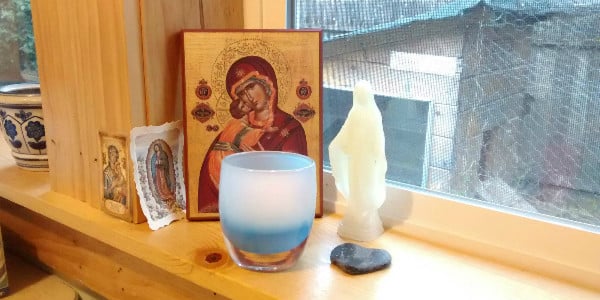
The Kitchen Shrine
Spiritual: “relating to a person’s spirit or religious beliefs”
That is such a vague definition as to be completely unhelpful. Which is why I find the common self-definition of “spiritual but not religious” to be completely unhelpful as well! I get what they mean, by feel and experience, but the words themselves mean nothing.
I believe that people, places, non-humans, and even a fair amount of inanimate objects have spirit. What do I mean by that? I mean an indwelling spark of divinity, something that transcends, but is not completely separate from, material form. I’m a panentheist (that the material world is both filled with divinity, but that divinity also is separate from and can transcend material form) in that regard. Do you believe in souls, or spirits, either embodied or disembodied? If so, in my most basic definition you are spiritual!
In my experience spiritual as a personal definition implies less definition, fewer rules, less structure, and almost no theology. I’m not very spiritual in this regard.
Magic: “the use of means (as charms or spells) believed to have supernatural power over natural forces; an extraordinary power or influence seemingly from a supernatural source ”
I sometimes think that “supernatural” forces are basically forces we just don’t yet understand. A thousand years ago talking about germs and the act of washing hands to prevent illness would have been considered quackery. I also think that things like wi-fi are magic. You can explain to me all day long about waves and technology and physics and I’m still going to say that there is something magical about the fact that I press a button and words and sounds and images instantaneously fly from my screen to yours. Also: airplanes are huge metal tubes that hurtle through the skies at breathtaking speeds. And also: eyeballs. I’m sure I’m muddying the waters by conflating science I don’t understand (or do and still feel profound awe about) with magic. (I’ve written about this before.)
There are many kinds of magic. Some use high magic: formal rituals, formal spells, more complex acts involving many things. This type of magic developed from ceremonial magic, out of grimoires, and are historically associated with highly educated men of privilege. I do very little of this type of magic. Sorcerers are usually associated with this type.

Witch bottle
Some use low magic: spells and workings that developed out of folk traditions, often using common and everyday items. It can blend in easily with most forms of housekeeping, gardening, and folk arts and crafts. I would consider prayer a form of low magic. Almost the entirety of my workings fall into this category. Witches are usually associated with this form.
Note the overuse of “usually” and “often” in the above definitions! I know plenty of magicians and witches that use a combination of styles, forms, and kinds of magic. One kind is not “better” than the other. Both kinds are tools and styles. High magic in the hands of a beginner may be significantly less effective than low magic used by a skilled worker, and vice versa. It’s about what works.
Some like to distinguish between black and white magic. Black magic being workings for malicious purposes and white magic being otherwise “good.” I make no such distinctions. One of my favorite quotes of Victor Anderson is “White magic is poetry; black magic is anything that works.” Amen.
Next up we’ll look at words like devotion, spiritual growth, self-work, and spirit-work.
*All definitions gleaned from Merriam-Webster online dictionary.
Previous Post

April 20, 2015
Expanding My Horizons
Next Post
April 27, 2015 Procession of the Species
Browse Our Archives
Select a Category Alaska altar altars Ana Ancestors Anderson witchcraft Arddu Bhairava Biography bodies books Christianity Christmas community current events death Delphic Maxims Dhumavati dual observance Durga Faery family life feminism Feri Feri tradition Feri witchcraft food ganesha gratitude Guest Post guru health Hinduism holidays Jesus Kali Lakshmi land links magic Many Gods West movie review movies music my heart mystery myth Navratri Orthodoxy pagan pagan culture paganism pantheacon parenting Place politics polytheism practice pratice prayer Red Goddess review ritual sacred arts Samhain Saraswati Shinto Shiva singing Star Goddess Tantra tarot the Gods theory Uncategorized values virgin mary wales washington winter witchcraft year in review yoga
Select a Month September 2015 August 2015 July 2015 June 2015 May 2015 April 2015 March 2015 February 2015 January 2015 December 2014 November 2014 October 2014 September 2014 August 2014 July 2014 June 2014 May 2014 April 2014 March 2014 February 2014 January 2014 December 2013 November 2013 October 2013 September 2013 August 2013 July 2013 June 2013 May 2013 April 2013 March 2013 February 2013 January 2013 December 2012 November 2012 October 2012 September 2012 August 2012 July 2012 June 2012 May 2012 April 2012 March 2012 February 2012 January 2012 December 2011 November 2011 October 2011 September 2011 August 2011 July 2011 June 2011
Follow Us!
TAKE THE
Religious Wisdom Quiz
What did Jesus use to heal a blind man in John 9?
Select your answer to see how you score.
Olive oil His robe Mud and saliva A fig leaf
Related posts from A Witch's Ashram

So Long, and Thanks for All the Clicks

Polytheism, Politics, Discomfort, and Growth

TRENDING AT PATHEOS Pagan

I was recently chatting with someone on Instagram. She asked me what...

While there are many people who share their results, the end of...

On July 23, I saw Christopher Nolan's The Odyssey which is Homer’s...

As I write this two big events have just finished up. One...

Restoring the Watershed of Divine Love
Perhaps cooperation is not something we manufacture through legislation, ideology, or moral...

Many UUs don’t pray because of bad experiences in a previous religion,...
view all Pagan blogs
Ad-Free & Subscriber Log-In Subscription Support
- About Us
- 2026 Calendar
- Videos
- Podcasts
- Library of World Religions
- Faith In Media Tracker
- Advertise With Us
- Write for Us
- Privacy Policy
- Terms of Service
- Do Not Sell My Data
- Contact Us
- Radiant Digital
- Manage Newsletter Subscriptions
- Unsubscribe From Notifications
- Sitemap
Copyright 2008-2026, Patheos. All rights reserved.
Subscription Support Ad-Free & Subscriber Log-In
Follow Patheos