
BuddhistCatholicContemplativeEvangelicalGeneral ChristianHinduJewishLatter-day SaintMuslimNew VisionsProgressive Christian
Beliefs
- Buddhist
- Catholic
- Contemplative
- Evangelical
- General Christian
- Hindu
- Jewish
- Latter-day Saint
- More Voices
- Muslim
- New Visions
- Pagan
- Progressive Christian
Topics
- Religion News
- Food and Religion
- Sports and Religion
- Religious Art
- Religious Music and Entertainment
- Religious Events
- History and Religion
- Style and Religion
- Politics and Religion
- Women in Religion
- Recreation Outdoors and Religion
- Business Finance and Religion
- Careers Workplace and Religion
- Education and Religion
- Family Parenting and Religion
- Health Fitness and Religion
- Home and Religion
- Relationships and Religion
- Technology and Religion
- Travel and Religion
Columnists
- Buddhist Columnists
- Business Finance and Religion Columnists
- Careers Workplace and Religion Columnists
- Catholic Columnists
- Contemplative Columnists
- Education and Religion Columnists
- Evangelists Columnists
- Family Parenting and Religion Columnists
- General Christian Columnists
- Health Fitness and Religion Columnists
- Hindu Columnists
- History and Religion Columnists
- Home and Religion Columnists
- Jewish Columnists
- More Voices Columnists
- Latter Day Columnists
- Muslim Columnists
- New Visions Columnists
- Nonreligious Columnists
- Pagan Columnists
- Politics and Religion Columnists
- Progressive Columnists
- Recreation Outdoors and Religion Columnists
- Relationships and Religion Columnists
- Religion News Columnists
- Religious Art Columnists
- Religious Events Columnists
- Religious Music and Entertainment Columnists
- Sports and Religion Columnists
- Style and Religion Columnists
- Technology and Religion Columnists
- Travel and Religion Columnists
- Women in Religion Columnists
Resource Library
- 2026 Calendar
- Library of World Religions
- The 100 Most Holy Places on Earth
- Patheos Answers
- Podcasts
- Videos
- Faith Leaders Database
- Anglican Episcopalian
- Bahai
- Baptist
- Buddhism
- Christianity
- Confucianism
- Eastern Orthodoxy
- Hinduism
- Holiness and Pentecostal
- ISKCON
- Islam
- Judaism
- Lutheran
- Methodist
- The Church of Jesus Christ of Latter-day Saints
- New Age
- Paganism
- Presbytarian and Reformed
- Protestantism
- Religion Behind the Scenes
- Roman Catholic
- Scientology
- Shia Islam
- Sikhism
- Sufism
- Sunni Islam
- Taoism
- Zen
- See all religions
Research Tools
 Ad-Free & Subscriber Log-In Subscription Support
Ad-Free & Subscriber Log-In Subscription Support
Follow Patheos 

- Trending:
- Forgiveness
- |
- Marriage
- |
- Consciousness
- |
- Death Penalty
- |
- Election
- |
- Halloween
 A Witch's Ashram
- Home
- Pagan
- The Annunciation as Divine Spring
The Annunciation as Divine Spring
Last updated on: March 25, 2015 at 7:00 am by Niki Whiting
The Annunciation as Divine Spring 2015-03-21T13:37:16-08:00 Niki Whiting
Patheos Explore the world's faith through different perspectives on religion and spirituality! Patheos has the views of the prevalent religions and spiritualities of the world.
[This is something I wrote ten years ago, fresh out of graduate school. I still like it, and hope you do too.]
Luke 1:26-38 (NIV)
Today is the Annunciation, the day that the angel Gabriel appeared to Mary and announced that she would be with child, that his name was to be Jesus, and he would be the Son of God. In many ways, this story can be seen as just another hokey tale made up by late-to-the-gospel-game Luke. Perhaps like Dan Brown, Luke was inspired by a previous story and needed to spice up the details so as to avoid possible plagiarism lawsuits.
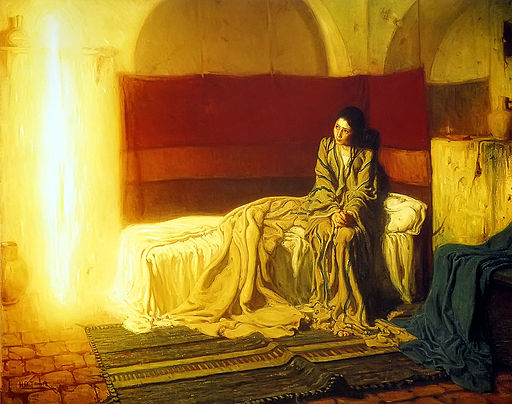
Henry Ossawa Tanner, The Annunciation
This story can also be seen as a patriarchal takeover of a woman’s body. In some feminist circles this is the most obvious way to interpret this story. A male god decides to reproduce, picks a young virgin, and impregnates her without her consent. Divine Rape, one might say. Seen in this light the Annunciation is another example Christianity’s disdain for women. Mary’s unimportance is supported by the lack of any mention of her in the other gospels, with the relatively minor exceptions of her presence at the wedding at Cana and at the crucifixion proving the point.
I have come to see this story differently. I think this is one story in which early Christianity’s positive views on women remain in the Christian heritage. Christianity is not known for its feminist agenda, and while many great spiritual men have exhorted Christians to peace or reminded us of God’s preferential option for the poor, in its early days Christianity had a revolutionary new way of treating women. Women were to be treated with all respect and not as property, which was the common practice of the day (and not much has changed, I hate to say). They were given religious freedoms unheard of in the pagan or Jewish traditions of the time. Much of this power was left out or deliberately stripped away as Christianity became codified in the early centuries. But there is no denying that hints remain in the New Testament; women are seen sharing in ministry: as deaconesses, as prophets, as apostles.
The story of the Annunciation is one of these passages that hint to us of early Christianity’s respect for women; it gives us a glimpse of how God interacts in the world, and it provides us with another lens with which to interpret Lent and our lead in to Easter.
While Luke never mentions her age, Mary would have been anywhere from 12 to 15 years of age. She was a virgin, betrothed to Joseph. In some unexpected moment she was found alone – not accompanied by a gaggle of girls or chaperoned by a male family member. In this moment God spoke to Mary through the angel. Like all smart women, she was suspicious of this unfamiliar character.
28The angel went to her and said, “Greetings, you who are highly favored! The Lord is with you.” 29Mary was greatly troubled at his words and wondered what kind of greeting this might be. 30But the angel said to her, “Do not be afraid, Mary, you have found favor with God. 31You will be with child and give birth to a son, and you are to give him the name Jesus. 32He will be great and will be called the Son of the Most High. The Lord God will give him the throne of his father David, 33and he will reign over the house of Jacob forever; his kingdom will never end.”
This interaction is interesting for a couple of reasons. First, there is the audacity of God to spring this on such a young woman! “Hey, guess what! You’re pregnant!” Secondly, there is the amazing fact that God did not speak with her father, her brothers, or Joseph – all the men that in this age can lay claim to her. He went directly to Mary. She was an autonomous being; she was approached as a person of worth.
Mary, however, remained skeptical. 34″How will this be,” Mary asked the angel, “since I am a virgin?” Mary questioned God. She didn’t run away frightened, she didn’t instantaneously acquiesce. She questioned, and in return Gabriel answered her; she was not smote for unbelief or heresy.
35The angel answered, “The Holy Spirit will come upon you, and the power of the Most High will overshadow you. So the holy one to be born will be called the Son of God. 36Even Elizabeth your relative is going to have a child in her old age, and she who was said to be barren is in her sixth month. 37For nothing is impossible with God.”
At any point Mary could have run away, or even have said no. God was telling her what was to be, but she could have walked away. Instead, she looked at the mystery of God and accepted: 38″I am the Lord’s servant,” Mary answered. “May it be to me as you have said.”
This to me is an example of faith and strength, though not a flashy faith, nor the kind of strength that leaps tall buildings in a single bound. Rather it is an example of what is required in those quiet moments when we have to look at mystery head on and make a choice. Mary could not have fully understood what the consequences of this acceptance were going to be, but she chose anyway. No one made the choice for her. She didn’t run home to ask her parents’ permission, nor her best friends’ opinions. She made a choice for herself. God spoke, she questioned, she listened, she chose. She could have said no. Maybe God approached one or two other women before Mary and they said no. We have no idea, but we know about Mary because she said yes.
Because of this choosing, new life sprouted where there shouldn’t have been life. A virgin pregnant is rationally absurd. But with God all things are possible! Through Mary’s choosing, in her yes to God, she allowed something new to grow within her. For this reason this story is a perfect holyday to celebrate in the midst of Lent. We are in the full flush of spring. The rains are nourishing the plants; the sun is restoring the earth and all that dwells in it. Celebrating Lent we are making way for the new growth in our lives, symbolized by Easter and the resurrection of Life. In the meantime, we may have to make a choice, or many choices. Do we say yes to this new growth, whatever it may be? Can we question the choices placed before us with the confidence that we are beloved by God and that there is no wrong answer? Mary’s example to us on this day is not one of meek obedience, simply cowed before an authoritarian god. Her example is one of faith and strength, present even in that which is considered weak. We are all called to meet God, to interact with God, and to participate in the life-giving activity of God.
Let us go forward in faith and embrace whatever new life is growing in us this season.
Amen.

Previous Post
March 23, 2015
Leaving Monotheism Behind
Next Post

April 3, 2015 What If We're Just Making It All Up?
Browse Our Archives
Select a Category Alaska altar altars Ana Ancestors Anderson witchcraft Arddu Bhairava Biography bodies books Christianity Christmas community current events death Delphic Maxims Dhumavati dual observance Durga Faery family life feminism Feri Feri tradition Feri witchcraft food ganesha gratitude Guest Post guru health Hinduism holidays Jesus Kali Lakshmi land links magic Many Gods West movie review movies music my heart mystery myth Navratri Orthodoxy pagan pagan culture paganism pantheacon parenting Place politics polytheism practice pratice prayer Red Goddess review ritual sacred arts Samhain Saraswati Shinto Shiva singing Star Goddess Tantra tarot the Gods theory Uncategorized values virgin mary wales washington winter witchcraft year in review yoga
Select a Month September 2015 August 2015 July 2015 June 2015 May 2015 April 2015 March 2015 February 2015 January 2015 December 2014 November 2014 October 2014 September 2014 August 2014 July 2014 June 2014 May 2014 April 2014 March 2014 February 2014 January 2014 December 2013 November 2013 October 2013 September 2013 August 2013 July 2013 June 2013 May 2013 April 2013 March 2013 February 2013 January 2013 December 2012 November 2012 October 2012 September 2012 August 2012 July 2012 June 2012 May 2012 April 2012 March 2012 February 2012 January 2012 December 2011 November 2011 October 2011 September 2011 August 2011 July 2011 June 2011
Follow Us!
TAKE THE
Religious Wisdom Quiz
What does "Maranatha" mean?
Select your answer to see how you score.
Praise Him It is finished Come, Lord Be joyful
Related posts from A Witch's Ashram

Polytheism, Politics, Discomfort, and Growth

TRENDING AT PATHEOS Pagan

I was recently chatting with someone on Instagram. She asked me what...

While there are many people who share their results, the end of...

On July 23, I saw Christopher Nolan's The Odyssey which is Homer’s...

As I write this two big events have just finished up. One...

Restoring the Watershed of Divine Love
Perhaps cooperation is not something we manufacture through legislation, ideology, or moral...

Many UUs don’t pray because of bad experiences in a previous religion,...
view all Pagan blogs
Ad-Free & Subscriber Log-In Subscription Support
- About Us
- 2026 Calendar
- Videos
- Podcasts
- Library of World Religions
- Faith In Media Tracker
- Advertise With Us
- Write for Us
- Privacy Policy
- Terms of Service
- Do Not Sell My Data
- Contact Us
- Radiant Digital
- Manage Newsletter Subscriptions
- Unsubscribe From Notifications
- Sitemap
Copyright 2008-2026, Patheos. All rights reserved.
Subscription Support Ad-Free & Subscriber Log-In
Follow Patheos