
BuddhistCatholicContemplativeEvangelicalGeneral ChristianHinduJewishLatter-day SaintMuslimNew VisionsProgressive Christian
Beliefs
- Buddhist
- Catholic
- Contemplative
- Evangelical
- General Christian
- Hindu
- Jewish
- Latter-day Saint
- More Voices
- Muslim
- New Visions
- Pagan
- Progressive Christian
Topics
- Religion News
- Food and Religion
- Sports and Religion
- Religious Art
- Religious Music and Entertainment
- Religious Events
- History and Religion
- Style and Religion
- Politics and Religion
- Women in Religion
- Recreation Outdoors and Religion
- Business Finance and Religion
- Careers Workplace and Religion
- Education and Religion
- Family Parenting and Religion
- Health Fitness and Religion
- Home and Religion
- Relationships and Religion
- Technology and Religion
- Travel and Religion
Columnists
- Buddhist Columnists
- Business Finance and Religion Columnists
- Careers Workplace and Religion Columnists
- Catholic Columnists
- Contemplative Columnists
- Education and Religion Columnists
- Evangelists Columnists
- Family Parenting and Religion Columnists
- General Christian Columnists
- Health Fitness and Religion Columnists
- Hindu Columnists
- History and Religion Columnists
- Home and Religion Columnists
- Jewish Columnists
- More Voices Columnists
- Latter Day Columnists
- Muslim Columnists
- New Visions Columnists
- Nonreligious Columnists
- Pagan Columnists
- Politics and Religion Columnists
- Progressive Columnists
- Recreation Outdoors and Religion Columnists
- Relationships and Religion Columnists
- Religion News Columnists
- Religious Art Columnists
- Religious Events Columnists
- Religious Music and Entertainment Columnists
- Sports and Religion Columnists
- Style and Religion Columnists
- Technology and Religion Columnists
- Travel and Religion Columnists
- Women in Religion Columnists
Resource Library
- 2026 Calendar
- Library of World Religions
- The 100 Most Holy Places on Earth
- Patheos Answers
- Podcasts
- Videos
- Faith Leaders Database
- Anglican Episcopalian
- Bahai
- Baptist
- Buddhism
- Christianity
- Confucianism
- Eastern Orthodoxy
- Hinduism
- Holiness and Pentecostal
- ISKCON
- Islam
- Judaism
- Lutheran
- Methodist
- The Church of Jesus Christ of Latter-day Saints
- New Age
- Paganism
- Presbytarian and Reformed
- Protestantism
- Religion Behind the Scenes
- Roman Catholic
- Scientology
- Shia Islam
- Sikhism
- Sufism
- Sunni Islam
- Taoism
- Zen
- See all religions
Research Tools
 Ad-Free & Subscriber Log-In Subscription Support
Ad-Free & Subscriber Log-In Subscription Support
Follow Patheos 

- Trending:
- Forgiveness
- |
- Marriage
- |
- Consciousness
- |
- Death Penalty
- |
- Election
- |
- Halloween
 A Witch's Ashram
- Home
- Pagan
- Why Polytheist Spaces Are Important
Why Polytheist Spaces Are Important
Last updated on: February 23, 2015 at 12:07 pm by Niki Whiting
Why Polytheist Spaces Are Important 2015-02-23T12:07:16-08:00 Niki Whiting
Patheos Explore the world's faith through different perspectives on religion and spirituality! Patheos has the views of the prevalent religions and spiritualities of the world.
I love the religions of the world. If you read this blog, you know that I write a lot about Christianity. I’ve got a big ol’ soft spot in my heart for wisdom where ever I find it. The optimist in me wants a world where our differences give us accent, but don’t overwhelm us to the point where we can’t talk together. I like the Big Umbrella aspect of Pantheacon, where various Pagan communities come together and mingle, work, explore, and share.
But spaces for each type of group are equally important. Attending Pantheacon this year made that clear to me. At a private gathering late on Saturday night an academic friend of mine was trying to talk about polytheism to myself and a certain Druid punk anarchist poet. I know the academic personally and knew what she was trying to work out. Her words weren’t graceful and the Druid got angry. What had she said, my friend asked. Well, you invalidated the entirety of his experience, with one sentence.
The scholar and the Druid managed to work out their misunderstandings. Oh, what listening and speaking calmly can do! But I was reminded that this is exactly why people need spaces where we don’t have to parse definitions, where we don’t have to explain or defend our experiences. It’s important to be able to talk about polytheisms with out the language of they/them, but rather as we/us.
Polytheism may be a Western monotheist construct, but for those of us in the West it’s a generally useful terminology. What I hope for us is that polytheists can remember that many people, particularly cultures and traditions outside the white Western world, might fit the Western definition of polytheist but might not view themselves as such. We need to let others define themselves as they will, but for those that want to talk about gods plural and gods as real, polytheism -broadly defined- creates that space.

The Welsh land near Skanda Vale, a Hindu mandir.
I know the vocal polytheisms visible online can appear alienating to some. Some of the voices are strident. This is why I wish River Devora and Anomalous Thracian’s discussion on polytheism at last weekend’s Pantheacon hadn’t been held in the last possible slot on Monday afternoon. Their many points and tone highlighted the best of the Polytheist movement. Below are the points I took away from their discussion.
Gods and people exist in a context of time, place, people groups, and relationships. Polytheisms are living traditions. Where are we as individuals situated in our traditions? What are our connections to our traditions and lineages? To the lands we live on? To the larger context of our historical time and place?
The core of polytheism – of all religious and spiritual practices – is relationship. Gods have relationships, with people as individuals, with people groups, with land, AND ALSO with each other. And all of these things are in relationship with each other as well! We exist in interconnected webs of relationships that move “horizontally” and “vertically,” as well as temporally. Because we as humans and peoples are not static and our lands are not static, these are relationships that change. The gods too are not static and exist in relationship with one another and the embodied world. The whole conversation smacks of Process theology!
Because we are in relationship we can learn from others, in this time and in other times. We can pool our resources and our voices to press the gods for change. We can learn from one another. What do other devotees experience? How do others relate to these gods and spirits? These questions are particularly important if we do not live in the lands that are originally connected with our gods or among their peoples.
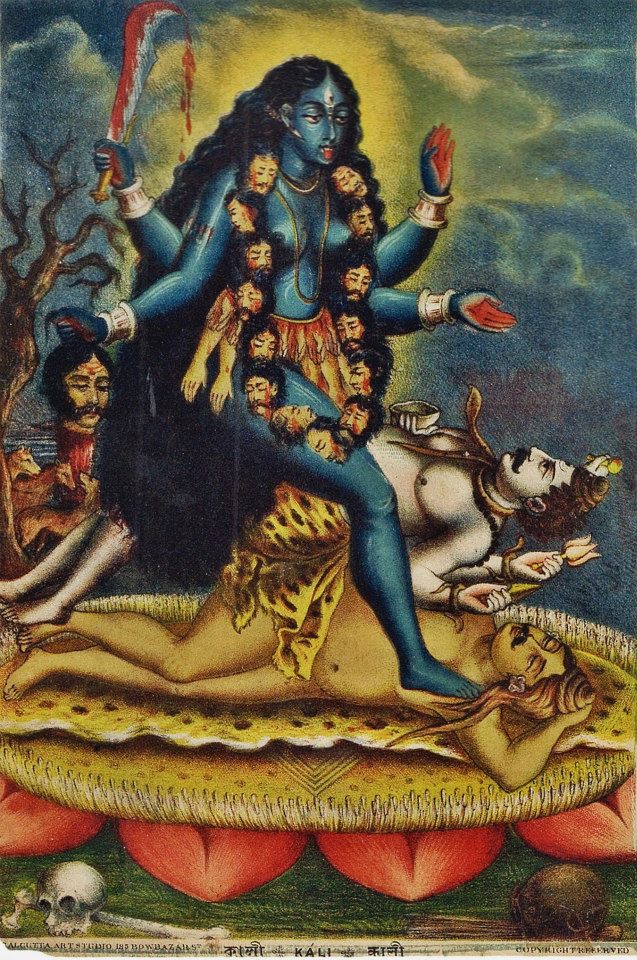 Taking my own practice as an example, as a white Westerner with a Hindu practice I need to ask myself: How does Kali relate to her temples, priests, devotees, and the lands in India? How were those people before me in in time in relationship with Kali and how are people now in relationship with her? How are people here in the US in relationship with her? While I may have a personal practice and be a lone devotee in my town, I am not outside of the webs of relationship that Kali creates and in which she exists. I am one of millions who are in relationship with her RIGHT NOW; my voice is one of many. Just because my voice is the only one I hear in my ears does not mean it is the loudest, most correct or authentic, or most special.
Everything comes back to relationship.
Ideally our various communities in the wider Pagan umbrella can create webs of relationship too, webs that strengthen our practices, care for one another, teach and support in various ways. But sometimes its nice to be among people that share similar definitions, certain aspects of practice, and won’t call you crazy when you say that the gods are speaking.
This is why I am proud to be co-chairing Many Gods West this summer. Come and join us in rituals, dialog and discussions, relationship and community building.
Previous Post

February 17, 2015
Pilgrimage to Pantheacon 2015
Next Post
March 3, 2015 Pantheacon Rituals are a Blessing
Browse Our Archives
Select a Category Alaska altar altars Ana Ancestors Anderson witchcraft Arddu Bhairava Biography bodies books Christianity Christmas community current events death Delphic Maxims Dhumavati dual observance Durga Faery family life feminism Feri Feri tradition Feri witchcraft food ganesha gratitude Guest Post guru health Hinduism holidays Jesus Kali Lakshmi land links magic Many Gods West movie review movies music my heart mystery myth Navratri Orthodoxy pagan pagan culture paganism pantheacon parenting Place politics polytheism practice pratice prayer Red Goddess review ritual sacred arts Samhain Saraswati Shinto Shiva singing Star Goddess Tantra tarot the Gods theory Uncategorized values virgin mary wales washington winter witchcraft year in review yoga
Select a Month September 2015 August 2015 July 2015 June 2015 May 2015 April 2015 March 2015 February 2015 January 2015 December 2014 November 2014 October 2014 September 2014 August 2014 July 2014 June 2014 May 2014 April 2014 March 2014 February 2014 January 2014 December 2013 November 2013 October 2013 September 2013 August 2013 July 2013 June 2013 May 2013 April 2013 March 2013 February 2013 January 2013 December 2012 November 2012 October 2012 September 2012 August 2012 July 2012 June 2012 May 2012 April 2012 March 2012 February 2012 January 2012 December 2011 November 2011 October 2011 September 2011 August 2011 July 2011 June 2011
Follow Us!
TAKE THE
Religious Wisdom Quiz
Which prophet was a shepherd and a sycamore-fig farmer?
Select your answer to see how you score.
Joel Micah Amos Daniel
Related posts from A Witch's Ashram

So Long, and Thanks for All the Clicks


Polytheism, Politics, Discomfort, and Growth
TRENDING AT PATHEOS Pagan

I was recently chatting with someone on Instagram. She asked me what...

While there are many people who share their results, the end of...

On July 23, I saw Christopher Nolan's The Odyssey which is Homer’s...

As I write this two big events have just finished up. One...

Restoring the Watershed of Divine Love
Perhaps cooperation is not something we manufacture through legislation, ideology, or moral...

Many UUs don’t pray because of bad experiences in a previous religion,...
view all Pagan blogs
Ad-Free & Subscriber Log-In Subscription Support
- About Us
- 2026 Calendar
- Videos
- Podcasts
- Library of World Religions
- Faith In Media Tracker
- Advertise With Us
- Write for Us
- Privacy Policy
- Terms of Service
- Do Not Sell My Data
- Contact Us
- Radiant Digital
- Manage Newsletter Subscriptions
- Unsubscribe From Notifications
- Sitemap
Copyright 2008-2026, Patheos. All rights reserved.
Subscription Support Ad-Free & Subscriber Log-In
Follow Patheos