
BuddhistCatholicContemplativeEvangelicalGeneral ChristianHinduJewishLatter-day SaintMuslimNew VisionsProgressive Christian
Beliefs
- Buddhist
- Catholic
- Contemplative
- Evangelical
- General Christian
- Hindu
- Jewish
- Latter-day Saint
- More Voices
- Muslim
- New Visions
- Pagan
- Progressive Christian
Topics
- Religion News
- Food and Religion
- Sports and Religion
- Religious Art
- Religious Music and Entertainment
- Religious Events
- History and Religion
- Style and Religion
- Politics and Religion
- Women in Religion
- Recreation Outdoors and Religion
- Business Finance and Religion
- Careers Workplace and Religion
- Education and Religion
- Family Parenting and Religion
- Health Fitness and Religion
- Home and Religion
- Relationships and Religion
- Technology and Religion
- Travel and Religion
Columnists
- Buddhist Columnists
- Business Finance and Religion Columnists
- Careers Workplace and Religion Columnists
- Catholic Columnists
- Contemplative Columnists
- Education and Religion Columnists
- Evangelists Columnists
- Family Parenting and Religion Columnists
- General Christian Columnists
- Health Fitness and Religion Columnists
- Hindu Columnists
- History and Religion Columnists
- Home and Religion Columnists
- Jewish Columnists
- More Voices Columnists
- Latter Day Columnists
- Muslim Columnists
- New Visions Columnists
- Nonreligious Columnists
- Pagan Columnists
- Politics and Religion Columnists
- Progressive Columnists
- Recreation Outdoors and Religion Columnists
- Relationships and Religion Columnists
- Religion News Columnists
- Religious Art Columnists
- Religious Events Columnists
- Religious Music and Entertainment Columnists
- Sports and Religion Columnists
- Style and Religion Columnists
- Technology and Religion Columnists
- Travel and Religion Columnists
- Women in Religion Columnists
Resource Library
- 2026 Calendar
- Library of World Religions
- The 100 Most Holy Places on Earth
- Patheos Answers
- Podcasts
- Videos
- Faith Leaders Database
- Anglican Episcopalian
- Bahai
- Baptist
- Buddhism
- Christianity
- Confucianism
- Eastern Orthodoxy
- Hinduism
- Holiness and Pentecostal
- ISKCON
- Islam
- Judaism
- Lutheran
- Methodist
- The Church of Jesus Christ of Latter-day Saints
- New Age
- Paganism
- Presbytarian and Reformed
- Protestantism
- Religion Behind the Scenes
- Roman Catholic
- Scientology
- Shia Islam
- Sikhism
- Sufism
- Sunni Islam
- Taoism
- Zen
- See all religions
Research Tools
 Ad-Free & Subscriber Log-In Subscription Support
Ad-Free & Subscriber Log-In Subscription Support
Follow Patheos 

- Trending:
- Forgiveness
- |
- Marriage
- |
- Consciousness
- |
- Death Penalty
- |
- Election
- |
- Halloween
 A Witch's Ashram
- Home
- Pagan
- Devotional Polytheism
Devotional Polytheism
Last updated on: October 28, 2014 at 1:37 pm by Niki Whiting
Devotional Polytheism 2014-10-28T13:37:38-08:00 Niki Whiting
Patheos Explore the world's faith through different perspectives on religion and spirituality! Patheos has the views of the prevalent religions and spiritualities of the world.
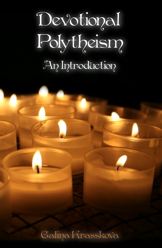 Devotional polytheism is what I “do.” Most Pagans, witches and/or occultists I know are involved to some degree in this practice, even if most people don’t use the term as a label or description. I like it as a descriptor, as it cleanly explains what the bulk of my practice is about. When I saw that Galina Krasskova had written a book on the subject I was immediately interested.
Galina Krasskova is an interesting internet personality. People seem to love her or hate her; few, other than myself, have ambivalent feelings toward her. Krasskova is a polytheist blogger, one that I don’t follow, though after reading her book that might change. I may have had an unfortunate introduction to her writing: she has said some down right mean and bitter things in the past, and that tone put me off. I am pleased to say that her tone overall in Devotional Polytheism is pleasant and encouraging.
The book is in two parts. Part one has chapters on subjects such as basic exercises, altars, ritual, and so on. The second section is basic outlines of how a weekly and yearly practice could look. Krasskova uses her Norse tradition, which doesn’t have much meaning for me, although the point is the structure, and I realize that much of my structure looks similar to hers.
Krasskova begins her book stating – and she reminds us of this throughout – that we get to decide for ourselves what our devotion looks like; the two most important things to remember are respect and consistency. Given that polytheist practices can vary wildly, I thought Krasskova’s basics were a nuanced way of embracing this reality. More importantly I really appreciated her repeated reminders to “start where you start.” Pick a practice and just begin. When it comes to personal devotion, I think just beginning is more important than doing it Right or Formally. Those things might be important later, but starting is the key.
Krasskova and I have many more areas of agreement. She emphasizes personal and spiritual boundaries (super important to me) and she spends time talking about breath work in the forms of grounding and meditation (both forms are also large parts of my practice). Gratitude is central to relationships with her gods, her communities, and her practices; it also important to me in those contexts.
In several places Krasskova bemoans the “potluck and party” attitude most Heathens have in their approach to ritual. I cannot speak to the Heathen community at all, but some of her descriptions of that attitude sound familiar to me. In Feri circles, though, I sometimes find the opposite to be the case: everyone is trying to “out trance” the others! Ritual and community can tricky, no matter the tradition.
My major disagreements with Krasskova are with two sentiments she repeatedly expresses in her book. The first is that devotional work is hard. I really don’t agree. Personally, I find my devotional practices to be a joy. It’s hard only in the sense that doing anything as a grown up is hard: each of us has only so many hours in a day; finding time for all the things we need to do (paid work, cleaning, eating, exercising, and so on) can be daunting. But if it’s important to us, we’ll find a way.
The second area of disagreement is Krasskova’s insistence that “in the face of the Gods, all else should be inconsequential.” Repeatedly, she reminds us that nothing is more important than the Gods. Here we significantly part ways. I disagree. Once upon a time I might have thought this, but now I cannot agree. Part of my divergence here is based on my own theological understanding of the gods and part of it is based on being a parent. While I am of use to my gods and perhaps as beloved by them as they are to me, I am not so important that my devotion and skills are of the utmost importance, nor do I give my life force over to anyone or anything. I might share that life force, I might even submit from instance to instance (gestating and birthing is submission), but never do I subsume my Self. And as a parent, I could not in good in conscience put the gods before my children. At this point they are too young to fare for themselves. It is my duty, my privilege, my honor to put them first. There are times they may not interrupt, but never do the gods “come first.” I have had a god politely let me know that we can work together later, when the kids don’t need me so much. I don’t think that Krasskova has children or dependents. In that case, putting the gods first and foremost is much more possible, if that is her choice and priority. We part ways on that point.
Those two differences aside, I enthusiastically recommend this book. I wish I had had this book several years ago when I began to take my own devotions more seriously. I think I even could have gained much from this book when I was a practicing Christian. The book is encouraging, helpful, and well-written.
One delightful surprise is found at the end of the book. Krasskova includes an appendix, which is basically a series of discussion questions for a novel she loves and has used with her own students. Seeing this appendix made my heart leap! It is CS Lewis’ Til We Have Faces, one of my favorite books of all time. I most certainly think Krasskova and I have more in common than we don’t! Reputation be damned. While I am still making my way through another heavy book for review, I have decided that I am going to re-read Til We Have Faces. It’s been over a decade since I’ve read it. What shall I see in the story now?
Since this is a self-published book through her publishing house and printed on demand I’ll admit that I expected the quality to be weak, but that was not the case. There are a few typos, but nothing out of the ordinary. The cover design is pleasing and the formatting clear and nicely done. While you can get a copy at Amazon for $1.80 less than at Createspace, I recommend purchasing your copy from the latter source, because I think Krasskova gets more of the profit. Enjoy!
Previous Post

October 27, 2014
Hello Again!
Next Post
November 1, 2014 Home Ownership and Death
Browse Our Archives
Select a Category Alaska altar altars Ana Ancestors Anderson witchcraft Arddu Bhairava Biography bodies books Christianity Christmas community current events death Delphic Maxims Dhumavati dual observance Durga Faery family life feminism Feri Feri tradition Feri witchcraft food ganesha gratitude Guest Post guru health Hinduism holidays Jesus Kali Lakshmi land links magic Many Gods West movie review movies music my heart mystery myth Navratri Orthodoxy pagan pagan culture paganism pantheacon parenting Place politics polytheism practice pratice prayer Red Goddess review ritual sacred arts Samhain Saraswati Shinto Shiva singing Star Goddess Tantra tarot the Gods theory Uncategorized values virgin mary wales washington winter witchcraft year in review yoga
Select a Month September 2015 August 2015 July 2015 June 2015 May 2015 April 2015 March 2015 February 2015 January 2015 December 2014 November 2014 October 2014 September 2014 August 2014 July 2014 June 2014 May 2014 April 2014 March 2014 February 2014 January 2014 December 2013 November 2013 October 2013 September 2013 August 2013 July 2013 June 2013 May 2013 April 2013 March 2013 February 2013 January 2013 December 2012 November 2012 October 2012 September 2012 August 2012 July 2012 June 2012 May 2012 April 2012 March 2012 February 2012 January 2012 December 2011 November 2011 October 2011 September 2011 August 2011 July 2011 June 2011
Follow Us!
TAKE THE
Religious Wisdom Quiz
Which mountain did this Abraham's near-sacrifice event occur on?
Select your answer to see how you score.
Mount Moriah Mount Sinai Mount Ararat Mount Carmel
Related posts from A Witch's Ashram

So Long, and Thanks for All the Clicks


Polytheism, Politics, Discomfort, and Growth
TRENDING AT PATHEOS Pagan

I was recently chatting with someone on Instagram. She asked me what...

While there are many people who share their results, the end of...

On July 23, I saw Christopher Nolan's The Odyssey which is Homer’s...

As I write this two big events have just finished up. One...

Restoring the Watershed of Divine Love
Perhaps cooperation is not something we manufacture through legislation, ideology, or moral...

Many UUs don’t pray because of bad experiences in a previous religion,...
view all Pagan blogs
Ad-Free & Subscriber Log-In Subscription Support
- About Us
- 2026 Calendar
- Videos
- Podcasts
- Library of World Religions
- Faith In Media Tracker
- Advertise With Us
- Write for Us
- Privacy Policy
- Terms of Service
- Do Not Sell My Data
- Contact Us
- Radiant Digital
- Manage Newsletter Subscriptions
- Unsubscribe From Notifications
- Sitemap
Copyright 2008-2026, Patheos. All rights reserved.
Subscription Support Ad-Free & Subscriber Log-In
Follow Patheos