
BuddhistCatholicContemplativeEvangelicalGeneral ChristianHinduJewishLatter-day SaintMuslimNew VisionsProgressive Christian
Beliefs
- Buddhist
- Catholic
- Contemplative
- Evangelical
- General Christian
- Hindu
- Jewish
- Latter-day Saint
- More Voices
- Muslim
- New Visions
- Pagan
- Progressive Christian
Topics
- Religion News
- Food and Religion
- Sports and Religion
- Religious Art
- Religious Music and Entertainment
- Religious Events
- History and Religion
- Style and Religion
- Politics and Religion
- Women in Religion
- Recreation Outdoors and Religion
- Business Finance and Religion
- Careers Workplace and Religion
- Education and Religion
- Family Parenting and Religion
- Health Fitness and Religion
- Home and Religion
- Relationships and Religion
- Technology and Religion
- Travel and Religion
Columnists
- Buddhist Columnists
- Business Finance and Religion Columnists
- Careers Workplace and Religion Columnists
- Catholic Columnists
- Contemplative Columnists
- Education and Religion Columnists
- Evangelists Columnists
- Family Parenting and Religion Columnists
- General Christian Columnists
- Health Fitness and Religion Columnists
- Hindu Columnists
- History and Religion Columnists
- Home and Religion Columnists
- Jewish Columnists
- More Voices Columnists
- Latter Day Columnists
- Muslim Columnists
- New Visions Columnists
- Nonreligious Columnists
- Pagan Columnists
- Politics and Religion Columnists
- Progressive Columnists
- Recreation Outdoors and Religion Columnists
- Relationships and Religion Columnists
- Religion News Columnists
- Religious Art Columnists
- Religious Events Columnists
- Religious Music and Entertainment Columnists
- Sports and Religion Columnists
- Style and Religion Columnists
- Technology and Religion Columnists
- Travel and Religion Columnists
- Women in Religion Columnists
Resource Library
- 2026 Calendar
- Library of World Religions
- The 100 Most Holy Places on Earth
- Patheos Answers
- Podcasts
- Videos
- Faith Leaders Database
- Anglican Episcopalian
- Bahai
- Baptist
- Buddhism
- Christianity
- Confucianism
- Eastern Orthodoxy
- Hinduism
- Holiness and Pentecostal
- ISKCON
- Islam
- Judaism
- Lutheran
- Methodist
- The Church of Jesus Christ of Latter-day Saints
- New Age
- Paganism
- Presbytarian and Reformed
- Protestantism
- Religion Behind the Scenes
- Roman Catholic
- Scientology
- Shia Islam
- Sikhism
- Sufism
- Sunni Islam
- Taoism
- Zen
- See all religions
Research Tools
 Ad-Free & Subscriber Log-In Subscription Support
Ad-Free & Subscriber Log-In Subscription Support
Follow Patheos 

- Trending:
- Forgiveness
- |
- Marriage
- |
- Consciousness
- |
- Death Penalty
- |
- Election
- |
- Halloween
 A Witch's Ashram
- Home
- Pagan
- Encyclopedia of Goddesses & Heroines (Book Review)
Encyclopedia of Goddesses & Heroines (Book Review)
Last updated on: September 10, 2014 at 7:02 am by Niki Whiting
Encyclopedia of Goddesses & Heroines (Book Review) 2014-09-10T07:02:39-08:00 Niki Whiting
Patheos Explore the world's faith through different perspectives on religion and spirituality! Patheos has the views of the prevalent religions and spiritualities of the world.
When The Red-Haired Girl from the Bog by Patricia Monaghan was published (February 2003) I was working at a bookstore in Seattle, preparing myself for graduate school that fall at Berkeley’s Graduate Theological Union, where I would study feminist and systematic theology. I saw Monaghan’s book at the store and, remembering fondly my own time in Ireland (1996-97), and seeing that she and I had both spent our youth in Alaska, I picked it up. It was a fantastic book, weaving personal narrative, travelogue, and history and mythology of Ireland as seen through feminist and goddess-centered lenses. I loved it. I still have the hard cover edition on my shelf.
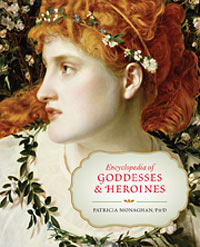 Until her passing in 2012, I had been unaware of Monaghan’s influence in feminist spiritualities or the wealth of works she’d published. It has been a pleasure getting to know about her and her works as I read through her most recent book, which was being prepared for publication during her passing. Monaghan’s Encyclopedia of Goddess & Heroines is a revised and expanded edition of this work. I was not familiar with it before receiving this copy for review.
I am unreservedly enthusiastic about this book. It’s not one that I can read cover-to-cover like other books. I have read the introduction, several section introductions, and a smattering of entries, some for goddesses I don’t know at all and some for goddesses that I know much better. I was impressed with her discussion of her choice of sources (only hard copy items, nothing digital as access can be unreliable) and her note on spelling. It is no surprise that a scholar and life-long devotee of the divine feminine also has a brilliant paragraph on the word “goddess” as it applies to this book. She talks about the differentiation between goddesses, heroines, semi-divine women, and women who occupy spaces that might be considered divine or magical within monotheism.
Once I’d read the various introductions I looked to her entry on Mary, the Mother of Jesus, to get a sense of her accuracy. I may not be able to gauge how accurate her entries on African deities are, but Mary is my specialty. In approximately 400 words Monaghan succinctly walks the reader through all the high points of Mary’s life, raises some of the issues surrounding her sources, talks about how she is considered in the Islamic tradition, and mentions her feast days. There was not a single sentence I could quibble with. The next entry is on Mary Magdalen, another Mary I know quite a bit about, and here I even learned something new. If this is indicative of the quality of entries in other areas, then I can trust that they are solid introductions to each figure.
While each entry is significantly shorter than a wikipedia entry, each one has a list of sources where you might go to learn more. Sure, I can look up all of these figures online, but for a quick, thoughtful paragraph (or more) to give me an idea of what each Lady is about this is a single handy reference. Myself at 11 would have surely sat and read this entire book and I look forward to using this as a reference for my family. In fact, I wish Monaghan had written something like this for male gods and heroes!
If I had to find something to complain about, it might be the choice of the word “pantheon” for each geographical section. I see what she is doing and it keeps the book consistent, but it doesn’t work very well for areas such as North America, as there weren’t pantheons in quite the same way as we might say there are for the Greeks. Because of the necessary limitations of this project, many regional divine forces were rleft out, entities that might be more related to land and place. I was also surprised by Santisima Muerte’s absence. Perhaps Monaghan viewed her as more of an aberation of Roman Catholic saints, but I believe she is a divine figure in her own right.
Overall this is a fantastic reference book that is worth the cover price ($29.95). I am pleased to have this on my shelf. I know I will use it often, and when I do I will think fondly of Monaghan’s work. This edition is truly the work of a lifetime.
Previous Post

September 3, 2014
Autumnal Updates
Next Post
September 10, 2014 Announcing Polytheist.com!
Browse Our Archives
Select a Category Alaska altar altars Ana Ancestors Anderson witchcraft Arddu Bhairava Biography bodies books Christianity Christmas community current events death Delphic Maxims Dhumavati dual observance Durga Faery family life feminism Feri Feri tradition Feri witchcraft food ganesha gratitude Guest Post guru health Hinduism holidays Jesus Kali Lakshmi land links magic Many Gods West movie review movies music my heart mystery myth Navratri Orthodoxy pagan pagan culture paganism pantheacon parenting Place politics polytheism practice pratice prayer Red Goddess review ritual sacred arts Samhain Saraswati Shinto Shiva singing Star Goddess Tantra tarot the Gods theory Uncategorized values virgin mary wales washington winter witchcraft year in review yoga
Select a Month September 2015 August 2015 July 2015 June 2015 May 2015 April 2015 March 2015 February 2015 January 2015 December 2014 November 2014 October 2014 September 2014 August 2014 July 2014 June 2014 May 2014 April 2014 March 2014 February 2014 January 2014 December 2013 November 2013 October 2013 September 2013 August 2013 July 2013 June 2013 May 2013 April 2013 March 2013 February 2013 January 2013 December 2012 November 2012 October 2012 September 2012 August 2012 July 2012 June 2012 May 2012 April 2012 March 2012 February 2012 January 2012 December 2011 November 2011 October 2011 September 2011 August 2011 July 2011 June 2011
Follow Us!
TAKE THE
Religious Wisdom Quiz
Which Christian denomination is known for wearing plain clothing and avoiding modern technology?
Select your answer to see how you score.
Amish Presbyterians Lutherans Baptists
Related posts from A Witch's Ashram

So Long, and Thanks for All the Clicks


Polytheism, Politics, Discomfort, and Growth

TRENDING AT PATHEOS Pagan

I was recently chatting with someone on Instagram. She asked me what...

While there are many people who share their results, the end of...

On July 23, I saw Christopher Nolan's The Odyssey which is Homer’s...

As I write this two big events have just finished up. One...

Restoring the Watershed of Divine Love
Perhaps cooperation is not something we manufacture through legislation, ideology, or moral...

Many UUs don’t pray because of bad experiences in a previous religion,...
view all Pagan blogs
Ad-Free & Subscriber Log-In Subscription Support
- About Us
- 2026 Calendar
- Videos
- Podcasts
- Library of World Religions
- Faith In Media Tracker
- Advertise With Us
- Write for Us
- Privacy Policy
- Terms of Service
- Do Not Sell My Data
- Contact Us
- Radiant Digital
- Manage Newsletter Subscriptions
- Unsubscribe From Notifications
- Sitemap
Copyright 2008-2026, Patheos. All rights reserved.
Subscription Support Ad-Free & Subscriber Log-In
Follow Patheos