
BuddhistCatholicContemplativeEvangelicalGeneral ChristianHinduJewishLatter-day SaintMuslimNew VisionsProgressive Christian
Beliefs
- Buddhist
- Catholic
- Contemplative
- Evangelical
- General Christian
- Hindu
- Jewish
- Latter-day Saint
- More Voices
- Muslim
- New Visions
- Pagan
- Progressive Christian
Topics
- Religion News
- Food and Religion
- Sports and Religion
- Religious Art
- Religious Music and Entertainment
- Religious Events
- History and Religion
- Style and Religion
- Politics and Religion
- Women in Religion
- Recreation Outdoors and Religion
- Business Finance and Religion
- Careers Workplace and Religion
- Education and Religion
- Family Parenting and Religion
- Health Fitness and Religion
- Home and Religion
- Relationships and Religion
- Technology and Religion
- Travel and Religion
Columnists
- Buddhist Columnists
- Business Finance and Religion Columnists
- Careers Workplace and Religion Columnists
- Catholic Columnists
- Contemplative Columnists
- Education and Religion Columnists
- Evangelists Columnists
- Family Parenting and Religion Columnists
- General Christian Columnists
- Health Fitness and Religion Columnists
- Hindu Columnists
- History and Religion Columnists
- Home and Religion Columnists
- Jewish Columnists
- More Voices Columnists
- Latter Day Columnists
- Muslim Columnists
- New Visions Columnists
- Nonreligious Columnists
- Pagan Columnists
- Politics and Religion Columnists
- Progressive Columnists
- Recreation Outdoors and Religion Columnists
- Relationships and Religion Columnists
- Religion News Columnists
- Religious Art Columnists
- Religious Events Columnists
- Religious Music and Entertainment Columnists
- Sports and Religion Columnists
- Style and Religion Columnists
- Technology and Religion Columnists
- Travel and Religion Columnists
- Women in Religion Columnists
Resource Library
- 2026 Calendar
- Library of World Religions
- The 100 Most Holy Places on Earth
- Patheos Answers
- Podcasts
- Videos
- Faith Leaders Database
- Anglican Episcopalian
- Bahai
- Baptist
- Buddhism
- Christianity
- Confucianism
- Eastern Orthodoxy
- Hinduism
- Holiness and Pentecostal
- ISKCON
- Islam
- Judaism
- Lutheran
- Methodist
- The Church of Jesus Christ of Latter-day Saints
- New Age
- Paganism
- Presbytarian and Reformed
- Protestantism
- Religion Behind the Scenes
- Roman Catholic
- Scientology
- Shia Islam
- Sikhism
- Sufism
- Sunni Islam
- Taoism
- Zen
- See all religions
Research Tools
 Ad-Free & Subscriber Log-In Subscription Support
Ad-Free & Subscriber Log-In Subscription Support
Follow Patheos 

- Trending:
- Forgiveness
- |
- Marriage
- |
- Consciousness
- |
- Death Penalty
- |
- Election
- |
- Halloween
 A Witch's Ashram
- Home
- Pagan
- On Dietrich Bonhoeffer’s Cost of Discipleship: the Cost of Being a Woman and Other
On Dietrich Bonhoeffer’s Cost of Discipleship: the Cost of Being a Woman and Other
Last updated on: May 16, 2014 at 7:00 am by Niki Whiting
On Dietrich Bonhoeffer’s Cost of Discipleship: the Cost of Being a Woman and Other 2014-05-15T20:41:03-08:00 Niki Whiting
Patheos Explore the world's faith through different perspectives on religion and spirituality! Patheos has the views of the prevalent religions and spiritualities of the world.
[This was written when I was revisiting Christianity at the beginning of 2012. I quite like this piece of writing.]
Revisiting things that once held meaning for me is both tedious and informative. For example, Dietrich Bonhoeffer’s The Cost of Discipleship. I studied Bonhoeffer in college. I wrote my senior history thesis on him. And I barely remember anything about him, other than: influential Lutheran German pastor, who resisted the Nazi co-option of the German church and joined the resistance movement, eventually being sent to concentration camps, where he was killed just days before the liberation. I believe I wrote about how he reconciled his Christian pacifist ideology with joining the resistance movement, which worked to assassinate Hitler. At least, I think it was. My memory from this stretch of my life is minimal, at best.
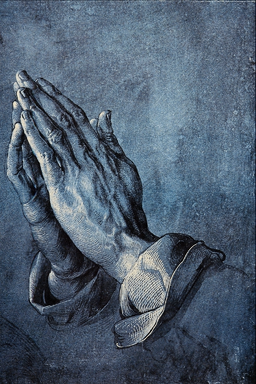
Albrecht Durer’s Praying Hands
I remember really liking The Cost of Discipleship. I’ve kept a copy on my bookshelf all these years. I connect Bonhoeffer with integrity in my mind, with doing the right thing in trying circumstances, with staying true to one’s beliefs and treating his fellow prisoners, as well as his captors, with dignity and love. Those thoughts haven’t changed one bit in my re-reading. However, I’ll be removing this book from my library. I can’t understand what about it I could have possibly found edifying.
Before we go any further, let me admit: I haven’t finished the book. I only re-read the first third. I can’t do it. I just don’t care. Besides Bonhoeffer being far more traditional and conservative than I remember, his book is basically a book by a man for men who need a male saviour.
In the beginning of the book Bonhoeffer writes about how grace has been cheapened. I think he would weep were he to witness the rise of mega-churches, prosperity gospel preaching, and mainstream American evangelicalism (which I think is basically cultural Christianity and not much connected with the gospels). “The real trouble is that the pure Word of Jesus has been overlaid with so much human ballast – burdensome rules and regulations, false hopes and consolations – that is has become extremely difficult to make a genuine decision for Christ.” (p. 35)
The majority of the first part of the book is about obedience: obedience to The Call, to Jesus. Let it be known that obedience has never been my strong suit. Rules apply to me only if I like the rules. This has been a sticking point for my spiritual development my whole life. But I also have a romantic view of discipleship. I intellectually recognize the wisdom that obeying can have – I’d better, I’m a parent! But the extent to which Bonhoeffer insists we obey Jesus – no questions, just following – worries me. Bonhoeffer writes about the ways in which we use our questions to attempt to ‘outsmart’ our would-be saviours, to avoid the hard work of Becoming (my language). He makes a really good point here – but the opportunity for maturation is not his point. He says that “…only he who believes is obedient, and only he who is obedient believes.” (p. 63) “Doubt and reflection take the place of spontaneous obedience.” (p. 73) Yikes.
While I can see that excessive questioning can be a form of self-delusion and avoidance of actually doing the Work, I think it is healthy to question. In fact, I think it is our duty to question. Jesus challenged the Powers that Be, the status quo. The implication that we ought never question our spiritual authority (be that God or the Bible – a document put together by men, even if I agree that it is divinely inspired – or a pastor) because we are sinful humans steals our human agency from us. Many Christians don’t have a problem with this. I believe the example of Adam and Eve in the garden is all most people need to say ‘yup, humans can’t be trusted.’ But Jesus was also fully human, even if he was infinitely wiser than we are by virtue of being also fully divine,* and he was not satisfied with the status quo. Blind obedience is problematic for all living things. It is even more problematic for women and other marginalized people.
Women, and other people who are Othered (marginalized and/or non-normative people), suffer in communities where questioning is discouraged. The kind of Christianity described by Bonhoeffer may win points for its integrity, but not for its compassion or sense of community. The pastors in Christianity like this are almost always male, and if a woman were to question her lot in life or her struggle then she would likely be told that she is questioning God’s Order. I have no sources to cite from this particular book, but after years of studying feminist theology and from living my own life I know there are scores of books (and blogs) that address this very phenomenon. God (who is He and male) knows best, the Bible (in spite of being written 1900 years ago in a specific time, place and culture) is the Way It Should Be, and Pastor (likely male) knows if you’re being obedient. All Others need to tow the line and know their places.

McNichol’s icon of Matthew Shephard
Obedience usually leads to a discussion of suffering, and this book does not disappoint. Like Roman Catholic theology, suffering is the center of Bonhoeffer’s Christianity. The point of Jesus is rejection and suffering. His crucifixion “must be a passion without honor. Suffering and rejection sum up the whole cross of Jesus. To die on the cross means to die despised and rejected of men. Suffering and rejection are laid upon Jesus as a divine necessity…” (p. 87) Why?? Why does giving of self have to equate with rejection? I reject all of this as completely untrue! Even in a Christian context I reject this as Not True. I believe that Jesus could have still accomplished the Christian message if everyone present at that time was mortified by his execution, if his followers and fellow Jews hadn’t rejected him but had instead embraced him. Suffering is NOT a divine necessity.
Suffering occurs in this life. We cannot have life without suffering. Learning to make sense of that is important, whether or not we follow a spiritual path. Jesus, by being part of this human existence and by fighting the Powers That Be, had to embrace suffering. What is to me the heart of the Christian message is that when suffering and death and rejection occur (because they occur to us all at some point, in some form) resurrection is possible. Suffering is not the core of the message, resurrection is. We rise again, in glory. We rise again, glorified.
“Suffering, then, is the true badge of discipleship” (p. 91) says Bonhoeffer. Once again women and other marginalized people lose out when this is the core of a theology. We already have noted the culture of not questioning. A woman in an unhappy marriage, a slave being a …well, slave, a child being abused by his parents – they are true disciples because they are not questioning the systems of the status quo and are enduring their suffering. People who choose not to suffer are then considered disobedient, less faithful, not True Christians. People who choose not to suffer are denying Jesus, in this context. Who are true disciples of Christ, according to Bonhoeffer? “They simply bear the suffering which comes their way as they try to follow Jesus Christ, and bear it for his sake.” (p. 109, emphasis Bonhoeffer’s) How can we bear anything for Christ’s sake? If he bore all for us, what can we possibly bear for God? How does our suffering improve or profit anything?? It profits nothing. I see it as a way to prove that one person is holier than another, or worse, a way to keep women and other marginalized people in their place.
I have no problem with a theology that has place for suffering, but when it is the crux of the faith then the only way into heaven is through suffering. To that I say, every one deserves in to heaven then, because everyone suffers. Or, change the fulcrum on which the tradition balances. I choose not to be obedient or to suffer, not in the Christian context, not according to patriarchal tradition of Western civilization. I will not be obedient to a deity or spiritual leader that insists I deny my own suffering, that I increase my suffering, that I submit to patriarchal status quo systems of injustice, on the flawed logic that we live in a fallen world and only Jesus will make it better…. in the world to come.
To some it may seem like I’m taking Bonhoeffer way out of context or addressing him in anachronistic terms. He was man writing during World War II. When he says things like “What can the call to discipleship mean to-day for the worker, the business man, the squire and the soldier?” (p. 38) am I being a deliberate trouble maker by pointing out that he has excluded women from the list? Sure, a woman is a worker, but so are business men and soldiers. I believe he is listing by class. He doesn’t mention the mother, which might be the main ‘job’ of women at that time. No, women are left out of this entire discussion of discipleship.
In this book there is an entire chapter titled “Woman.” Great! I thought, here he will address the 51% of the population! No. It’s an entire chapter on Jesus’s teaching on divorce and whether male disciples should marry. This chapter is not about women at all. If this is the only context for women, then we are merely equated with male desires and functions.
After getting to this point in the book I just threw my hands up and decided it’s time to move on. This is one of the reasons I quit my PhD program. I am beyond tired of this sort of theology: written by men for male believers in a male saviour who saves men.
*I actually think we – all of us – are fully human and fully divine already and that the point of the Incarnation was revealing that to us. The work of the spiritual life is to embrace both, to be Whole.
Previous Post

May 14, 2014
Reach Out and Touch Faith
Next Post
May 21, 2014 The Left Hand Path
Browse Our Archives
Select a Category Alaska altar altars Ana Ancestors Anderson witchcraft Arddu Bhairava Biography bodies books Christianity Christmas community current events death Delphic Maxims Dhumavati dual observance Durga Faery family life feminism Feri Feri tradition Feri witchcraft food ganesha gratitude Guest Post guru health Hinduism holidays Jesus Kali Lakshmi land links magic Many Gods West movie review movies music my heart mystery myth Navratri Orthodoxy pagan pagan culture paganism pantheacon parenting Place politics polytheism practice pratice prayer Red Goddess review ritual sacred arts Samhain Saraswati Shinto Shiva singing Star Goddess Tantra tarot the Gods theory Uncategorized values virgin mary wales washington winter witchcraft year in review yoga
Select a Month September 2015 August 2015 July 2015 June 2015 May 2015 April 2015 March 2015 February 2015 January 2015 December 2014 November 2014 October 2014 September 2014 August 2014 July 2014 June 2014 May 2014 April 2014 March 2014 February 2014 January 2014 December 2013 November 2013 October 2013 September 2013 August 2013 July 2013 June 2013 May 2013 April 2013 March 2013 February 2013 January 2013 December 2012 November 2012 October 2012 September 2012 August 2012 July 2012 June 2012 May 2012 April 2012 March 2012 February 2012 January 2012 December 2011 November 2011 October 2011 September 2011 August 2011 July 2011 June 2011
Follow Us!
TAKE THE
Religious Wisdom Quiz
What is the meaning of "amen" as Jesus often used it?
Select your answer to see how you score.
Glory Hurry Truly or verily Let it happen
Related posts from A Witch's Ashram


Polytheism, Politics, Discomfort, and Growth


TRENDING AT PATHEOS Pagan

I was recently chatting with someone on Instagram. She asked me what...

While there are many people who share their results, the end of...

On July 23, I saw Christopher Nolan's The Odyssey which is Homer’s...

As I write this two big events have just finished up. One...

Restoring the Watershed of Divine Love
Perhaps cooperation is not something we manufacture through legislation, ideology, or moral...

Many UUs don’t pray because of bad experiences in a previous religion,...
view all Pagan blogs
Ad-Free & Subscriber Log-In Subscription Support
- About Us
- 2026 Calendar
- Videos
- Podcasts
- Library of World Religions
- Faith In Media Tracker
- Advertise With Us
- Write for Us
- Privacy Policy
- Terms of Service
- Do Not Sell My Data
- Contact Us
- Radiant Digital
- Manage Newsletter Subscriptions
- Unsubscribe From Notifications
- Sitemap
Copyright 2008-2026, Patheos. All rights reserved.
Subscription Support Ad-Free & Subscriber Log-In
Follow Patheos