
BuddhistCatholicContemplativeEvangelicalGeneral ChristianHinduJewishLatter-day SaintMuslimNew VisionsProgressive Christian
Beliefs
- Buddhist
- Catholic
- Contemplative
- Evangelical
- General Christian
- Hindu
- Jewish
- Latter-day Saint
- More Voices
- Muslim
- New Visions
- Pagan
- Progressive Christian
Topics
- Religion News
- Food and Religion
- Sports and Religion
- Religious Art
- Religious Music and Entertainment
- Religious Events
- History and Religion
- Style and Religion
- Politics and Religion
- Women in Religion
- Recreation Outdoors and Religion
- Business Finance and Religion
- Careers Workplace and Religion
- Education and Religion
- Family Parenting and Religion
- Health Fitness and Religion
- Home and Religion
- Relationships and Religion
- Technology and Religion
- Travel and Religion
Columnists
- Buddhist Columnists
- Business Finance and Religion Columnists
- Careers Workplace and Religion Columnists
- Catholic Columnists
- Contemplative Columnists
- Education and Religion Columnists
- Evangelists Columnists
- Family Parenting and Religion Columnists
- General Christian Columnists
- Health Fitness and Religion Columnists
- Hindu Columnists
- History and Religion Columnists
- Home and Religion Columnists
- Jewish Columnists
- More Voices Columnists
- Latter Day Columnists
- Muslim Columnists
- New Visions Columnists
- Nonreligious Columnists
- Pagan Columnists
- Politics and Religion Columnists
- Progressive Columnists
- Recreation Outdoors and Religion Columnists
- Relationships and Religion Columnists
- Religion News Columnists
- Religious Art Columnists
- Religious Events Columnists
- Religious Music and Entertainment Columnists
- Sports and Religion Columnists
- Style and Religion Columnists
- Technology and Religion Columnists
- Travel and Religion Columnists
- Women in Religion Columnists
Resource Library
- 2026 Calendar
- Library of World Religions
- The 100 Most Holy Places on Earth
- Patheos Answers
- Podcasts
- Videos
- Faith Leaders Database
- Anglican Episcopalian
- Bahai
- Baptist
- Buddhism
- Christianity
- Confucianism
- Eastern Orthodoxy
- Hinduism
- Holiness and Pentecostal
- ISKCON
- Islam
- Judaism
- Lutheran
- Methodist
- The Church of Jesus Christ of Latter-day Saints
- New Age
- Paganism
- Presbytarian and Reformed
- Protestantism
- Religion Behind the Scenes
- Roman Catholic
- Scientology
- Shia Islam
- Sikhism
- Sufism
- Sunni Islam
- Taoism
- Zen
- See all religions
Research Tools
 Ad-Free & Subscriber Log-In Subscription Support
Ad-Free & Subscriber Log-In Subscription Support
Follow Patheos 

- Trending:
- Forgiveness
- |
- Marriage
- |
- Consciousness
- |
- Death Penalty
- |
- Election
- |
- Halloween
 A Witch's Ashram
- Home
- Pagan
- Praying Like a Pilgrim
Praying Like a Pilgrim
Last updated on: May 5, 2014 at 7:01 am by Niki Whiting
Praying Like a Pilgrim 2014-05-04T13:17:24-08:00 Niki Whiting
Patheos Explore the world's faith through different perspectives on religion and spirituality! Patheos has the views of the prevalent religions and spiritualities of the world.
[This was written in early 2012, when I was immersed in my Christian quarter, revisiting my Christian past. I really like this post. Every tradition has something we can learn from. Re-reading this post reminds me of the benefits of mantra and prayer, mercy and gratitude.]
I was hoping to have all of The Pilgrim’s Tale, a Russian spiritual classic, read for review today. Even with kids and limited reading time I can plow through a book if need be. This time? I’m savoring it. In fact, I’m inspired by it.

Christ in Majesty/Christ the Great Hierophant
One of the things I love about the Eastern Orthodox tradition in all its ‘flavors’ (the Church is divided along ethnic and national lines) is that mysticism is front and center: in its liturgy, traditions, stories and practice. Mysticism is more than theology or incense or icons or even an embrace of mystery. Part of mysticism is the belief that every individual has access to and the ability for deep union with the Divine. The Pilgrim’s Tale is focused on the Hesychastic tradition of inner prayer, also called prayer of the heart or the Jesus prayer: Lord Jesus Christ, son of God, have mercy on me, a sinner. It can be shortened to: Lord Jesus Christ, have mercy on me.
This type of prayer is essentially a form of Christian meditation; it’s a mantra for deep inner meditation. When I started reading the book I decided that I would start praying it as well. Except, the prayer as is doesn’t sit well with me. Jesus and I don’t have much to say to each other, and I while I believe in sin and that I am flawed, I don’t believe in sin and being a sinner the way this tradition does. So I altered the prayer to the following: Holy God, Holy Mighty, Holy Immortal, have mercy/Holy Mother, Holy Mighty, Holy Immortal, have mercy. It’s another form of Orthodox prayer (using God, instead of Mother), so I felt the spirit was there. I also didn’t just want to pray for mercy on myself. For a week now I’ve been praying this aloud or under my breath while walking, folding laundry, doing dishes, lying in bed at night, etc.
What has been surprising to me is how deeply this prayer affects me. I’ll just be standing at the sink doing the dishes, thinking about my day or what chore I’ll tackle next or which park I’ll take the 3-year-old to, and I find myself feeling things, things I didn’t know I was feeling, needing to coat those feelings in mercy.
See, I’m not so good with feelings. There’s a lot of Stuff I know I haven’t dealt with. This mantra prayer is like a distraction for my brain. While brain and body are busy forming the words, heart bubbles up Stuff and it needs mercy. I have feelings about being so frustrated with my son’s inability to stop pushing his sister over – have mercy on me for being so angry, have mercy on my son, may his feelings find a better outlet, have mercy on my daughter’s body, and thank you that she didn’t whack her head this time. I have feelings, mostly judgment, for various thing I’m doing or not doing – or even feeling! Have mercy on me, that I’ll be more compassionate to myself, that I’ve so far to go before enlightenment, that I’ll stop judging even that. Have mercy on the sadness that trickles out from the edges of my thoughts, have mercy, have mercy, have mercy.
Just as the Pilgrim describes, the repeated request for mercy also comes out as a thanksgiving. Have mercy (thank you that we are so well fed and have mercy on those who aren’t and have mercy on the hands that made it possible have this food at all), have mercy (thank you that my friends arrived safely), have mercy (thank you for this opportunity, thank you for the support to push forward even when I feel scared). Oh have mercy. Oh thank you for this life.
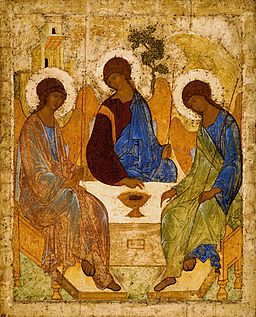
Rublev’s icon of the Old Testament Trinity
There’s a lot in this book that’s repetitive and rather boring. It is firmly situated in the Orthodox trope in form and content; I’m used to it, but I could see it boring the crap out of most people. There are some gems in here, though, things that I think many people can relate to.
On the very first page we see the Pilgrim coming across the instruction in the Gospel to ‘pray without ceasing.’ He is stumped; how in the world is that possible? This entire book is his search to find out how and what happens when he does.
“I thought and thought but could find no answer. So I asked a cleric: ‘What does it mean to pray unceasingly and how does one do it?’ He replied: ‘Just pray it as it says.’ I asked again: ‘Yes, but how do you pray unceasingly?’ ‘You’re still asking?’ said the cleric and left.”
I love this. This is the opening. On one hand I see the frustration of a beginner, seeking and asking and basically being brushed off by someone who seems to know but won’t tell. I think many of us have had similar experiences. We want to know something, to go deeper and the person we’ve asked gives us some crappy line: ‘Well, if you haven’t figured it out by now you never will’ or ‘One either is ready and therefore gets it, or one is not.’ On the other hand, to pray unceasingly, we must start praying. That’s something this blog project has taught me: dive in, just begin, sort out the how later, it will make sense eventually.
The Pilgrim asks another man about this prayer:
“Unceasing interior prayer is the uninterrupted striving of the human spirit toward attentiveness in the divine center. … You will not understand. But if you pray as you know how, this very prayer will itself reveal to you how it can be unceasing. Everything takes its own time….”
I believe this is true of so much of the mystic life. Knowledge come from words, but wisdom comes from experience. Both are important, but all the words in the world will not give us the wisdom we seek.
This book has a few little one-off moments of anti-Semitism and anti-Catholicism, and claims that the Hindu yogis got this meditative prayer from the Eastern Fathers (it is likely the other way around). This is par for the course in a Russian Orthodox book of this era. Despite these flaws, I will be keeping this book on my shelf. And I will be continuing to pray this prayer for the remainder of this quarter.
Previous Post

May 2, 2014
What is Feri?
Next Post
May 6, 2014 Happy Five Years Patheos!
Browse Our Archives
Select a Category Alaska altar altars Ana Ancestors Anderson witchcraft Arddu Bhairava Biography bodies books Christianity Christmas community current events death Delphic Maxims Dhumavati dual observance Durga Faery family life feminism Feri Feri tradition Feri witchcraft food ganesha gratitude Guest Post guru health Hinduism holidays Jesus Kali Lakshmi land links magic Many Gods West movie review movies music my heart mystery myth Navratri Orthodoxy pagan pagan culture paganism pantheacon parenting Place politics polytheism practice pratice prayer Red Goddess review ritual sacred arts Samhain Saraswati Shinto Shiva singing Star Goddess Tantra tarot the Gods theory Uncategorized values virgin mary wales washington winter witchcraft year in review yoga
Select a Month September 2015 August 2015 July 2015 June 2015 May 2015 April 2015 March 2015 February 2015 January 2015 December 2014 November 2014 October 2014 September 2014 August 2014 July 2014 June 2014 May 2014 April 2014 March 2014 February 2014 January 2014 December 2013 November 2013 October 2013 September 2013 August 2013 July 2013 June 2013 May 2013 April 2013 March 2013 February 2013 January 2013 December 2012 November 2012 October 2012 September 2012 August 2012 July 2012 June 2012 May 2012 April 2012 March 2012 February 2012 January 2012 December 2011 November 2011 October 2011 September 2011 August 2011 July 2011 June 2011
Follow Us!
TAKE THE
Religious Wisdom Quiz
What is the first commandment in the Ten Commandments?
Select your answer to see how you score.
Do not steal No other gods Honor parents Do not murder
Related posts from A Witch's Ashram

So Long, and Thanks for All the Clicks


Many Gods, Many Peoples, Many Experiences

TRENDING AT PATHEOS Pagan

I was recently chatting with someone on Instagram. She asked me what...

While there are many people who share their results, the end of...

On July 23, I saw Christopher Nolan's The Odyssey which is Homer’s...

As I write this two big events have just finished up. One...

Restoring the Watershed of Divine Love
Perhaps cooperation is not something we manufacture through legislation, ideology, or moral...

Many UUs don’t pray because of bad experiences in a previous religion,...
view all Pagan blogs
Ad-Free & Subscriber Log-In Subscription Support
- About Us
- 2026 Calendar
- Videos
- Podcasts
- Library of World Religions
- Faith In Media Tracker
- Advertise With Us
- Write for Us
- Privacy Policy
- Terms of Service
- Do Not Sell My Data
- Contact Us
- Radiant Digital
- Manage Newsletter Subscriptions
- Unsubscribe From Notifications
- Sitemap
Copyright 2008-2026, Patheos. All rights reserved.
Subscription Support Ad-Free & Subscriber Log-In
Follow Patheos