
BuddhistCatholicContemplativeEvangelicalGeneral ChristianHinduJewishLatter-day SaintMuslimNew VisionsProgressive Christian
Beliefs
- Buddhist
- Catholic
- Contemplative
- Evangelical
- General Christian
- Hindu
- Jewish
- Latter-day Saint
- More Voices
- Muslim
- New Visions
- Pagan
- Progressive Christian
Topics
- Religion News
- Food and Religion
- Sports and Religion
- Religious Art
- Religious Music and Entertainment
- Religious Events
- History and Religion
- Style and Religion
- Politics and Religion
- Women in Religion
- Recreation Outdoors and Religion
- Business Finance and Religion
- Careers Workplace and Religion
- Education and Religion
- Family Parenting and Religion
- Health Fitness and Religion
- Home and Religion
- Relationships and Religion
- Technology and Religion
- Travel and Religion
Columnists
- Buddhist Columnists
- Business Finance and Religion Columnists
- Careers Workplace and Religion Columnists
- Catholic Columnists
- Contemplative Columnists
- Education and Religion Columnists
- Evangelists Columnists
- Family Parenting and Religion Columnists
- General Christian Columnists
- Health Fitness and Religion Columnists
- Hindu Columnists
- History and Religion Columnists
- Home and Religion Columnists
- Jewish Columnists
- More Voices Columnists
- Latter Day Columnists
- Muslim Columnists
- New Visions Columnists
- Nonreligious Columnists
- Pagan Columnists
- Politics and Religion Columnists
- Progressive Columnists
- Recreation Outdoors and Religion Columnists
- Relationships and Religion Columnists
- Religion News Columnists
- Religious Art Columnists
- Religious Events Columnists
- Religious Music and Entertainment Columnists
- Sports and Religion Columnists
- Style and Religion Columnists
- Technology and Religion Columnists
- Travel and Religion Columnists
- Women in Religion Columnists
Resource Library
- 2026 Calendar
- Library of World Religions
- The 100 Most Holy Places on Earth
- Patheos Answers
- Podcasts
- Videos
- Faith Leaders Database
- Anglican Episcopalian
- Bahai
- Baptist
- Buddhism
- Christianity
- Confucianism
- Eastern Orthodoxy
- Hinduism
- Holiness and Pentecostal
- ISKCON
- Islam
- Judaism
- Lutheran
- Methodist
- The Church of Jesus Christ of Latter-day Saints
- New Age
- Paganism
- Presbytarian and Reformed
- Protestantism
- Religion Behind the Scenes
- Roman Catholic
- Scientology
- Shia Islam
- Sikhism
- Sufism
- Sunni Islam
- Taoism
- Zen
- See all religions
Research Tools
 Ad-Free & Subscriber Log-In Subscription Support
Ad-Free & Subscriber Log-In Subscription Support
Follow Patheos 

- Trending:
- Forgiveness
- |
- Marriage
- |
- Consciousness
- |
- Death Penalty
- |
- Election
- |
- Halloween
 A Witch's Ashram
- Home
- Pagan
- On Finding My Yoga
On Finding My Yoga
Last updated on: April 14, 2014 at 6:10 am by Niki Whiting
On Finding My Yoga 2014-04-14T06:10:02-08:00 Niki Whiting
Patheos Explore the world's faith through different perspectives on religion and spirituality! Patheos has the views of the prevalent religions and spiritualities of the world.
[This piece was written in August of 2011. My son was 3 and my daughter was 6 months old. I’ve edited it in places, but much of it remains true to where I’m at now.]
One of the things I love about yoga and Hinduism is that there is an ‘in’ for just about everyone. Are you a monotheist? There is point of entry. Are you a non-dualist? Try Advaita Vedanta. Do you see the God as male? Perhaps being a Vaishnava is for you. Do you see God as female? Say hello to Durga. Want to be less religious and more philosophical? Perhaps the dualist, non-divinity believing Samkhya path is for you. Love yoga but aren’t very accomplished at the poses? Well, there are many branches of yoga to try.
My original point of entry came from hatha yoga classes, the physical exercise that most Westerners are familiar with. I had already moved away from a hard and fast understanding of God as male. The more I sought the Divine and explored feminist and liberation theologies in my academic work the less and less satisfied I was with the generic monotheistic understanding of God. I don’t believe God is female, although I prefer to use female images and pronouns to counter the millenia of androcentric language. I believe that the Divine is beyond gender and certainly isn’t sexed, containing all of our experiences of self and then some. I believe in a Great Ground of Being as the ultimate Divine, from which all is made and to which all returns. I also believe that most of us need something a bit more friendly and anthropomorphic on which to grasp hold. We are embodied beings, but are not separate from what is Divine, and so it is appropriate that our gods look like us. We look to the highest examples of our best aspects as if to lighthouses from the open sea. Then we bring back what the gods teach us so that we can shine all the brighter.
I guess you could say I am a non-dual, panentheistic polytheist. This seems best to express my experience in the world, as well as captures what I long for. Ultimately, labels aren’t that important to me anymore. I often feel like one label suits me best one day, another label better on another day. I don’t think this is wishy-washy anymore; rather it reflects the slippery, changeable experience of living, experiencing, thinking, and evolving.

By Sigurdas, Wikimedia Commons.
As I was saying, hatha yoga was my gateway drug to Hinduism. The asanas (postures) of yoga are not intended to be a fitness system, though they are mighty effective for gaining strength, flexibility and general vitality. Hatha yoga developed to bring ease to the body and to prepare us for long sessions of sitting meditation. Once I got serious about my hatha yoga practice, I began to see and feel the effects of daily yoga in my life: more equanimity, greater physical health, ease, andpeace. I credit meditation and yoga with helping manage my anxiety issues. I very much miss doing hatha yoga and sitting meditation daily. Diving deeper into my Hindu practices was supposed to bring these two spiritual pillars of my life – yoga and meditation – back to the core of my practice!
I thought I would be up with the sun every day. I would be disciplined! Hard core! An actual yogini! Go me! But I’m beginning to realize that right now, other forms of yoga need to be my base line.
The most common understanding of the system of yoga is that of raja-yoga, associated with Patanjali and his eight limbs, also known as kriya-yoga, the path of transformative action.* This limb contains the yamas (thou shalt nots), niyamas (thou shalls), asana, and pranayama (breath control), along with different levels of meditation: pratyahara, dharana and dhyana, and finally samadhi (ecstasy). Jnana-yoga, is the yoga of wisdom, a form of Self-realization through discerning the real from the unreal. Bhakti-yoga, is the yoga of devotion. Instead of transcending the world to find the Divine, one sees the Other as the Divine. For example a person might have a deep devotion to a particular god or goddess and thus seek union with that deity. Karma-yoga is the path of action and/or work. This is the form of yoga that is highlighted in the holy text, the Bhagavad-Gita. In a way this path is about service; we transcend our ego and our attachment to outcomes through selfless action. Lastly, there is tantra-yoga, a much more ecstatic form of yoga.
I’m finding that right now in my life, as a stay-at-home mother of a toddler and an infant, my main forms of yoga are karma-yoga and bhakti-yoga. I serve my family in a very mama-specific way: no one else can nurse my daughter for me, for example. Since my daughter was born I have been struggling with my identity as a stay-at-home mother. This was never my plan! And yet… it’s worked out as best for me, for my kids, for my family.** Some mornings I am just not rested enough to get up with the dawn. But every day I care for my family and as a parent I have to love and care for my kids without attachment to the outcome. Parenting is a spiritual practice! This is my karma-yoga. It is also a form of devotion, even as a cultivate relationships with the gods.
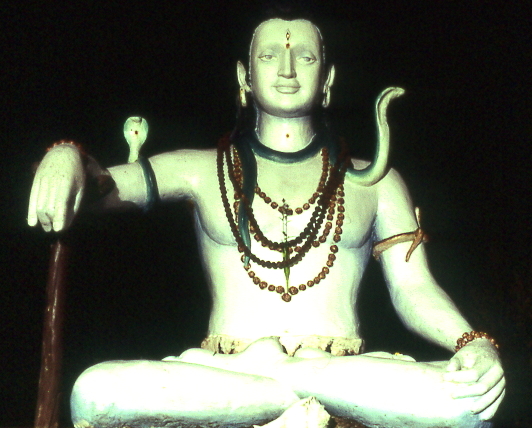
By Sardaka, via Wikimedia Creative Commons.
All the forms of yoga complement one another. I can do parts of each, some forms now and come back to other forms later. This is one of the things that I love about yoga and Hinduism in general. There is an ‘in’ wherever you are in life, whatever your disposition. It is not a hard and fast system, an all or nothing religion. While there is a place for the devoted goddess worshiper, the avatar follower, the philosopher, the ascetic monk, the ecstatic dancer, and even the atheist, it is not a formless mash of ideas with no core. Hinduism seems more like a web to me – a cohesive whole, with a core that welcomes all from many ends, flexible but strong.
*Unless otherwise stated or indicated by a link, most of my facts come from Georg Feuerstein’s essay ‘The Tree of Hindu Yoga’ in his book The Deeper Dimension of Yoga.
**Your mileage may vary. The dynamics and details of my family are not the same as yours and so my expression of what is best for my family is in no way a statement of what would be best for your family.
Previous Post

April 8, 2014
Values
Next Post
April 16, 2014 What is a Witch?
Browse Our Archives
Select a Category Alaska altar altars Ana Ancestors Anderson witchcraft Arddu Bhairava Biography bodies books Christianity Christmas community current events death Delphic Maxims Dhumavati dual observance Durga Faery family life feminism Feri Feri tradition Feri witchcraft food ganesha gratitude Guest Post guru health Hinduism holidays Jesus Kali Lakshmi land links magic Many Gods West movie review movies music my heart mystery myth Navratri Orthodoxy pagan pagan culture paganism pantheacon parenting Place politics polytheism practice pratice prayer Red Goddess review ritual sacred arts Samhain Saraswati Shinto Shiva singing Star Goddess Tantra tarot the Gods theory Uncategorized values virgin mary wales washington winter witchcraft year in review yoga
Select a Month September 2015 August 2015 July 2015 June 2015 May 2015 April 2015 March 2015 February 2015 January 2015 December 2014 November 2014 October 2014 September 2014 August 2014 July 2014 June 2014 May 2014 April 2014 March 2014 February 2014 January 2014 December 2013 November 2013 October 2013 September 2013 August 2013 July 2013 June 2013 May 2013 April 2013 March 2013 February 2013 January 2013 December 2012 November 2012 October 2012 September 2012 August 2012 July 2012 June 2012 May 2012 April 2012 March 2012 February 2012 January 2012 December 2011 November 2011 October 2011 September 2011 August 2011 July 2011 June 2011
Follow Us!
TAKE THE
Religious Wisdom Quiz
What is the seventh commandment?
Select your answer to see how you score.
Thou shall not commit adultery. Thou shalt not murder. Thou shall have no other gods before me. Thou shall not covet.
Related posts from A Witch's Ashram

So Long, and Thanks for All the Clicks



Many Gods, Many Peoples, Many Experiences
TRENDING AT PATHEOS Pagan

I was recently chatting with someone on Instagram. She asked me what...

While there are many people who share their results, the end of...

On July 23, I saw Christopher Nolan's The Odyssey which is Homer’s...

As I write this two big events have just finished up. One...

Restoring the Watershed of Divine Love
Perhaps cooperation is not something we manufacture through legislation, ideology, or moral...

Many UUs don’t pray because of bad experiences in a previous religion,...
view all Pagan blogs
Ad-Free & Subscriber Log-In Subscription Support
- About Us
- 2026 Calendar
- Videos
- Podcasts
- Library of World Religions
- Faith In Media Tracker
- Advertise With Us
- Write for Us
- Privacy Policy
- Terms of Service
- Do Not Sell My Data
- Contact Us
- Radiant Digital
- Manage Newsletter Subscriptions
- Unsubscribe From Notifications
- Sitemap
Copyright 2008-2026, Patheos. All rights reserved.
Subscription Support Ad-Free & Subscriber Log-In
Follow Patheos