
BuddhistCatholicContemplativeEvangelicalGeneral ChristianHinduJewishLatter-day SaintMuslimNew VisionsProgressive Christian
Beliefs
- Buddhist
- Catholic
- Contemplative
- Evangelical
- General Christian
- Hindu
- Jewish
- Latter-day Saint
- More Voices
- Muslim
- New Visions
- Pagan
- Progressive Christian
Topics
- Religion News
- Food and Religion
- Sports and Religion
- Religious Art
- Religious Music and Entertainment
- Religious Events
- History and Religion
- Style and Religion
- Politics and Religion
- Women in Religion
- Recreation Outdoors and Religion
- Business Finance and Religion
- Careers Workplace and Religion
- Education and Religion
- Family Parenting and Religion
- Health Fitness and Religion
- Home and Religion
- Relationships and Religion
- Technology and Religion
- Travel and Religion
Columnists
- Buddhist Columnists
- Business Finance and Religion Columnists
- Careers Workplace and Religion Columnists
- Catholic Columnists
- Contemplative Columnists
- Education and Religion Columnists
- Evangelists Columnists
- Family Parenting and Religion Columnists
- General Christian Columnists
- Health Fitness and Religion Columnists
- Hindu Columnists
- History and Religion Columnists
- Home and Religion Columnists
- Jewish Columnists
- More Voices Columnists
- Latter Day Columnists
- Muslim Columnists
- New Visions Columnists
- Nonreligious Columnists
- Pagan Columnists
- Politics and Religion Columnists
- Progressive Columnists
- Recreation Outdoors and Religion Columnists
- Relationships and Religion Columnists
- Religion News Columnists
- Religious Art Columnists
- Religious Events Columnists
- Religious Music and Entertainment Columnists
- Sports and Religion Columnists
- Style and Religion Columnists
- Technology and Religion Columnists
- Travel and Religion Columnists
- Women in Religion Columnists
Resource Library
- 2026 Calendar
- Library of World Religions
- The 100 Most Holy Places on Earth
- Patheos Answers
- Podcasts
- Videos
- Faith Leaders Database
- Anglican Episcopalian
- Bahai
- Baptist
- Buddhism
- Christianity
- Confucianism
- Eastern Orthodoxy
- Hinduism
- Holiness and Pentecostal
- ISKCON
- Islam
- Judaism
- Lutheran
- Methodist
- The Church of Jesus Christ of Latter-day Saints
- New Age
- Paganism
- Presbytarian and Reformed
- Protestantism
- Religion Behind the Scenes
- Roman Catholic
- Scientology
- Shia Islam
- Sikhism
- Sufism
- Sunni Islam
- Taoism
- Zen
- See all religions
Research Tools
 Ad-Free & Subscriber Log-In Subscription Support
Ad-Free & Subscriber Log-In Subscription Support
Follow Patheos 

- Trending:
- Forgiveness
- |
- Marriage
- |
- Consciousness
- |
- Death Penalty
- |
- Election
- |
- Halloween
 A Witch's Ashram
- Home
- Pagan
- Dual Observance and Me
Dual Observance and Me
Last updated on: December 13, 2013 at 6:36 am by Niki Whiting
Dual Observance and Me 2013-12-13T06:36:49-08:00 Niki Whiting
Patheos Explore the world's faith through different perspectives on religion and spirituality! Patheos has the views of the prevalent religions and spiritualities of the world.
Dual observance, the practice of more than one tradition at one time, is more common than most people realize, I think. It’s not just for Pagans, either. For some people, it becomes syncretism, a blending of two (or more) systems into one. For some, one practice is spiritual or religious and the other practice is more cultural. Some people pick and choose parts of various traditions they like, leaving the difficult, challenging, or distasteful aspects by the wayside. For others, like myself, although I have qualities of all the previous forms too, more than one tradition is practiced harmoniously side by side.
Recently I asked a professor of Judaism what her thoughts on Jewish dual observance were, since intermarriage in the wider Jewish community is a hot topic. She told me no one had done any research on this. I think dual observance would make a great academic paper for a graduate class, conference panel, or research seminar. This post is not that paper. Most of my thoughts here are from my own experience, as well from what’s in my head after my own graduate work.
We can find many examples of syncretism and dual-observance throughout history. Would these people from the past see themselves as dually observant? It’s hard to say, as the concept wasn’t well developed, and the practice was usually discouraged by authorities. For example, take the tradition of cunning folk in England and Wales. These people performed tasks that we today might identify as witchcraft. Yet, most cunning folk considered themselves Christians. They used bits of Psalms or holy water to perform their spells. They just happened to have gifts or skills that others didn’t, and they would use them in the service of their communities (however defined).
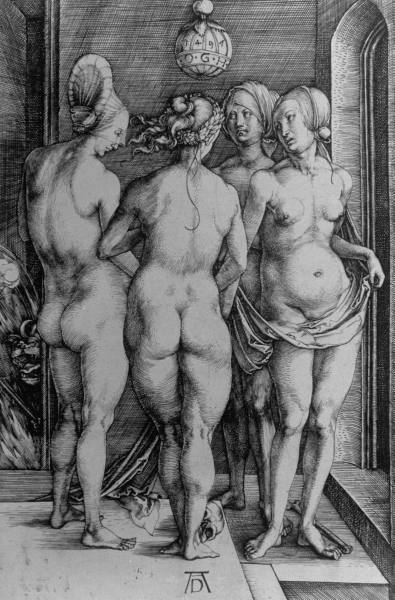
Albrecht Durer, Die Vier Hexen (or The Four Witches), 1497.
Looking at medieval Europe, we also see people who fit the modern day description of the village witch. Did they see themselves as witches? Likely not. Many of these people also attended church and participated in their community’s Christian folk traditions. Using specialized skills and working with spirits may not have been viewed as ‘other’ or outside of church tradition, but rather as one more tool to aid themselves and their community.
What I have found in my own present day experience is that dual observance makes many people uncomfortable. It’s much easier for people if a person is One or the Other. I see this in people’s confusion around sexual identities (bisexual? polysexual? what?), racial identities (being bi-racial or mixed race confuses the heck out of white folk), and myriad other expressions of self, chosen or otherwise. But this seems to stem from a hegemonic view point, one that thinks we all need to be Just One Thing. I see a lot of Christian thinking here. Christianity is exclusivist, claiming to be the One Right Way. Many (but not all) Christians believe that there is only one, or at most very few, ways to be an ‘authentic’ Christian. I have heard more than one Protestant tell me that Catholics aren’t really Christians.
This exclusivist strain of Christianity makes a little bit of sense when viewing that tradition by its own standards. I see where they are coming from. In all the years I was earnestly trying to be a Christian, I never got baptized. I really wanted to join the Eastern Orthodox Church, but felt that I needed to be more fully on-board with their beliefs in order to join. Several ‘cradle’ Orthodox (those born into the tradition) told me that I was over-thinking things, that Orthodoxy needed more voices, that no one was perfect or believed completely in every detail. Maybe if I had been born into Orthodoxy or into the Christian tradition, period, I would have felt that it was more mine to alter. As it was, I felt like a guest. I would never come into your home and ask you to redecorate; why would I join a tradition I wanted to change?
When I began my blog project two and half years ago (exploring traditions that I had been practicing in one form or another already), it was an experiment in living as if: as if I was a Pagan, as if I was a Hindu, as if I was a Christian (again). My ‘faith’ has come from my experiences in the doing. At the end of the experiment I realized that the gods had shown up for me during my Hindu quarter and Feri* quarter. I experienced much depth of these spirits during my focus on Place. Christianity was a dead end for me.
Both Feri and the Tantric Hinduism I pursue have many similarities. The deeper I go in my own practice the more I see where the Current gleams in other traditions too. We do not need to have all the same practices, beliefs or gods for me to feel a common heartbeat. However, I find that rarely do my practices conflict. They support one another in ways that often astonish me. I am a stronger Feri practitioner because of my Hindu devotions, and a better Hindu devotee because of the strength of my Feri work.
You may notice that I rarely call myself a Feri or a Hindu. That’s for several reasons. I am not initiated into either tradition. I do not have a guru for my Tantra practice. I call myself a practitioner or a devotee. I often tell people, when asked, “I practice a form of American Traditional Witchcraft and have a Hindu devotion.” I am most reluctant to label myself as a Hindu. I am not of any ethnic or cultural heritage from which Hinduism springs. I have not adopted most forms of South Asian expressions of Hinduism, which is what most Americans (and many Hindus, frankly) look for. Most importantly, I have no Hindu community near me. Yes, I go to yoga class occasionally. There is one in my town that actually focuses more on the Hindu aspects of yoga, which I love. But it’s not the same as a community of people worshiping together. Whereas with Feri I have teachers and a thriving (mostly online) community of friends who are initiates or students.
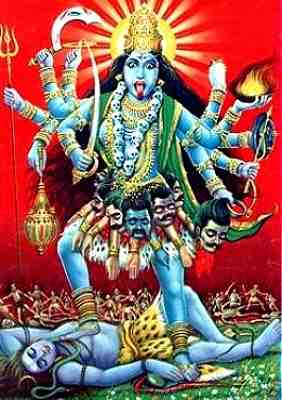
The murti of Kali and Shiva I have on my altar.
My dual observance feels juicy and fruitful at this point in my life. It feeds me spiritually and enriches my family life. I finally, after all my years of longing and searching, decided to trust myself, my Self. That trust has led me here. I will continue to deepen both of my practices, my observances, my chosen traditions, until my Self says otherwise.
*A note on spelling. A few years ago there was a split in the Feri/Faery tradition. One side chose one spelling and the other another spelling. I have not written about this split, nor publicly declared sides, as it is not useful nor necessary for me to do so at this time. No one has asked me to, and as an non-initiate I don’t think my opinion is useful, at this time. However, I do have opinions. They are not necessarily represented in my choice of spelling. I choose to spell my practice with the FERI spelling for three reasons: one, I think it’s neat; two, most people are familiar with Feri via this spelling; and three, it’s more immediately distinct from other forms of faery/faerie/fairy/etc out there.
Sources and Resources
Yvonne Arburrow’s four-part series on Dual-faith practices. This blog series at Patheos is scholarly, sociological, and a great intro to what dual observance is all about. It also has an extensive bibliography.
Carlo Ginzberg, The Night Battles. A scholarly text subtitled “Witchcraft and Agrarian Cults in the Sixteenth and Seventeenth Centuries.” It focuses on communities in Italy. More interesting that you might think!
Michael Howard, Welsh Witches and Wizards. He talks about cunning folk in Wales here. You can also read my short review of the book.
Two great blog posts on dual-observance: Downstrodden’s experience and a great post from the always fantastic Nicholaj de Mattos Frisvold.
Previous Post

December 10, 2013
Welcome to A Witch's Ashram
Next Post
December 13, 2013 Singing In Christmas
Browse Our Archives
Select a Category Alaska altar altars Ana Ancestors Anderson witchcraft Arddu Bhairava Biography bodies books Christianity Christmas community current events death Delphic Maxims Dhumavati dual observance Durga Faery family life feminism Feri Feri tradition Feri witchcraft food ganesha gratitude Guest Post guru health Hinduism holidays Jesus Kali Lakshmi land links magic Many Gods West movie review movies music my heart mystery myth Navratri Orthodoxy pagan pagan culture paganism pantheacon parenting Place politics polytheism practice pratice prayer Red Goddess review ritual sacred arts Samhain Saraswati Shinto Shiva singing Star Goddess Tantra tarot the Gods theory Uncategorized values virgin mary wales washington winter witchcraft year in review yoga
Select a Month September 2015 August 2015 July 2015 June 2015 May 2015 April 2015 March 2015 February 2015 January 2015 December 2014 November 2014 October 2014 September 2014 August 2014 July 2014 June 2014 May 2014 April 2014 March 2014 February 2014 January 2014 December 2013 November 2013 October 2013 September 2013 August 2013 July 2013 June 2013 May 2013 April 2013 March 2013 February 2013 January 2013 December 2012 November 2012 October 2012 September 2012 August 2012 July 2012 June 2012 May 2012 April 2012 March 2012 February 2012 January 2012 December 2011 November 2011 October 2011 September 2011 August 2011 July 2011 June 2011
Follow Us!
TAKE THE
Religious Wisdom Quiz
Who was Jacob's firstborn son?
Select your answer to see how you score.
Joseph Reuben Levi Judah
Related posts from A Witch's Ashram

So Long, and Thanks for All the Clicks


Polytheism, Politics, Discomfort, and Growth

TRENDING AT PATHEOS Pagan

I was recently chatting with someone on Instagram. She asked me what...

While there are many people who share their results, the end of...

On July 23, I saw Christopher Nolan's The Odyssey which is Homer’s...

As I write this two big events have just finished up. One...

Restoring the Watershed of Divine Love
Perhaps cooperation is not something we manufacture through legislation, ideology, or moral...

Many UUs don’t pray because of bad experiences in a previous religion,...
view all Pagan blogs
Ad-Free & Subscriber Log-In Subscription Support
- About Us
- 2026 Calendar
- Videos
- Podcasts
- Library of World Religions
- Faith In Media Tracker
- Advertise With Us
- Write for Us
- Privacy Policy
- Terms of Service
- Do Not Sell My Data
- Contact Us
- Radiant Digital
- Manage Newsletter Subscriptions
- Unsubscribe From Notifications
- Sitemap
Copyright 2008-2026, Patheos. All rights reserved.
Subscription Support Ad-Free & Subscriber Log-In
Follow Patheos