
BuddhistCatholicContemplativeEvangelicalGeneral ChristianHinduJewishLatter-day SaintMuslimNew VisionsProgressive Christian
Beliefs
- Buddhist
- Catholic
- Contemplative
- Evangelical
- General Christian
- Hindu
- Jewish
- Latter-day Saint
- More Voices
- Muslim
- New Visions
- Pagan
- Progressive Christian
Topics
- Religion News
- Food and Religion
- Sports and Religion
- Religious Art
- Religious Music and Entertainment
- Religious Events
- History and Religion
- Style and Religion
- Politics and Religion
- Women in Religion
- Recreation Outdoors and Religion
- Business Finance and Religion
- Careers Workplace and Religion
- Education and Religion
- Family Parenting and Religion
- Health Fitness and Religion
- Home and Religion
- Relationships and Religion
- Technology and Religion
- Travel and Religion
Columnists
- Buddhist Columnists
- Business Finance and Religion Columnists
- Careers Workplace and Religion Columnists
- Catholic Columnists
- Contemplative Columnists
- Education and Religion Columnists
- Evangelists Columnists
- Family Parenting and Religion Columnists
- General Christian Columnists
- Health Fitness and Religion Columnists
- Hindu Columnists
- History and Religion Columnists
- Home and Religion Columnists
- Jewish Columnists
- More Voices Columnists
- Latter Day Columnists
- Muslim Columnists
- New Visions Columnists
- Nonreligious Columnists
- Pagan Columnists
- Politics and Religion Columnists
- Progressive Columnists
- Recreation Outdoors and Religion Columnists
- Relationships and Religion Columnists
- Religion News Columnists
- Religious Art Columnists
- Religious Events Columnists
- Religious Music and Entertainment Columnists
- Sports and Religion Columnists
- Style and Religion Columnists
- Technology and Religion Columnists
- Travel and Religion Columnists
- Women in Religion Columnists
Resource Library
- 2026 Calendar
- Library of World Religions
- The 100 Most Holy Places on Earth
- Patheos Answers
- Podcasts
- Videos
- Faith Leaders Database
- Anglican Episcopalian
- Bahai
- Baptist
- Buddhism
- Christianity
- Confucianism
- Eastern Orthodoxy
- Hinduism
- Holiness and Pentecostal
- ISKCON
- Islam
- Judaism
- Lutheran
- Methodist
- The Church of Jesus Christ of Latter-day Saints
- New Age
- Paganism
- Presbytarian and Reformed
- Protestantism
- Religion Behind the Scenes
- Roman Catholic
- Scientology
- Shia Islam
- Sikhism
- Sufism
- Sunni Islam
- Taoism
- Zen
- See all religions
Research Tools
 Ad-Free & Subscriber Log-In Subscription Support
Ad-Free & Subscriber Log-In Subscription Support
Follow Patheos 

- Trending:
- Forgiveness
- |
- Marriage
- |
- Consciousness
- |
- Death Penalty
- |
- Election
- |
- Halloween
 A Witch's Ashram
- Home
- Pagan
- Living Saraswati
Living Saraswati
Last updated on: October 11, 2013 at 8:00 am by Niki Whiting
Living Saraswati 2013-10-11T08:00:21-08:00 Niki Whiting
Patheos Explore the world's faith through different perspectives on religion and spirituality! Patheos has the views of the prevalent religions and spiritualities of the world.
Today begins the final three days of Navratri, in which Saraswati, goddess of language, knowledge and sound, is honored. I have an affinity with Her, as I have spent much of my life in pursuit of education and knowledge, as well as honing my singing skills.
Saraswati is comparable to the Greek goddess Athena in many ways. Both are independent; Saraswati, unlike most of the other Hindu goddesses, is not the consort of any male deity; her devotion to her studies means she has little time for domestic duties or love relationships. Like Athena who was born from the head of Zeus, Saraswati “emerged from Brahma’s mouth as the power of the creative word.” (Sally Kempton, Awakening Shakti, p. 178) Like Athena she has a bird as a companion, though a swan, not an owl. Sraswati is invoked for creative inspiration, musical skill, depth of knowledge, learning of languages, communication, wisdom, and all forms of general study. I think modern inclusions might be computer coding, scientific research, problem solving, and all forms of discernment. In a world where women have only recently had widespread access to education, I find it fascinating that a female has long been the embodiment of all these things!
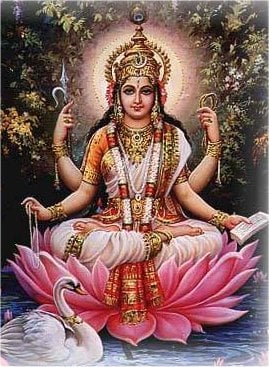
Saraswati
As I sat in meditation yesterday I was reminded of the blessings I’ve received thanks to my education, and in the course of my studies I never forgot the privilege it was to be a woman, much less studying theology. In the United States, until fairly recently, it was a rare event for women to study theology. Several of the women that I studied under (including the iconic Rosemary Radford Ruether) received their doctorates in the 1960s and ’70s. Most of them did not write their dissertations on the topics for which they are now known. For example, Judith Plaskow, renowned Jewish feminist theologian, wrote her dissertation on the theologies of Reinhold Niebuhr and Paul Tillich, two Protestant theologians. I will wager a guess that the female professors I was able to study under at the graduate level had few, if any, female professors themselves when they were in school.
Looking at the broader history of Western religion and education, I can quickly name only three great female theologians before the mid-twentieth century, Saints Macrina, Hildegard von Bingen, and Julian of Norwich. Macrina the Younger was sister to two of the three great Cappadocian Fathers, Basil the Great and Gregory of Nyssa. Gregory wrote about her, praising her intellect and claiming that she had a prominent role in his education. It is not unlikely that she influenced his theology, yet she wrote nothing of her own. Hildegard von Bingen lived in the twelfth century and was nothing short of a polymath genius. She was a mystic, a theologian, an abbess, a composer, and a scientist. Julian of Norwich, born in the mid-fourteenth century, is most famous for her Revelations of Divine Love, a collection of her mystical visions.
There are other mystics and influential female theologians, but not many in the grand sweep of a Christian tradition of two thousand years. Given that most people did not receive a formal education, and women not even until the late 19th century, I see my own education as a recent privilege and do not take it for granted. Even today in many parts of the world women are still denied access to an education. Many boys may receive only a basic education or are given only a religious education, without an understanding of science, arts, and the world around them.
We can see the struggle for learning in the life of young Malala Yousafzai. She is a Pakistani Muslim, so I hope she will forgive the comparison, but I see her as an incarnation of Saraswati. This is the young girl who was shot in the face by the Taliban for doggedly pursuing her studies, even after she had been warned to quit. She survived, had reconstructive surgery, and now speaks – in excellent English – around the world on behalf of education for all. Her determination and insistence that education is important, valuable, and necessary is full of Saraswati energy. Not only must she contain some fierce passion in her heart, and have the love and support of those closest to her, but surely she must be blessed by Saraswati and Athena and all the gods who love learning! I imagine Athena and Saraswati proudly blessing their bold daughter, Malala. I cannot help but think the gods love her: she was shot in the face and did not die, but held fast to her dedication to learning. With that dedication she now, at the age of 16, campaigns for everyone’s right to learn.
I am in awe of her. I will ask Saraswati for blessings upon her, her family, and her work.
As a white, middle class American it can be far too easy to take education for granted. I harbor a deep love of learning. I crave complex ideas, beautiful words, and critical thinking. And as a woman I do not take the opportunity for education for granted. I expect my children, a boy and girl, to value learning. My husband and I can talk about why and how our education and ability to learn has benefited us. I can point toward the history of women being allowed to learn at all. I can point to Malala, reminding them that in some parts of the world, it’s not just females who aren’t allowed to learn, but boys’ learning is limited as well. There are plenty of examples of how limited education is bad for all people and all societies. The rise of militant religious fundamentalism is but one very strong example.
In honor of Saraswati, I praise education. Let us educate our sons and daughters, let us honor all incarnations and glimpses of Saraswati and Athena, and let us continue to educate ourselves!
Previous Post

October 8, 2013
Navratri 2013
Next Post
October 14, 2013 Maxim Monday: Consult the Wise
Browse Our Archives
Select a Category Alaska altar altars Ana Ancestors Anderson witchcraft Arddu Bhairava Biography bodies books Christianity Christmas community current events death Delphic Maxims Dhumavati dual observance Durga Faery family life feminism Feri Feri tradition Feri witchcraft food ganesha gratitude Guest Post guru health Hinduism holidays Jesus Kali Lakshmi land links magic Many Gods West movie review movies music my heart mystery myth Navratri Orthodoxy pagan pagan culture paganism pantheacon parenting Place politics polytheism practice pratice prayer Red Goddess review ritual sacred arts Samhain Saraswati Shinto Shiva singing Star Goddess Tantra tarot the Gods theory Uncategorized values virgin mary wales washington winter witchcraft year in review yoga
Select a Month September 2015 August 2015 July 2015 June 2015 May 2015 April 2015 March 2015 February 2015 January 2015 December 2014 November 2014 October 2014 September 2014 August 2014 July 2014 June 2014 May 2014 April 2014 March 2014 February 2014 January 2014 December 2013 November 2013 October 2013 September 2013 August 2013 July 2013 June 2013 May 2013 April 2013 March 2013 February 2013 January 2013 December 2012 November 2012 October 2012 September 2012 August 2012 July 2012 June 2012 May 2012 April 2012 March 2012 February 2012 January 2012 December 2011 November 2011 October 2011 September 2011 August 2011 July 2011 June 2011
Follow Us!
TAKE THE
Religious Wisdom Quiz
Which prophet was a shepherd and a sycamore-fig farmer?
Select your answer to see how you score.
Joel Micah Amos Daniel
Related posts from A Witch's Ashram

So Long, and Thanks for All the Clicks

Polytheism, Politics, Discomfort, and Growth


Many Gods, Many Peoples, Many Experiences
TRENDING AT PATHEOS Pagan

I was recently chatting with someone on Instagram. She asked me what...

While there are many people who share their results, the end of...

On July 23, I saw Christopher Nolan's The Odyssey which is Homer’s...

As I write this two big events have just finished up. One...

Restoring the Watershed of Divine Love
Perhaps cooperation is not something we manufacture through legislation, ideology, or moral...

Many UUs don’t pray because of bad experiences in a previous religion,...
view all Pagan blogs
Ad-Free & Subscriber Log-In Subscription Support
- About Us
- 2026 Calendar
- Videos
- Podcasts
- Library of World Religions
- Faith In Media Tracker
- Advertise With Us
- Write for Us
- Privacy Policy
- Terms of Service
- Do Not Sell My Data
- Contact Us
- Radiant Digital
- Manage Newsletter Subscriptions
- Unsubscribe From Notifications
- Sitemap
Copyright 2008-2026, Patheos. All rights reserved.
Subscription Support Ad-Free & Subscriber Log-In
Follow Patheos