
BuddhistCatholicContemplativeEvangelicalGeneral ChristianHinduJewishLatter-day SaintMuslimNew VisionsProgressive Christian
Beliefs
- Buddhist
- Catholic
- Contemplative
- Evangelical
- General Christian
- Hindu
- Jewish
- Latter-day Saint
- More Voices
- Muslim
- New Visions
- Pagan
- Progressive Christian
Topics
- Religion News
- Food and Religion
- Sports and Religion
- Religious Art
- Religious Music and Entertainment
- Religious Events
- History and Religion
- Style and Religion
- Politics and Religion
- Women in Religion
- Recreation Outdoors and Religion
- Business Finance and Religion
- Careers Workplace and Religion
- Education and Religion
- Family Parenting and Religion
- Health Fitness and Religion
- Home and Religion
- Relationships and Religion
- Technology and Religion
- Travel and Religion
Columnists
- Buddhist Columnists
- Business Finance and Religion Columnists
- Careers Workplace and Religion Columnists
- Catholic Columnists
- Contemplative Columnists
- Education and Religion Columnists
- Evangelists Columnists
- Family Parenting and Religion Columnists
- General Christian Columnists
- Health Fitness and Religion Columnists
- Hindu Columnists
- History and Religion Columnists
- Home and Religion Columnists
- Jewish Columnists
- More Voices Columnists
- Latter Day Columnists
- Muslim Columnists
- New Visions Columnists
- Nonreligious Columnists
- Pagan Columnists
- Politics and Religion Columnists
- Progressive Columnists
- Recreation Outdoors and Religion Columnists
- Relationships and Religion Columnists
- Religion News Columnists
- Religious Art Columnists
- Religious Events Columnists
- Religious Music and Entertainment Columnists
- Sports and Religion Columnists
- Style and Religion Columnists
- Technology and Religion Columnists
- Travel and Religion Columnists
- Women in Religion Columnists
Resource Library
- 2026 Calendar
- Library of World Religions
- The 100 Most Holy Places on Earth
- Patheos Answers
- Podcasts
- Videos
- Faith Leaders Database
- Anglican Episcopalian
- Bahai
- Baptist
- Buddhism
- Christianity
- Confucianism
- Eastern Orthodoxy
- Hinduism
- Holiness and Pentecostal
- ISKCON
- Islam
- Judaism
- Lutheran
- Methodist
- The Church of Jesus Christ of Latter-day Saints
- New Age
- Paganism
- Presbytarian and Reformed
- Protestantism
- Religion Behind the Scenes
- Roman Catholic
- Scientology
- Shia Islam
- Sikhism
- Sufism
- Sunni Islam
- Taoism
- Zen
- See all religions
Research Tools
 Ad-Free & Subscriber Log-In Subscription Support
Ad-Free & Subscriber Log-In Subscription Support
Follow Patheos 

- Trending:
- Forgiveness
- |
- Marriage
- |
- Consciousness
- |
- Death Penalty
- |
- Election
- |
- Halloween
 A Witch's Ashram
- Home
- Pagan
- The best non-magic books about magic, part 1
The best non-magic books about magic, part 1
Last updated on: September 5, 2012 at 11:51 am by Niki Whiting
The best non-magic books about magic, part 1 2012-09-05T11:51:37-08:00 Niki Whiting
Patheos Explore the world's faith through different perspectives on religion and spirituality! Patheos has the views of the prevalent religions and spiritualities of the world.
My two most favorite books about magic aren’t explicitly about magic at all. One is a philosophical work in the ‘deep ecology’ vein, the other is a young adult book about Vikings and Saxons.
In this post I’ll review (oh, who am I kidding? I’ll praise) David Abram’s The Spell of the Sensuous. I first learned of this book three years ago, during my first autumn in Wales. My friend, Haloquin, loaned it to me. I was thick into my PhD studies, so I did a ‘grad school skim.’ I loved it and knew it was a book I’d come back to. Fast forward to my Place quarter and I wanted to re-read and review this book for that quarter. However, the book is so lush, so dense, so thought-provoking, and I have so few long, uninterrupted reading moments, that it has taken me the better part of four months to finish it. It’s not a long book: about 300 pages with extensive notes. It’s not you, book, it’s me being the parent of small children.
The Spell of the Sensuous is a book to savour, to read in sections and then ponder while you do the dishes, sit under a tree, or walk around your neighborhood. It’s a book whose ideas about connection, listening, reciprocity, and relationship demand meditation.
The basic gist of the book is this: language and the written language has separated us from being in relationship with the land and other living things; our surroundings do communicate with us, but we have come to privilege only a few ways of knowing, learning, and communicating, and are therefore shut off from the wisdom that is all around us. This leads us to devalue the natural world and inevitably run roughshod over it, in extreme cases silencing the Land permanently.
Humans are story tellers. We long to communicate and be heard. Oral cultures tell stories in certain ways, and while we are no longer an oral culture, we continue to tell stories all the time. We use movies, novels, television, and blogs to tell each other stories, to tell our own stories. We use fandom and social media to bond over and engage with these stories. Our religious systems use stories too (narrative theology), whether that’s to help us feel part of something bigger and more timeless, or to control us and keep up in check.
Abram presents us with an idea that the Land tells stories and humans participate and engage in those stories through creation tales, the cycles of seasons, the ebbs and flows of tides, populations, and epic life events. The Land becomes a container: a moral, communal, temporal, as well as physical container for communities. Abram cites many examples from many different kinds of oral cultures. I find it fascinating to see how modern society tries to recreate the same things, only using different methods.
That’s the larger scale. On a smaller scale, we seem to have lost the art of observation. We forget that a patient and skilled eye can notice incredible subtleties. This is part of wisdom. Careful gardeners might learn from experience which fertilizer works best in their particular soil, which flowers draw the bees, might start to learn the cycles of flowers and birds in ways that books can’t teach. Some one who is outside a lot can learn to anticipate rain long before the clouds roll over and drops fall – just from the shifts in the air. This is a form of communication. Realizing that we are in relationship with everything – I touch an ant, it senses me, I sense it – isn’t to make the non-human world into gods (although you can go ahead and do that, and I think this book will give you fodder for it). It is merely to realize that other living things sense and respond to us, just in different ways than we perceive.
And that very perception is at the heart of magic! Do we have ears to hear? Eyes to see? I’m guessing most of us could use some sharper ears and eyes – I know I do. How can we hone our sense and spirits to perceive the magic that is all around us? For those of us that do believe in gods, might not they be trying to communicate with us, but we’ve just gotten dulled? Unable to see them or hear them as clearly as we could?
For those of you with little patience for eco-apocalyptic tales, have no fear, this is not one of them. It does create a sense of urgency to engage with the world and live WITH the Land and all non-human creatures, as opposed to OVER and AGAINST the Land. What I walk away with is a beautiful, sensuous encouragement to listen, to look, to feel, to engage with the wider world around me, to “reinhabit” my surroundings. It makes me pained for the all too loud hum of my refrigerator and the neighbors’ perpetual too bright porch light.
This is not a religious or spiritual book. It’s not an academic book either, even though Abram has used phenomenology, a branch of philosophy, as his methodology. You could skip those sections and still get a lot out of this book. Abram does not present himself, nor even come across as, a religious person in any tradition. Yet he finds a sense of the numinous in the wider world, and this work speaks so deeply of magic that I cannot help thinking ‘yes, this!’ over and over again, even in a magical, spiritual context.
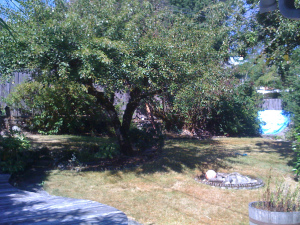
My backyard, taken just after I wrote this post
This is a book that sits on my desk, asking me to pick it up and reread sections. I have several other blog posts stewing my head, based on passages from this book! I cannot recommend this book enough. Want to jump start your magical practice? Want to shake up your usual way of thinking? Want to go deeper? Read The Spell of the Sensuous. Are you not spiritual or magical (or don’t consider yourselves such) but just want a beautifully written, philosophical book to explore a new way of thinking about our surroundings? Read this book.
I am reminded over and over again how profound it is to listen, to observe, to just be with what is around me. This book makes me want to go hiking, to go out into the fjords of SE Alaska again, but it also makes me want to sit out in my backyard and listen to the bugs and trees and birds. And to get dirty. To be more in touch with my primal, non-verbal self. I’m certain the gods approve.

Another land I love: the view of the Chilkat Mountains, as seen from Paradise Point on Shelter Island, Alaska
Previous Post

September 2, 2012
Control Yourself
Next Post
September 6, 2012 Guest posting
Browse Our Archives
Select a Category Alaska altar altars Ana Ancestors Anderson witchcraft Arddu Bhairava Biography bodies books Christianity Christmas community current events death Delphic Maxims Dhumavati dual observance Durga Faery family life feminism Feri Feri tradition Feri witchcraft food ganesha gratitude Guest Post guru health Hinduism holidays Jesus Kali Lakshmi land links magic Many Gods West movie review movies music my heart mystery myth Navratri Orthodoxy pagan pagan culture paganism pantheacon parenting Place politics polytheism practice pratice prayer Red Goddess review ritual sacred arts Samhain Saraswati Shinto Shiva singing Star Goddess Tantra tarot the Gods theory Uncategorized values virgin mary wales washington winter witchcraft year in review yoga
Select a Month September 2015 August 2015 July 2015 June 2015 May 2015 April 2015 March 2015 February 2015 January 2015 December 2014 November 2014 October 2014 September 2014 August 2014 July 2014 June 2014 May 2014 April 2014 March 2014 February 2014 January 2014 December 2013 November 2013 October 2013 September 2013 August 2013 July 2013 June 2013 May 2013 April 2013 March 2013 February 2013 January 2013 December 2012 November 2012 October 2012 September 2012 August 2012 July 2012 June 2012 May 2012 April 2012 March 2012 February 2012 January 2012 December 2011 November 2011 October 2011 September 2011 August 2011 July 2011 June 2011
Follow Us!
TAKE THE
Religious Wisdom Quiz
What is written on Jesus’ robe in Revelation 19:16?
Select your answer to see how you score.
The Alpha and Omega King of Kings and Lord of Lords The Lamb of God The Lion of Judah
Related posts from A Witch's Ashram



TRENDING AT PATHEOS Pagan

I was recently chatting with someone on Instagram. She asked me what...

While there are many people who share their results, the end of...

On July 23, I saw Christopher Nolan's The Odyssey which is Homer’s...

As I write this two big events have just finished up. One...

Restoring the Watershed of Divine Love
Perhaps cooperation is not something we manufacture through legislation, ideology, or moral...

Many UUs don’t pray because of bad experiences in a previous religion,...
view all Pagan blogs
Ad-Free & Subscriber Log-In Subscription Support
- About Us
- 2026 Calendar
- Videos
- Podcasts
- Library of World Religions
- Faith In Media Tracker
- Advertise With Us
- Write for Us
- Privacy Policy
- Terms of Service
- Do Not Sell My Data
- Contact Us
- Radiant Digital
- Manage Newsletter Subscriptions
- Unsubscribe From Notifications
- Sitemap
Copyright 2008-2026, Patheos. All rights reserved.
Subscription Support Ad-Free & Subscriber Log-In
Follow Patheos