
BuddhistCatholicContemplativeEvangelicalGeneral ChristianHinduJewishLatter-day SaintMuslimNew VisionsProgressive Christian
Beliefs
- Buddhist
- Catholic
- Contemplative
- Evangelical
- General Christian
- Hindu
- Jewish
- Latter-day Saint
- More Voices
- Muslim
- New Visions
- Pagan
- Progressive Christian
Topics
- Religion News
- Food and Religion
- Sports and Religion
- Religious Art
- Religious Music and Entertainment
- Religious Events
- History and Religion
- Style and Religion
- Politics and Religion
- Women in Religion
- Recreation Outdoors and Religion
- Business Finance and Religion
- Careers Workplace and Religion
- Education and Religion
- Family Parenting and Religion
- Health Fitness and Religion
- Home and Religion
- Relationships and Religion
- Technology and Religion
- Travel and Religion
Columnists
- Buddhist Columnists
- Business Finance and Religion Columnists
- Careers Workplace and Religion Columnists
- Catholic Columnists
- Contemplative Columnists
- Education and Religion Columnists
- Evangelists Columnists
- Family Parenting and Religion Columnists
- General Christian Columnists
- Health Fitness and Religion Columnists
- Hindu Columnists
- History and Religion Columnists
- Home and Religion Columnists
- Jewish Columnists
- More Voices Columnists
- Latter Day Columnists
- Muslim Columnists
- New Visions Columnists
- Nonreligious Columnists
- Pagan Columnists
- Politics and Religion Columnists
- Progressive Columnists
- Recreation Outdoors and Religion Columnists
- Relationships and Religion Columnists
- Religion News Columnists
- Religious Art Columnists
- Religious Events Columnists
- Religious Music and Entertainment Columnists
- Sports and Religion Columnists
- Style and Religion Columnists
- Technology and Religion Columnists
- Travel and Religion Columnists
- Women in Religion Columnists
Resource Library
- 2026 Calendar
- Library of World Religions
- The 100 Most Holy Places on Earth
- Patheos Answers
- Podcasts
- Videos
- Faith Leaders Database
- Anglican Episcopalian
- Bahai
- Baptist
- Buddhism
- Christianity
- Confucianism
- Eastern Orthodoxy
- Hinduism
- Holiness and Pentecostal
- ISKCON
- Islam
- Judaism
- Lutheran
- Methodist
- The Church of Jesus Christ of Latter-day Saints
- New Age
- Paganism
- Presbytarian and Reformed
- Protestantism
- Religion Behind the Scenes
- Roman Catholic
- Scientology
- Shia Islam
- Sikhism
- Sufism
- Sunni Islam
- Taoism
- Zen
- See all religions
Research Tools
 Ad-Free & Subscriber Log-In Subscription Support
Ad-Free & Subscriber Log-In Subscription Support
Follow Patheos 

- Trending:
- Forgiveness
- |
- Marriage
- |
- Consciousness
- |
- Death Penalty
- |
- Election
- |
- Halloween
 Away with the Witch!
- Home
- Pagan
- Roman curse tablets in England
Roman curse tablets in England
Last updated on: January 4, 2019 at 3:31 pm by Lyn Thurman
Roman curse tablets in England 2019-01-04T15:31:35+01:00 Lyn Thurman
Patheos Explore the world's faith through different perspectives on religion and spirituality! Patheos has the views of the prevalent religions and spiritualities of the world.
Living in Britain, you’re never far from history: it’s literally under our feet. All it takes it a little curiosity and research to find out about who once lived, loved and died in your local area. At school, we were taught general history from the Roman invasion onward but I was never particularly interested in the Roman era. Recently, that’s changed.
I live about seven-miles away from the town of Portchester, known as Portus Adurni to the Romans and an important defence to see off Saxon invaders. Today, the walls, built in the 3rd century, are almost all intact.
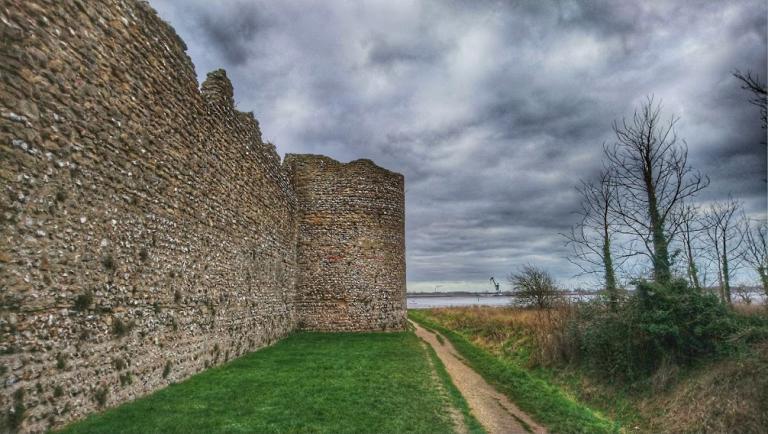
Roman walls at Portchester, Hampshire, UK
I often visit the Roman walls and the old church, built in the 1120s, within them (there’s a labyrinth in the churchyard). There’s a castle too, managed by English Heritage, within the Roman walls which makes an interesting visit if you’re ever down this way.
I’ve known about Portchester ever since I moved down to the south coast but I was not aware, until a couple of weeks ago, that a couple of miles from my home is a Roman curse tablet.
Curse tablets, made from small sheets of lead or pewter, were written petitions to the gods to intervene on the inscriber’s behalf. Once written, they were rolled up and placed somewhere for the gods to see. In Britain, watery places were popular to dump the curses.
Out of the 500 or so Roman curse tablets discovered throughout the lands occupied by the Romans, half have been found in Britain. It seems like cursing has been a favoured pastime of the inhabitants of this land since antiquity! British curses favoured revenge and the recovery of stolen goods whereas continental curses were biased towards sex and gambling.
I’ve seen a curse tablet before at the Roman baths in Bath, near Bristol. The temple there was dedicated to Sulis Minerva so it was the goddess petitioned to seek revenge and retribution. Over a hundred curse tablets, made of pewter or lead, have been recovered at Bath. Almost as many curse tablets have been uncovered at a site of a Roman temple, believed to be dedicated to Mercury, at Uley in Gloucestershire.
My local curse tablet was found within the mud flats of the river Hamble, Hampshire and is now in Westbury Manor museum, Fareham.
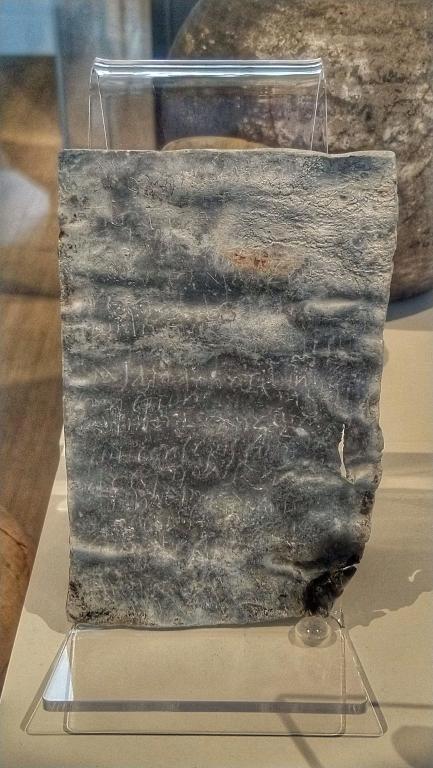
Roman curse tablet, Westbury Manor museum, Hampshire
The inscription, written on lead and in Latin, reads:
Lord Neptune, I give you the man who has stolen the solidus (gold coin) and six argentioli (silver coins) of Muconius. So I give the names who took them away, whether male or female, boy or girl. So give you Niskus, and to Neptune, the life, health, blood, of him who has been privy to that taking away. The mind which stole this and has been privy to it, may you take it away. The thief that stole this, may you consume his blood and take it away, Lord Neptune.
I wonder if Muconius ever did get his money back.

About Lyn Thurman
Lyn Thurman is a witch and priestess on the south coast of England. She's the author of The Inner Goddess Revolution and Goddess Rising, and the creator of the Sea Whispers oracle. When she's not writing, she is helping authors build their business and find their voice at the Quiet Rebel Bureau (or she's obsessing over vegan cakes). You can read more about the author here.
Previous Post

December 21, 2018
Self-Care for the Darkest Night
Next Post

January 12, 2019 The Sacred Pause of Winter
Browse Our Archives
Select a Category Musings Paganism Reviews Wicca Witchcraft
Select a Month December 2020 November 2020 August 2020 May 2020 April 2020 February 2020 January 2020 November 2019 October 2019 September 2019 August 2019 July 2019 June 2019 May 2019 April 2019 March 2019 February 2019 January 2019 December 2018 November 2018 October 2018 September 2018 August 2018
Follow Us!
TAKE THE
Religious Wisdom Quiz
What does Jeremiah use to symbolize Israel's relationship to God in Jeremiah 18?
Select your answer to see how you score.
A potter and clay A bride and bridegroom A tree and fruit A shepherd and sheep
Related posts from Away with the Witch!



Finding and Working with a Genius Loci

TRENDING AT PATHEOS Pagan

I was recently chatting with someone on Instagram. She asked me what...

While there are many people who share their results, the end of...

On July 23, I saw Christopher Nolan's The Odyssey which is Homer’s...

As I write this two big events have just finished up. One...

Restoring the Watershed of Divine Love
Perhaps cooperation is not something we manufacture through legislation, ideology, or moral...

Many UUs don’t pray because of bad experiences in a previous religion,...
view all Pagan blogs
Ad-Free & Subscriber Log-In Subscription Support
- About Us
- 2026 Calendar
- Videos
- Podcasts
- Library of World Religions
- Faith In Media Tracker
- Advertise With Us
- Write for Us
- Privacy Policy
- Terms of Service
- Do Not Sell My Data
- Contact Us
- Radiant Digital
- Manage Newsletter Subscriptions
- Unsubscribe From Notifications
- Sitemap
Copyright 2008-2026, Patheos. All rights reserved.
Subscription Support Ad-Free & Subscriber Log-In
Follow Patheos