
BuddhistCatholicContemplativeEvangelicalGeneral ChristianHinduJewishLatter-day SaintMuslimNew VisionsProgressive Christian
Beliefs
- Buddhist
- Catholic
- Contemplative
- Evangelical
- General Christian
- Hindu
- Jewish
- Latter-day Saint
- More Voices
- Muslim
- New Visions
- Pagan
- Progressive Christian
Topics
- Religion News
- Food and Religion
- Sports and Religion
- Religious Art
- Religious Music and Entertainment
- Religious Events
- History and Religion
- Style and Religion
- Politics and Religion
- Women in Religion
- Recreation Outdoors and Religion
- Business Finance and Religion
- Careers Workplace and Religion
- Education and Religion
- Family Parenting and Religion
- Health Fitness and Religion
- Home and Religion
- Relationships and Religion
- Technology and Religion
- Travel and Religion
Columnists
- Buddhist Columnists
- Business Finance and Religion Columnists
- Careers Workplace and Religion Columnists
- Catholic Columnists
- Contemplative Columnists
- Education and Religion Columnists
- Evangelists Columnists
- Family Parenting and Religion Columnists
- General Christian Columnists
- Health Fitness and Religion Columnists
- Hindu Columnists
- History and Religion Columnists
- Home and Religion Columnists
- Jewish Columnists
- More Voices Columnists
- Latter Day Columnists
- Muslim Columnists
- New Visions Columnists
- Nonreligious Columnists
- Pagan Columnists
- Politics and Religion Columnists
- Progressive Columnists
- Recreation Outdoors and Religion Columnists
- Relationships and Religion Columnists
- Religion News Columnists
- Religious Art Columnists
- Religious Events Columnists
- Religious Music and Entertainment Columnists
- Sports and Religion Columnists
- Style and Religion Columnists
- Technology and Religion Columnists
- Travel and Religion Columnists
- Women in Religion Columnists
Resource Library
- 2026 Calendar
- Library of World Religions
- The 100 Most Holy Places on Earth
- Patheos Answers
- Podcasts
- Videos
- Faith Leaders Database
- Anglican Episcopalian
- Bahai
- Baptist
- Buddhism
- Christianity
- Confucianism
- Eastern Orthodoxy
- Hinduism
- Holiness and Pentecostal
- ISKCON
- Islam
- Judaism
- Lutheran
- Methodist
- The Church of Jesus Christ of Latter-day Saints
- New Age
- Paganism
- Presbytarian and Reformed
- Protestantism
- Religion Behind the Scenes
- Roman Catholic
- Scientology
- Shia Islam
- Sikhism
- Sufism
- Sunni Islam
- Taoism
- Zen
- See all religions
Research Tools
 Ad-Free & Subscriber Log-In Subscription Support
Ad-Free & Subscriber Log-In Subscription Support
Follow Patheos 

- Trending:
- Forgiveness
- |
- Marriage
- |
- Consciousness
- |
- Death Penalty
- |
- Election
- |
- Halloween
 Ask Angus
- Home
- Pagan
- Ask Angus #38: A Web of Indigenous Jolly Ranchers
Ask Angus #38: A Web of Indigenous Jolly Ranchers
Last updated on: October 24, 2017 at 7:58 am by Angus McMahan
Ask Angus #38: A Web of Indigenous Jolly Ranchers 2017-10-24T07:58:29-07:00 Angus McMahan
Patheos Explore the world's faith through different perspectives on religion and spirituality! Patheos has the views of the prevalent religions and spiritualities of the world.
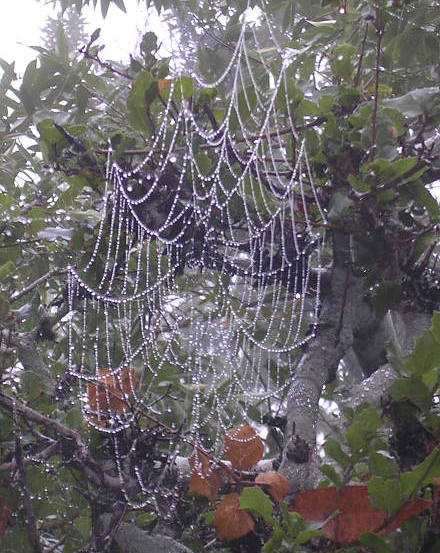
Not a tangled web we weave……
All Wrapped Up: What is a “Cob Web”? I know what a spider web is but a cob web? Can’t be made by male Swans.
Dear Wrap, Easy to get confused. A cob web IS a spider web. Colloquially it’s ‘spider’, officially scientifically nerdily its ‘cob’. Further confusion: Cob, as in web, comes from the archaic word coppe, which means……wait for it……spider.
Coppe is not to be confused with loppe, which is the Old English word for spider, but the word is not related to cob.
Still not confused? Remember Shelob, the monstrous arachnid from “The Lord of the Rings”? Well, J.R.R. Tolkien named her that because ‘she’ (duh), + ‘lob’ which is close enough to ‘loppe’, the Old English word for spider.
And ‘lob’ sounds like ‘cob’ but the two have different family trees and so are not related.
Except of course, that they both mean ‘spider’.
You are correct in that a male swan is called a ‘cob’, but that’s Middle English (‘cobbe’) which means ‘leader’, and is in no way related to the Old English ‘loppe’ or the archaic ‘coppe’.
Got it? No? Think of it this way then: Swans are large, white, have feathers, only two legs, and they don’t spin webs.
Not just another white person: I recently had an indigenous person become openly hostile about aspects of my magical path. He said that my use of the directions, the Elements, the correspondences and the Spirit Guardians for each direction were just another example of ‘white people stealing ideas that they don’t understand’. His anger took me by surprise and I tried to explain that these things exist in cultures throughout the world, but he wasn’t having it. The conversation did make me think, though, about how we pull in ideas from the Kabbalah to Shamanism in our practice. So, how is witchcraft different than cultural appropriation and should there be a line drawn.
Dear NJAWP,
Excellent question! Cultural Appropriation is a very real thing, and something that non-white peoples have every right to be angry about.
And yes, lines should be drawn. Problem is, this is the Occult we’re talking about, meaning that every witch draws their own lines for their own selves.
My personal standard goes something like this: Did this action/direction/deity/lifestyle come from a specific group of people? Has it remained unique and unchanged over a specific period of time? And will my using it harm/diminish/embarrass the tradition from whence it came?
So, Native American headdresses? Right out.
Karma? Its a 3 part concept and most people only seem to use the 2nd part, and then out of context. Its a central tenet to several eastern religions, none of which are mine, so I have chosen not to use the term.

Team “Do or Do Not There Is No Try” doing yoga poses at the Oyster Race San Francisco, 2011
Yoga? Its an ancient system, altered, blended and watered down through several cultures on its way to the west, landing about 130 years ago. The term and its practices are so varied and widespread that I don’t believe there is much left of the Samkhya Philosophy of the Hindu in my Hatha stretching down at 24 hour Fitness. So I will allow that.
Regarding your examples that peeved your indigenous friend, I would go with:
- Paganism using directions? Well, I’m pretty sure EVERY culture has the concept of ‘this way means this, and we’ll call it that’ and this way over here means this other thing and so on.
- The Elements? The classic 4 (or 5) from The Golden Dawn up to Silver Ravenwolf use the classic elements first laid down by the ancient Greeks. I’m calling that one okay.
- The 3 realms comes from Irish Reconstructionists. Allowed.
- Correspondences? I’ve read about many, utilized several, and honed mine down to a few. None of which I have ever heard came from a Native American tradition.
- Spirit Guardians for each direction? Maybe, but it would depend on how YOU are characterizing your watchtowers, and whether that was taken from a native tribes way of worship.
In short, NJAWP, your friend is accusing you of using concepts that are ill-defined and Universal. More specificity is necessary for their case to stick.
Cultural Appropriation is a filter that we need to keep in place, but we all draw the line differently. I wouldn’t host a pow-wow, but Shamanism is a fuzzy concept that one can find world-wide. Kabbalah in Witchcraft is no-go with me, but I know several Jewitches who have no problem integrating Jewish Mysticism into their Paganism.
Meanwhile, I will continue to eat burritos and listen to the blues.
Candy Crush: Why are they called Jolly Ranchers? Are ranchers particularly Jolly?
Dear CC,
Bless you for having the courage to finally address one of the central mysteries of our modern existence.
The little, hard candies are called “Jolly Ranchers” because the inventor, Bill Harmsen, sold his goods around Denver, Colorado and he wanted a name that sounds ‘hospitable and Western’.
Now, to the second, and more esoteric conundrum that you have unearthed for us: Are ranchers particularly happy?
Turns out they are! Fishing people and forestry folks too. In fact, anything rural, outdoorsy and crafty is going to score high in the squee department.

Making something, out in the forest, near a stream. Recipe for happiness!
A recent report from the British Office of National Statistics showed 3 clear criteria for a happy job (and by extension, a happy life):
1) Work closely with the land
2) Work around water
3) Make a physical product
Sound good? See? Happy times. Think of the 8 of pentacles: the earnest, contented worker. Who is making something tangible.
Why do so many people live next to an ocean, when its much cheaper to live in a city in flyover country?
But I think there is something older and deeper here. I’m not advocating wearing animal skins and living in a cave again, but it does seem like the closer we get to our ancestors, the jollier we become.
The least happy people in the study were the ones who were the most removed from actual ‘things’.
This ‘back to the land and make stuff’ motif has played out for me in my jobs. The happiest work I’ve had is being a delivery person on a bicycle (work with the land), and my current job at a print shop (making stuff). And the only good thing about the job at the hot tub showroom was that I was around water all day!
There is something else too. All employment carries with it stress and unknowns, but with the older jobs the problems were immediate and tangible. For cube slaves the pressures are more convoluted and the results are ephemeral at best.
But when I worked at a Whole Foods Market I was very close to the land (with the produce changing with the seasons), my work was hard but also simple and rewarding. And I was doing a job that people have been doing for hundreds of years.
So yes, Candy Crush, they’re called Jolly Ranchers because Ranchers (a/k/a people who work with Nature) are jolly. And you too can be more jolly by spending more time outside, near water, making something.
While eating candy.
~Ask Angus
Send your questions, about paganism (or anything!) to:
[email protected]
Sources:http://www.chatelaine.com/the-happiness-plan/why-farmers-are-happier-than-the-rest-of-us/
http://webarchive.nationalarchives.gov.uk/
Photo Credit: All photos came from my iPhone.
Previous Post

July 4, 2017
How I Found Paganism - When I Wasn't Even Looking!
Next Post

February 7, 2018 Ask Angus #39: Words to Live By
Browse Our Archives
Select a Category Uncategorized
Select a Month June 2020 December 2019 February 2019 January 2019 September 2018 July 2018 April 2018 February 2018 October 2017 July 2017 March 2017 February 2017 April 2016 July 2015 March 2015 February 2015 December 2014 November 2014 October 2014 April 2014 March 2014 February 2014 December 2013 November 2013 October 2013 September 2013 August 2013 July 2013 June 2013 May 2013 April 2013 March 2013 February 2013
Follow Us!
TAKE THE
Religious Wisdom Quiz
Who was the Roman emperor when Jesus was crucified?
Select your answer to see how you score.
Tiberius Augustus Nero Caligula
Related posts from Ask Angus

Review: Instant Fortune Teller!

Ask Angus #45: Bibbidi-Bobbidi-Boo!

Ask Angus #43: Think Positive about Salty Tarot...
TRENDING AT PATHEOS Pagan

I was recently chatting with someone on Instagram. She asked me what...

While there are many people who share their results, the end of...

On July 23, I saw Christopher Nolan's The Odyssey which is Homer’s...

As I write this two big events have just finished up. One...

Restoring the Watershed of Divine Love
Perhaps cooperation is not something we manufacture through legislation, ideology, or moral...

Many UUs don’t pray because of bad experiences in a previous religion,...
view all Pagan blogs
Ad-Free & Subscriber Log-In Subscription Support
- About Us
- 2026 Calendar
- Videos
- Podcasts
- Library of World Religions
- Faith In Media Tracker
- Advertise With Us
- Write for Us
- Privacy Policy
- Terms of Service
- Do Not Sell My Data
- Contact Us
- Radiant Digital
- Manage Newsletter Subscriptions
- Unsubscribe From Notifications
- Sitemap
Copyright 2008-2026, Patheos. All rights reserved.
Subscription Support Ad-Free & Subscriber Log-In
Follow Patheos