
BuddhistCatholicContemplativeEvangelicalGeneral ChristianHinduJewishLatter-day SaintMuslimNew VisionsProgressive Christian
Beliefs
- Buddhist
- Catholic
- Contemplative
- Evangelical
- General Christian
- Hindu
- Jewish
- Latter-day Saint
- More Voices
- Muslim
- New Visions
- Pagan
- Progressive Christian
Topics
- Religion News
- Food and Religion
- Sports and Religion
- Religious Art
- Religious Music and Entertainment
- Religious Events
- History and Religion
- Style and Religion
- Politics and Religion
- Women in Religion
- Recreation Outdoors and Religion
- Business Finance and Religion
- Careers Workplace and Religion
- Education and Religion
- Family Parenting and Religion
- Health Fitness and Religion
- Home and Religion
- Relationships and Religion
- Technology and Religion
- Travel and Religion
Columnists
- Buddhist Columnists
- Business Finance and Religion Columnists
- Careers Workplace and Religion Columnists
- Catholic Columnists
- Contemplative Columnists
- Education and Religion Columnists
- Evangelists Columnists
- Family Parenting and Religion Columnists
- General Christian Columnists
- Health Fitness and Religion Columnists
- Hindu Columnists
- History and Religion Columnists
- Home and Religion Columnists
- Jewish Columnists
- More Voices Columnists
- Latter Day Columnists
- Muslim Columnists
- New Visions Columnists
- Nonreligious Columnists
- Pagan Columnists
- Politics and Religion Columnists
- Progressive Columnists
- Recreation Outdoors and Religion Columnists
- Relationships and Religion Columnists
- Religion News Columnists
- Religious Art Columnists
- Religious Events Columnists
- Religious Music and Entertainment Columnists
- Sports and Religion Columnists
- Style and Religion Columnists
- Technology and Religion Columnists
- Travel and Religion Columnists
- Women in Religion Columnists
Resource Library
- 2026 Calendar
- Library of World Religions
- The 100 Most Holy Places on Earth
- Patheos Answers
- Podcasts
- Videos
- Faith Leaders Database
- Anglican Episcopalian
- Bahai
- Baptist
- Buddhism
- Christianity
- Confucianism
- Eastern Orthodoxy
- Hinduism
- Holiness and Pentecostal
- ISKCON
- Islam
- Judaism
- Lutheran
- Methodist
- The Church of Jesus Christ of Latter-day Saints
- New Age
- Paganism
- Presbytarian and Reformed
- Protestantism
- Religion Behind the Scenes
- Roman Catholic
- Scientology
- Shia Islam
- Sikhism
- Sufism
- Sunni Islam
- Taoism
- Zen
- See all religions
Research Tools
 Ad-Free & Subscriber Log-In Subscription Support
Ad-Free & Subscriber Log-In Subscription Support
Follow Patheos 

- Trending:
- Forgiveness
- |
- Marriage
- |
- Consciousness
- |
- Death Penalty
- |
- Election
- |
- Halloween
 A Sense of Place
- Home
- Pagan
- Oiche Fhéile Bhríde: The Eve of St. Brighid’s Feast
Oiche Fhéile Bhríde: The Eve of St. Brighid’s Feast
Last updated on: January 30, 2014 at 4:49 pm by Traci
Oiche Fhéile Bhríde: The Eve of St. Brighid’s Feast 2014-01-30T16:49:14+00:00 Traci
Patheos Explore the world's faith through different perspectives on religion and spirituality! Patheos has the views of the prevalent religions and spiritualities of the world.
Tomorrow night is perhaps one of the most celebrated in Ireland. No, there won’t be any mad parties or green beer; not even wild heathen drumming on the High Places. Instead, the evening is about family, purification, and continuity of ancient practice.
You see, the last night of January is the eve of St. Brighid’s Feast–the eve of Imbolc–and it’s a big deal.
The indigenous Irish marked the beginning of their festivals at sundown, and deemed that dark time especially potent. [Consider how this thinking impacts the division of the Irish year between Samhain (winter) and Bealtaine (summer), and how the ‘new’ year begins at Samhain.] While February 1st is unlikely to mark the exact date of the ancient festival, it’s only off by a few days (or 10, as Máire MacNeill would have it), and the practice of keeping the Eve hallow continues.
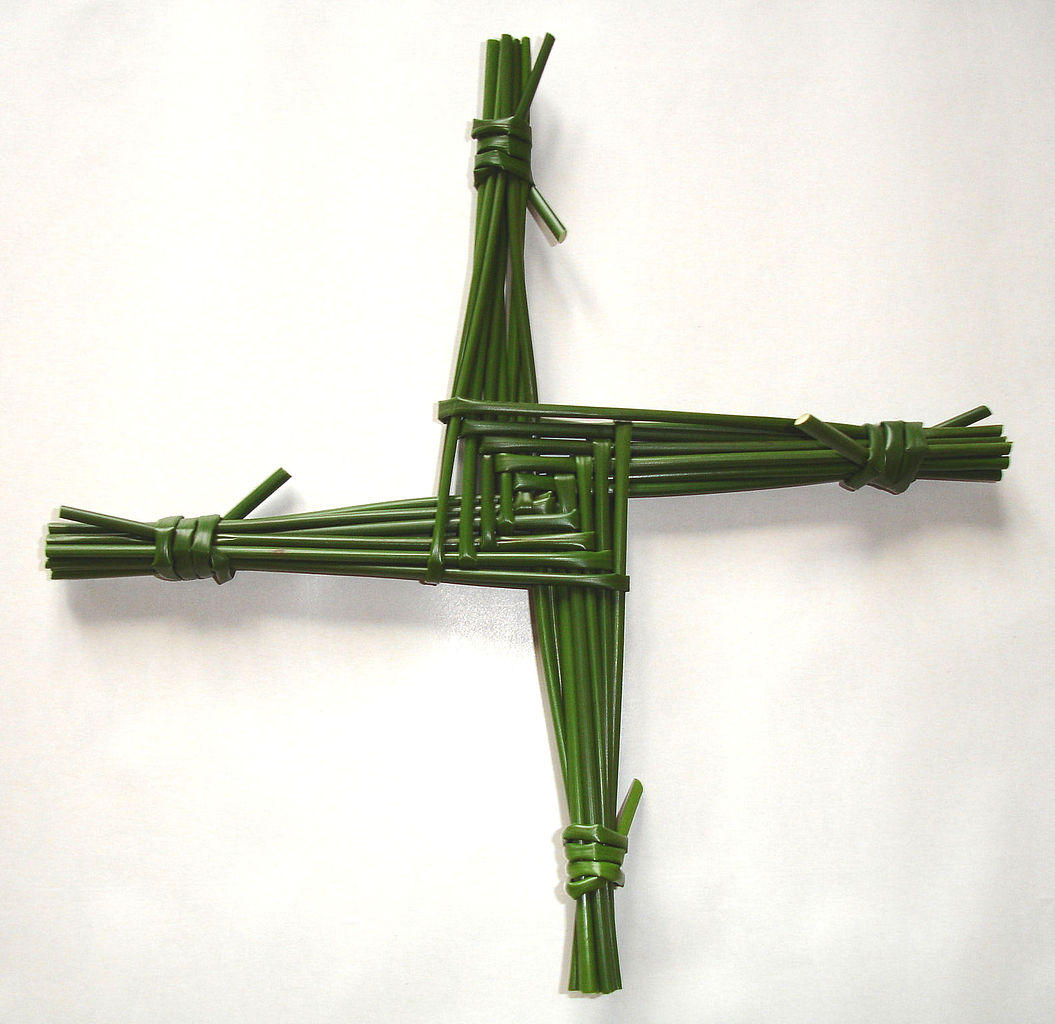
For instance, tomorrow tonight is when the Brídeóg procession took place around the home, and Brighid was invited in for a meal with the family. The Brídeóg was a doll, often fashioned from the last sheaf of grain which was tenderly stored in the barn over winter. In many parts of the country, the young girls of the family collected the Brídeóg from the barn and walked her around the home three times, calling out as they passed the door, “Brigid is coming!” During this Threshold Rite, those inside the home would respond, “Brigid is welcome! Welcome, Brigid!”
Tomorrow night is also the time for making the Solar Cross (Brigid’s Cross); leaving it, and the Brat Bríde (the cloth to be used for healing), on the doorstep to collect her blessing as she enters; and performing fire divination in the hearth ashes after everyone is to bed.
“Brid is come. Brid is welcome. Welcome Brid.”
Another important activity that takes place tomorrow night is the vigil. Many will light candles around their local St. Brigid’s Well, perform the pattern (patron)—which may include circumambulating trees and mounds, in addition to the well—taking the holy water and leaving various offerings. Interestingly, there are often patterns held at the many St. Brighid’s wells on another important (and mirror) festival: Lughnasadh.
On St. Brigid’s Eve, as the night fell,
my mother and I went to Saint Brigid’s Well,
where the candles do burn and the great walls do shine
on the graves of the dead and the vaults of O’Brien.
(Irish Folklore Commission MS 901; 55-56)
The etymology of Imbolc/Imbolg has been tied to the word for milk. Sanas Cormaic (ca. 900) indicates oímelc (sheep’s milk) as an etymological base, but Eric Hamp has argued that the rather complicated etymology should be *uts-molgo- < *ommolg, so that oimelc is a mixed-up spelling for *ommolg. Hamp concludes that Imbolc arises from a root meaning both “milk” and “purification”, and he offers several examples within Irish literature where milk is used in these ways: as a cure for poison darts (1),where it is poured into the battlefield furrows of Eremon (2), and the curious detail from the story of Suibhne, where he drinks milk from a hole made in manure—the original implication being that milk would purify even dung!
So in keeping with the spirit of the season, I am on my spring-time vegetable juice cleanse. It enlivens my system and jump-starts my sluggish winter body. I am also, as my Grandmother taught me, cleaning-out and wiping-down all the surfaces of my home. This is an important step, especially in Ireland, for over the winter, when the sky is gray and low, the damp seeps into corners and down walls. Green peeks through the white wash and rooms begin to smell musty. It is time for a freshen-up!
I am not in Ireland this year, and I already miss the ritual of walking down my lane to gather reeds and visit the Holy Well. I will weave the Solar Cross, though. And into the local foraged materials, I will weave items specific to my livelihood and well-being, tokens I wish Brigid to bless as she visits. This was the purpose of the Brat Bríde: the piece of cloth, often taken from the bread-winner’s clothing, would be put out for blessing. Strips of this would then be used for healing throughout the year, but a piece was also worn by the giver, to protect him/her in their labour. Other tokens of livelihood might also be put out for blessing: grain from the last harvest, seed, milk, butter. For myself, I will put out the pen I use to write, the glasses I use to read scholarly discussion, and tokens that represent my four precious Little Bigs.
If you would like to make your own traditional Imbolc Eve meal, try Colcannon. It’s pretty easy and mighty tasty!
Colcannon (serves 6)
1 1/4 lbs. Kale or green Cabbage
2 cups water
1 tablespoon olive oil
1 1/4 pounds peeled and quartered potatoes
1 tablespoon chopped parsley
1 cup cleaned and chopped leeks white part only
1 cup milk
Pinch of ground mace
Salt and ground pepper to taste
1/2 cup melted butter
Simmer kale or cabbage in 2 cups water and oil for 10 minutes, then drain, and chop fine. Boil potatoes and water, and simmer ’til tender. Simmer the leeks in milk for ten minutes ’til tender. Drain and puree the potatoes. Add leeks and their milk and the cooked kale, and mix in. Add mace, salt and pepper. Mound on a plate and pour on the melted butter.Garnish with parsley.
“Brid agus Muire dhuit.”
We are under the shielding of Bríd each day,
We are under the mantle of Bríd each night,
We shall not be lost in this shifting age,
Nor political corruption dismay us,
Nor apathy delay us.No fire, no sun, nor star shall burn us,
No lake, no water, nor sea shall drown us,
Bríd is our comrade,
Bríd is our escort through danger,
Our choicest of women, our guide.
~ adapted by Traci
Duinn, Seán Ó. “The Rites of Brigid, Goddess and Saint”. The Columba Press.
Hamp, Eric. “Imbolc, Óimelc”. Studia Celtica 14/15 (1979-80), 106-113
MacNeill, Máire. “The Festival of Lughnasadh”. Oxford Press.
(1)
And many early Irish magical charms use butter as a curative agent; cf. Carney, “A Collection of Irish Charms”.
(2)
Eremon is the mythical first Milesian—i.e. human—king of Ireland; his name is thought to derive from the same origin as Aryaman/Airyaman, the Indo-Iranian embodiment of “Aryan-ness”, i.e. nobility and the ruling class.
Previous Post

January 24, 2014
A Choice of Worldings
Next Post

January 31, 2014 On the Hearth and the Un-Hearthed
Browse Our Archives
Select a Category Africa Amazon Ancestors Animism Austin Boots Across Ireland Boston boundary crossing Bretagne Children Cities Community Connection Culture Detroit Druidry Earth Edinburgh Elements England Eskdalemuir Eugene experiential family Fiction Florida folklore France Glasgow Heathenry home how to build it Human Spaces imaginary landscapes Introduction Ireland Journeys Know your wild herbs Land Spirits London Maine memory lane Naturalizing Nature's Metaphors New York Poetry Remembering Ancestors Sacred Spaces San Francisco Scotland Seasons Seattle Tanzania Technology Texas the South Theory Top 10 traditions Travel Uncategorized United States video Water West Virginia Witchcraft Worlding
Select a Month August 2015 June 2015 May 2015 April 2015 March 2015 February 2015 January 2015 December 2014 November 2014 October 2014 September 2014 August 2014 July 2014 June 2014 May 2014 April 2014 March 2014 February 2014 January 2014 December 2013 November 2013 October 2013 September 2013 August 2013 July 2013 June 2013 May 2013 April 2013 March 2013 February 2013 January 2013 December 2012
Follow Us!
TAKE THE
Religious Wisdom Quiz
In what city was Jesus born?
Select your answer to see how you score.
Capernaum Jerusalem Nazareth Bethlehem
Related posts from A Sense of Place

Speaking of Burning Mountains...

The Mountain Of Fire, A Parable

The Most Important Issue Of Our Day

TRENDING AT PATHEOS Pagan

I was recently chatting with someone on Instagram. She asked me what...

While there are many people who share their results, the end of...

On July 23, I saw Christopher Nolan's The Odyssey which is Homer’s...

As I write this two big events have just finished up. One...

Restoring the Watershed of Divine Love
Perhaps cooperation is not something we manufacture through legislation, ideology, or moral...

Many UUs don’t pray because of bad experiences in a previous religion,...
view all Pagan blogs
Ad-Free & Subscriber Log-In Subscription Support
- About Us
- 2026 Calendar
- Videos
- Podcasts
- Library of World Religions
- Faith In Media Tracker
- Advertise With Us
- Write for Us
- Privacy Policy
- Terms of Service
- Do Not Sell My Data
- Contact Us
- Radiant Digital
- Manage Newsletter Subscriptions
- Unsubscribe From Notifications
- Sitemap
Copyright 2008-2026, Patheos. All rights reserved.
Subscription Support Ad-Free & Subscriber Log-In
Follow Patheos