
BuddhistCatholicContemplativeEvangelicalGeneral ChristianHinduJewishLatter-day SaintMuslimNew VisionsProgressive Christian
Beliefs
- Buddhist
- Catholic
- Contemplative
- Evangelical
- General Christian
- Hindu
- Jewish
- Latter-day Saint
- More Voices
- Muslim
- New Visions
- Pagan
- Progressive Christian
Topics
- Religion News
- Food and Religion
- Sports and Religion
- Religious Art
- Religious Music and Entertainment
- Religious Events
- History and Religion
- Style and Religion
- Politics and Religion
- Women in Religion
- Recreation Outdoors and Religion
- Business Finance and Religion
- Careers Workplace and Religion
- Education and Religion
- Family Parenting and Religion
- Health Fitness and Religion
- Home and Religion
- Relationships and Religion
- Technology and Religion
- Travel and Religion
Columnists
- Buddhist Columnists
- Business Finance and Religion Columnists
- Careers Workplace and Religion Columnists
- Catholic Columnists
- Contemplative Columnists
- Education and Religion Columnists
- Evangelists Columnists
- Family Parenting and Religion Columnists
- General Christian Columnists
- Health Fitness and Religion Columnists
- Hindu Columnists
- History and Religion Columnists
- Home and Religion Columnists
- Jewish Columnists
- More Voices Columnists
- Latter Day Columnists
- Muslim Columnists
- New Visions Columnists
- Nonreligious Columnists
- Pagan Columnists
- Politics and Religion Columnists
- Progressive Columnists
- Recreation Outdoors and Religion Columnists
- Relationships and Religion Columnists
- Religion News Columnists
- Religious Art Columnists
- Religious Events Columnists
- Religious Music and Entertainment Columnists
- Sports and Religion Columnists
- Style and Religion Columnists
- Technology and Religion Columnists
- Travel and Religion Columnists
- Women in Religion Columnists
Resource Library
- 2026 Calendar
- Library of World Religions
- The 100 Most Holy Places on Earth
- Patheos Answers
- Podcasts
- Videos
- Faith Leaders Database
- Anglican Episcopalian
- Bahai
- Baptist
- Buddhism
- Christianity
- Confucianism
- Eastern Orthodoxy
- Hinduism
- Holiness and Pentecostal
- ISKCON
- Islam
- Judaism
- Lutheran
- Methodist
- The Church of Jesus Christ of Latter-day Saints
- New Age
- Paganism
- Presbytarian and Reformed
- Protestantism
- Religion Behind the Scenes
- Roman Catholic
- Scientology
- Shia Islam
- Sikhism
- Sufism
- Sunni Islam
- Taoism
- Zen
- See all religions
Research Tools
 Ad-Free & Subscriber Log-In Subscription Support
Ad-Free & Subscriber Log-In Subscription Support
Follow Patheos 

- Trending:
- Forgiveness
- |
- Marriage
- |
- Consciousness
- |
- Death Penalty
- |
- Election
- |
- Halloween
 A Sense of Place
- Home
- Pagan
- Elemental Ethos: Air
Elemental Ethos: Air
Last updated on: February 4, 2015 at 2:19 am by James Lindenschmidt
Elemental Ethos: Air 2015-02-04T02:19:11+00:00 James Lindenschmidt
Patheos Explore the world's faith through different perspectives on religion and spirituality! Patheos has the views of the prevalent religions and spiritualities of the world.

Snow absorbing sound in the Maine woods. January 2015.
It’s snowing again today. The forecast calls for an additional 8-12″ blanket to top off the 30″ already on the ground. It had been a light winter until this week; certainly 3+ feet of snow on the ground changes one’s experience in the landscape substantially.
For me, the most striking thing about the snow is the blanket of quietness it creates. Because I am so attuned to sound as an audiogeek, it’s one of the things I notice early on. I live on a road in Maine that provides irregular roars as logging trucks rumble along at 60 miles per hour, less than 75 feet from my house. Between trucks, the turnpike traffic a mile away slowly breathes its backdrop drone.
With almost no traffic, there is an unfamiliar quiet when it snows. This kind of fluffy snow absorbs sound, so noises don’t travel as far — I’m convinced that the acoustic effects of snow play a big part in the differentiation of the myriad words for snow the indigenous Northerners use. The sonic immediacy of this snowstorm is reminiscent of my work in room acoustics. The first time one hears familiar music in a well-treated acoustic environment can be startling. Being out in the stillness of a gentle snowstorm is similar, making the world somehow both smaller and much larger.
Sound
Sound, as we experience it, is a phenomenon of Air, in the sense that what we are hearing is the vibration of air molecules around us, at sufficient power and frequency to excite our eardrums and hearing mechanisms in our head. Sound is one mode of perception in terms of our sense organs. But there is also music, which is a type of sound. All music is sound, but not all sound is music. The boundaries here are of course subjective, fluid, and in motion…. not unlike music itself.
Language
Language is also a phenomenon of Air, particularly in the sense that the earliest languages were verbal — they were sounds in a place — and not written. Text on a page is one abstraction layer away from sound in a space, though both involve the construction and articulation of ideas and stories.
A striking example of language as sound was the “mic check” technique used at Zuccotti Park during Occupy Wall Street in 2011, in which a person would speak a sentence or a phrase, and the crowd around would loudly repeat the phrase in unison, so others could hear more easily. I remember thinking as I witnessed it, that these were the Bardic Arts in action. I’m sure this technique, with all these consciousnesses focused on repeating the messages, was one reason why the political energy in that place was more than I have experienced anywhere else, ever.
Breath
Breath is perhaps the most obvious manifestation of Air in our lives. It is no accident that nearly every metaphysical or theological tradition emphasizes breath in some way — from Buddhist meditative breath, to the primacy of The Word and notions of Word-Made-Flesh in the Gospel of John, to yogic breathing at the foundation of 20th century western magical traditions. Air, and the oxygen it contains is the most immediate need for us to live. We can go 3 weeks without food, 3 days without water, 3 hours without shelter (in adverse conditions), but only about 3 minutes without air.
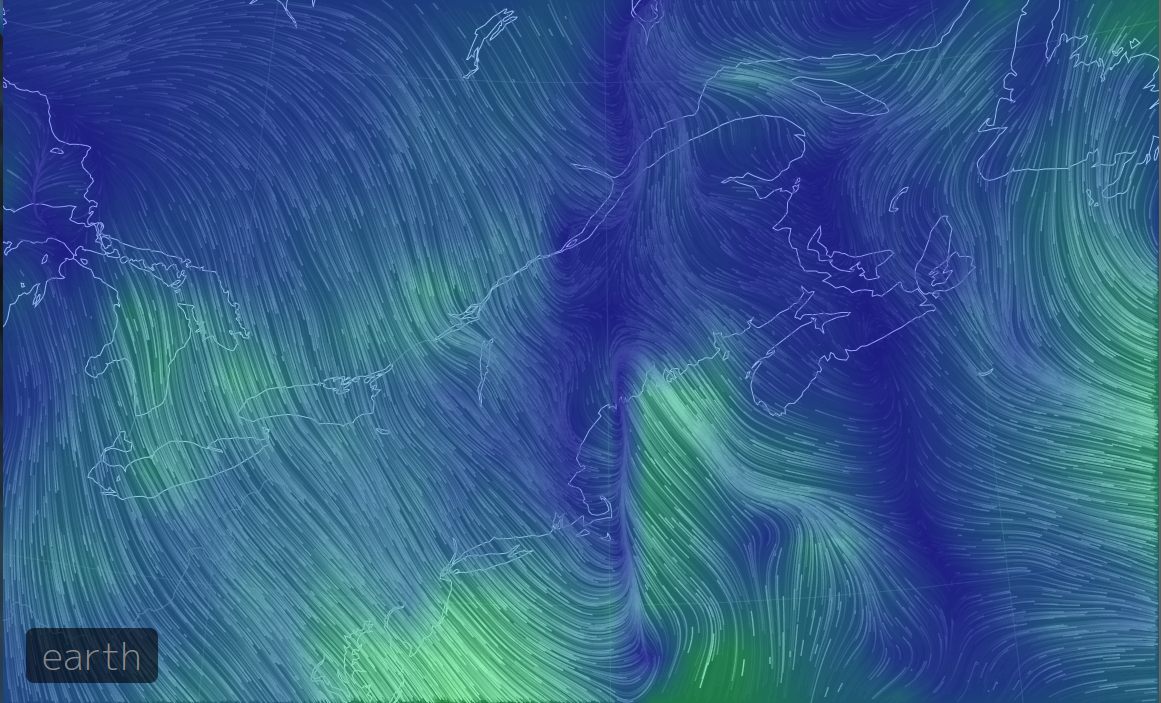
A still from an animated map of wind currents over Maine. Taken 30 January 2015.
It is also important to point out that Air is a COMMONS. The Commons is an important concept, creating a third modality of social relationship, “besides and equal to the State and the Market,” as the (mostly-unquestioned) organizing principles driving our culture’s activities. The fact that Air is a Commons is not because the commons movement have done a great job articulating and expressing the commons as a real idea to take hold in people’s lives — there remains much work to be done here — but rather it just happens to be a resource that is mostly impossible to privatize on the surface of this planet. It is easy to visualize the Air Commons using modern tools that show the movement of air across the planet. For humans, air is ubiquitous. Therefore, it usually resides beyond our thought, except when it is most seriously polluted or degraded in some way. Also, note that the more polluted Air becomes, the more easily clean Air can be commodified for those able to pay for it, which gives a capital incentive to keep polluting Air.
But even if you are in the most polluted area available — the worst industrial neighborhoods of the worst cities — the indoor air is still at least 5 times, and perhaps as much as 100 times, more polluted than the outside air. This gives us more incentive to be outside as much as possible, breathing the cleanest Air we have access to. For me, this means ocean Air, forest Air, or mountain Air whenever possible. Even better is when I exercise in these environments, which forces me to breathe deeper and circulate more quality air through my body.
Air Hallow: The Blade
It took me a long time to understand that the traditional symbols for the elements weren’t just arbitrary associations. In the case of Air, the Blade is not an abstract representation. A Blade is probably the most essential tool a human can have with them in the wild. It is a meta-tool, a tool that allows one to make additional tools, with practice and mastery of specific cutting techniques. In addition, making a blade itself requires a mastery of skill, adequate intellect, and practice at the technique, whether knapping flint or forging steel. Is it any wonder that the esoteric associations of Air reside in the realm of imagination, intellect, and ideas?
Ideas for Air Devotional Practices
- Get outside and breathe deeply, preferably while exercising so you take in more oxygen, as often as you can.
- Fill a room — or a forest, or a desert — with sound that you love.
- Get a good knife, and learn to use and maintain it. Keeping a sharp yet stout edge on a blade is a very useful skill, and can be an apt metaphor for many life experiences. It requires forethought, subtlety, precision, and practice.
Previous Post
January 30, 2015
The Science of Subjugation
Next Post

February 17, 2015 Pagan is Latin for Redneck
Browse Our Archives
Select a Category Africa Amazon Ancestors Animism Austin Boots Across Ireland Boston boundary crossing Bretagne Children Cities Community Connection Culture Detroit Druidry Earth Edinburgh Elements England Eskdalemuir Eugene experiential family Fiction Florida folklore France Glasgow Heathenry home how to build it Human Spaces imaginary landscapes Introduction Ireland Journeys Know your wild herbs Land Spirits London Maine memory lane Naturalizing Nature's Metaphors New York Poetry Remembering Ancestors Sacred Spaces San Francisco Scotland Seasons Seattle Tanzania Technology Texas the South Theory Top 10 traditions Travel Uncategorized United States video Water West Virginia Witchcraft Worlding
Select a Month August 2015 June 2015 May 2015 April 2015 March 2015 February 2015 January 2015 December 2014 November 2014 October 2014 September 2014 August 2014 July 2014 June 2014 May 2014 April 2014 March 2014 February 2014 January 2014 December 2013 November 2013 October 2013 September 2013 August 2013 July 2013 June 2013 May 2013 April 2013 March 2013 February 2013 January 2013 December 2012
Follow Us!
TAKE THE
Religious Wisdom Quiz
Which river did Naaman wash in to be healed of leprosy?
Select your answer to see how you score.
Arnon River Jordan River Nile River Euphrates River
Related posts from A Sense of Place
On Place, Pagan Values, and Politicizing Paganism
Beltane On The Beach: An Enduring Maine Tradition
Footprints in the Muck, Blind Spots, & Seeing...
Small Revolutions in Urban Reclamation
TRENDING AT PATHEOS Pagan

I was recently chatting with someone on Instagram. She asked me what...

While there are many people who share their results, the end of...

On July 23, I saw Christopher Nolan's The Odyssey which is Homer’s...

As I write this two big events have just finished up. One...

Restoring the Watershed of Divine Love
Perhaps cooperation is not something we manufacture through legislation, ideology, or moral...

Many UUs don’t pray because of bad experiences in a previous religion,...
view all Pagan blogs
Ad-Free & Subscriber Log-In Subscription Support
- About Us
- 2026 Calendar
- Videos
- Podcasts
- Library of World Religions
- Faith In Media Tracker
- Advertise With Us
- Write for Us
- Privacy Policy
- Terms of Service
- Do Not Sell My Data
- Contact Us
- Radiant Digital
- Manage Newsletter Subscriptions
- Unsubscribe From Notifications
- Sitemap
Copyright 2008-2026, Patheos. All rights reserved.
Subscription Support Ad-Free & Subscriber Log-In
Follow Patheos