
BuddhistCatholicContemplativeEvangelicalGeneral ChristianHinduJewishLatter-day SaintMuslimNew VisionsProgressive Christian
Beliefs
- Buddhist
- Catholic
- Contemplative
- Evangelical
- General Christian
- Hindu
- Jewish
- Latter-day Saint
- More Voices
- Muslim
- New Visions
- Pagan
- Progressive Christian
Topics
- Religion News
- Food and Religion
- Sports and Religion
- Religious Art
- Religious Music and Entertainment
- Religious Events
- History and Religion
- Style and Religion
- Politics and Religion
- Women in Religion
- Recreation Outdoors and Religion
- Business Finance and Religion
- Careers Workplace and Religion
- Education and Religion
- Family Parenting and Religion
- Health Fitness and Religion
- Home and Religion
- Relationships and Religion
- Technology and Religion
- Travel and Religion
Columnists
- Buddhist Columnists
- Business Finance and Religion Columnists
- Careers Workplace and Religion Columnists
- Catholic Columnists
- Contemplative Columnists
- Education and Religion Columnists
- Evangelists Columnists
- Family Parenting and Religion Columnists
- General Christian Columnists
- Health Fitness and Religion Columnists
- Hindu Columnists
- History and Religion Columnists
- Home and Religion Columnists
- Jewish Columnists
- More Voices Columnists
- Latter Day Columnists
- Muslim Columnists
- New Visions Columnists
- Nonreligious Columnists
- Pagan Columnists
- Politics and Religion Columnists
- Progressive Columnists
- Recreation Outdoors and Religion Columnists
- Relationships and Religion Columnists
- Religion News Columnists
- Religious Art Columnists
- Religious Events Columnists
- Religious Music and Entertainment Columnists
- Sports and Religion Columnists
- Style and Religion Columnists
- Technology and Religion Columnists
- Travel and Religion Columnists
- Women in Religion Columnists
Resource Library
- 2026 Calendar
- Library of World Religions
- The 100 Most Holy Places on Earth
- Patheos Answers
- Podcasts
- Videos
- Faith Leaders Database
- Anglican Episcopalian
- Bahai
- Baptist
- Buddhism
- Christianity
- Confucianism
- Eastern Orthodoxy
- Hinduism
- Holiness and Pentecostal
- ISKCON
- Islam
- Judaism
- Lutheran
- Methodist
- The Church of Jesus Christ of Latter-day Saints
- New Age
- Paganism
- Presbytarian and Reformed
- Protestantism
- Religion Behind the Scenes
- Roman Catholic
- Scientology
- Shia Islam
- Sikhism
- Sufism
- Sunni Islam
- Taoism
- Zen
- See all religions
Research Tools
 Ad-Free & Subscriber Log-In Subscription Support
Ad-Free & Subscriber Log-In Subscription Support
Follow Patheos 

- Trending:
- Forgiveness
- |
- Marriage
- |
- Consciousness
- |
- Death Penalty
- |
- Election
- |
- Halloween
 A Sense of Place
- Home
- Pagan
- When water is cut off: from Cochabamba to Detroit, by way of my bathroom
When water is cut off: from Cochabamba to Detroit, by way of my bathroom
Last updated on: May 8, 2017 at 5:41 pm by Elinor Prędota
When water is cut off: from Cochabamba to Detroit, by way of my bathroom 2017-05-08T17:41:56+00:00 Elinor Prędota
Patheos Explore the world's faith through different perspectives on religion and spirituality! Patheos has the views of the prevalent religions and spiritualities of the world.
In the mid-1990s, the water services of Cochabamba, a town in Bolivia, were taken over by the subsidiary of a trans-national corporation, Bechdel. Water bills rose at an astounding rate, and people were charged even for collecting rainwater from their own roofs.
The people revolted.
Despite pressure from both private and public security services, the people of Cochabamba won through in 1995, and made a declaration — reiterating, in more earth-centred language, the UN’s declaration of access to clean water as a human right:
1) Water belongs to the earth and all species and is sacred to life, therefore, the world’s water must be conserved, reclaimed and protected for all future generations and its natural patterns respected.
2) Water is a fundamental human right and a public trust to be guarded by all levels of government, therefore, it should not be commodified, privatized or traded for commercial purposes. These rights must be enshrined at all levels of government. In particular, an international treaty must ensure these principles are noncontrovertable.
3) Water is best protected by local communities and citizens who must be respected as equal partners with governments in the protection and regulation of water. Peoples of the earth are the only vehicle to promote earth democracy and save water.
Water consciousness
I can’t help but be conscious of water, living where I do. Our house is in an isolated spot: a mile as the crow flies from the nearest mains water. Our water comes from a spring on the hill behind us. We put it through five physical filters (down to 1 micron) and a UV microbe killer before it comes out of our taps. We get it checked every year or so to ensure it exceeds drinking water standards. It’s a precious resource.
Since we moved back in at the beginning of June, we’ve had repeated issues with water flow. At first, we thought it was just the spring struggling with the dry spell we’ve been having. But a check of the flow rate at the spring itself assured us that was not the case.
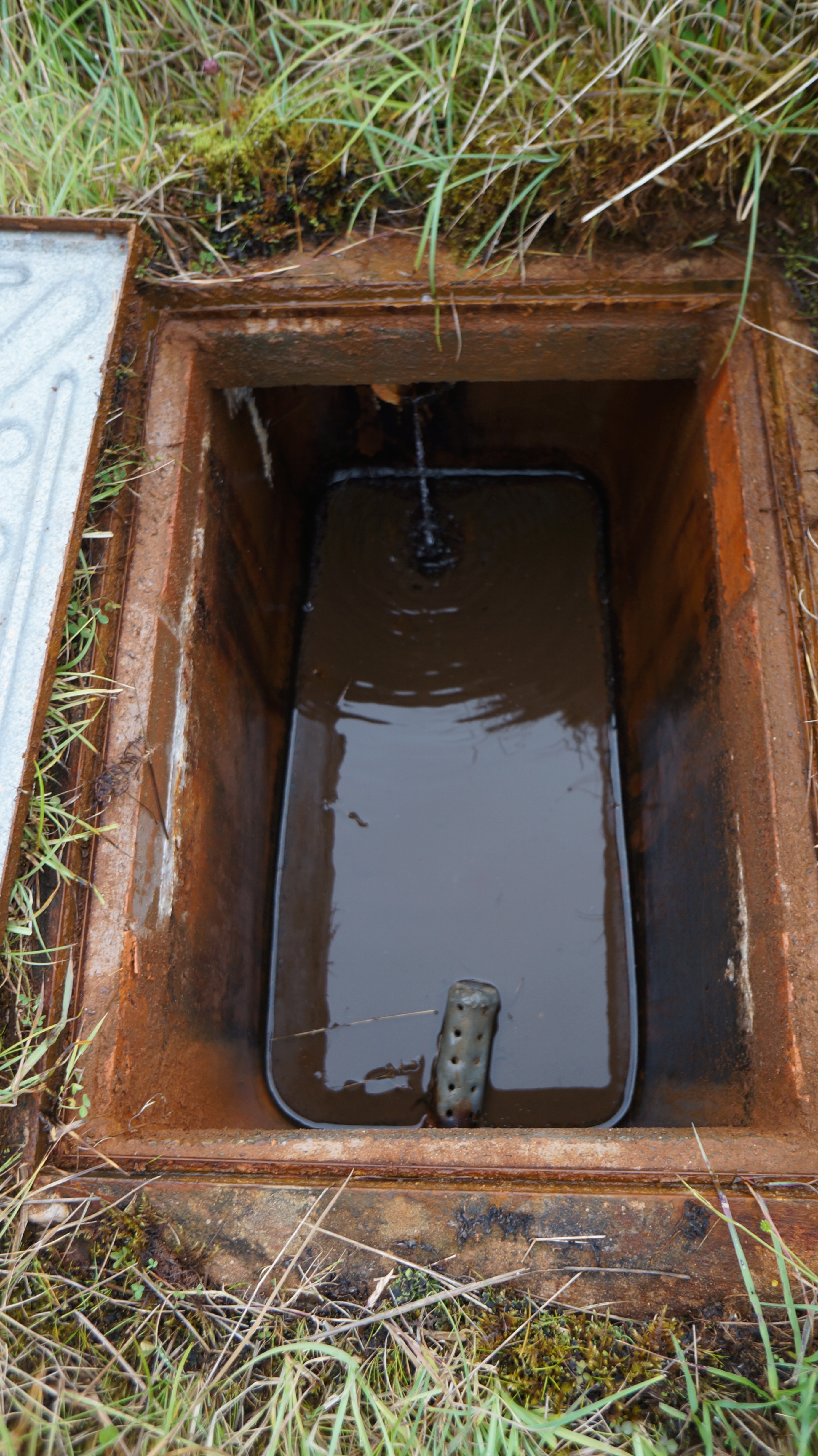
Spring water catch box, with flow rate of 1 litre per 1.75 minutes.
After much checking and experimentation (including two condoms placed over the outlet pipe from the spring water holding tank further down the hill!) we ascertained the problem: a leak somewhere in the 200 metres of 70+ year old steel pipe running from the holding tank to the house.
Today, work began on replacing it.
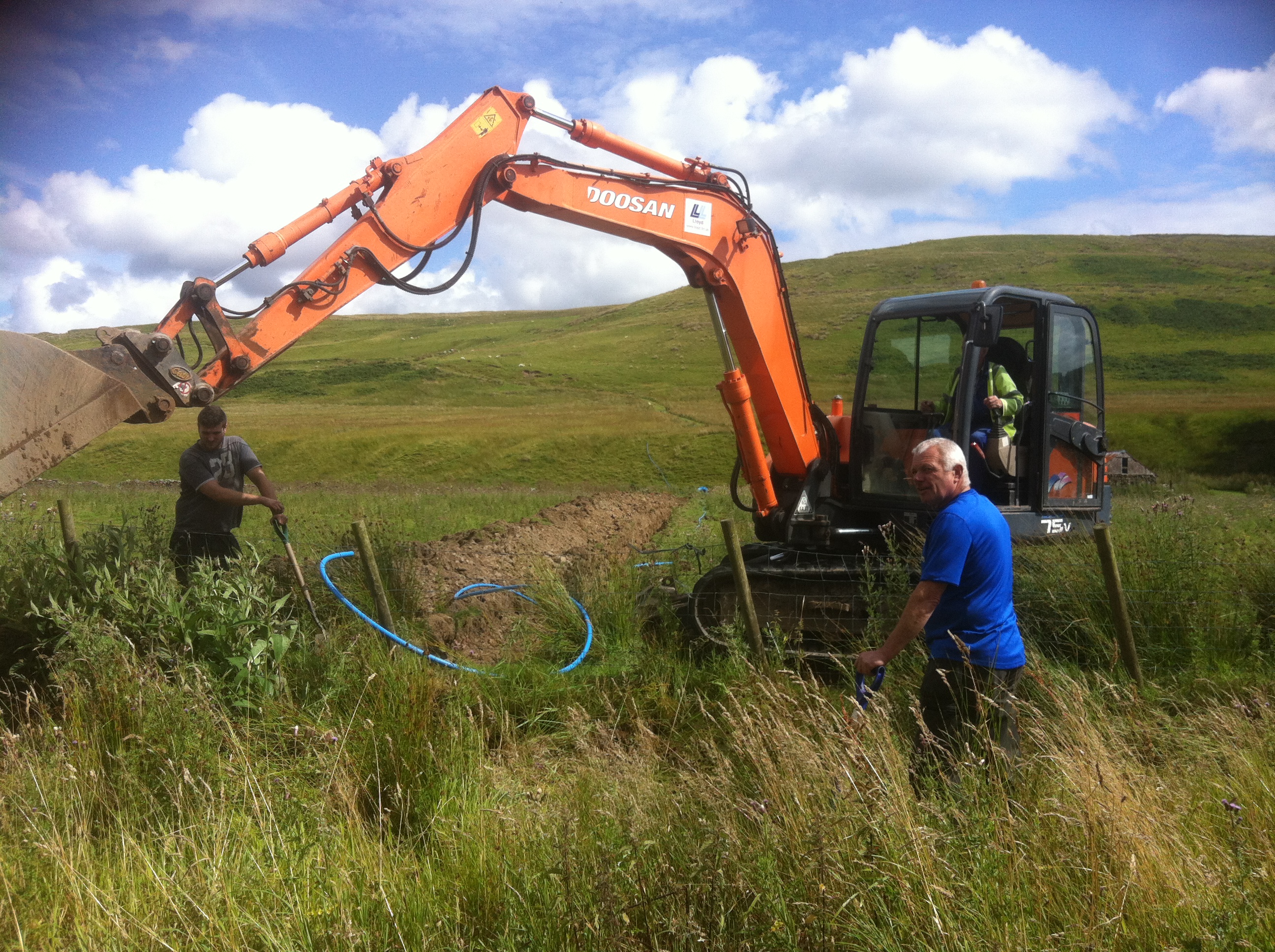
Digger at work trying to find the house end of the existing pipe.
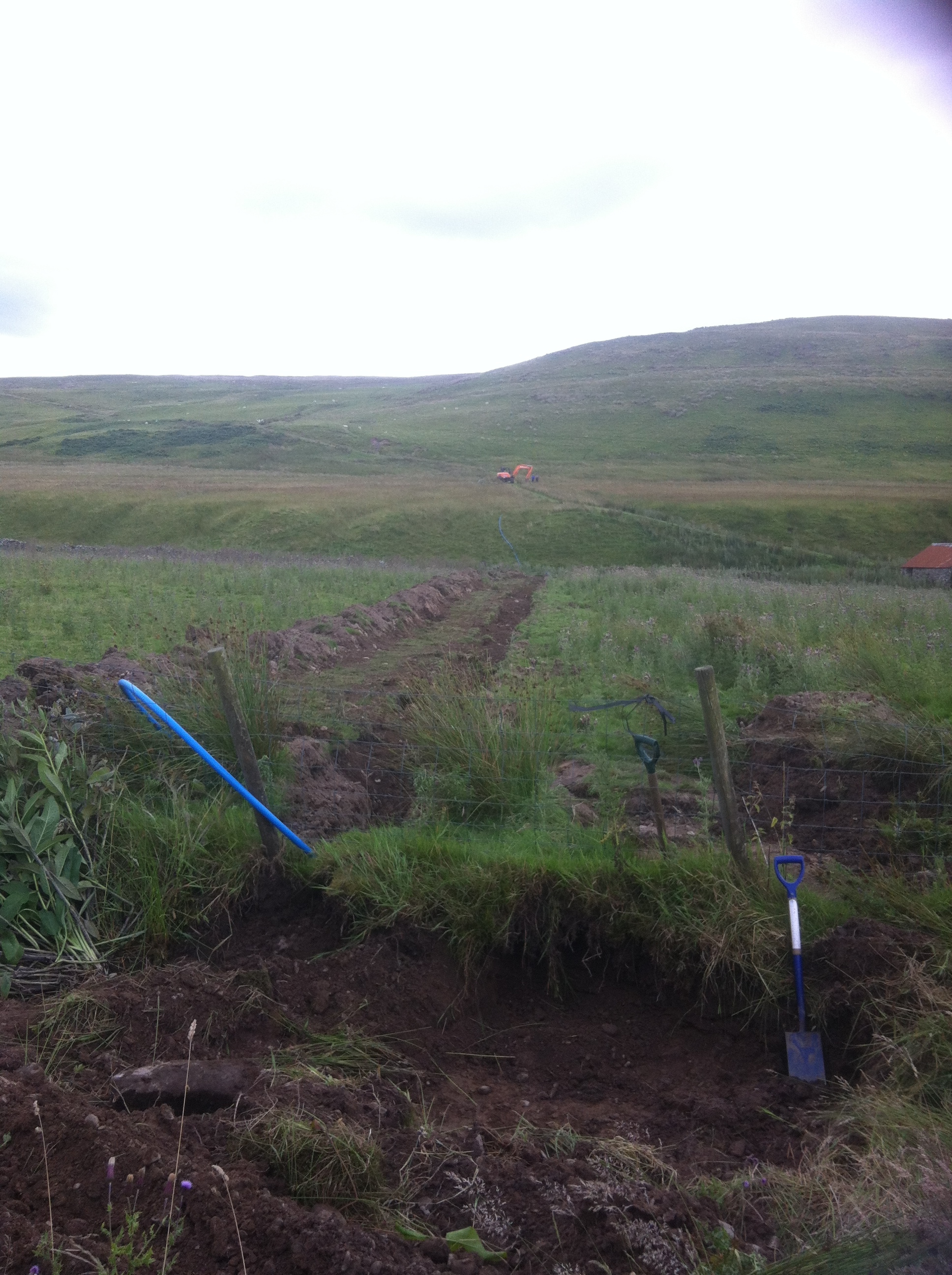
Digger at work in the distance, uncovering the holding tank end of the pipe.
The luxury of choice
Here, we have the luxury of choice: spring water, borehole, stream collection, rainwater collection, or mains connection? And we also, at present, have the resources to exercise that choice effectively. Luckily for us, the best, most resource and cost-effective option was to stay with our spring water. While it is not a resource we solely control — it lies on land belonging to the neighbouring farm — we can see from our kitchen and bathroom windows what happens on and near the spring, its catch box and its holding tank.
Most people don’t have that level of power and control in regard to their own water supply. And nor do those who do have power and control always — or even often — respect the sentiments of either the Cochabamba declaration, or the UN Universal Declaration of Human Rights:
In West Virginia, Freedom Industries leaked poisonous chemical waste into Elk River without, apparently, any consequences — except for the 300,000 West Virginians whose drinking water was affected;
In Gaza, refugee camps and hospitals struggle to access sufficient clean water, as the area’s water infrastructure continues to be affected by Israeli bombardment, leaving hundreds of thousands of Gazans without water;
And then, of course, there is Detroit City.
As I understand it, the City went bankrupt, and handed over control of making good debts to an unelected person/committee. This person/committee decided it would be a good idea to go after some 150,000-300,000 of Detroit City’s poorest citizens who were behind on their water bills by as little as a few hundred dollars, and cut off their water supply if they didn’t pay. Rather than, say, go after the corporate water debtors to the city, who collectively owe/d a total of $30 million, and were in a better position to be able to pay.
Thankfully, through public pressure and protests, and through representation by organisations such as the UN, the water cut offs in Detroit City have now been (temporarily) suspended. But it remains an egregious example of how little control ordinary people have over their basic needs, and how easily fundamental human rights can be ignored.
A new way of calling the quarters
When I worked in development education, a tool which we used a lot when helping learners to come to grips with our interconnected world was the Development Compass Rose [PDF]. Each of the points of the compass is associated with a set of questions, beginning with its initial letter. So to the North we consider questions about Natural resources, to the East questions of Economics, to the South we look at Social questions and to the West we ask Who decides?

Development Compass Rose by TIDE Global Learning
Although I have both the luxury and the necessity of acting for myself and my household alone — at least in regards to our water supply — the vast majority of people in the world do not. I think we would all do well to consider the questions of the Development Compass Rose when looking at the places where we live, and the ways in which we meet our basic human needs: to consider them together, and now. Only then can we gather communities together in knowledge and in solidarity, and take effective action, as the people of Cochabamba and Detroit City have done.
Previous Post

July 29, 2014
Buying Land
Next Post
August 5, 2014 The Scythe... Harvest And Death
Browse Our Archives
Select a Category Africa Amazon Ancestors Animism Austin Boots Across Ireland Boston boundary crossing Bretagne Children Cities Community Connection Culture Detroit Druidry Earth Edinburgh Elements England Eskdalemuir Eugene experiential family Fiction Florida folklore France Glasgow Heathenry home how to build it Human Spaces imaginary landscapes Introduction Ireland Journeys Know your wild herbs Land Spirits London Maine memory lane Naturalizing Nature's Metaphors New York Poetry Remembering Ancestors Sacred Spaces San Francisco Scotland Seasons Seattle Tanzania Technology Texas the South Theory Top 10 traditions Travel Uncategorized United States video Water West Virginia Witchcraft Worlding
Select a Month August 2015 June 2015 May 2015 April 2015 March 2015 February 2015 January 2015 December 2014 November 2014 October 2014 September 2014 August 2014 July 2014 June 2014 May 2014 April 2014 March 2014 February 2014 January 2014 December 2013 November 2013 October 2013 September 2013 August 2013 July 2013 June 2013 May 2013 April 2013 March 2013 February 2013 January 2013 December 2012
Follow Us!
TAKE THE
Religious Wisdom Quiz
Which Genesis figure "walked with God and was no more, for God took him"?
Select your answer to see how you score.
Seth Abraham Lamech Enoch
Related posts from A Sense of Place

Speaking of Burning Mountains...


Beltane On The Beach: An Enduring Maine Tradition
TRENDING AT PATHEOS Pagan

I was recently chatting with someone on Instagram. She asked me what...

While there are many people who share their results, the end of...

On July 23, I saw Christopher Nolan's The Odyssey which is Homer’s...

As I write this two big events have just finished up. One...

Restoring the Watershed of Divine Love
Perhaps cooperation is not something we manufacture through legislation, ideology, or moral...

Many UUs don’t pray because of bad experiences in a previous religion,...
view all Pagan blogs
Ad-Free & Subscriber Log-In Subscription Support
- About Us
- 2026 Calendar
- Videos
- Podcasts
- Library of World Religions
- Faith In Media Tracker
- Advertise With Us
- Write for Us
- Privacy Policy
- Terms of Service
- Do Not Sell My Data
- Contact Us
- Radiant Digital
- Manage Newsletter Subscriptions
- Unsubscribe From Notifications
- Sitemap
Copyright 2008-2026, Patheos. All rights reserved.
Subscription Support Ad-Free & Subscriber Log-In
Follow Patheos