
BuddhistCatholicContemplativeEvangelicalGeneral ChristianHinduJewishLatter-day SaintMuslimNew VisionsProgressive Christian
Beliefs
- Buddhist
- Catholic
- Contemplative
- Evangelical
- General Christian
- Hindu
- Jewish
- Latter-day Saint
- More Voices
- Muslim
- New Visions
- Pagan
- Progressive Christian
Topics
- Religion News
- Food and Religion
- Sports and Religion
- Religious Art
- Religious Music and Entertainment
- Religious Events
- History and Religion
- Style and Religion
- Politics and Religion
- Women in Religion
- Recreation Outdoors and Religion
- Business Finance and Religion
- Careers Workplace and Religion
- Education and Religion
- Family Parenting and Religion
- Health Fitness and Religion
- Home and Religion
- Relationships and Religion
- Technology and Religion
- Travel and Religion
Columnists
- Buddhist Columnists
- Business Finance and Religion Columnists
- Careers Workplace and Religion Columnists
- Catholic Columnists
- Contemplative Columnists
- Education and Religion Columnists
- Evangelists Columnists
- Family Parenting and Religion Columnists
- General Christian Columnists
- Health Fitness and Religion Columnists
- Hindu Columnists
- History and Religion Columnists
- Home and Religion Columnists
- Jewish Columnists
- More Voices Columnists
- Latter Day Columnists
- Muslim Columnists
- New Visions Columnists
- Nonreligious Columnists
- Pagan Columnists
- Politics and Religion Columnists
- Progressive Columnists
- Recreation Outdoors and Religion Columnists
- Relationships and Religion Columnists
- Religion News Columnists
- Religious Art Columnists
- Religious Events Columnists
- Religious Music and Entertainment Columnists
- Sports and Religion Columnists
- Style and Religion Columnists
- Technology and Religion Columnists
- Travel and Religion Columnists
- Women in Religion Columnists
Resource Library
- 2026 Calendar
- Library of World Religions
- The 100 Most Holy Places on Earth
- Patheos Answers
- Podcasts
- Videos
- Faith Leaders Database
- Anglican Episcopalian
- Bahai
- Baptist
- Buddhism
- Christianity
- Confucianism
- Eastern Orthodoxy
- Hinduism
- Holiness and Pentecostal
- ISKCON
- Islam
- Judaism
- Lutheran
- Methodist
- The Church of Jesus Christ of Latter-day Saints
- New Age
- Paganism
- Presbytarian and Reformed
- Protestantism
- Religion Behind the Scenes
- Roman Catholic
- Scientology
- Shia Islam
- Sikhism
- Sufism
- Sunni Islam
- Taoism
- Zen
- See all religions
Research Tools
 Ad-Free & Subscriber Log-In Subscription Support
Ad-Free & Subscriber Log-In Subscription Support
Follow Patheos 

- Trending:
- Forgiveness
- |
- Marriage
- |
- Consciousness
- |
- Death Penalty
- |
- Election
- |
- Halloween
 A Sense of Place
- Home
- Pagan
- Love and Magnolias
Love and Magnolias
Last updated on: May 28, 2014 at 5:17 pm by Sara Amis
Love and Magnolias 2014-05-28T17:17:07+00:00 Sara Amis
Patheos Explore the world's faith through different perspectives on religion and spirituality! Patheos has the views of the prevalent religions and spiritualities of the world.
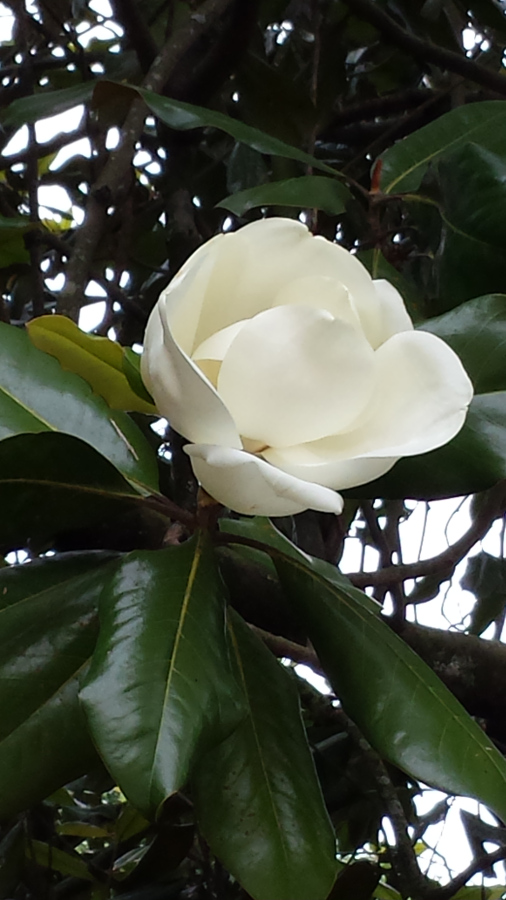
Magnolia in bloom
“Have enough courage to trust love one more time and always one more time.”– Maya Angelou
The magnolias are in bloom. A week ago they were just buds mostly, slim white fingers on big, dark, glossy trees. Now they are a riot of beauty you can see a hundred yards away, driving down the road, hiking through the woods, everywhere. Magnolias are a favored ornamental in the South and you can hardly find an old house here that doesn’t have one in the yard, but unlike many ornamental trees they are indigenous. They grow wild.
They also loom large in the culture, literary and otherwise. “Moonlight and magnolias” was a mocking phrase used by Rhett Butler towards Scarlett O’Hara in Gone With the Wind when she came all dressed up in her curtains to wheedle money out of him. It is also a name given to a sub-genre of historical romance set in the antebellum South (with insufficient irony if you ask me). Magnolias are iconic, an arboreal symbol of the South only matched by live oaks draped in Spanish moss. (Which also has magical uses. Another time, perhaps…). The media-culture meanings tend towards illusion and romanticism, frothy Southern belle sugar-won’t-melt artifice, which may say more about attitudes towards the South in general American culture than anything else.
The traditional associations are quite the opposite. According to Cat Yronwode’s Hoodoo Herb and Root Magic, magnolias are used for spells of fidelity in marriage. She doesn’t give her source for this (it’s not in Hyatt that I can find) but I can see why. Magnolias are beautiful, sensuous, with showy cream-colored lemon-scented flowers, but also evergreen. Their big glossy leaves do not drop in winter, but hold fast. They grow tall and old, with lateral branches good for tree-climbing children (I speak from experience). In the South, their long-term status as an ornamental means they are often found around “the old home place.” Their associations with family, longevity, legacy, and faithfulness make me think of the Ten of Pentacles from the Tarot. You might extend the comparison to use magnolia in spells for prosperity, stability, fertility even (one magnolia left long enough will produce a grove of them). The lemony smell makes me think of Van Van oil and the uses of lemon for clearing away negative influences. You might use a magnolia blossom, therefore, to break old bad habits in love, especially those holding you back from a long-term, stable relationship if that is your desire.
Now, most of this is extrapolation on my part, but it is based partially on tradition and partially on simply knowing the tree…which is how these traditions get started in the first place. I have seen magnolias all my life, seen their broad leaves shining in the Georgia sun, climbed them, smelled the scent of them drifting on warm breezes, crawled under their low branches for the shade. I know they like water though not as much as a willow tree, and that they have smooth loose bark that is hard to get a grip on but horizontal branches at regular intervals, ladder-like. They are beautiful but sometimes harbor wasps. A mature magnolia is a big, showy, extravagant tree, drawing your attention and giving back beauty.
Love can be like a magnolia: valued but wild, blossoming suddenly out of nowhere but also growing and lasting for decades, bringing beauty and transformation to your life, offering dizzying heights and a lovely view for the intrepid climber but not without dangers and pain. All of the things I mentioned above…family, legacy, prosperity, fidelity, even clarity, have their proper roots in love.
What plant or tree means home to you? What speaks of love?
“Of all the things in Georgia I love,
hazy blue mountains,
long lazy rivers,
the people who surprise me with their kindness even though I have known that kindness all my life,
the way things are funny to them the same way they are funny to me,
when life hurts you, you cry
also when it hurts you, you laugh,
muskedines,
lightning bugs,
thunderstorms, the smell,
lemon smell of magnolia trees in summer,
snow drift of dogwoods in the spring,
boiled peanuts sold by an old guy in a hat by the side of the road
and a million other things including alligators,
I don’t think alligators are my favorite but I like them just fine.”
–from my poem “Talking Alligator (Blues)” published in Southern Fried Weirdness: Reconstruction. All profits from the anthology go to Red Cross disaster relief.
Previous Post

May 27, 2014
Amsterdam
Next Post

May 30, 2014 Where They May Be Found: Arianrhod
Browse Our Archives
Select a Category Africa Amazon Ancestors Animism Austin Boots Across Ireland Boston boundary crossing Bretagne Children Cities Community Connection Culture Detroit Druidry Earth Edinburgh Elements England Eskdalemuir Eugene experiential family Fiction Florida folklore France Glasgow Heathenry home how to build it Human Spaces imaginary landscapes Introduction Ireland Journeys Know your wild herbs Land Spirits London Maine memory lane Naturalizing Nature's Metaphors New York Poetry Remembering Ancestors Sacred Spaces San Francisco Scotland Seasons Seattle Tanzania Technology Texas the South Theory Top 10 traditions Travel Uncategorized United States video Water West Virginia Witchcraft Worlding
Select a Month August 2015 June 2015 May 2015 April 2015 March 2015 February 2015 January 2015 December 2014 November 2014 October 2014 September 2014 August 2014 July 2014 June 2014 May 2014 April 2014 March 2014 February 2014 January 2014 December 2013 November 2013 October 2013 September 2013 August 2013 July 2013 June 2013 May 2013 April 2013 March 2013 February 2013 January 2013 December 2012
Follow Us!
TAKE THE
Religious Wisdom Quiz
Which city was destroyed by fire and brimstone along with Gomorrah?
Select your answer to see how you score.
Jericho Nineveh Babylon Sodom
Related posts from A Sense of Place

Some things I learned from blackberries

Can a human being be the spirit of...


TRENDING AT PATHEOS Pagan

I was recently chatting with someone on Instagram. She asked me what...

While there are many people who share their results, the end of...

On July 23, I saw Christopher Nolan's The Odyssey which is Homer’s...

As I write this two big events have just finished up. One...

Restoring the Watershed of Divine Love
Perhaps cooperation is not something we manufacture through legislation, ideology, or moral...

Many UUs don’t pray because of bad experiences in a previous religion,...
view all Pagan blogs
Ad-Free & Subscriber Log-In Subscription Support
- About Us
- 2026 Calendar
- Videos
- Podcasts
- Library of World Religions
- Faith In Media Tracker
- Advertise With Us
- Write for Us
- Privacy Policy
- Terms of Service
- Do Not Sell My Data
- Contact Us
- Radiant Digital
- Manage Newsletter Subscriptions
- Unsubscribe From Notifications
- Sitemap
Copyright 2008-2026, Patheos. All rights reserved.
Subscription Support Ad-Free & Subscriber Log-In
Follow Patheos