
BuddhistCatholicContemplativeEvangelicalGeneral ChristianHinduJewishLatter-day SaintMuslimNew VisionsProgressive Christian
Beliefs
- Buddhist
- Catholic
- Contemplative
- Evangelical
- General Christian
- Hindu
- Jewish
- Latter-day Saint
- More Voices
- Muslim
- New Visions
- Pagan
- Progressive Christian
Topics
- Religion News
- Food and Religion
- Sports and Religion
- Religious Art
- Religious Music and Entertainment
- Religious Events
- History and Religion
- Style and Religion
- Politics and Religion
- Women in Religion
- Recreation Outdoors and Religion
- Business Finance and Religion
- Careers Workplace and Religion
- Education and Religion
- Family Parenting and Religion
- Health Fitness and Religion
- Home and Religion
- Relationships and Religion
- Technology and Religion
- Travel and Religion
Columnists
- Buddhist Columnists
- Business Finance and Religion Columnists
- Careers Workplace and Religion Columnists
- Catholic Columnists
- Contemplative Columnists
- Education and Religion Columnists
- Evangelists Columnists
- Family Parenting and Religion Columnists
- General Christian Columnists
- Health Fitness and Religion Columnists
- Hindu Columnists
- History and Religion Columnists
- Home and Religion Columnists
- Jewish Columnists
- More Voices Columnists
- Latter Day Columnists
- Muslim Columnists
- New Visions Columnists
- Nonreligious Columnists
- Pagan Columnists
- Politics and Religion Columnists
- Progressive Columnists
- Recreation Outdoors and Religion Columnists
- Relationships and Religion Columnists
- Religion News Columnists
- Religious Art Columnists
- Religious Events Columnists
- Religious Music and Entertainment Columnists
- Sports and Religion Columnists
- Style and Religion Columnists
- Technology and Religion Columnists
- Travel and Religion Columnists
- Women in Religion Columnists
Resource Library
- 2026 Calendar
- Library of World Religions
- The 100 Most Holy Places on Earth
- Patheos Answers
- Podcasts
- Videos
- Faith Leaders Database
- Anglican Episcopalian
- Bahai
- Baptist
- Buddhism
- Christianity
- Confucianism
- Eastern Orthodoxy
- Hinduism
- Holiness and Pentecostal
- ISKCON
- Islam
- Judaism
- Lutheran
- Methodist
- The Church of Jesus Christ of Latter-day Saints
- New Age
- Paganism
- Presbytarian and Reformed
- Protestantism
- Religion Behind the Scenes
- Roman Catholic
- Scientology
- Shia Islam
- Sikhism
- Sufism
- Sunni Islam
- Taoism
- Zen
- See all religions
Research Tools
 Ad-Free & Subscriber Log-In Subscription Support
Ad-Free & Subscriber Log-In Subscription Support
Follow Patheos 

- Trending:
- Forgiveness
- |
- Marriage
- |
- Consciousness
- |
- Death Penalty
- |
- Election
- |
- Halloween
 A Sense of Place
- Home
- Pagan
- Getting clear about my place: the uses of withdrawal
Getting clear about my place: the uses of withdrawal
Last updated on: May 3, 2017 at 5:25 pm by Elinor Prędota
Getting clear about my place: the uses of withdrawal 2017-05-03T17:25:48+00:00 Elinor Prędota
Patheos Explore the world's faith through different perspectives on religion and spirituality! Patheos has the views of the prevalent religions and spiritualities of the world.
Recently I read a blog post by Michael Taft at HuffPost, called Take Your Body With You. In it, he talks about the importance of his physicality and sexuality to his spiritual path, and how he believes his commitment to celibacy and giving up all the bodily pleasures he enjoyed so much as a younger man in an effort to reach his spiritual goals was deeply wrong-headed.
As a Pagan, I agree wholeheartedly about the sacredness of the body, of sex and of pleasure, and of the vital importance of not excluding any aspect of our humanity from our spirituality path and practice. It is one of the worst aspects of the split between body and spirit which goes back not only to Christianity, but all the way to Classical Greece.
However, I do think there is a place for withdrawal, even in immanence-based spirituality. Cleansing is vital, and sometimes withdrawal is the only way to achieve that. But there are ways and ways of doing it. It’s about choice, and about listening to all parts of ourselves, and about flowing with the rhythms of our own path, not doing something just because someone else told us to.
For example: when I was a teenager, I drank. I drank a lot. Not as much as my friends, but still, more than was healthy for me either physically or emotionally. As I became fully adult, I toned my drinking down. I drank socially on occasion – a pint of cider or beer, or maybe a glass of wine with a meal.
In the mid-90s I had a physical-spiritual experience which turned me inside out and upside down. And within a few months, I found that I could no longer drink alcohol without suffering from crippling depression for days afterwards. So I gave it up.
I didn’t give it up because someone in a pulpit or a book told me it was “wrong” or “sinful” or a block to “enlightenment”, but out of love and respect for my own self. My body was telling me it was time to withdraw from stimulants and intoxicants, so I did. I was becoming more sensitive in all ways to my environment, beginning to relate to it in different ways.
Another example: in 2000, my partner and I moved to the country with our two dogs. Our new home was not only rural, but extremely so. Two miles of farm track to reach the road, then another 13 miles to the nearest town – and neither of us drove at the time. By choice, we had no TV or newspapers. Intermittent Internet access. Crackly phone line. No neighbours to speak of. Surrounded by hills, streams, trees, sheep and wildlife.
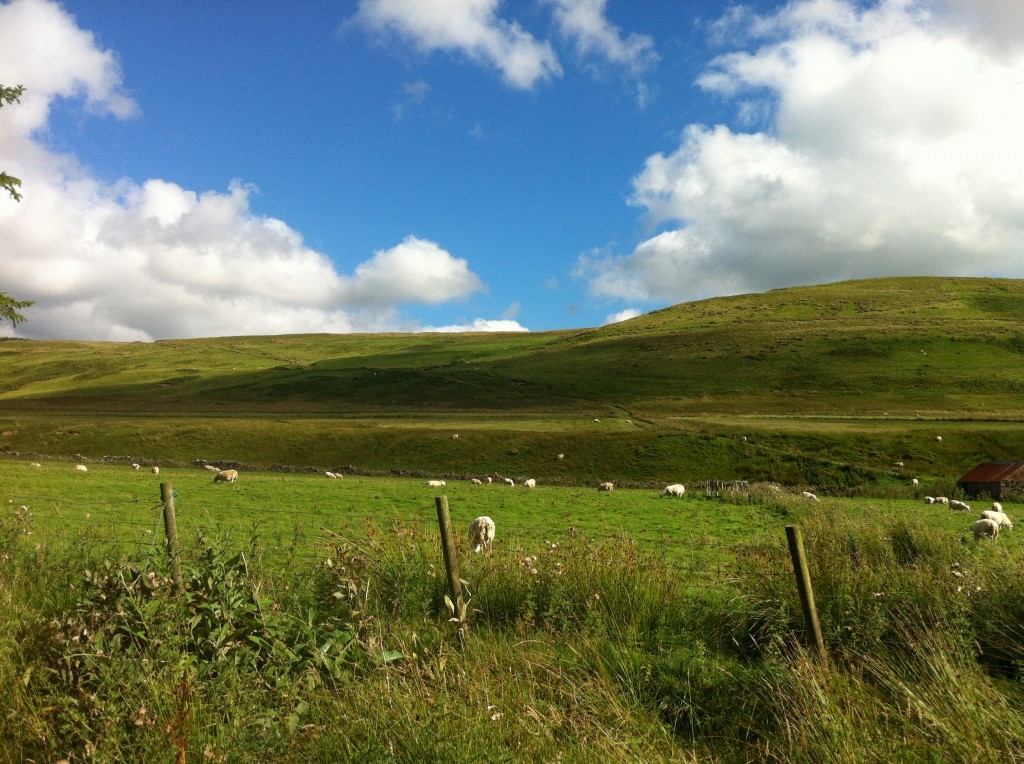
The view to the east from our house.
The first few years in our new home – and especially the first 6 months – was a time of blissful detoxification from modern life. My sensitivity increased exponentially. The first time I went to the nearest city, I felt side-swiped by the idea that people could actually choose to live on top of each other like that. It felt like a physical pain. The first time I went down to London after moving, I could actually hear the buzz of people’s thoughts, the massed swarming of countless busy minds.
In both of these cases, my withdrawal, my apparent asceticism, actually brought me into deeper touch with the sacredness of the physical: both of my own body, and of the land on which I walk. It enabled me to hear, see, smell, taste and feel more clearly, more sweetly, more deeply.
Gradually, we reintroduced ourselves to the world. We went shopping, and to the cinema. I took a job in the nearest city. We visited friends and family in London and Birmingham more often. I learned to drive. Now we even, through the medium of the Internet, watch television programmes.
But what that time of withdrawal and detoxification did for me was to give me the realisation that my engagement in the confusion of modern living is a choice. I consciously choose to watch specific television programmes, at specific times. I consciously choose to engage or not engage in social or political debates. When I go into areas of mass population, I am, at base, clearer about what is me or mine to get enmeshed in, and what is not.
My sense of my own space and place in the world is stronger, more rooted, and much, much calmer for my time of withdrawal. It’s not a part of everyone’s path, but it has its place, and we should be careful not to dismiss it too glibly.
Previous Post
October 10, 2013
Naturalizing: Bringing Our Practice Home
Next Post

October 15, 2013 The Place Where I'm Not Weird
Browse Our Archives
Select a Category Africa Amazon Ancestors Animism Austin Boots Across Ireland Boston boundary crossing Bretagne Children Cities Community Connection Culture Detroit Druidry Earth Edinburgh Elements England Eskdalemuir Eugene experiential family Fiction Florida folklore France Glasgow Heathenry home how to build it Human Spaces imaginary landscapes Introduction Ireland Journeys Know your wild herbs Land Spirits London Maine memory lane Naturalizing Nature's Metaphors New York Poetry Remembering Ancestors Sacred Spaces San Francisco Scotland Seasons Seattle Tanzania Technology Texas the South Theory Top 10 traditions Travel Uncategorized United States video Water West Virginia Witchcraft Worlding
Select a Month August 2015 June 2015 May 2015 April 2015 March 2015 February 2015 January 2015 December 2014 November 2014 October 2014 September 2014 August 2014 July 2014 June 2014 May 2014 April 2014 March 2014 February 2014 January 2014 December 2013 November 2013 October 2013 September 2013 August 2013 July 2013 June 2013 May 2013 April 2013 March 2013 February 2013 January 2013 December 2012
Follow Us!
TAKE THE
Religious Wisdom Quiz
What event marked the start of the early church?
Select your answer to see how you score.
Pentecost Jesus’ Baptism The Ascension The Crucifixion
Related posts from A Sense of Place

Speaking of Burning Mountains...

The Mountain Of Fire, A Parable

The Most Important Issue Of Our Day

TRENDING AT PATHEOS Pagan

When we talk about Greek religion, we often begin with the dodekatheion—the...

I was recently chatting with someone on Instagram. She asked me what...

While there are many people who share their results, the end of...

On July 23, I saw Christopher Nolan's The Odyssey which is Homer’s...

As I write this two big events have just finished up. One...

Restoring the Watershed of Divine Love
Perhaps cooperation is not something we manufacture through legislation, ideology, or moral...
view all Pagan blogs
Ad-Free & Subscriber Log-In Subscription Support
- About Us
- 2026 Calendar
- Videos
- Podcasts
- Library of World Religions
- Faith In Media Tracker
- Advertise With Us
- Write for Us
- Privacy Policy
- Terms of Service
- Do Not Sell My Data
- Contact Us
- Radiant Digital
- Manage Newsletter Subscriptions
- Unsubscribe From Notifications
- Sitemap
Copyright 2008-2026, Patheos. All rights reserved.
Subscription Support Ad-Free & Subscriber Log-In
Follow Patheos