
BuddhistCatholicContemplativeEvangelicalGeneral ChristianHinduJewishLatter-day SaintMuslimNew VisionsProgressive Christian
Beliefs
- Buddhist
- Catholic
- Contemplative
- Evangelical
- General Christian
- Hindu
- Jewish
- Latter-day Saint
- More Voices
- Muslim
- New Visions
- Pagan
- Progressive Christian
Topics
- Religion News
- Food and Religion
- Sports and Religion
- Religious Art
- Religious Music and Entertainment
- Religious Events
- History and Religion
- Style and Religion
- Politics and Religion
- Women in Religion
- Recreation Outdoors and Religion
- Business Finance and Religion
- Careers Workplace and Religion
- Education and Religion
- Family Parenting and Religion
- Health Fitness and Religion
- Home and Religion
- Relationships and Religion
- Technology and Religion
- Travel and Religion
Columnists
- Buddhist Columnists
- Business Finance and Religion Columnists
- Careers Workplace and Religion Columnists
- Catholic Columnists
- Contemplative Columnists
- Education and Religion Columnists
- Evangelists Columnists
- Family Parenting and Religion Columnists
- General Christian Columnists
- Health Fitness and Religion Columnists
- Hindu Columnists
- History and Religion Columnists
- Home and Religion Columnists
- Jewish Columnists
- More Voices Columnists
- Latter Day Columnists
- Muslim Columnists
- New Visions Columnists
- Nonreligious Columnists
- Pagan Columnists
- Politics and Religion Columnists
- Progressive Columnists
- Recreation Outdoors and Religion Columnists
- Relationships and Religion Columnists
- Religion News Columnists
- Religious Art Columnists
- Religious Events Columnists
- Religious Music and Entertainment Columnists
- Sports and Religion Columnists
- Style and Religion Columnists
- Technology and Religion Columnists
- Travel and Religion Columnists
- Women in Religion Columnists
Resource Library
- 2026 Calendar
- Library of World Religions
- The 100 Most Holy Places on Earth
- Patheos Answers
- Podcasts
- Videos
- Faith Leaders Database
- Anglican Episcopalian
- Bahai
- Baptist
- Buddhism
- Christianity
- Confucianism
- Eastern Orthodoxy
- Hinduism
- Holiness and Pentecostal
- ISKCON
- Islam
- Judaism
- Lutheran
- Methodist
- The Church of Jesus Christ of Latter-day Saints
- New Age
- Paganism
- Presbytarian and Reformed
- Protestantism
- Religion Behind the Scenes
- Roman Catholic
- Scientology
- Shia Islam
- Sikhism
- Sufism
- Sunni Islam
- Taoism
- Zen
- See all religions
Research Tools
 Ad-Free & Subscriber Log-In Subscription Support
Ad-Free & Subscriber Log-In Subscription Support
Follow Patheos 

- Trending:
- Forgiveness
- |
- Marriage
- |
- Consciousness
- |
- Death Penalty
- |
- Election
- |
- Halloween
 A Sense of Place
- Home
- Pagan
- The Sacred Springs of South West England
The Sacred Springs of South West England
Last updated on: June 13, 2013 at 12:32 pm by Traci
The Sacred Springs of South West England 2013-06-13T12:32:42+00:00 Traci
Patheos Explore the world's faith through different perspectives on religion and spirituality! Patheos has the views of the prevalent religions and spiritualities of the world.
My eldest daughter is visiting, and this usually means one thing…road trip! So this past weekend we toured south west England and Wales, visiting the Doctor Who Experience in Cardiff; the Isle of Avalon in Glastonbury; Durdle Door on the Dorset coast; Stonehenge; and the city of Bath. We had unusually sunny weather for our visit, and in the midst of that summer sun profusion the spirit of the waters touched my heart.
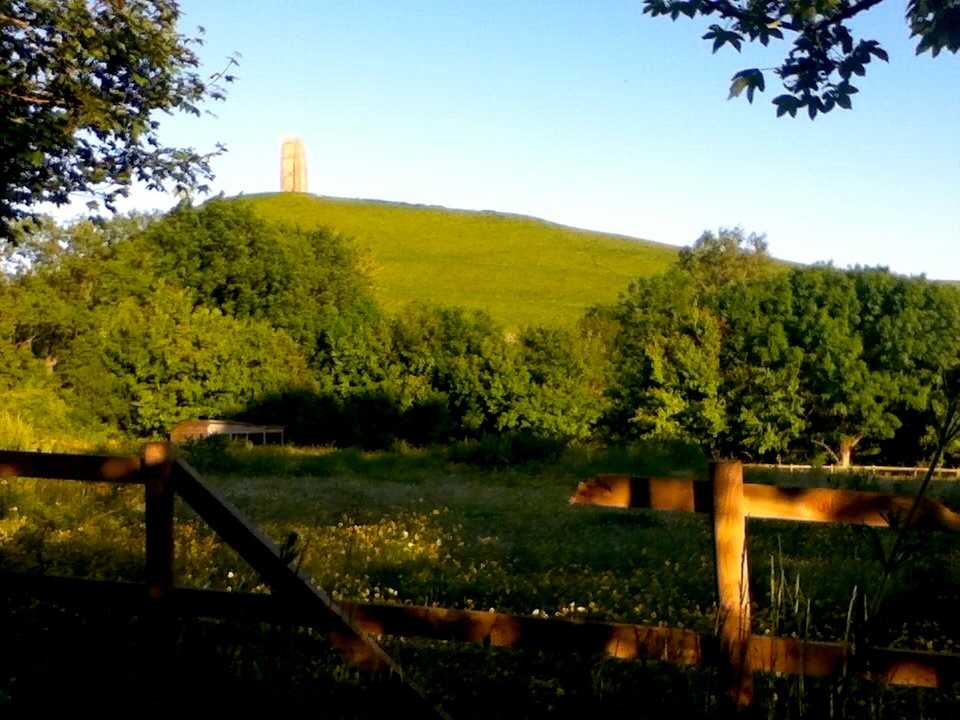
the Tor : Glastonbury
I visited Glastonbury many years ago. I hiked the Tor, slept in the city, had my visionary dreams, and took the waters: but my daughter had never been. She was excited by the Arthurian connection, and romantic visions of the Isle of Avalon. Since this was her first trip to England, and we were focusing our long weekend on the south west, Glastonbury was a must on our agenda. 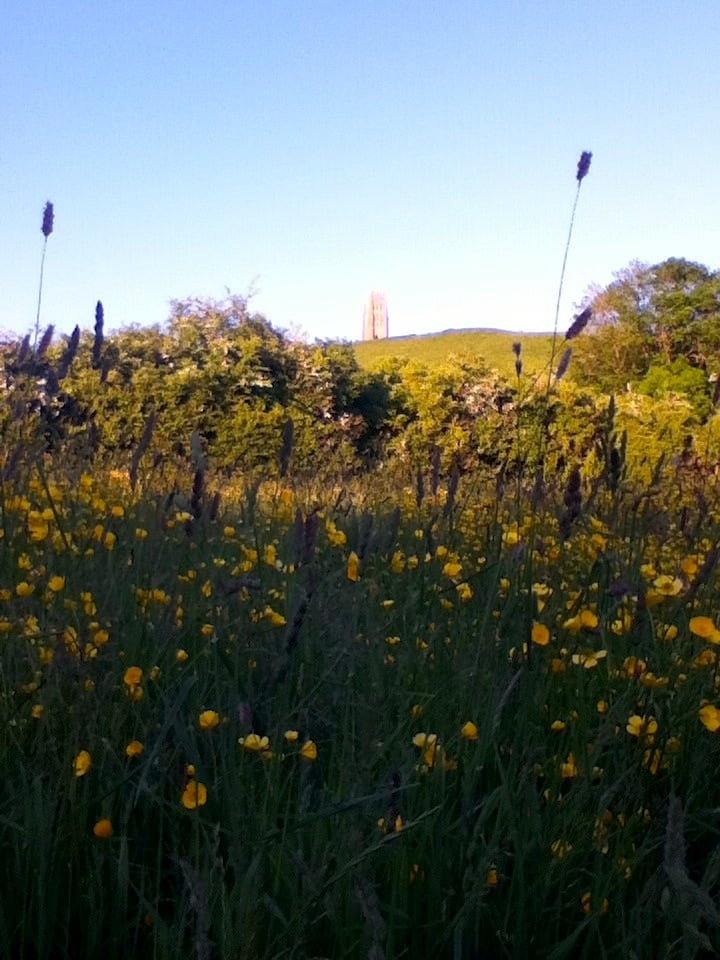
We stayed in a yoga ashram located at the base of Chalice Hill, on a pilgrimage route to the Tor. I love the British culture of public access footpaths; it is one of the simplest and greatest pleasures–strolling through a country field. The pathways to the Tor were a riot of wild flowers, and the fields billowed with tall grasses. The apple orchard at the Abbey drooped heavy with apple blossom, and each gentle breeze sent a dance of white petals to carpet the path.
Chalice Well, or the red / blood spring, is famous for its iron rich waters which flow from a spring at the foot of the Tor. The cultivated gardens surrounding the wellhead are a lovely place to meditate and relax, and we had fun exploring their nooks and crannies. The water from the well flows in stages: first, the lion head fountain, where water can be taken (drank); next, a shallow bathing pool; and finally, a lovely cascading Seven Bowls Flow Form and Vesica Piscis reflective pool, surrounded by wide grassy lawns. 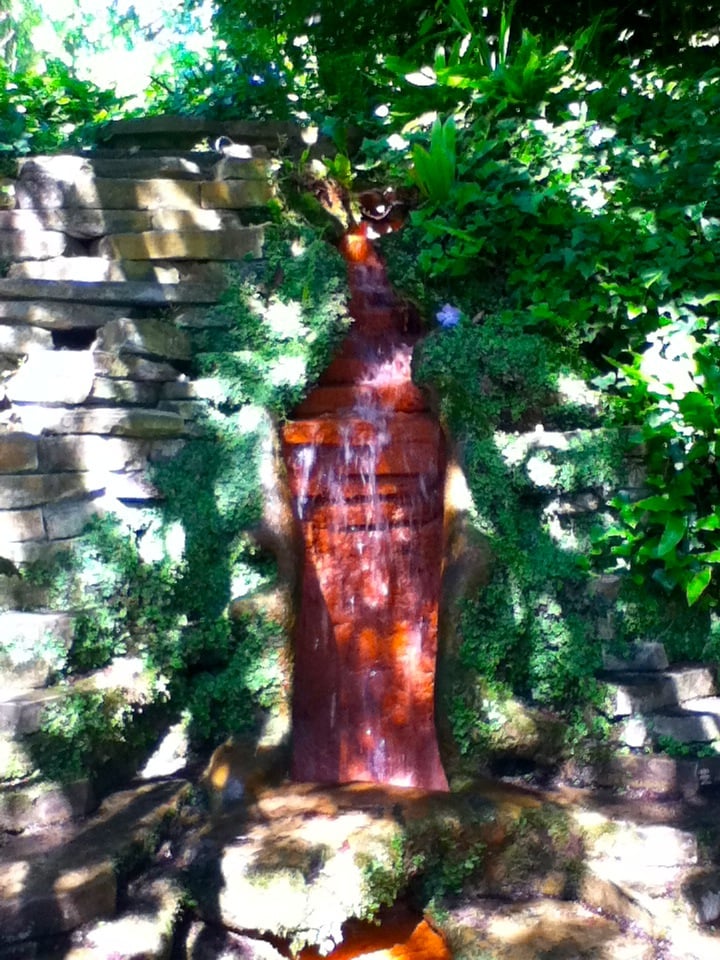
I filled a bottle with the metallic waters, and we shared a drink–saving the rest for my home altar. As we passed the bathing pool, I felt compelled to step in. The water was very cold, and my first thought was the therapeutic value of hydrotherapy for migraine. I was only in for a moment, mindful of my daughter’s desire to reach the Dorset coast that day, but as soon as I stepped out my heart felt an effervescent lightness and I longed to step back in. So, as my daughter sat in the sun with her own thoughts, I waded in the ferrous oxide encrusted pool, opening myself to the other-than-human person who is the Red Spring.
The experience was nurturing, and the lightness of heart exquisite. If healing was effected, it was of a soul wound and I was happy for it. I did not hear a voice, or see a vision. Yet, I felt bodily sensation when I came into contact with the water. My knowledge of the spring’s sacred history added to my feeling of connection– I was walking in the footsteps of a distant ancestress, and it made me glad.
We made our way down to Dorset, where we reveled in the miraculous pebble beach at Durdle Door. The sound, as the waves crashed onto the pebbles and retreated, was new to me, and utterly amazing; in fact, it sounded just like a rain stick! We ran, and climbed, and gaped in awe. And after a lovely night, we headed to Bath–to indulge our Jane Austen obsession, and walk in the footsteps of Anne Elliot.
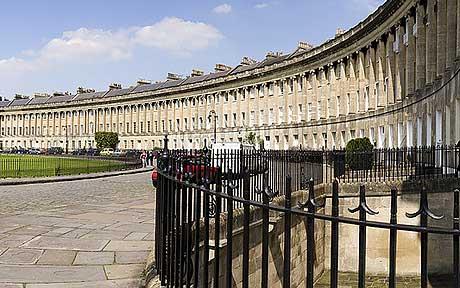
the Royal Crescent : Bath
For those not familiar with Bath, it is an ancient city in Somerset. Established as a Roman military outpost and temple complex, it was built around an even older sacred spring, known as the ‘waters of Sulis’. The city is an elegant expression of Palladian and Georgian architecture, and one feels elevated and more refined in its presence–for cities do have their own persona. The spring is a natural mineral hot spring, the only one in Britain, and whatever personality this warm, health imbuing (and curse answering) water-person has, the Romans identified her with Minerva–thus, the temple of Sulis Minerva was built. 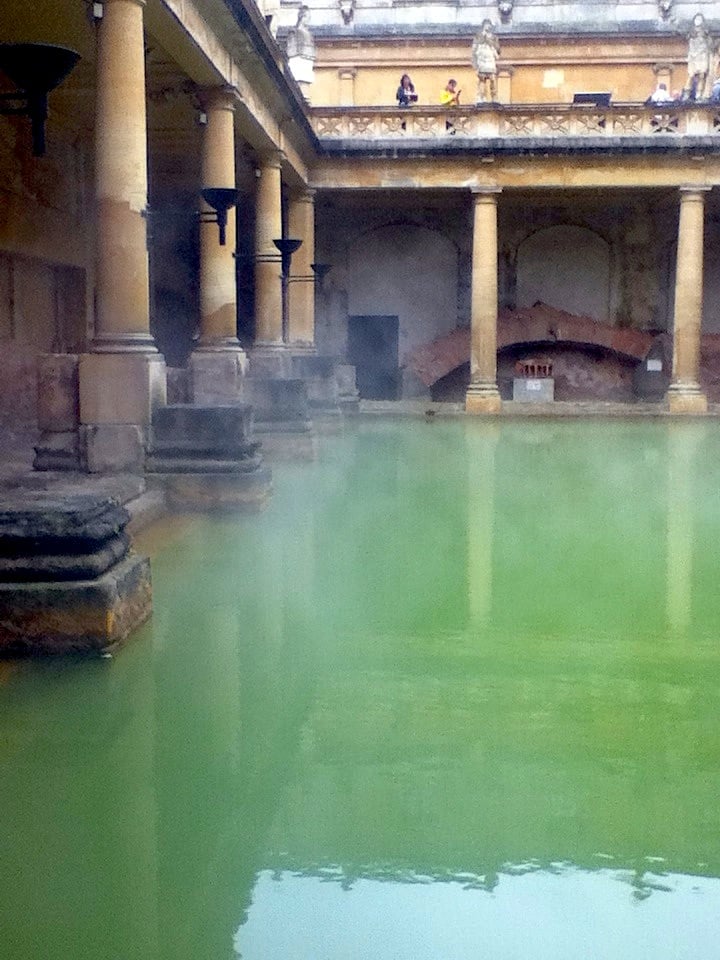
I knew my visit to the spring would be meaningful after walking past the doors to the Roman Baths on our first day. The vapors that rise from the great pool wafted out as visitors exited, and the aroma drew me. It felt both curative and inviting. And so it was. When we finally got down into the old temple complex, I wept. The presence of this other-than-human person, combined with the energetic intent of the multitudes of human-person pilgrims, was so potent I was stilled to reverence–as before an important dignitary. I wanted to spend time, go barefoot, allow her to caress my body with her thermal liquid, and get to know her. Sadly, you aren’t allowed to touch the sacred water (though I broke the rules, and trailed my fingers ever so delicately), and we had a plane to catch.

The two springs, Glastonbury and Bath, are located in very different Places. The countryside setting of the Red Spring at Glastonbury is contrasted to the human-centric cityscape of the Roman temple at Bath. Though these two healing springs were both contained (wells built around them) and venerated by early humans, the surrounding Places evolved quite differently. It put me in mind of the contrast between the masculine energy of the wild here in Ireland, as embodied by An Dagda, and the feminine energy of the sovereignty deities who governed society–the ordered, structured lives of human-persons.
I love the countryside, and the wild (though the wild scares me). I also love the city, where human-persons congregate. But not all cities are created equal. Bath, with its sacred centre–a contained expression for wild energies (the spring)–and thoughtful architecture, is an example of how cities can express the best of us. Now, if they would just open those baths to actual bathing! I want to get my feet wet!
Previous Post

June 11, 2013
An Extraenvironmentalist
Next Post

June 14, 2013 Being in nature
Browse Our Archives
Select a Category Africa Amazon Ancestors Animism Austin Boots Across Ireland Boston boundary crossing Bretagne Children Cities Community Connection Culture Detroit Druidry Earth Edinburgh Elements England Eskdalemuir Eugene experiential family Fiction Florida folklore France Glasgow Heathenry home how to build it Human Spaces imaginary landscapes Introduction Ireland Journeys Know your wild herbs Land Spirits London Maine memory lane Naturalizing Nature's Metaphors New York Poetry Remembering Ancestors Sacred Spaces San Francisco Scotland Seasons Seattle Tanzania Technology Texas the South Theory Top 10 traditions Travel Uncategorized United States video Water West Virginia Witchcraft Worlding
Select a Month August 2015 June 2015 May 2015 April 2015 March 2015 February 2015 January 2015 December 2014 November 2014 October 2014 September 2014 August 2014 July 2014 June 2014 May 2014 April 2014 March 2014 February 2014 January 2014 December 2013 November 2013 October 2013 September 2013 August 2013 July 2013 June 2013 May 2013 April 2013 March 2013 February 2013 January 2013 December 2012
Follow Us!
TAKE THE
Religious Wisdom Quiz
How many stringed instruments were used in the Temple?
Select your answer to see how you score.
10 3 5 7
Related posts from A Sense of Place

Speaking of Burning Mountains...

The Mountain Of Fire, A Parable

The Most Important Issue Of Our Day

TRENDING AT PATHEOS Pagan

When we talk about Greek religion, we often begin with the dodekatheion—the...

I was recently chatting with someone on Instagram. She asked me what...

While there are many people who share their results, the end of...

On July 23, I saw Christopher Nolan's The Odyssey which is Homer’s...

As I write this two big events have just finished up. One...

Restoring the Watershed of Divine Love
Perhaps cooperation is not something we manufacture through legislation, ideology, or moral...
view all Pagan blogs
Ad-Free & Subscriber Log-In Subscription Support
- About Us
- 2026 Calendar
- Videos
- Podcasts
- Library of World Religions
- Faith In Media Tracker
- Advertise With Us
- Write for Us
- Privacy Policy
- Terms of Service
- Do Not Sell My Data
- Contact Us
- Radiant Digital
- Manage Newsletter Subscriptions
- Unsubscribe From Notifications
- Sitemap
Copyright 2008-2026, Patheos. All rights reserved.
Subscription Support Ad-Free & Subscriber Log-In
Follow Patheos