
BuddhistCatholicContemplativeEvangelicalGeneral ChristianHinduJewishLatter-day SaintMuslimNew VisionsProgressive Christian
Beliefs
- Buddhist
- Catholic
- Contemplative
- Evangelical
- General Christian
- Hindu
- Jewish
- Latter-day Saint
- More Voices
- Muslim
- New Visions
- Pagan
- Progressive Christian
Topics
- Religion News
- Food and Religion
- Sports and Religion
- Religious Art
- Religious Music and Entertainment
- Religious Events
- History and Religion
- Style and Religion
- Politics and Religion
- Women in Religion
- Recreation Outdoors and Religion
- Business Finance and Religion
- Careers Workplace and Religion
- Education and Religion
- Family Parenting and Religion
- Health Fitness and Religion
- Home and Religion
- Relationships and Religion
- Technology and Religion
- Travel and Religion
Columnists
- Buddhist Columnists
- Business Finance and Religion Columnists
- Careers Workplace and Religion Columnists
- Catholic Columnists
- Contemplative Columnists
- Education and Religion Columnists
- Evangelists Columnists
- Family Parenting and Religion Columnists
- General Christian Columnists
- Health Fitness and Religion Columnists
- Hindu Columnists
- History and Religion Columnists
- Home and Religion Columnists
- Jewish Columnists
- More Voices Columnists
- Latter Day Columnists
- Muslim Columnists
- New Visions Columnists
- Nonreligious Columnists
- Pagan Columnists
- Politics and Religion Columnists
- Progressive Columnists
- Recreation Outdoors and Religion Columnists
- Relationships and Religion Columnists
- Religion News Columnists
- Religious Art Columnists
- Religious Events Columnists
- Religious Music and Entertainment Columnists
- Sports and Religion Columnists
- Style and Religion Columnists
- Technology and Religion Columnists
- Travel and Religion Columnists
- Women in Religion Columnists
Resource Library
- 2026 Calendar
- Library of World Religions
- The 100 Most Holy Places on Earth
- Patheos Answers
- Podcasts
- Videos
- Faith Leaders Database
- Anglican Episcopalian
- Bahai
- Baptist
- Buddhism
- Christianity
- Confucianism
- Eastern Orthodoxy
- Hinduism
- Holiness and Pentecostal
- ISKCON
- Islam
- Judaism
- Lutheran
- Methodist
- The Church of Jesus Christ of Latter-day Saints
- New Age
- Paganism
- Presbytarian and Reformed
- Protestantism
- Religion Behind the Scenes
- Roman Catholic
- Scientology
- Shia Islam
- Sikhism
- Sufism
- Sunni Islam
- Taoism
- Zen
- See all religions
Research Tools
 Ad-Free & Subscriber Log-In Subscription Support
Ad-Free & Subscriber Log-In Subscription Support
Follow Patheos 

- Trending:
- Forgiveness
- |
- Marriage
- |
- Consciousness
- |
- Death Penalty
- |
- Election
- |
- Halloween
 A Sense of Place
- Home
- Pagan
- Childhood, risk and ‘wild’ places
Childhood, risk and ‘wild’ places
Last updated on: May 8, 2017 at 5:39 pm by Elinor Prędota
Childhood, risk and ‘wild’ places 2017-05-08T17:39:38+00:00 Elinor Prędota
Patheos Explore the world's faith through different perspectives on religion and spirituality! Patheos has the views of the prevalent religions and spiritualities of the world.
When I came back from my travels recently, I spent a week at my mum’s on the way back. It was an opportunity to revisit some of the haunts of my youth: the huge willow tree at the bottom of the road, still standing, and the old railway track which has since been transformed into a public path all the way from Harborne to Winson Green, approximately two miles of green, car-free paths winding through Birmingham’s suburbia.
The willow tree is an old friend. I and the little gang of pre-teens I hung out with as a child – all residents of one, long road running from the willow tree to the local primary school – would rest under its branches on long summer days. We would cut switches that hung near the ground, stripping them of leaves for the fresh, green scent and the make-believe of creating whips.
We would egg each other on to climb higher and higher among the swaying branches. The bark was strong and vertical and slippery, even on dry days, but there was a technique for swinging from the ground onto a lower hanging branch and pulling and scrambling up, to sit in comfort on the spreading crown, looking at the world below through pale leaves. I was not a physically courageous child, but I learned that technique, terrified and thrilled.
The climbing branches are gone now, and the low switches which used to caress the earth, creating a ready-made den, are trimmed to a demure bob, a good three feet off the ground. So much safer. So much tamer. So much more restrictive.
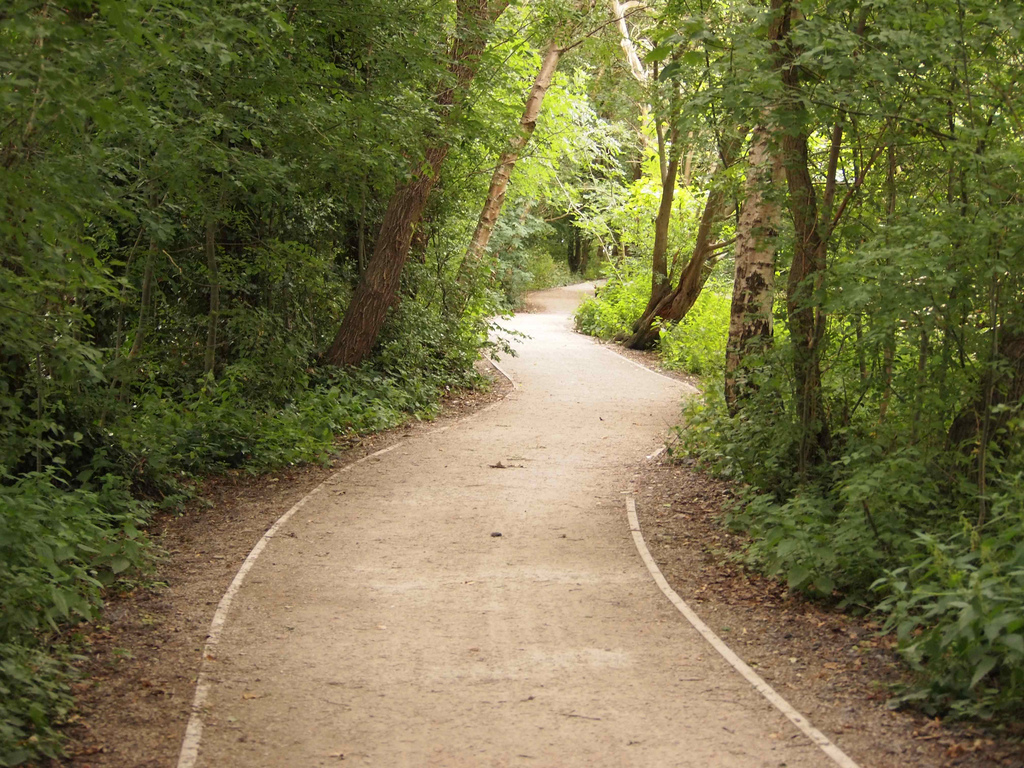
Harborne Walkway in its current, manicured state. Image by Andy Reeve, used under Creative Commons license.
The walkway was another favourite summer haunt. It was a scramble, in those days, to reach the woods and stream now so easily accessible – at least, when we chose to approach over the old railway bridge, always rumoured to be about to give way. The path itself runs across the top of an old railway embankment, offering endless opportunities for steep downhill runs, rides, rolls and swings. And mud: mud galore!
On the western side of the path is a stream, just a trickle really, which we would rush down to and paddle in, leaving our shoes and socks on the bank. We would tell each other that leeches lived in the stream, and delight in the harmless – and groundless – fear of being suckered. Now that stream is fenced off with broad, high metal spikes, too close together for even a small child to slide through. No fun to be had there any more.
The risk aversion of contemporary Western society has been oft remarked upon. In the UK, the most accessible account of it is from Tim Gill, in his book No Fear: Growing up in a risk averse society. He argues that the very nature of childhood is being undermined by the adult fear of risk, which:
…restricts children’s play, limits their freedom of movement, corrodes their relationships with adults and constrains their exploration of physical, social and virtual worlds.
Not only are children stopped from exploring, they therefore do not learn how to assess risk. Surely one of the key tasks of growing into adults capable of making decisions and taking responsibility for themselves, their actions, and their part in the interdependent world of which they are part.
Linked with this aversion to risk and cotton-wadding of children is the fact that children in the ‘developed’ world have fewer and fewer unconstrained, spontaneous opportunities to spend time in nature, playing on their own terms. Child advocate Richard Louv has famously made the case for the devastating effects of this growing division between children and nature – the wilder, more-than-human world – in his book Last Child in the Woods.
Both as an academic researching young people’s relationship with wooded environments, and as a Pagan whose relationship with the more-than-human world grew through my own engagements with the green, this tendency to keep children away from wild(er) spaces, where they can be wild, free to explore, risk, discover, hurt themselves and learn how to be safe, hits to my core.
I’m doing what I can through my own research and future sharing of its findings to contribute to a culture and society where children have the freedom that I had in the late 1970s and early 1980s, to go ‘wild’ in ‘wild’ places. As a non-parent, being part of the conversation is all I can do. I hope it’s enough.
Previous Post

May 3, 2013
Procession Photos and May Day
Next Post

May 7, 2013 An unexpected way to meet a Goddess
Browse Our Archives
Select a Category Africa Amazon Ancestors Animism Austin Boots Across Ireland Boston boundary crossing Bretagne Children Cities Community Connection Culture Detroit Druidry Earth Edinburgh Elements England Eskdalemuir Eugene experiential family Fiction Florida folklore France Glasgow Heathenry home how to build it Human Spaces imaginary landscapes Introduction Ireland Journeys Know your wild herbs Land Spirits London Maine memory lane Naturalizing Nature's Metaphors New York Poetry Remembering Ancestors Sacred Spaces San Francisco Scotland Seasons Seattle Tanzania Technology Texas the South Theory Top 10 traditions Travel Uncategorized United States video Water West Virginia Witchcraft Worlding
Select a Month August 2015 June 2015 May 2015 April 2015 March 2015 February 2015 January 2015 December 2014 November 2014 October 2014 September 2014 August 2014 July 2014 June 2014 May 2014 April 2014 March 2014 February 2014 January 2014 December 2013 November 2013 October 2013 September 2013 August 2013 July 2013 June 2013 May 2013 April 2013 March 2013 February 2013 January 2013 December 2012
Follow Us!
TAKE THE
Religious Wisdom Quiz
Be strong and work, for I am with you. My Spirit remains among you according to what covenant?
Select your answer to see how you score.
The covenant made when Israel came out of Egypt The Mosaic covenant The Abrahamic Covenant The new covenant
Related posts from A Sense of Place

Speaking of Burning Mountains...

The Mountain Of Fire, A Parable

The Most Important Issue Of Our Day

TRENDING AT PATHEOS Pagan

I was recently chatting with someone on Instagram. She asked me what...

While there are many people who share their results, the end of...

On July 23, I saw Christopher Nolan's The Odyssey which is Homer’s...

As I write this two big events have just finished up. One...

Restoring the Watershed of Divine Love
Perhaps cooperation is not something we manufacture through legislation, ideology, or moral...

Many UUs don’t pray because of bad experiences in a previous religion,...
view all Pagan blogs
Ad-Free & Subscriber Log-In Subscription Support
- About Us
- 2026 Calendar
- Videos
- Podcasts
- Library of World Religions
- Faith In Media Tracker
- Advertise With Us
- Write for Us
- Privacy Policy
- Terms of Service
- Do Not Sell My Data
- Contact Us
- Radiant Digital
- Manage Newsletter Subscriptions
- Unsubscribe From Notifications
- Sitemap
Copyright 2008-2026, Patheos. All rights reserved.
Subscription Support Ad-Free & Subscriber Log-In
Follow Patheos