
BuddhistCatholicContemplativeEvangelicalGeneral ChristianHinduJewishLatter-day SaintMuslimNew VisionsProgressive Christian
Beliefs
- Buddhist
- Catholic
- Contemplative
- Evangelical
- General Christian
- Hindu
- Jewish
- Latter-day Saint
- More Voices
- Muslim
- New Visions
- Pagan
- Progressive Christian
Topics
- Religion News
- Food and Religion
- Sports and Religion
- Religious Art
- Religious Music and Entertainment
- Religious Events
- History and Religion
- Style and Religion
- Politics and Religion
- Women in Religion
- Recreation Outdoors and Religion
- Business Finance and Religion
- Careers Workplace and Religion
- Education and Religion
- Family Parenting and Religion
- Health Fitness and Religion
- Home and Religion
- Relationships and Religion
- Technology and Religion
- Travel and Religion
Columnists
- Buddhist Columnists
- Business Finance and Religion Columnists
- Careers Workplace and Religion Columnists
- Catholic Columnists
- Contemplative Columnists
- Education and Religion Columnists
- Evangelists Columnists
- Family Parenting and Religion Columnists
- General Christian Columnists
- Health Fitness and Religion Columnists
- Hindu Columnists
- History and Religion Columnists
- Home and Religion Columnists
- Jewish Columnists
- More Voices Columnists
- Latter Day Columnists
- Muslim Columnists
- New Visions Columnists
- Nonreligious Columnists
- Pagan Columnists
- Politics and Religion Columnists
- Progressive Columnists
- Recreation Outdoors and Religion Columnists
- Relationships and Religion Columnists
- Religion News Columnists
- Religious Art Columnists
- Religious Events Columnists
- Religious Music and Entertainment Columnists
- Sports and Religion Columnists
- Style and Religion Columnists
- Technology and Religion Columnists
- Travel and Religion Columnists
- Women in Religion Columnists
Resource Library
- 2026 Calendar
- Library of World Religions
- The 100 Most Holy Places on Earth
- Patheos Answers
- Podcasts
- Videos
- Faith Leaders Database
- Anglican Episcopalian
- Bahai
- Baptist
- Buddhism
- Christianity
- Confucianism
- Eastern Orthodoxy
- Hinduism
- Holiness and Pentecostal
- ISKCON
- Islam
- Judaism
- Lutheran
- Methodist
- The Church of Jesus Christ of Latter-day Saints
- New Age
- Paganism
- Presbytarian and Reformed
- Protestantism
- Religion Behind the Scenes
- Roman Catholic
- Scientology
- Shia Islam
- Sikhism
- Sufism
- Sunni Islam
- Taoism
- Zen
- See all religions
Research Tools
 Ad-Free & Subscriber Log-In Subscription Support
Ad-Free & Subscriber Log-In Subscription Support
Follow Patheos 

- Trending:
- Forgiveness
- |
- Marriage
- |
- Consciousness
- |
- Death Penalty
- |
- Election
- |
- Halloween
 A Sense of Place
- Home
- Pagan
- An Animist’s Take on Fiction: to view or not to view
An Animist’s Take on Fiction: to view or not to view
Last updated on: May 23, 2013 at 12:52 pm by Traci
An Animist’s Take on Fiction: to view or not to view 2013-05-23T12:52:56+00:00 Traci
Patheos Explore the world's faith through different perspectives on religion and spirituality! Patheos has the views of the prevalent religions and spiritualities of the world.

Co. Kerry
Sermons from the Mound published a summary article last week titled, “Notes toward a Pagan Theology of Fiction” and referenced some of my own tangential thinking on ‘spirit’ communication, and how the mental images derived from fiction impact this. Re-reading my cogitation offered an opportunity to consider whether my thinking had changed. I found it had not. In fact, if anything, it had deepened. My move three years ago to Ireland, a land I mythicized for years, dramatically shifted my spirituality. When finally able to experientially connect with the land on a daily basis, the stories I had long read with a sense of disconnection, and almost romanticized wonder, took on an unexpected immediacy–they became embodied. No longer was the Cailleach a symbol, or even a divine principle. She was now the unity of all it means to live in a dark land during the howling winter. With this in mind, I want to re-examine how I, as an animist, perceive ‘spirit’ communication and how fiction might influence this.
If you have read any of RJ Stewart’s work, you know he advises against “filling your mind” with images from popular entertainment. His reasoning for this is two-fold, and related to an example I heard Ivo Domínguez, Jr. use at PantheaCon some years ago during a possession workshop. In this workshop, Ivo discussed his process for god-form communication, and how he ensures he has “dialed the right number.” To explain how god-forms might communicate with human-persons, Ivo told the story of the monkey and the talking board:
A monkey, who was willingly or unwillingly a subject in animal communication research, had been given watermelon and really liked it: in fact, he wanted more! He communicated with his human collaborators using a board with images painted on tiles. Having decided he wanted watermelon, but lacking an image for watermelon, he pressed “water+candy+fruit” – the closest imagery available.

Yule Revels
Ivo’s point being that spirits use the same principle when communicating with humans — they use our stored imagery. This is why RJ recommends staying away from modern entertainment, such as TV, movies and popular fiction. Instead, he encourages his students to read source material and folklore. He wants mythic imagery stored in the human mind to ensure more accessible and accurate faery communication. RJ also relates this sanction to the old faery warning that the underworld acts as a mirror for our psyche–reflecting back to us what we bring in.
Mental imagery is also used in horse training, and in the experimental fields of consciousness research. A study that came out recently, which I have misplaced the reference for (though other research can be found here), recounts how horses respond to the image held in the mind of the human trainer, i.e., if you want the horse to go toward the barn, hold the image of the barn in your mind. Relatedly, Psychologists report accounts of humans with memories of both understanding and communicating non-verbally to those around them, during their pre-verbal developmental stage.
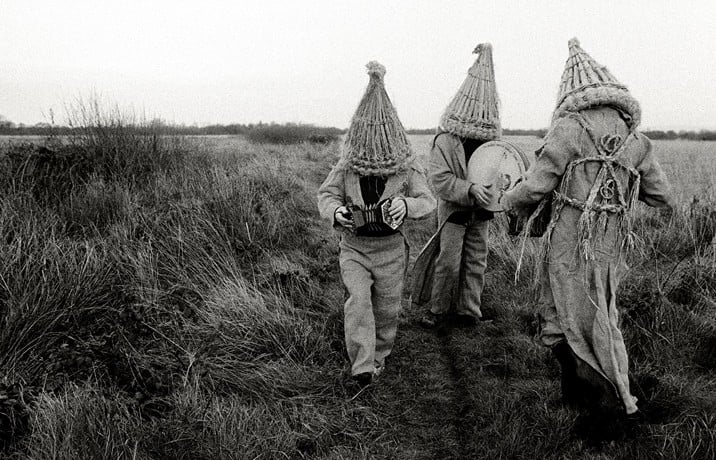
Straw Boys
In Spell of the Sensuous, David Abram touches on this extra-sensory way of perceiving and discusses how it is normative in pre-literate cultures. He describes how human-persons, in those oral cultures, “come to know themselves primarily as they are reflected back by the [other-than-human persons] and the animate landscapes with which they are directly engaged.” I suspect this extra-sensory mode of perception was once tied more closely to our primary method of communication, and still is for most life in the universe–including earth herself. Yet, we need not think of this experience as ‘extra.’ It is based in our neurology. According to Merleau-Ponty, when the synaesthesia between our eyes and ears is concentrated, the visual and auditory foci are virtually indistinguishable, readying us–sensual beings that we are– to respond with our whole body to the Other.
“The animistic proclivity to perceive the angular shape of a boulder (while shadows shift across its surface) as a kind of meaningful gesture, or to enter into felt conversations with clouds and owls–all of this could be brushed aside as imaginary distortion or hallucinatory fantasy if such active participation were not the very structure of perception, if the creative interplay of the senses in the things they encounter was not our sole way of linking ourselves to those things and letting the things weave themselves into our experience. Direct, prereflective perception is inherently synaesthetic, participatory, and animist, disclosing the things and elements that surround us not as inert objects but as expressive subjects, entities, powers, potencies.”

Forenachts : Co. Kildare
Anthropocentrism has led us toward an experience of isolation and separateness. Cut-off from the living world around us, we turn instead to fictions and fantasies of our mind: constructs developed to mimic the native connection between one’s own flesh and the encompassing flesh of the world.
As an animist (and I only speak for myself), I do not view the land around me as filled with disembodied, non-corporeal entities–a dualism arising from the scientific world view– though, I do not discount the possibility of Mind or Life expressing itself in this way, in some alternate reality or universe. Instead, I see the universe as FULL of living, conscious, embodied powers, some of whom may be open to, or interested in, communication. “Helios, ‘lord of high noon,’ is not distinct from the sun (the fiery sun here a willful intelligence able even to father children). Even ‘fair Dawn, with her spreading fingertips of rose,’ is a living power.” Within this perspective, I see our common language–the one all life can tap into–as one of imagery and sensuality. I leave it with you to decide, given the importance of this channel for direct and participatory experience, what constitutes ‘garbage’ –in regard to the images we fill our unconscious with– and whether ‘garbage in’ equals ‘garbage out.’
Previous Post

May 21, 2013
Wrinkles in Space
Next Post

May 27, 2013 Place and vulnerability
Browse Our Archives
Select a Category Africa Amazon Ancestors Animism Austin Boots Across Ireland Boston boundary crossing Bretagne Children Cities Community Connection Culture Detroit Druidry Earth Edinburgh Elements England Eskdalemuir Eugene experiential family Fiction Florida folklore France Glasgow Heathenry home how to build it Human Spaces imaginary landscapes Introduction Ireland Journeys Know your wild herbs Land Spirits London Maine memory lane Naturalizing Nature's Metaphors New York Poetry Remembering Ancestors Sacred Spaces San Francisco Scotland Seasons Seattle Tanzania Technology Texas the South Theory Top 10 traditions Travel Uncategorized United States video Water West Virginia Witchcraft Worlding
Select a Month August 2015 June 2015 May 2015 April 2015 March 2015 February 2015 January 2015 December 2014 November 2014 October 2014 September 2014 August 2014 July 2014 June 2014 May 2014 April 2014 March 2014 February 2014 January 2014 December 2013 November 2013 October 2013 September 2013 August 2013 July 2013 June 2013 May 2013 April 2013 March 2013 February 2013 January 2013 December 2012
Follow Us!
TAKE THE
Religious Wisdom Quiz
Who was the high priest during the boyhood of Samuel?
Select your answer to see how you score.
Hophni Phinehas Ahijah Eli
Related posts from A Sense of Place

Speaking of Burning Mountains...

The Mountain Of Fire, A Parable

The Most Important Issue Of Our Day

TRENDING AT PATHEOS Pagan

I was recently chatting with someone on Instagram. She asked me what...

While there are many people who share their results, the end of...

On July 23, I saw Christopher Nolan's The Odyssey which is Homer’s...

As I write this two big events have just finished up. One...

Restoring the Watershed of Divine Love
Perhaps cooperation is not something we manufacture through legislation, ideology, or moral...

Many UUs don’t pray because of bad experiences in a previous religion,...
view all Pagan blogs
Ad-Free & Subscriber Log-In Subscription Support
- About Us
- 2026 Calendar
- Videos
- Podcasts
- Library of World Religions
- Faith In Media Tracker
- Advertise With Us
- Write for Us
- Privacy Policy
- Terms of Service
- Do Not Sell My Data
- Contact Us
- Radiant Digital
- Manage Newsletter Subscriptions
- Unsubscribe From Notifications
- Sitemap
Copyright 2008-2026, Patheos. All rights reserved.
Subscription Support Ad-Free & Subscriber Log-In
Follow Patheos