
BuddhistCatholicContemplativeEvangelicalGeneral ChristianHinduJewishLatter-day SaintMuslimNew VisionsProgressive Christian
Beliefs
- Buddhist
- Catholic
- Contemplative
- Evangelical
- General Christian
- Hindu
- Jewish
- Latter-day Saint
- More Voices
- Muslim
- New Visions
- Pagan
- Progressive Christian
Topics
- Religion News
- Food and Religion
- Sports and Religion
- Religious Art
- Religious Music and Entertainment
- Religious Events
- History and Religion
- Style and Religion
- Politics and Religion
- Women in Religion
- Recreation Outdoors and Religion
- Business Finance and Religion
- Careers Workplace and Religion
- Education and Religion
- Family Parenting and Religion
- Health Fitness and Religion
- Home and Religion
- Relationships and Religion
- Technology and Religion
- Travel and Religion
Columnists
- Buddhist Columnists
- Business Finance and Religion Columnists
- Careers Workplace and Religion Columnists
- Catholic Columnists
- Contemplative Columnists
- Education and Religion Columnists
- Evangelists Columnists
- Family Parenting and Religion Columnists
- General Christian Columnists
- Health Fitness and Religion Columnists
- Hindu Columnists
- History and Religion Columnists
- Home and Religion Columnists
- Jewish Columnists
- More Voices Columnists
- Latter Day Columnists
- Muslim Columnists
- New Visions Columnists
- Nonreligious Columnists
- Pagan Columnists
- Politics and Religion Columnists
- Progressive Columnists
- Recreation Outdoors and Religion Columnists
- Relationships and Religion Columnists
- Religion News Columnists
- Religious Art Columnists
- Religious Events Columnists
- Religious Music and Entertainment Columnists
- Sports and Religion Columnists
- Style and Religion Columnists
- Technology and Religion Columnists
- Travel and Religion Columnists
- Women in Religion Columnists
Resource Library
- 2026 Calendar
- Library of World Religions
- The 100 Most Holy Places on Earth
- Patheos Answers
- Podcasts
- Videos
- Faith Leaders Database
- Anglican Episcopalian
- Bahai
- Baptist
- Buddhism
- Christianity
- Confucianism
- Eastern Orthodoxy
- Hinduism
- Holiness and Pentecostal
- ISKCON
- Islam
- Judaism
- Lutheran
- Methodist
- The Church of Jesus Christ of Latter-day Saints
- New Age
- Paganism
- Presbytarian and Reformed
- Protestantism
- Religion Behind the Scenes
- Roman Catholic
- Scientology
- Shia Islam
- Sikhism
- Sufism
- Sunni Islam
- Taoism
- Zen
- See all religions
Research Tools
 Ad-Free & Subscriber Log-In Subscription Support
Ad-Free & Subscriber Log-In Subscription Support
Follow Patheos 

- Trending:
- Forgiveness
- |
- Marriage
- |
- Consciousness
- |
- Death Penalty
- |
- Election
- |
- Halloween
 A Sense of Place
- Home
- Pagan
- Why getting outside matters
Why getting outside matters
Last updated on: April 12, 2013 at 3:14 pm by Niki Whiting
Why getting outside matters 2013-04-12T15:14:35+00:00 Niki Whiting
Patheos Explore the world's faith through different perspectives on religion and spirituality! Patheos has the views of the prevalent religions and spiritualities of the world.
There are a million ways to connect to Place, and most of them involve going ‘outside.’ Some of the reasons don’t necessarily involve the Land, but involve people, groups, events, our own homes, etc. Of course, this makes it sound like those things are separate from the Land, which they are not, as everything is interdependent.
There are also many reasons why going outside matters. We can talk about the health reasons for walking and not driving, for the environmental education the outdoors imparts to us. We can talk about connecting to spirits – either the Land spirits or just our own. We can talk about how going outside bolsters community connection and safety. All of these things are important and good.
I read this beautifully written article by Rebecca Solnit today. So much of our very language is geared toward consuming and efficiency. How do we learn to listen if we do not practice it? How do we learn to relate if we only think of relating to humans? How can we create space for the intangible?
The language of commerce has been engineered to describe the overt purpose of a thing, but cannot encompass fringe benefits or peripheral pleasures. It weighs the obvious against what in its terms are incomprehensible. When I drive from here to there, speed, privacy, control, and safety are easy to claim. When I walk, what happens is more vague, more ambiguous—and in many circumstances much richer. I am out in the world. It’s exercise, though not so quantifiably as on a treadmill in a gym with a digital readout. It’s myriad little epiphanies and encounters that knit me more tightly into my place and maybe enhance the place overall. The carbon emissions are essentially nil. Many more benefits are more subjective, more ethereal—and more wordy. You can’t describe them in a few familiar phrases; and if you’re not practiced at describing them, you may not be able to articulate them at all. It is difficult to value what cannot be named. Since someone makes money every time you buy a car or fill it up, there’s a whole commercial language built around getting us to drive; there’s little or no language promoting the free act of walking.
I get so distracted during my days. What was for dinner again? Do I have all the ingredients? Is it time to pick up the boy from preschool? All the little things to care for and think about crowd out the spaciousness of birds and breezes. But getting outside – walking the mile into town, walking the three blocks to and from preschool – these little outings help me connect in non-quantifiable ways to my surroundings. The buds of the blooms are just ever so slightly more open today. The air smells more like rain this afternoon than it did in the morning (time to put raincoats on everyone).
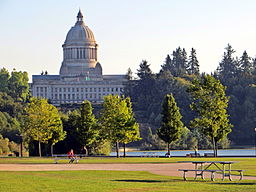
Capitol and Capitol Lake, Olympia, WA by Brylie Oxley, via Wikimedia Commons.
Those observances are beneficial to me. I relate to my new chosen Land more and more every day. I encourage the kids to develop their senses. But, as Solnit goes on to point out, getting outside and the resulting “slowness is an act of resistance, not because slowness is a good in itself but because of all that it makes room for, the things that don’t get measured and can’t be bought.”
Lifestyles, by choice or necessity, that engage us with our communities and our Lands are acts of resistance. Many gardeners and urban homesteaders talk about how they are practicing food security. Those who bike or forgo commuting all together sometimes speak about reducing their dependency on oil. In a world where we are encouraged to own cars as soon as we know how to drive, that suggests commuting an hour or more to work is a good idea, that packaged foods are just fine for our bodies, these seemingly small acts of resistance still feel radical. I want what I eat to connect me to other living things, not chemicals manufactured in a plant designed with profits in mind. I want to a live a life that affords me more time with the people that I love – and walking enables that.
Whatever acts bring you in closer connection to your gods, your loved ones, your communities, and your lands, these are potentially radical acts. Going outside matters. And I think it’s going to matter more and more in our world. I think that these acts of resistance are part of the revolution our societies are headed toward. If walking and being together in our lands isn’t, I’m not sure it’s a revolution I want to be part of!
Previous Post
April 11, 2013
Boots Across Ireland: Liosnabroc ringfort {video}
Next Post

April 16, 2013 The Fox in the Park
Browse Our Archives
Select a Category Africa Amazon Ancestors Animism Austin Boots Across Ireland Boston boundary crossing Bretagne Children Cities Community Connection Culture Detroit Druidry Earth Edinburgh Elements England Eskdalemuir Eugene experiential family Fiction Florida folklore France Glasgow Heathenry home how to build it Human Spaces imaginary landscapes Introduction Ireland Journeys Know your wild herbs Land Spirits London Maine memory lane Naturalizing Nature's Metaphors New York Poetry Remembering Ancestors Sacred Spaces San Francisco Scotland Seasons Seattle Tanzania Technology Texas the South Theory Top 10 traditions Travel Uncategorized United States video Water West Virginia Witchcraft Worlding
Select a Month August 2015 June 2015 May 2015 April 2015 March 2015 February 2015 January 2015 December 2014 November 2014 October 2014 September 2014 August 2014 July 2014 June 2014 May 2014 April 2014 March 2014 February 2014 January 2014 December 2013 November 2013 October 2013 September 2013 August 2013 July 2013 June 2013 May 2013 April 2013 March 2013 February 2013 January 2013 December 2012
Follow Us!
TAKE THE
Religious Wisdom Quiz
Which prophet confronted David about his sin with Bathsheba?
Select your answer to see how you score.
Gad Nathan Abiathar Samuel
Related posts from A Sense of Place

Speaking of Burning Mountains...

The Mountain Of Fire, A Parable

The Most Important Issue Of Our Day

TRENDING AT PATHEOS Pagan

I was recently chatting with someone on Instagram. She asked me what...

While there are many people who share their results, the end of...

On July 23, I saw Christopher Nolan's The Odyssey which is Homer’s...

As I write this two big events have just finished up. One...

Restoring the Watershed of Divine Love
Perhaps cooperation is not something we manufacture through legislation, ideology, or moral...

Many UUs don’t pray because of bad experiences in a previous religion,...
view all Pagan blogs
Ad-Free & Subscriber Log-In Subscription Support
- About Us
- 2026 Calendar
- Videos
- Podcasts
- Library of World Religions
- Faith In Media Tracker
- Advertise With Us
- Write for Us
- Privacy Policy
- Terms of Service
- Do Not Sell My Data
- Contact Us
- Radiant Digital
- Manage Newsletter Subscriptions
- Unsubscribe From Notifications
- Sitemap
Copyright 2008-2026, Patheos. All rights reserved.
Subscription Support Ad-Free & Subscriber Log-In
Follow Patheos