
BuddhistCatholicContemplativeEvangelicalGeneral ChristianHinduJewishLatter-day SaintMuslimNew VisionsProgressive Christian
Beliefs
- Buddhist
- Catholic
- Contemplative
- Evangelical
- General Christian
- Hindu
- Jewish
- Latter-day Saint
- More Voices
- Muslim
- New Visions
- Pagan
- Progressive Christian
Topics
- Religion News
- Food and Religion
- Sports and Religion
- Religious Art
- Religious Music and Entertainment
- Religious Events
- History and Religion
- Style and Religion
- Politics and Religion
- Women in Religion
- Recreation Outdoors and Religion
- Business Finance and Religion
- Careers Workplace and Religion
- Education and Religion
- Family Parenting and Religion
- Health Fitness and Religion
- Home and Religion
- Relationships and Religion
- Technology and Religion
- Travel and Religion
Columnists
- Buddhist Columnists
- Business Finance and Religion Columnists
- Careers Workplace and Religion Columnists
- Catholic Columnists
- Contemplative Columnists
- Education and Religion Columnists
- Evangelists Columnists
- Family Parenting and Religion Columnists
- General Christian Columnists
- Health Fitness and Religion Columnists
- Hindu Columnists
- History and Religion Columnists
- Home and Religion Columnists
- Jewish Columnists
- More Voices Columnists
- Latter Day Columnists
- Muslim Columnists
- New Visions Columnists
- Nonreligious Columnists
- Pagan Columnists
- Politics and Religion Columnists
- Progressive Columnists
- Recreation Outdoors and Religion Columnists
- Relationships and Religion Columnists
- Religion News Columnists
- Religious Art Columnists
- Religious Events Columnists
- Religious Music and Entertainment Columnists
- Sports and Religion Columnists
- Style and Religion Columnists
- Technology and Religion Columnists
- Travel and Religion Columnists
- Women in Religion Columnists
Resource Library
- 2026 Calendar
- Library of World Religions
- The 100 Most Holy Places on Earth
- Patheos Answers
- Podcasts
- Videos
- Faith Leaders Database
- Anglican Episcopalian
- Bahai
- Baptist
- Buddhism
- Christianity
- Confucianism
- Eastern Orthodoxy
- Hinduism
- Holiness and Pentecostal
- ISKCON
- Islam
- Judaism
- Lutheran
- Methodist
- The Church of Jesus Christ of Latter-day Saints
- New Age
- Paganism
- Presbytarian and Reformed
- Protestantism
- Religion Behind the Scenes
- Roman Catholic
- Scientology
- Shia Islam
- Sikhism
- Sufism
- Sunni Islam
- Taoism
- Zen
- See all religions
Research Tools
 Ad-Free & Subscriber Log-In Subscription Support
Ad-Free & Subscriber Log-In Subscription Support
Follow Patheos 

- Trending:
- Forgiveness
- |
- Marriage
- |
- Consciousness
- |
- Death Penalty
- |
- Election
- |
- Halloween
 A Sense of Place
- Home
- Pagan
- Boots Across Ireland: Liosnabroc ringfort {video}
Boots Across Ireland: Liosnabroc ringfort {video}
Last updated on: April 11, 2013 at 8:51 pm by Traci
Boots Across Ireland: Liosnabroc ringfort {video} 2013-04-11T20:51:41+00:00 Traci
Patheos Explore the world's faith through different perspectives on religion and spirituality! Patheos has the views of the prevalent religions and spiritualities of the world.
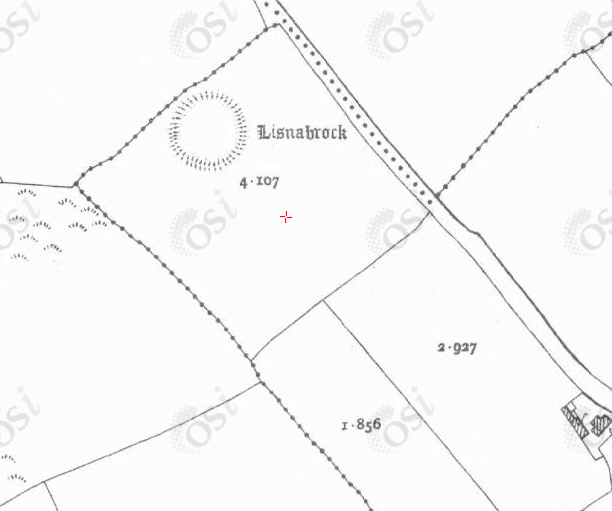
1890 Ordnance Survey map : my house can be seen lower right
Liosnabroc (Fort of the Badger – anglicized as Lisnabrock) is a ringfort located in the townland of Templebodan, east Cork. The ring is found labeled on the 1890 Ordnance Survey map. Like the majority of ringforts in Ireland, Liosnabroc opens to the NE — offering a lovely view of the Knockmealdown and Galtee mountain ranges. I am privileged to live next door to this active and beautiful Lios.
Ringforts were constructed mainly from the Iron Age into the early Medieval period (800 BCE to ~1000 CE) by the indigenous population of the island. They are one of the most common Irish field monuments, with estimates on their numbers varying between 30,000 to 40,000 throughout the country.
The early Irish law tracts set out the size and morphology of enclosures and homes for various classes of people in early Irish society — which was highly stratified. For instance, the bóaire or ‘cow lord’ was entitled to a house of 8.23m, an out-house of 4.57m, a kiln, a barn, a sheep-fold, a calf-fold and pigsty.
The term ‘Ringfort’ is a bit of a misnomer. These sites were almost certainly incapable of withstanding any form of determined attack. And while they may have provided refuge from wild animals and fast moving cattle-raiding parties, they were most likely constructed as a show of wealth by the individual in control of the area. In fact, the longevity of the sites is a testament to the prestige and honor shown these individuals — many have stood the test of over 1,000 years of turbulent history!
And it’s this strong ancestral element that gave rise, in folk memory, to the belief that lios, rath, and dún were habitations of the Sí (people of the mounds/ ancestral dead – a term that harkens back to the neolithic mound building period, which was itself 2,000 to 4,000 years before the occupation of the ringforts!). The ancestral connection and memory of ‘powerful leaders’ folded these more ‘modern’ monuments into the well established corpus of taboo and folklore attached to such sites, and ultimately contributed to their preservation through the centuries.
The footage below was filmed on Wednesday morning, 3rd April 2013: the first sunny spring day we’ve seen! (though it rapidly deteriorated afterward) I had a nice long visit with my other-than-human-person friends while filming, and took the opportunity to meditate while basking in the lovely day. The energy of the ring flowed clear while I was there. You will find several minutes of meditational encounter at the end of the film. I hope you enjoy meeting the Liosnabroc.
Oh, yes, yes, yes! You kept very far away from the raths. As a matter of fact, I knew one man who thought he’d make a very good job of it. He had been in the States, and he came home he wouldn’t listen to the like of this, the old Irish, he wouldn’t listen to them over there, you know. And he cut all the bushes. It had overgrown with bushes. So he cut all the bushes around, and thought it was a great place to fodder cattle in the wintertime. So as he was going home, he fell. And he was dead on the ninth day. There’s no lie in that.
Matty O’Brien, Teltown, Co. Meath. Recorded July 1, 1979
Visit Voices From The Dawn, to hear this story in its entirety.
sources:
Early medieval settlement enclosures in Ireland: dwellings, daily life, and social identity
Previous Post

April 9, 2013
Cultural Boundary Spaces
Next Post

April 12, 2013 Why getting outside matters
Browse Our Archives
Select a Category Africa Amazon Ancestors Animism Austin Boots Across Ireland Boston boundary crossing Bretagne Children Cities Community Connection Culture Detroit Druidry Earth Edinburgh Elements England Eskdalemuir Eugene experiential family Fiction Florida folklore France Glasgow Heathenry home how to build it Human Spaces imaginary landscapes Introduction Ireland Journeys Know your wild herbs Land Spirits London Maine memory lane Naturalizing Nature's Metaphors New York Poetry Remembering Ancestors Sacred Spaces San Francisco Scotland Seasons Seattle Tanzania Technology Texas the South Theory Top 10 traditions Travel Uncategorized United States video Water West Virginia Witchcraft Worlding
Select a Month August 2015 June 2015 May 2015 April 2015 March 2015 February 2015 January 2015 December 2014 November 2014 October 2014 September 2014 August 2014 July 2014 June 2014 May 2014 April 2014 March 2014 February 2014 January 2014 December 2013 November 2013 October 2013 September 2013 August 2013 July 2013 June 2013 May 2013 April 2013 March 2013 February 2013 January 2013 December 2012
Follow Us!
TAKE THE
Religious Wisdom Quiz
How many books are in the Bible (Protestant version)?
Select your answer to see how you score.
12 66 40 73
Related posts from A Sense of Place

Speaking of Burning Mountains...

The Mountain Of Fire, A Parable

The Most Important Issue Of Our Day

TRENDING AT PATHEOS Pagan

I was recently chatting with someone on Instagram. She asked me what...

While there are many people who share their results, the end of...

On July 23, I saw Christopher Nolan's The Odyssey which is Homer’s...

As I write this two big events have just finished up. One...

Restoring the Watershed of Divine Love
Perhaps cooperation is not something we manufacture through legislation, ideology, or moral...

Many UUs don’t pray because of bad experiences in a previous religion,...
view all Pagan blogs
Ad-Free & Subscriber Log-In Subscription Support
- About Us
- 2026 Calendar
- Videos
- Podcasts
- Library of World Religions
- Faith In Media Tracker
- Advertise With Us
- Write for Us
- Privacy Policy
- Terms of Service
- Do Not Sell My Data
- Contact Us
- Radiant Digital
- Manage Newsletter Subscriptions
- Unsubscribe From Notifications
- Sitemap
Copyright 2008-2026, Patheos. All rights reserved.
Subscription Support Ad-Free & Subscriber Log-In
Follow Patheos