
BuddhistCatholicContemplativeEvangelicalGeneral ChristianHinduJewishLatter-day SaintMuslimNew VisionsProgressive Christian
Beliefs
- Buddhist
- Catholic
- Contemplative
- Evangelical
- General Christian
- Hindu
- Jewish
- Latter-day Saint
- More Voices
- Muslim
- New Visions
- Pagan
- Progressive Christian
Topics
- Religion News
- Food and Religion
- Sports and Religion
- Religious Art
- Religious Music and Entertainment
- Religious Events
- History and Religion
- Style and Religion
- Politics and Religion
- Women in Religion
- Recreation Outdoors and Religion
- Business Finance and Religion
- Careers Workplace and Religion
- Education and Religion
- Family Parenting and Religion
- Health Fitness and Religion
- Home and Religion
- Relationships and Religion
- Technology and Religion
- Travel and Religion
Columnists
- Buddhist Columnists
- Business Finance and Religion Columnists
- Careers Workplace and Religion Columnists
- Catholic Columnists
- Contemplative Columnists
- Education and Religion Columnists
- Evangelists Columnists
- Family Parenting and Religion Columnists
- General Christian Columnists
- Health Fitness and Religion Columnists
- Hindu Columnists
- History and Religion Columnists
- Home and Religion Columnists
- Jewish Columnists
- More Voices Columnists
- Latter Day Columnists
- Muslim Columnists
- New Visions Columnists
- Nonreligious Columnists
- Pagan Columnists
- Politics and Religion Columnists
- Progressive Columnists
- Recreation Outdoors and Religion Columnists
- Relationships and Religion Columnists
- Religion News Columnists
- Religious Art Columnists
- Religious Events Columnists
- Religious Music and Entertainment Columnists
- Sports and Religion Columnists
- Style and Religion Columnists
- Technology and Religion Columnists
- Travel and Religion Columnists
- Women in Religion Columnists
Resource Library
- 2026 Calendar
- Library of World Religions
- The 100 Most Holy Places on Earth
- Patheos Answers
- Podcasts
- Videos
- Faith Leaders Database
- Anglican Episcopalian
- Bahai
- Baptist
- Buddhism
- Christianity
- Confucianism
- Eastern Orthodoxy
- Hinduism
- Holiness and Pentecostal
- ISKCON
- Islam
- Judaism
- Lutheran
- Methodist
- The Church of Jesus Christ of Latter-day Saints
- New Age
- Paganism
- Presbytarian and Reformed
- Protestantism
- Religion Behind the Scenes
- Roman Catholic
- Scientology
- Shia Islam
- Sikhism
- Sufism
- Sunni Islam
- Taoism
- Zen
- See all religions
Research Tools
 Ad-Free & Subscriber Log-In Subscription Support
Ad-Free & Subscriber Log-In Subscription Support
Follow Patheos 

- Trending:
- Forgiveness
- |
- Marriage
- |
- Consciousness
- |
- Death Penalty
- |
- Election
- |
- Halloween
 Approaching Justice
- Home
- About Approaching Justice
- Rawls and Religion
- "Are Mormons Christian?" An Interfaith Round Table
- Home
- Latter-day Saint
Rawls and Religion
Follow this link to see the posts in this series.
The treatment of religion in the philosophy of John Rawls has been a focus of much writing.
This writings have generally fallen into two categories:
- Religious thinkers looking to at the intersection of Rawls’ secular theory of justice and religious social teaching about justice.
- Discussions the role Rawls gives to religious doctrines in his later arguments for political liberalism and public reason.
There will be a substantial review of the above literature as the project proceeds.
However, this project is not about those discussions. Instead, with the posthumous publication of Rawls’ senior thesis A Brief 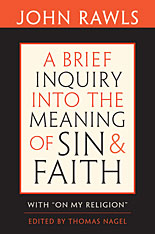 Inquiry into the Meaning of Sin and Faith and his much later personal essay "On My Religion" (2010) we can find insights into both the early religious views of Rawls as well as his personal view of religion in his later life. These insights illuminate both the religious roots of his theory of justice and the respectful tension that Rawls had with religion.
By better understanding these lesser known writings on religion, one will have a better understanding of the arguments made in his two most major works A Theory of Justice (1999) and Political Liberalism (1996).
Both Samuel Freeman (2007) and Daniel Dombrowski (2011) distinguish between doing Rawlsian political philosophy or applied philosophy, which they view themselves as doing, and detailed analysis of Rawls and his writings (which both have also done much of). Dombrowski, in particular notes that he is not doing an exegesis of the writing of Rawls. Instead, he is extending a philosophical school of thought.
This project, while by a Rawlsian, is different from Dombrowki’s in that sense. This is an exegesis of Rawls’s work, in particular his senior theology thesis and his major later works.
The significance of such a project is not only to bring clarification to what are some of the most important 20th century writings in moral and political philosophy, but also to give a fuller basis for the exercise of Rawlsian political philosophy.
Follow this link to see the posts in this series.
Follow this link for all posts about Rawls.
Ad-Free & Subscriber Log-In Subscription Support
- About Us
- 2026 Calendar
- Videos
- Podcasts
- Library of World Religions
- Faith In Media Tracker
- Advertise With Us
- Write for Us
- Privacy Policy
- Terms of Service
- Do Not Sell My Data
- Contact Us
- Radiant Digital
- Manage Newsletter Subscriptions
- Unsubscribe From Notifications
- Sitemap
Copyright 2008-2026, Patheos. All rights reserved.
Subscription Support Ad-Free & Subscriber Log-In
Follow Patheos