
BuddhistCatholicContemplativeEvangelicalGeneral ChristianHinduJewishLatter-day SaintMuslimNew VisionsProgressive Christian
Beliefs
- Buddhist
- Catholic
- Contemplative
- Evangelical
- General Christian
- Hindu
- Jewish
- Latter-day Saint
- More Voices
- Muslim
- New Visions
- Pagan
- Progressive Christian
Topics
- Religion News
- Food and Religion
- Sports and Religion
- Religious Art
- Religious Music and Entertainment
- Religious Events
- History and Religion
- Style and Religion
- Politics and Religion
- Women in Religion
- Recreation Outdoors and Religion
- Business Finance and Religion
- Careers Workplace and Religion
- Education and Religion
- Family Parenting and Religion
- Health Fitness and Religion
- Home and Religion
- Relationships and Religion
- Technology and Religion
- Travel and Religion
Columnists
- Buddhist Columnists
- Business Finance and Religion Columnists
- Careers Workplace and Religion Columnists
- Catholic Columnists
- Contemplative Columnists
- Education and Religion Columnists
- Evangelists Columnists
- Family Parenting and Religion Columnists
- General Christian Columnists
- Health Fitness and Religion Columnists
- Hindu Columnists
- History and Religion Columnists
- Home and Religion Columnists
- Jewish Columnists
- More Voices Columnists
- Latter Day Columnists
- Muslim Columnists
- New Visions Columnists
- Nonreligious Columnists
- Pagan Columnists
- Politics and Religion Columnists
- Progressive Columnists
- Recreation Outdoors and Religion Columnists
- Relationships and Religion Columnists
- Religion News Columnists
- Religious Art Columnists
- Religious Events Columnists
- Religious Music and Entertainment Columnists
- Sports and Religion Columnists
- Style and Religion Columnists
- Technology and Religion Columnists
- Travel and Religion Columnists
- Women in Religion Columnists
Resource Library
- 2026 Calendar
- Library of World Religions
- The 100 Most Holy Places on Earth
- Patheos Answers
- Podcasts
- Videos
- Faith Leaders Database
- Anglican Episcopalian
- Bahai
- Baptist
- Buddhism
- Christianity
- Confucianism
- Eastern Orthodoxy
- Hinduism
- Holiness and Pentecostal
- ISKCON
- Islam
- Judaism
- Lutheran
- Methodist
- The Church of Jesus Christ of Latter-day Saints
- New Age
- Paganism
- Presbytarian and Reformed
- Protestantism
- Religion Behind the Scenes
- Roman Catholic
- Scientology
- Shia Islam
- Sikhism
- Sufism
- Sunni Islam
- Taoism
- Zen
- See all religions
Research Tools
 Ad-Free & Subscriber Log-In Subscription Support
Ad-Free & Subscriber Log-In Subscription Support
Follow Patheos 

- Trending:
- Forgiveness
- |
- Marriage
- |
- Consciousness
- |
- Death Penalty
- |
- Election
- |
- Halloween
 Approaching Justice
- Home
- About Approaching Justice
- Rawls and Religion
- "Are Mormons Christian?" An Interfaith Round Table
- Home
- Latter-day Saint
- “By Night in Chile”: Reflections in Remembrance of the Other 9/11
“By Night in Chile”: Reflections in Remembrance of the Other 9/11
Last updated on: September 11, 2013 at 8:17 am by Chris Henrichsen
“By Night in Chile”: Reflections in Remembrance of the Other 9/11 2013-09-11T08:17:18-07:00 Chris Henrichsen
Patheos Explore the world's faith through different perspectives on religion and spirituality! Patheos has the views of the prevalent religions and spiritualities of the world.
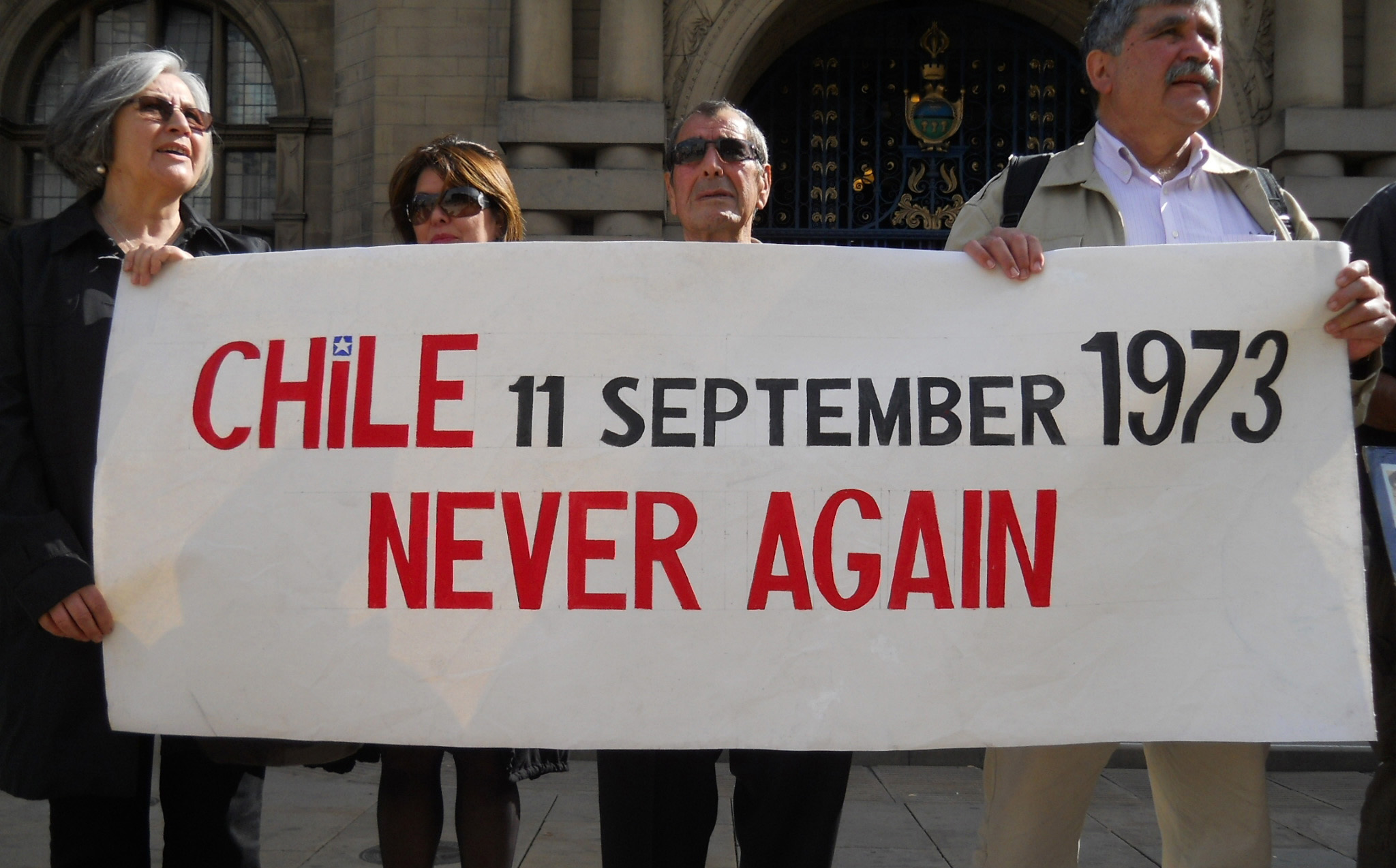
Author’s Note: Today marks the 40th Anniversary of the military coup in Chile which overthrew the democratic socialist regmine of President Salvador Allende. The coup ushered in over 15 years of autocratic military rule. I wrote the following reflection on Roberto Bolaño’s By Night in Chile back in 2008.
In the immediate aftermath of the coup, thousands of leftists and others where murdered by the military regime. 40 years later, I honor and remember them.
By Night in Chile by Roberto Bolaño is not so much about Chile and its troubled past, as it is about Chile’s intellectual elite. While the focus of the stories is on the literary elite of Chile, the message of the book is not just about the intellectual elite of Chile, but intellectual elites in general and their response to the world around them.
This short book is narrated by Sebastian Urrutia Lacroix, an elderly Catholic priest. Sebastian’s life is presented as the rambling thoughts of an old man who cannot sleep. While his thoughts cover the entirety of his life, these thoughts appear in the narrative as they pop into his mind during the night. Stories from his life interweave with each other throughout the book. This book has two paragraphs with the second paragraph consisting of one line on the last page. While this style takes some getting used to, it does give one the sense of his thoughts and who he is as a character.


The Story
Sebastian is from a poor Chilean family, though he is quite proud of his European roots. He describes practices that are Chilean as lowly and common. He enters the seminary at the age of 15, despite the misgivings of his father. His father appears throughout the night as a shadow in Sebastian’s memories.
In the seminary, Sebastian finds his life’s love. However, it is not a woman, or even the ministry but instead poetry. His poetic pursuits lead him to fall within the sphere of influence of an influential literary critic, Farewell, who encourages Sebastian to venture into literary criticism as a career. While he continues to write and teach poetry, it is a critic that Sebastian becomes a notable member of the literary community of Chile.
While he likes literature, Sebastian is most enamored with the literary life-style. First, he enjoys the status and celebrity that he has enjoyed. Secondly, he enjoys the social life which comes with it. He enjoys the late-night literary discussions, with the accompanying meals and cognac, that he is a regular partaker of.
Sebastian’s desire for the intellectual life style is one that I am sympathetic with. My master’s advisor was a major political theorist with a budget that allowed him to invite well known scholars to Utah. I would sometimes be invited to attend social gatherings at his house following lectures on campus. Good food and great conversation, the type of conversation that you could only have with a group of people who cared about liberal political philosophy the way that only we did. These events were intoxicating. I also vividly recall the feeling of not being invited. As an awkward outsider who got a taste of these gatherings, I could relate to the young Sebastian.
For a story about a priest, religion does not play a huge role in Sebastian’s life as he reflects upon it. The priesthood was more a path to the comfortable life, which would not have been otherwise possible for a poor Chilean boy. While it is unlikely that this was the reason for entering the seminary, his life as a clergyman is very peripheral as he reminisces about his life.
The matter of being a priest seems to come up most often when he thinks back to those times when he was conflicted about whether to dress as a priest when going to certain events. In his first excursion to Farewell’s country vacation home, his first formal entry into elite literary circles, Sebastian is not sure whether to go as a priest or merely as a friend of Farewell. While he dressed as a priest, he is unsure of his choice. There is little pride in the priesthood and an apparent desire to be a strictly a poet and critic who is part of the literary elite. Being a priest is at times an embarrassment.
The one time that Sebastian seems actively proud about his role as a priest is when he travels by ship to Europe. The European trip is connected to his Opus Dei membership, and the purpose of the trip is to investigate the preservation of old churches in Europe. While traveling, he leads mass and gives counsel to fellow travelers. Here he is the proud priest because in this setting, being the priest allowed him to be the center of the social attention.
By portraying Sebastian as somewhat disconnected from his religious role, I interpret this as not an omission by Bolano but as a statement. Those in the Church who sustain the status quo did not do so for theological reasons but because they were more worried about maintaining their place in society. This is why Sebastian trip to Europe is focused on the attempt to protect old church from the damage of pigeon droppings. The concern is not for people, or even theology, but preserving old buildings…no matter the cost.
I think that it could be said that many of the actions and policies of the Catholic Church where done out of a desire for institutional survival and positioning. This makes them a mysterious and complex player in the South American military regimes of the 1970s and 1980s.
Knowing beforehand that the main character was a member of Opus Dei, I had expected to find something sensational about such a membership. However, there is no Davinci Code here. For Sebastian, Opus Dei is merely a matter of prestige.
Yet, it is because of his Opus Dei membership that he is first sent to Europe and then is pushed into lecturing Augusto Pinochet and other military leaders about Karl Marx. He wears the priest garb to these meetings as a means of protecting himself against association with Marxists. He soon finds out that these meetings are being used as propaganda. The regime wants to show that the generals are intellectuals who are also interested in Marx. For the first time, Sebastian is aware that those in power are using him for political ends. Yet, he is able to move on.
Classics and Politics
The events surrounding the rise and fall of the Salvador Allende administration in Chile, are one of the things that most interest me about South America. My interest in this issue also led me to seek out this book. However, we learn little more about these events in Bolaño’s book because it is of little notice to Sebastian, though it is very much an inconvenience to Farewell whose country cottage is taken by the state.
As the events of the Allende years play out, Sebastian notes that they occur but with little interest. Instead, he turns to the classics: Aesop, Herodotus,Thucydides, Aristotle, and Plato. Most of all, he is relieved when it is over. My thoughts turned to the Straussians who argue that such classics are all one needs to be educated. The problem with their argument (amongst over things) is that it avoids the actual conditions of the world. Sebastian similarly ignors the nation around him. No need to read anything that would undermine the social order. For Sebastian, there is a general disinterest in other human beings and their well-being. His own comfort and life-style is all that he worries about and this literature, particularly the classics, helps him maintain that focus.
While Sebastian’s actions and attitude as disturbing, they are not that much different from intellectual elites of other stripes. Am I responsive to real social problems or am I just off in my own theoretical world?
The heart of Bolano’s critique of literary elites is the contention that they are aloof and uninterested in the situation of everyday people. This is not because of a political ideology, but because of a twisted and shallow self-interest. As long as they are able to enjoy their cognac and social atmosphere, little else matters. Now many other people may be like this as well, but these intellectuals give the aura of being above such pettiness. They are not.
Maria and her house
During the Pinochet years, much of Sebastian’s social life centers around the home of Maria Canales. She is a popular socialite and writer. While her writing has been recognized with awards, her status in the eye of Sebastian comes from the way in which she and her house have become the center of the literary scene in Santiago and a refuge from the turmoil of the day. Without saying as much, he is quite smitten with her.
It turns out that Maria’s North American husband is an official with the defense intelligence agency. He is actively involved in the atrocities of the Pinochet regime. It even turns out that he has been routinely interrogating and torturing political dissenters in their home by day while he joined Maria and her friends at their literary gatherings by night. From their house, prisoners are sent off into the system of political prisons.
Maria and her house symbolize the horror that not only took place around them in Chile but the horrors that took place under their very noses. Did they know about it? Well, one drunk guest did claim to have come across a bound person on a metal table while aimlessly wondering through Maria’s house. But it made no sense. Sadly, it turned out to make too much sense.
A Warning
These elites only cared about their lifestyle. Yet, that life was a life which was not far from the atrocities of the Chilean military regime. It took place right below them. Did they not see it or did they choose not to see it?
Are they to be blamed? They did not torture anyone. But, are they to be blamed? Not in a legal sense, but in a moral sense? Yes, they are to be blamed. They lived in a place of horror, but stayed in their place of comfort and pleasure. They did nothing that would threaten their own position, not for any principled reason, just vanity.
Are we any different? Could not the same be said of intellectual elites everywhere in light of the suffering and human rights violations that take place in our world? Studying these events through fiction, in this case through haunting historical literature, allows us to think beyond the specific events of the text and apply the implications of these critiques to our day and time.
When Farewell, the prominent literary critic of a prior generation died, no one really cared or noticed. Sebastian knows that the same fate awaits him. This is why he cannot sleep. Does the same fate await me?
Bolaño, Roberto, and Chris Andrews. By Night in Chile. New York: New Directions Books, 2003.
Previous Post

September 10, 2013
The Ten Key Values of the Green Party

Browse Our Archives
Select a Category Adventures in Parenting Adventures in Sunday School American History American Political Thought American Politics American Religion Blog Admin Books Campaign Chronicles Culture Current Events Faith & Social Justice News Roundup General Conference Green Party Guest Post Guns HuffPost Live Hymns of Social Justice Independence Rock Group Las Vegas Marginalia Mormon Studies Mormonism Music Personal and Family Philosophy Political Philosophy Pop culture Queer Pioneer Week Quote of the Day Rawls Rawls and Religion Religion Social Justice Social Justice Book Club Sports Theology U.S Constitution Uncategorized Unions Video Wyoming
Select a Month February 2014 January 2014 December 2013 November 2013 October 2013 September 2013 August 2013 July 2013 June 2013 May 2013 April 2013 March 2013 February 2013
TAKE THE
Religious Wisdom Quiz
What does "Lo-debar" mean in Hebrew?
Select your answer to see how you score.
No pasture The chosen city Valley of rest The Lord’s land
Related posts from Approaching Justice

Polygamy Researcher Responds to Sister Wives Ruling
Our "Elf on the Shelf" Has Good Taste

Review: The Challenge of Honesty
TRENDING AT PATHEOS Latter-day Saint

Did Prayer Cure His Cancer? Or Was It...
At 4 AM one morning, Joshua W. Brown’s wife awoke to a...

8 Ways a Near-Death Experience Rewires the Soul
Does Consciousness Survive Physical Death? After 50 Years of Research, Dr. Raymond...

Holy Longing: What Our Restlessness Is Telling Us
“One can find so many pains when the rain is falling.” -John...

What this is NOT about. This blog is definitely not about...

Who said the Israelites were God’s chosen? That’s right, they did. Who...

The Spirit World Is the Real World: God...
A Monk’s Wisdom on Body and Spirit I sit with Brother Martin...
view all Latter-day Saint blogs
Ad-Free & Subscriber Log-In Subscription Support
- About Us
- 2026 Calendar
- Videos
- Podcasts
- Library of World Religions
- Faith In Media Tracker
- Advertise With Us
- Write for Us
- Privacy Policy
- Terms of Service
- Do Not Sell My Data
- Contact Us
- Radiant Digital
- Manage Newsletter Subscriptions
- Unsubscribe From Notifications
- Sitemap
Copyright 2008-2026, Patheos. All rights reserved.
Subscription Support Ad-Free & Subscriber Log-In
Follow Patheos