
BuddhistCatholicContemplativeEvangelicalGeneral ChristianHinduJewishLatter-day SaintMuslimNew VisionsProgressive Christian
Beliefs
- Buddhist
- Catholic
- Contemplative
- Evangelical
- General Christian
- Hindu
- Jewish
- Latter-day Saint
- More Voices
- Muslim
- New Visions
- Pagan
- Progressive Christian
Topics
- Religion News
- Food and Religion
- Sports and Religion
- Religious Art
- Religious Music and Entertainment
- Religious Events
- History and Religion
- Style and Religion
- Politics and Religion
- Women in Religion
- Recreation Outdoors and Religion
- Business Finance and Religion
- Careers Workplace and Religion
- Education and Religion
- Family Parenting and Religion
- Health Fitness and Religion
- Home and Religion
- Relationships and Religion
- Technology and Religion
- Travel and Religion
Columnists
- Buddhist Columnists
- Business Finance and Religion Columnists
- Careers Workplace and Religion Columnists
- Catholic Columnists
- Contemplative Columnists
- Education and Religion Columnists
- Evangelists Columnists
- Family Parenting and Religion Columnists
- General Christian Columnists
- Health Fitness and Religion Columnists
- Hindu Columnists
- History and Religion Columnists
- Home and Religion Columnists
- Jewish Columnists
- More Voices Columnists
- Latter Day Columnists
- Muslim Columnists
- New Visions Columnists
- Nonreligious Columnists
- Pagan Columnists
- Politics and Religion Columnists
- Progressive Columnists
- Recreation Outdoors and Religion Columnists
- Relationships and Religion Columnists
- Religion News Columnists
- Religious Art Columnists
- Religious Events Columnists
- Religious Music and Entertainment Columnists
- Sports and Religion Columnists
- Style and Religion Columnists
- Technology and Religion Columnists
- Travel and Religion Columnists
- Women in Religion Columnists
Resource Library
- 2026 Calendar
- Library of World Religions
- The 100 Most Holy Places on Earth
- Patheos Answers
- Podcasts
- Videos
- Faith Leaders Database
- Anglican Episcopalian
- Bahai
- Baptist
- Buddhism
- Christianity
- Confucianism
- Eastern Orthodoxy
- Hinduism
- Holiness and Pentecostal
- ISKCON
- Islam
- Judaism
- Lutheran
- Methodist
- The Church of Jesus Christ of Latter-day Saints
- New Age
- Paganism
- Presbytarian and Reformed
- Protestantism
- Religion Behind the Scenes
- Roman Catholic
- Scientology
- Shia Islam
- Sikhism
- Sufism
- Sunni Islam
- Taoism
- Zen
- See all religions
Research Tools
 Ad-Free & Subscriber Log-In Subscription Support
Follow Patheos 

- Trending:
- Advent
- |
- Forgiveness
- |
- Thanksgiving
- |
- Election
- |
- Seasonal Holidays
- |
- Marriage
 Approaching Justice
- Home
- About Approaching Justice
- Rawls and Religion
- "Are Mormons Christian?" An Interfaith Round Table
- Home
- Latter-day Saint
- “I Don’t Mind Stealing Bread…” Remembering Mitch Snyder (Hymns of Social Justice)
“I Don’t Mind Stealing Bread…” Remembering Mitch Snyder (Hymns of Social Justice)
Last updated on: July 24, 2013 at 9:44 am by Chris Henrichsen
“I Don’t Mind Stealing Bread…” Remembering Mitch Snyder (Hymns of Social Justice) 2013-07-24T09:44:18-07:00 Chris Henrichsen
Patheos Explore the world's faith through different perspectives on religion and spirituality! Patheos has the views of the prevalent religions and spiritualities of the world.
“Hunger Strike” by Temple of the Dog brings us a duet by Pearl Jam’s Eddie Vedder and Soundgarden’s Chris Cornell. The band is largely the line-up which we better recognize as Pearl Jam, including Jeff Ament, Stone Gossard, Mike McCready, and Matt Cameron.
Maybe it is just the vocal power Vedder and Cornell combined, but few songs strike me more emotionally in the way the “Hunger Strike” does.
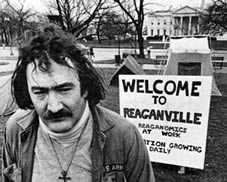
The image of the hunger strike in this song reminds my of DC-area homeless activist Mitch Snyder. As a kid growing up in the suburbs of Washington, DC, I remember the news stories about the activism of Mitch Snyder, including sometimes quite lengthy hunger strikes.
Here is an excerpt from a remembrance of Snyder by the National Coalition for the Homeless:
In 1981, Ronald Reagan was sworn in as President of the United States. For many the Reagan Administration is remembered for Reaganomics and ending the Cold War. Yet the poor and homeless of the time remember it rather for a dramatic reduction in housing and social services, Boss Tweed politics, and constant reminders that a mythical “welfare queen” in Chicago and exaggerated “welfare cheats” across America made their poverty their fault. “Mr. Reagan and Congress’s housing cutbacks are directly responsible for the homeless problem,” Snyder once said of the Administration.
On Thanksgiving Day 1981, tents appeared in Lafayette Park, across from the White House. A sign amidst the spread of tents read “Reaganville: Reagonomics at Work.” The tent city, an intentional throwback to the Hooverville encampments of the Great Depression, held 20-25 homeless persons and activists each night for the next four months. For many observers, a fine line had been drawn between what is real and what is theater. Such was precisely Snyder’s desire.
In addition to being an activist, Snyder was a self-proclaimed actor. A master of social pageantry and what now would be dubbed “street theater,” Mitch was famed for his insatiable motivation to cause a public scene. Among his exploits, he orchestrated a blood spattering of the Capitol steps, sloshed through the world’s biggest pie yelling “It’s all mine,” sat outside the White House in an old Irish tradition of waiting outside the home of someone who had wronged you without appropriate remorse, often jumped the White House fence, and, most infamously, fasted, nearly unto death three times. These actions gained significant attention to Mitch, the cause of homelessness, and helped to energize and unify many homeless persons and advocates.
Mitch, both during and after his lifetime, has been criticized for manipulative protest, particularly for his fasts demanding various rights and services for the homeless. Snyder became something of a celebrity by means of his flamboyant activism. CCNV actions Mitch organized were frequently reported in the media. One of the most famous was a CBS 60-Minutes episode featuring clips of Mitch starving from a fast as part of a protest demanding that the federal government repair the Federal City Shelter to make it livable for its 1000 plus inhabitants. The episode aired just before President Reagan’s second presidential election in 1984. With Snyder quite literally preparing to die, the federal government changed its policy and promised funds to the shelter. Manipulative or not, it is rarely said that Snyder was ineffective, and it is generally agreed that he reached and impacted diverse audiences with his message.
After all, it seems that eyes, if not cameras were always on Mitch. It was not only news media that captured Snyder’s activities. He was also the subject of books, the PBS documentary Promises to Keep, and the TV-movie Samaritan: The Mitch Snyder Story, starring Martin Sheen as Mitch. But Mitch didn’t only have an ability to make homelessness interesting, he made it the topic of the day.
It has been said of Snyder that he “never went Hollywood,” rather, “Hollywood went Mitch.” Sheen and other actors were so moved by working with Snyder that many of them donated time, money, and resources to the homelessness cause – Sheen even protested and was arrested with Snyder. In the mid to late 80’s homelessness was a social issue in vogue.
With Snyder as its visual and vocal leader, the homeless movement grew tremendously. In his time, Mitch saw not only significant change for Federal City Shelter but also in DC as a whole and in America as a nation. Snyder’s work was key in pushing homeless rights locally and nationally. He contributed to such legislation as Initiative 17, which was meant to mandate shelter for all and the McKinney-Vento Act, which provides federal homeless assistance. Snyder helped assure that the Federal City Shelter became CCNV, which did and continues to provide temporary-long-term shelter for more than 1300 DC residents.
Mitch Snyder accomplished a lot in 46 years of life, certainly more than most. The effort required took its toll. Struggling against devolution of homelessness policy in DC, as well as with a series of personal challenges, Snyder committed suicide on July 4, 1990.
As a child, I did not appreciate Mitch Snyder. I often looked down on his work…and the homeless.
No more. He is now one of my heroes.
Thanks, Mitch.
For other posts in the “Hymns of Social Justice” series click here.
"Like" Approaching Justice on Facebook

Next Post

July 24, 2013 This is Why I Respect Libertarianism
Browse Our Archives
Select a Category Adventures in Parenting Adventures in Sunday School American History American Political Thought American Politics American Religion Blog Admin Books Campaign Chronicles Culture Current Events Faith & Social Justice News Roundup General Conference Green Party Guest Post Guns HuffPost Live Hymns of Social Justice Independence Rock Group Las Vegas Marginalia Mormon Studies Mormonism Music Personal and Family Philosophy Political Philosophy Pop culture Queer Pioneer Week Quote of the Day Rawls Rawls and Religion Religion Social Justice Social Justice Book Club Sports Theology U.S Constitution Uncategorized Unions Video Wyoming
Select a Month February 2014 January 2014 December 2013 November 2013 October 2013 September 2013 August 2013 July 2013 June 2013 May 2013 April 2013 March 2013 February 2013
TAKE THE
Religious Wisdom Quiz
What does the name "Elijah" mean?
Select your answer to see how you score.
God is judge God saves My God is Yahweh God heals
Related posts from Approaching Justice

Stephen Colbert's Tribute to Pete Seeger
Idaho State Rep Wants to Turn Back the...


TRENDING AT PATHEOS Latter-day Saint

Did Prayer Cure His Cancer? Or Was It...
At 4 AM one morning, Joshua W. Brown’s wife awoke to a...

8 Ways a Near-Death Experience Rewires the Soul
Does Consciousness Survive Physical Death? After 50 Years of Research, Dr. Raymond...

Holy Longing: What Our Restlessness Is Telling Us
“One can find so many pains when the rain is falling.” -John...

What this is NOT about. This blog is definitely not about...

Who said the Israelites were God’s chosen? That’s right, they did. Who...

The Spirit World Is the Real World: God...
A Monk’s Wisdom on Body and Spirit I sit with Brother Martin...
view all Latter-day Saint blogs
Ad-Free & Subscriber Log-In Subscription Support
- About Us
- 2026 Calendar
- Videos
- Podcasts
- Library of World Religions
- Faith In Media Tracker
- Advertise With Us
- Write for Us
- Privacy Policy
- Terms of Service
- Do Not Sell My Data
- Contact Us
- Radiant Digital
- Manage Newsletter Subscriptions
- Unsubscribe From Notifications
- Sitemap
Copyright 2008-2026, Patheos, part of the Radiant Digital network of media brands. All rights reserved.
Subscription Support Ad-Free & Subscriber Log-In
Follow Patheos