
BuddhistCatholicContemplativeEvangelicalGeneral ChristianHinduJewishLatter-day SaintMuslimNew VisionsProgressive Christian
Beliefs
- Buddhist
- Catholic
- Contemplative
- Evangelical
- General Christian
- Hindu
- Jewish
- Latter-day Saint
- More Voices
- Muslim
- New Visions
- Pagan
- Progressive Christian
Topics
- Religion News
- Food and Religion
- Sports and Religion
- Religious Art
- Religious Music and Entertainment
- Religious Events
- History and Religion
- Style and Religion
- Politics and Religion
- Women in Religion
- Recreation Outdoors and Religion
- Business Finance and Religion
- Careers Workplace and Religion
- Education and Religion
- Family Parenting and Religion
- Health Fitness and Religion
- Home and Religion
- Relationships and Religion
- Technology and Religion
- Travel and Religion
Columnists
- Buddhist Columnists
- Business Finance and Religion Columnists
- Careers Workplace and Religion Columnists
- Catholic Columnists
- Contemplative Columnists
- Education and Religion Columnists
- Evangelists Columnists
- Family Parenting and Religion Columnists
- General Christian Columnists
- Health Fitness and Religion Columnists
- Hindu Columnists
- History and Religion Columnists
- Home and Religion Columnists
- Jewish Columnists
- More Voices Columnists
- Latter Day Columnists
- Muslim Columnists
- New Visions Columnists
- Nonreligious Columnists
- Pagan Columnists
- Politics and Religion Columnists
- Progressive Columnists
- Recreation Outdoors and Religion Columnists
- Relationships and Religion Columnists
- Religion News Columnists
- Religious Art Columnists
- Religious Events Columnists
- Religious Music and Entertainment Columnists
- Sports and Religion Columnists
- Style and Religion Columnists
- Technology and Religion Columnists
- Travel and Religion Columnists
- Women in Religion Columnists
Resource Library
- 2026 Calendar
- Library of World Religions
- The 100 Most Holy Places on Earth
- Patheos Answers
- Podcasts
- Videos
- Faith Leaders Database
- Anglican Episcopalian
- Bahai
- Baptist
- Buddhism
- Christianity
- Confucianism
- Eastern Orthodoxy
- Hinduism
- Holiness and Pentecostal
- ISKCON
- Islam
- Judaism
- Lutheran
- Methodist
- The Church of Jesus Christ of Latter-day Saints
- New Age
- Paganism
- Presbytarian and Reformed
- Protestantism
- Religion Behind the Scenes
- Roman Catholic
- Scientology
- Shia Islam
- Sikhism
- Sufism
- Sunni Islam
- Taoism
- Zen
- See all religions
Research Tools
 Ad-Free & Subscriber Log-In Subscription Support
Ad-Free & Subscriber Log-In Subscription Support
Follow Patheos 

- Trending:
- Forgiveness
- |
- Marriage
- |
- Consciousness
- |
- Death Penalty
- |
- Election
- |
- Halloween

- Home
- General Christian
- History and Religion
- The Cost of Looking Away: Who Is My Neighbor?
The Cost of Looking Away: Who Is My Neighbor?
Last updated on: March 3, 2025 at 8:00 am by Dorothy Sanders Wells
The Cost of Looking Away: Who Is My Neighbor? 2025-03-03T08:00:54-06:00 Dorothy Sanders Wells
Patheos Explore the world's faith through different perspectives on religion and spirituality! Patheos has the views of the prevalent religions and spiritualities of the world.
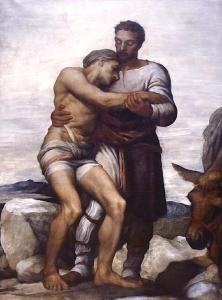
“It is harder to do the right thing than it is to do the same thing as everyone else… [and if you look] around you and notice that everyone is doing nothing…you can conclude that nothing is the thing to do…” | Image courtesy of George Frederic Watts, Public domain, via Wikimedia Commons.

On Mercy…
One hour, twenty minutes.
That’s how long Hugo Tale-Yax lay on a sidewalk in New York, in front of shops and businesses, in the path of passersby.
One hour, and twenty minutes during which dozens of people walked past Tale-Yax, some staring, some mocking, but most seeming to pay no attention at all as he lay dying on that sidewalk on an April morning in 2010.
One hour, twenty minutes, during which time it simply was too easy to look the other way.
The tragic drama began to unfold when Hugo Tale-Yax, a homeless Guatemalan immigrant, tried to come to the aid of a woman who was being threatened by a knife-wielding man. Because of Tale-Yax’s assistance, the woman was able to escape unharmed. But the assailant stabbed her rescuer instead.
One Hour and Twenty Minutes
The woman, and the attacker, both fled the scene, running in opposite directions, leaving Tale-Yax wounded on the sidewalk.
One hour, twenty minutes, all caught on camera — a surveillance camera mounted on the building just in front of which the attack occurred.
One hour, twenty minutes during which no one in the passing cast of characters called for help: Not the woman who was saved from the attack, nor the attacker; they both fled. Not any of the few gawkers; kept walking. Not the curious man who took a photo of Tale-Yax with his cell phone; he hurried off, probably to share the photo with his friends. Not the man who stopped and vigorously shook him, then left him exactly where he’d found him; whatever his motivations, he didn’t call for help, and he, too, continued on his way.
Efforts May Have Been Misunderstood
In the days immediately following the attack, as the grainy video footage made its way to news broadcasts all over the world, we questioned how so many people could see a man lying on the sidewalk yet do nothing to help him. Psychologists – professional, and amateur, alike – pontificated on talk shows. Some speculated that passersby likely thought that Tale-Yax was just another drunk who had passed out on a New York street; he’d eventually come to and stumble away. Others guessed that in the neighborhood where the attack occurred – home to many immigrants like Tale-Yax – other immigrants may have been afraid of being detained themselves if they stopped to help or called the police. Still, others thought that passersby may have feared that their efforts to help may have been misunderstood or misinterpreted by the victim as causing harm, not seeking to help, and steered clear to avoid liability.
But most expressed concerns about a phenomenon known as the bystander effect, the fancy name given to the theory that we are less likely to step in and help someone when others are nearby; it’s easy to look the other way, to not get involved, to convince ourselves that someone else will step in. The term “bystander effect” grew from what was later described as an overstated, but nonetheless real, reluctance of neighbors of Kitty Genovese to phone authorities after they heard her screaming outside her Queens, New York apartment in 1964. Genovese died from injuries sustained in the attack by her killer.
He Refused To Look Away
There’s a very real irony, that Hugo Tale-Yax should die on a New York street and no one would come to his rescue after he had come to the rescue of another; he refused to look the other way and put his own life in jeopardy in the process.
Tale-Yax’s tragic story isn’t the only one of its kind to shock our senses: When an employee at a trendy Maryland retail shop was attacked by a co-worker in 2011, employees of a neighboring business admitted hearing her screaming and struggling with her attacker, but failed to call for help. When a toddler was hit by a van on a street in China in 2011, she was left injured in the middle of the street, only to be struck by a second vehicle, while dozens of people walked by. In 2021, a woman was harassed and then raped by attackers on a train in Philadelphia while other riders appeared to be recording the attack on their cell phones. Columnist Alexandra Petri wrote, “It is harder to do the right thing than it is to do the same thing as everyone else… [and if you look] around you and notice that everyone is doing nothing…you can conclude that nothing is the thing to do…”
It’s simply too easy to look the other way.
Go And Show Mercy
Once, when a lawyer asked Jesus who is that neighbor we’re commanded to love as ourselves, Jesus shared a parable (Luke 10:25-37) about a man who had been beaten, robbed and left on the side of a busy and dangerous roadway between Jerusalem and Jericho. Jesus tells us about a first, and then a second, holy man traveling along the same road; but when the holy men saw the injured man, they passed by on the other side – clearly, looking the other way. But a stranger, a foreigner – a Samaritan – came along and saw the injured man. Instead of passing by, instead of looking the other way, he stopped, putting himself in harm’s way. This foreigner used his provisions to treat and bandage the injured man’s wounds before taking the man to an inn, where he paid for the man’s stay while he recovered. Jesus asked the lawyer which of the three men was a neighbor to the injured man. The lawyer replied, “the one who showed him mercy.” Jesus instructed the lawyer to go and do likewise – to go and be a good neighbor, to go and show mercy.
Go and show mercy to the person we might fear, a person who doesn’t look like us, speak the same language or live in the same neighborhood. Go and show mercy to the person who is without clothing, food or shelter. God and show mercy to the neighbor who is imprisoned – perhaps, wrongfully. Go and show mercy to the neighbor who is sick. Go and show mercy to the neighbor for whom our help could put us at risk.
Parable of the Samaritan
What would each of us see if we could have watched ourselves on the video from those hidden cameras that captured Hugo Tale-Yax as he lay dying? What would the cameras have captured us doing? Would we have hurriedly walked past? Would we have gawked and stared, pointed or laughed? Would we have snapped a quick pic on our cell phones?
Would we, indifferent to the scene unfolding before us, simply have looked the other way, thinking that surely, if anything were actually wrong, someone else would help?
Jesus invites us to hear the parable of the Samaritan again and to go and show mercy.
The more we see all of our neighbors as being made in the image and likeness of our God, the less likely, it seems, that we can look the other way, and the more likely, it seems, that we would feel compelled to show mercy – to stand alongside our most vulnerable neighbors, offering whatever God-given resources we have to assist, support, and bring about healing.
Previous Post

February 10, 2025
The harvest is plentiful, but the laborers are few...
Next Post

May 27, 2025 Memphis, Mercy, and the Men We Remember
Browse Our Archives
Select a Category Christmas Easter family History religion Uncategorized
Select a Month May 2026 December 2025 May 2025 March 2025 February 2025 December 2024 April 2024 December 2023 November 2023 September 2023 August 2023 July 2023 June 2023 May 2023 April 2023 March 2023 February 2023 January 2023 December 2022
TAKE THE
Religious Wisdom Quiz
How many chapters are in the book of Revelation?
Select your answer to see how you score.
24 12 22 30
Related posts from A Pastor's Musings

60 Years of A Charlie Brown Christmas

Memphis, Mercy, and the Men We Remember

The harvest is plentiful, but the laborers are...

Fighting for My Daughter’s Health in a Broken...
TRENDING AT PATHEOS General Christian

Letters on Living the Faith by C.S. Lewis
Most of us met C.S. Lewis as a public intellectual. Mere Christianity....

When Halloween Unmasks Married Hearts
Written by Dr. David K. Ewen from Eternal Truth Bible College Behind...

Aristotle. He’s been called the father of logic, the father of the...

Methodist Central Hall and Westminster Abbey
Situated on the same square is Methodist Central Hall and Westminster Abbey. ...

57th Dove Awards Honor Dolly Parton, Crown New...
On gospel music’s biggest night, the 57th annual GMA Dove Awards honored...

The First Eucharistic Controversy: Christ’s Real Presence
For Catholics, the Eucharist is the source and summit of the Christian...
view all General Christian blogs
Ad-Free & Subscriber Log-In Subscription Support
- About Us
- 2026 Calendar
- Videos
- Podcasts
- Library of World Religions
- Faith In Media Tracker
- Advertise With Us
- Write for Us
- Privacy Policy
- Terms of Service
- Do Not Sell My Data
- Contact Us
- Radiant Digital
- Manage Newsletter Subscriptions
- Unsubscribe From Notifications
- Sitemap
Copyright 2008-2026, Patheos. All rights reserved.
Subscription Support Ad-Free & Subscriber Log-In
Follow Patheos