
BuddhistCatholicContemplativeEvangelicalGeneral ChristianHinduJewishLatter-day SaintMuslimNew VisionsProgressive Christian
Beliefs
- Buddhist
- Catholic
- Contemplative
- Evangelical
- General Christian
- Hindu
- Jewish
- Latter-day Saint
- More Voices
- Muslim
- New Visions
- Pagan
- Progressive Christian
Topics
- Religion News
- Food and Religion
- Sports and Religion
- Religious Art
- Religious Music and Entertainment
- Religious Events
- History and Religion
- Style and Religion
- Politics and Religion
- Women in Religion
- Recreation Outdoors and Religion
- Business Finance and Religion
- Careers Workplace and Religion
- Education and Religion
- Family Parenting and Religion
- Health Fitness and Religion
- Home and Religion
- Relationships and Religion
- Technology and Religion
- Travel and Religion
Columnists
- Buddhist Columnists
- Business Finance and Religion Columnists
- Careers Workplace and Religion Columnists
- Catholic Columnists
- Contemplative Columnists
- Education and Religion Columnists
- Evangelists Columnists
- Family Parenting and Religion Columnists
- General Christian Columnists
- Health Fitness and Religion Columnists
- Hindu Columnists
- History and Religion Columnists
- Home and Religion Columnists
- Jewish Columnists
- More Voices Columnists
- Latter Day Columnists
- Muslim Columnists
- New Visions Columnists
- Nonreligious Columnists
- Pagan Columnists
- Politics and Religion Columnists
- Progressive Columnists
- Recreation Outdoors and Religion Columnists
- Relationships and Religion Columnists
- Religion News Columnists
- Religious Art Columnists
- Religious Events Columnists
- Religious Music and Entertainment Columnists
- Sports and Religion Columnists
- Style and Religion Columnists
- Technology and Religion Columnists
- Travel and Religion Columnists
- Women in Religion Columnists
Resource Library
- 2026 Calendar
- Library of World Religions
- The 100 Most Holy Places on Earth
- Patheos Answers
- Podcasts
- Videos
- Faith Leaders Database
- Anglican Episcopalian
- Bahai
- Baptist
- Buddhism
- Christianity
- Confucianism
- Eastern Orthodoxy
- Hinduism
- Holiness and Pentecostal
- ISKCON
- Islam
- Judaism
- Lutheran
- Methodist
- The Church of Jesus Christ of Latter-day Saints
- New Age
- Paganism
- Presbytarian and Reformed
- Protestantism
- Religion Behind the Scenes
- Roman Catholic
- Scientology
- Shia Islam
- Sikhism
- Sufism
- Sunni Islam
- Taoism
- Zen
- See all religions
Research Tools
 Ad-Free & Subscriber Log-In Subscription Support
Follow Patheos 

- Trending:
- Advent
- |
- Forgiveness
- |
- Thanksgiving
- |
- Election
- |
- Seasonal Holidays
- |
- Marriage

- Home
- General Christian
- History and Religion
- Acid in the Pool: The Photo That Shook a Nation Awake
Acid in the Pool: The Photo That Shook a Nation Awake
Last updated on: May 6, 2025 at 8:57 am by Dorothy Sanders Wells
Acid in the Pool: The Photo That Shook a Nation Awake 2025-05-06T08:57:33-05:00 Dorothy Sanders Wells
Patheos Explore the world's faith through different perspectives on religion and spirituality! Patheos has the views of the prevalent religions and spiritualities of the world.
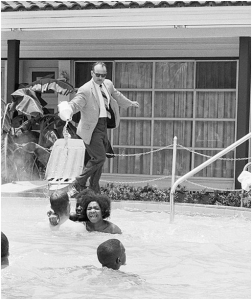
Monson Motor Lodge manager James Brock, pouring muriatic acid into a pool of desegregated swimmers in St. Augustine, FL, June 18, 1964. Source: Wikimedia Commons.
A Look Back at 1964, the Passage of the Civil Rights Act, and St. Augustine, Florida’s Unexpected Role
June 18, 1964.
It’s often said that a picture is worth 1,000 words.
So it was that a photo of James Brock, manager of the Monson Motor Lodge in St. Augustine, Florida, pouring muriatic acid into the pool where black and white guests were swimming on June 18, 1964 – spoke loudly as Congress wrestled with the passage of a Civil Rights Act. In St. Augustine, where nonviolent protest efforts to desegregate beaches and places of public accommodation had been met with a violent backlash, the swimmers were, no doubt, staging a swim-in. Brock’s action apparently, was more an effort to frighten than to harm the swimmers, as experts claim that a single gallon of muriatic acid diluted in the pool likely could not have harmed the swimmers. But the photo quickly made national news and told a sad story of the bitter fight for passage of the Civil Rights Act of 1964.
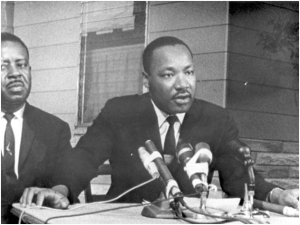
Rev. Dr. Martin Luther King, Jr. and Ralph Abernathy in St. Augustine, FL. Source: Wikimedia Commons
Juneteenth
One day after the photo was taken, on June 19, 1964 (Juneteenth, anyone?!), after four months of debate and filibuster, the Senate passed the Act by a vote of 73-27. The House of Representatives had already passed the Act by a vote of 290-130. And, President Lyndon Johnson would sign the Act into law on July 2, 1964.
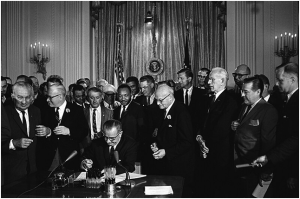
President Lyndon Johnson signed the Civil Rights Act of 1964 into law on July 2, 1964. Source: Wikimedia Commons, Cecil Stoughton
That such an iconic photo of a motel manager pouring acid into a pool filled with swimmers could arise at that time from St. Augustine, the oldest continuously occupied colonized settlement in the United States, was a story in and of itself. St. Augustine holds a rich history of European, African, and Native persons–and its history is tied to Christianity and the Roman Catholic Church. When Don Pedro Menendez de Aviles landed in what is now St. Augustine, Florida in September 1565, he immediately began to discover the potential of this new land, blessed with a healthful climate, fertile soil, and a multitude of natives whose conversion to Catholicism he approached with great zeal. Pedro Menendez arrived at St. Augustine some 50 years after historians credit Spanish explorer Juan Ponce de Léon with having been the first European to arrive in the area in 1513; Spain’s King Ferdinand authorized Ponce de Léon to settle this land that he had called, La Florida.
Freed and Enslaved Black Persons
While St. Augustine was visited by Spanish, French and British would-be settlers, it wasn’t until 1565 that Pedro Menendez would actually settle and claim the land for Spain. Control of the area bounced back and forth between Britain and Spain for the next two-and-one-half centuries; ultimately, its control was turned over to the United States in 1821.
The would-be European settlers of the area all apparently arrived with enslaved African persons. According to the City of St. Augustine’s website, during these years of competing colonizers arriving on her shores, St. Augustine also became a home to enslaved black persons who chose freedom in exchange for having declared allegiance to the King of Spain and converted to Catholicism. As such, St. Augustine became a stop on the Underground Railroad, and both freed and enslaved black persons made the area their home.
In the Eye of the Proverbial Storm
By the turn of the 20th Century, when Henry Flagler (one of the founders, along with John D. Rockefeller, of Standard Oil Company) made a foray into St. Augustine, he put it on the map as a tourist resort after building opulent hotels to cater to the wealthiest clientele and purchasing what would become the Florida East Coast Railway to allow ease of travel to this resort location. Flagler’s website touts that Flagler is largely responsible for Florida being “the third largest state in the Union with an economy larger than 90% of the world’s nations. Indeed, no individual has had a greater or more lasting impact on a state than Henry Flagler has had in Florida.”
But the month of June invites us to consider a different piece of St. Augustine’s history: St. Augustine would also be known for its pivotal role in the Civil Rights Movement. By June 1964, as the push to desegregate public accommodations grew more intense, St. Augustine found itself in the eye of the proverbial storm. Dr. Martin Luther King, Jr. traveled to St. Augustine to lead peaceful protesters in restaurant sit-ins and beach swim-ins, in an effort to urge the desegregation of those accommodations in the nation’s oldest city. The peaceful protesters were reportedly met with violent counter-protests, and Dr. King, Ralph Abernathy were among the protesters who were arrested following a sit-in at the Monson Motor Lodge restaurant.
To Be Afforded Due Process and Equal Protection
Within days, the Civil Rights Act of 1964 would be passed – and signed into law. But the passage of the new law was certainly not the end of the struggle for freedom.
Nearly sixty years after peaceful protesters sought the right to enter beaches, restaurants, pools and other accommodations in St. Augustine, Florida, we commemorate their struggle.
1964 was a long time after the ratification of the 13th, 14th and 15th Amendments to the Constitution, respectively in 1865, 1868 and 1870, giving freedom to enslaved persons, making them citizens of the United States to be afforded due process and equal protection under the law, and granting them the right to vote.
A City Steeped in Religious History
1964 seemed like a long time to wait, to have struggled for justice, and have hoped for a day on which all of God’s people would be seen as having been made in God’s image and likeness.
And, picturesque, historic St. Augustine, Florida, the oldest continuously occupied colonized settlement in the United States, a city steeped in religious history, seems an unlikely – or, alternatively perfect – spot to which to draw the nation’s attention to the acceptance and normalization of racism. Its place in history is duly noted and commemorated.
Previous Post

May 13, 2023
Frances Perkins: The Intersection of Faith and Policy
Recent Comments
Browse Our Archives
Select a Category Christmas Easter family History religion Uncategorized
Select a Month May 2026 December 2025 May 2025 March 2025 February 2025 December 2024 April 2024 December 2023 November 2023 September 2023 August 2023 July 2023 June 2023 May 2023 April 2023 March 2023 February 2023 January 2023 December 2022
TAKE THE
Religious Wisdom Quiz
What does "Rabbi" mean?
Select your answer to see how you score.
Priest Teacher Messenger Scribe
Related posts from A Pastor's Musings
Speaking and hearing anew at Pentecost
Memphis, Mercy, and the Men We Remember

Twelve Inspiring Films to Watch in December

TRENDING AT PATHEOS General Christian

Smart people saying smart things (11.24.26)
Please take time to listen to Perry Bacon, Sarah Posner, Adam Serwer,...

The Contingency of Our Technology
Last week we were hit with a raft of massive technology outages....

In 1939, President Franklin D. Roosevelt moved Thanksgiving from November 30 to...

Reasons for Restraint: Ricardo Gonzalez, Florida and Dec...
The Morning of January 3 I begin with the dead. On the...

I published this column for Thanksgiving 2012 in the Deseret News....

For many years, Catholicism has been caught up in division over the...
view all General Christian blogs
Ad-Free & Subscriber Log-In Subscription Support
- About Us
- 2026 Calendar
- Videos
- Podcasts
- Library of World Religions
- Faith In Media Tracker
- Advertise With Us
- Write for Us
- Privacy Policy
- Terms of Service
- Do Not Sell My Data
- Contact Us
- Radiant Digital
- Manage Newsletter Subscriptions
- Unsubscribe From Notifications
- Sitemap
Copyright 2008-2026, Patheos, part of the Radiant Digital network of media brands. All rights reserved.
Subscription Support Ad-Free & Subscriber Log-In
Follow Patheos