
BuddhistCatholicContemplativeEvangelicalGeneral ChristianHinduJewishLatter-day SaintMuslimNew VisionsProgressive Christian
Beliefs
- Buddhist
- Catholic
- Contemplative
- Evangelical
- General Christian
- Hindu
- Jewish
- Latter-day Saint
- More Voices
- Muslim
- New Visions
- Pagan
- Progressive Christian
Topics
- Religion News
- Food and Religion
- Sports and Religion
- Religious Art
- Religious Music and Entertainment
- Religious Events
- History and Religion
- Style and Religion
- Politics and Religion
- Women in Religion
- Recreation Outdoors and Religion
- Business Finance and Religion
- Careers Workplace and Religion
- Education and Religion
- Family Parenting and Religion
- Health Fitness and Religion
- Home and Religion
- Relationships and Religion
- Technology and Religion
- Travel and Religion
Columnists
- Buddhist Columnists
- Business Finance and Religion Columnists
- Careers Workplace and Religion Columnists
- Catholic Columnists
- Contemplative Columnists
- Education and Religion Columnists
- Evangelists Columnists
- Family Parenting and Religion Columnists
- General Christian Columnists
- Health Fitness and Religion Columnists
- Hindu Columnists
- History and Religion Columnists
- Home and Religion Columnists
- Jewish Columnists
- More Voices Columnists
- Latter Day Columnists
- Muslim Columnists
- New Visions Columnists
- Nonreligious Columnists
- Pagan Columnists
- Politics and Religion Columnists
- Progressive Columnists
- Recreation Outdoors and Religion Columnists
- Relationships and Religion Columnists
- Religion News Columnists
- Religious Art Columnists
- Religious Events Columnists
- Religious Music and Entertainment Columnists
- Sports and Religion Columnists
- Style and Religion Columnists
- Technology and Religion Columnists
- Travel and Religion Columnists
- Women in Religion Columnists
Resource Library
- 2026 Calendar
- Library of World Religions
- The 100 Most Holy Places on Earth
- Patheos Answers
- Podcasts
- Videos
- Faith Leaders Database
- Anglican Episcopalian
- Bahai
- Baptist
- Buddhism
- Christianity
- Confucianism
- Eastern Orthodoxy
- Hinduism
- Holiness and Pentecostal
- ISKCON
- Islam
- Judaism
- Lutheran
- Methodist
- The Church of Jesus Christ of Latter-day Saints
- New Age
- Paganism
- Presbytarian and Reformed
- Protestantism
- Religion Behind the Scenes
- Roman Catholic
- Scientology
- Shia Islam
- Sikhism
- Sufism
- Sunni Islam
- Taoism
- Zen
- See all religions
Research Tools
 Ad-Free & Subscriber Log-In Subscription Support
Follow Patheos 

- Trending:
- Advent
- |
- Forgiveness
- |
- Thanksgiving
- |
- Election
- |
- Seasonal Holidays
- |
- Marriage

- Home
- General Christian
- History and Religion
- Remembering Rev. Dr. Martin Luther King, Jr.|Dorothy Wellsls
Remembering Rev. Dr. Martin Luther King, Jr.|Dorothy Wellsls
Last updated on: January 14, 2024 at 11:32 pm by Dorothy Sanders Wells
Remembering Rev. Dr. Martin Luther King, Jr.|Dorothy Wellsls 2024-01-14T23:32:00-06:00 Dorothy Sanders Wells
Patheos Explore the world's faith through different perspectives on religion and spirituality! Patheos has the views of the prevalent religions and spiritualities of the world.
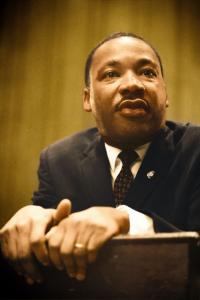
Photo: Unseen Historie /Unsplash
As we pause to celebrate the life and legacy of Rev. Dr. Martin Luther King, Jr., we celebrate the many accomplishments and achievements in the life of an extraordinary leader.
We celebrate –
- that, as a prodigious student, he had already, at age 17, written a letter to the editor of the Atlanta Constitution newspaper – which was published – stating that Black persons were “entitled to the basic rights and opportunities of American citizens”;
- that he was graduated from Morehouse College at age 19, and that he was graduated from Crozer Theological Seminary in Pennsylvania at age 22, where he gave the valedictory address;
- that he was awarded his doctorate in systematic theology from Boston University at age 26;
- that in 1954, he became the pastor of Montgomery’s Dexter Avenue Baptist Church, and in 1955, he became president of the Montgomery, AL Improvement Association – working diligently with the leaders of the Montgomery Bus Boycott that paved the way toward the 1956 U.S. Supreme Court decision declaring Montgomery and Alabama bus segregation laws unconstitutional;
- that, as one who had studied nonviolence, Dr. King could step to the helm of the Southern Christian Leadership Conference, and help lead nonviolent protests throughout the South, to fight for Black persons to have the right to vote, to fight for Black persons to have the right to access public accommodations, to fight for Black persons to have the right to enjoy the same freedoms for which our nation’s Founding Fathers had argued for White persons;
- that, as an exemplary orator, Dr. King would address more than 200,000 persons in Washington, D.C. at the Lincoln Memorial in 1963 with his “I Have a Dream” speech, daring to envision a day on which Black persons in our nation would be judged not by the color of their skin but by the content of their character.
All of these accomplishments and achievements are worthy of our recognition and celebration.
But we would be remiss in failing to focus on Dr. King, the preacher and theologian. On July 4, 1965, Dr. King preached a sermon in his Ebenezer Baptist Church pulpit in Atlanta that shows the relevance of his ministry to us today.
Dr. King’s July 4, 1965 American Dream sermon
On July 4, 1965, a day on which our nation celebrated its Independence, Dr. King spoke about the American Dream – and the principles upon which the founding fathers of our nation declared their independence. How often have we heard these words: “We hold these truths to be self-evident that all men are created equal, that they are endowed by their Creator with certain inalienable Rights, that among these are Life, Liberty, and the pursuit of Happiness.”
Nearly 250 years later after the founding of our country, we know that those principles were never intended to apply to all persons on this soil, for indeed, indigenous persons, and the many persons who were brought to this land as indentured servants and slaves, were never included in those founding principles. Through war, through struggle, through pain, through heartbreak, our nation would ultimately grant freedom to the slaves, make them citizens and give them the right to vote immediately following the Civil War, but even those advances – the Reconstruction Amendments to the Constitution – would be rolled back for nearly 100 years with Black Codes and Jim Crow laws.
Dr. King’s July 4, 1965 sermon follows about two years after the March on Washington D.C., and the “I Have a Dream” address. We see in this 1965 sermon a Dr. King who is more of a realist. He honestly shares with his congregation that his dream has been shattered: shattered by the killing of even more persons who labored for Civil Rights, shattered by seeing many Black men and women without jobs, shattered by seeing how many persons, White and Black, were living in poverty. And while he could acknowledge that his dream had been shattered, he also claimed with confidence that he had not lost his faith: faith that one day, all of God’s black children would be respected like God’s White children, faith that all of God’s children will have food and clothing and material well-being for their bodies, culture and education for their minds, and freedom for their spirits.
Dr. King’s attention to poverty among Black and White persons would continue for the remaining nearly three years of his life. In November 1967, Dr. King announced a Poor People’s Campaign at a staff retreat for the Southern Christian Leadership Conference (SCLC). Dr. King recognized that poverty would continue to be a crippling force in our nation, and education, jobs and fair wages were essential to creating a just society.
Indeed, poverty and the plight of poor workers were part of his draw to Memphis in 1968, where he came to support sanitation workers in their quest for three simple things for which they’d originally asked: a place to use the restrooms in a segregated city where facilities weren’t available to them, a place to shower at the end of the day and to wash off the stains and stench of garbage, and the ability to work in the garage on rainy days when trash wasn’t being collected, so that they could be paid. So little, to respect the dignity of these human beings…
Why choose this sermon, of all of Dr. King’s sermons and writings? Why does it matter in 2023?
Poverty remains a critical dividing line in our nation – and a global pandemic has made even more apparent that division between the haves and the have-nots: Those whose employment allowed them to quickly shift to working from home, or even from a vacation home, experienced a pandemic very differently than essential workers who were still on the front lines serving all of our people every single day. Those whose careers and income streams remained intact experienced a pandemic very differently than those who lost their jobs, their income, their homes, and what might have already been a tenuous hold on economic stability. Students who were privileged to have dedicated tutors, quarantined learning pods and unfaltering access to computers and internet experienced a pandemic very differently than students who had no help at home, intermittent or no internet access, or devices to be shared with siblings or parents. The vantage points from which we experienced the pandemic are decidedly different ones; the millions who have lost jobs and income, the millions who lost shelter, even if only temporarily, are real people, real flesh and blood, not mere statistics.
How do we honor the legacy of Dr. King, at such a time as this, when our own hearts are shattered – by divisions between us, by a growing intolerance among us, by a seeming inability to work together for the good of all of our people? We honor his legacy by picking up the mantle where he has laid it for us, by carrying on the work he began, by advocating tirelessly for the underserved in our communities. It’s not a matter of paying lip-service to the struggles of the poorest persons among us, but rather taking a critical look at all of our structures to ask ourselves if we are doing the best we can to lift our brothers and sisters. Are we feeding our hungry, to help keep them healthy, as best we can? Are we sheltering our neighbors experiencing homelessness, to give them the stability to get on their feet, as best we can? Are we educating our children and preparing them for careers as best we can?
Our entire community is better off when all of our people are better off; leaving anyone behind only serves to cripple us all. And when we are able to see the least of these among us as our neighbors, as children made in the image and likeness of our Creator, the bitter divisions between us – the bitter divisions between us that have been far too prominently on display – truly will cease.
On this (and every) day that we honor Dr. King, we have a sterling new opportunity to commit ourselves to his work, to commit ourselves to the fight for equity and justice for all of God’s people, to commit ourselves to respect the dignity of every human being – in our words, and in our actions. Dr. King’s spirit is with us, and he is urging us to ask ourselves, as he urged us to ask ourselves in Memphis on April 3, 1968, “If I do not stop to help my neighbor, what will become of him?”

Recent Comments
Browse Our Archives
Select a Category Christmas Easter family History religion Uncategorized
Select a Month May 2026 December 2025 May 2025 March 2025 February 2025 December 2024 April 2024 December 2023 November 2023 September 2023 August 2023 July 2023 June 2023 May 2023 April 2023 March 2023 February 2023 January 2023 December 2022
TAKE THE
Religious Wisdom Quiz
Which Christian denomination is most associated with the Reformation led by Martin Luther?
Select your answer to see how you score.
Catholic Lutheran Anglican Orthodox
Related posts from A Pastor's Musings
Speaking and hearing anew at Pentecost

Memphis, Mercy, and the Men We Remember
The Cost of Looking Away: Who Is My...

The harvest is plentiful, but the laborers are...
TRENDING AT PATHEOS General Christian

Adventurous Lectionary -1st. Sunday of Advent - November...
The Adventurous Lectionary - The First Sunday of Advent – November 29,...

Will Islam become the world's biggest religion by 2035? Congo will replace...

The resilience of the Christian faith in the english speaking world of...

An Advent Calendar, and a Tree full of...
I've spent the weekend deeply invested in internet drama about a $150...

How to Have Financial Transparency in Marriage
Despite the fact that financial issues and money problems are the number...
The Healing Power of Forgiveness in Marriage
Learning how to give and accept apologies are essential ingredients of a...
view all General Christian blogs
Ad-Free & Subscriber Log-In Subscription Support
- About Us
- 2026 Calendar
- Videos
- Podcasts
- Library of World Religions
- Faith In Media Tracker
- Advertise With Us
- Write for Us
- Privacy Policy
- Terms of Service
- Do Not Sell My Data
- Contact Us
- Radiant Digital
- Manage Newsletter Subscriptions
- Unsubscribe From Notifications
- Sitemap
Copyright 2008-2026, Patheos. All rights reserved.
Subscription Support Ad-Free & Subscriber Log-In
Follow Patheos