
BuddhistCatholicContemplativeEvangelicalGeneral ChristianHinduJewishLatter-day SaintMuslimNew VisionsProgressive Christian
Beliefs
- Buddhist
- Catholic
- Contemplative
- Evangelical
- General Christian
- Hindu
- Jewish
- Latter-day Saint
- More Voices
- Muslim
- New Visions
- Pagan
- Progressive Christian
Topics
- Religion News
- Food and Religion
- Sports and Religion
- Religious Art
- Religious Music and Entertainment
- Religious Events
- History and Religion
- Style and Religion
- Politics and Religion
- Women in Religion
- Recreation Outdoors and Religion
- Business Finance and Religion
- Careers Workplace and Religion
- Education and Religion
- Family Parenting and Religion
- Health Fitness and Religion
- Home and Religion
- Relationships and Religion
- Technology and Religion
- Travel and Religion
Columnists
- Buddhist Columnists
- Business Finance and Religion Columnists
- Careers Workplace and Religion Columnists
- Catholic Columnists
- Contemplative Columnists
- Education and Religion Columnists
- Evangelists Columnists
- Family Parenting and Religion Columnists
- General Christian Columnists
- Health Fitness and Religion Columnists
- Hindu Columnists
- History and Religion Columnists
- Home and Religion Columnists
- Jewish Columnists
- More Voices Columnists
- Latter Day Columnists
- Muslim Columnists
- New Visions Columnists
- Nonreligious Columnists
- Pagan Columnists
- Politics and Religion Columnists
- Progressive Columnists
- Recreation Outdoors and Religion Columnists
- Relationships and Religion Columnists
- Religion News Columnists
- Religious Art Columnists
- Religious Events Columnists
- Religious Music and Entertainment Columnists
- Sports and Religion Columnists
- Style and Religion Columnists
- Technology and Religion Columnists
- Travel and Religion Columnists
- Women in Religion Columnists
Resource Library
- 2026 Calendar
- Library of World Religions
- The 100 Most Holy Places on Earth
- Patheos Answers
- Podcasts
- Videos
- Faith Leaders Database
- Anglican Episcopalian
- Bahai
- Baptist
- Buddhism
- Christianity
- Confucianism
- Eastern Orthodoxy
- Hinduism
- Holiness and Pentecostal
- ISKCON
- Islam
- Judaism
- Lutheran
- Methodist
- The Church of Jesus Christ of Latter-day Saints
- New Age
- Paganism
- Presbytarian and Reformed
- Protestantism
- Religion Behind the Scenes
- Roman Catholic
- Scientology
- Shia Islam
- Sikhism
- Sufism
- Sunni Islam
- Taoism
- Zen
- See all religions
Research Tools
 Ad-Free & Subscriber Log-In Subscription Support
Ad-Free & Subscriber Log-In Subscription Support
Follow Patheos 

- Trending:
- Forgiveness
- |
- Marriage
- |
- Consciousness
- |
- Death Penalty
- |
- Election
- |
- Halloween

- Home
- General Christian
- History and Religion
- It’s not just Black History…
It’s not just Black History…
Last updated on: February 3, 2024 at 9:28 am by Dorothy Sanders Wells
It’s not just Black History… 2024-02-03T09:28:32-06:00 Dorothy Sanders Wells
Patheos Explore the world's faith through different perspectives on religion and spirituality! Patheos has the views of the prevalent religions and spiritualities of the world.
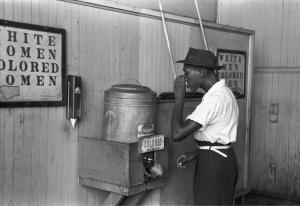
Image source Library of Congress
People often ask me why I’m not a fan of Black History Month. My explanation is simple: It’s impossible to compress the history, contributions and accomplishments of people whose lives are inextricably linked with this soil on which we’ve lived for 400 years in 28 days.
It is also impossible to tell the history of black persons in this country without telling the story of all of us – black and white. Our history, since slavery, is shared and intertwined.
In our shared history, there are achievements, milestones, heroism, courage, and perseverance to celebrate.
There are atrocities to grieve.
“We hold these truths to be self-evident, that all men are created equal, that they are endowed by their Creator with certain unalienable Rights, that among these are Life, Liberty and the pursuit of Happiness.”
We’re more than 400 years beyond the arrival of slaves at the colony at Jamestown, Virginia – and black persons sharing life in this land. Despite the claims of our founding fathers that “all men are created equal,” slavery would be the law of the land here for 250 years. The importation and sale of enslaved persons, as well as the labor force that they provided, became a driving force in our nation’s economy. Abolitionists persevered, arguing that our founding principles were inconsistent with slavery. Our differences became irreconcilable.
A Civil War would divide our nation and her families before hard-bought freedom for slaves would be realized.
Indeed, the 13th, 14th, and 15th Amendments to the Constitution (the Reconstruction Amendments), were ratified in the years immediately following the Civil War, freed the slaves, made them citizens entitled to due process of the law, and gave these citizens the right to vote, respectively. And just after the passage of these amendments to the Constitution, the period of Reconstruction gave us a brief glimpse into what it could mean to see equality in the legislative process. A Black Senator and Congressmen were elected from Mississippi, Florida, Alabama, Georgia, and South Carolina – Southern states with large populations of newly freed black citizens. Eric Foner, Pulitzer Prize-winning historian, and author of Freedom’s Lawmakers: A Directory of Black Officeholders During Reconstruction, estimated that about 2,000 black Americans held public office – at the local, state, and national levels, and certainly, in Southern states – during Reconstruction.
But any glimmer of progress quickly faded. The hope of Reconstruction gave way to Jim Crow laws, quickly enacted to usher in a new era of legal segregation and separation. “Separate but equal” public accommodations became a legal fiction. The right of black persons to vote – guaranteed under the Constitution – was again being denied. Violent attacks on black communities, including what have been termed, “race riots,” became far too commonplace. Lynchings became public entertainment, some even with commemorative postcards being sold.
The struggle for human dignity continued. White and black persons alike remained committed to the struggle, willing to give their lives for all of God’s people to experience freedom.
100 years after the 13th, 14th, and 15th Amendments to the Constitution were ratified, our nation was again passing sweeping civil rights legislation – to guarantee the very same protections that had already been granted.
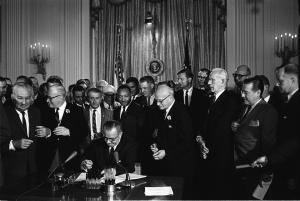
Photograph by Cecil Stoughton, courtesy of the LBJ Library
In the Civil Rights Act of 1964, we affirmed through law that men equal under God are also equal when they seek a job, when they go to get a meal in a restaurant, or when they seek lodging for the night in any State in the Union…In the Civil Rights Act of 1965, we affirmed through law for every citizen in this land the most basic right of democracy–the right of a citizen to vote in an election in his country. – President Lyndon B. Johnson
How had we made so little progress over 100 years?
And why is there still such a long way to go?
The City of Memphis, where the median household income of black households is roughly 2/3 of that of white households, is reflective of our entire nation. One-third of Memphis’ black citizens live in poverty. Underperforming schools are still too often the norm in inner-city neighborhoods. Food deserts still exist. Healthcare outcomes are still disparate (See, here, and here.)
There is still work to be done. There is still progress to be made.
Black History is our history – all of our history, white and black together in this country. How does one teach “history” without teaching about the arrival of the first enslaved persons at Jamestown in 1619? How does one teach “history” without teaching about Crispus Attucks? How does one teach “history” without teaching about Frederick Douglass? How does one teach “history” without teaching about our country’s first Black Senator, Hiram Revels? How does one teach “history” without teaching about “race riots” in Memphis in 1866, East St. Louis in 1917, Chicago in 1919, Elaine, Arkansas in 1919, and Tulsa in 1921 (where, by the way, “historians,” say the first bombs were dropped on US soil in a domestic attack)? How does one teach “history” without teaching about Emmett Till, or without teaching about Michael Schwerner, James Chaney, and Andrew Goodman, and the struggle to gain the right to vote which had previously been guaranteed by the 15th Amendment? Similarly, how do we teach “history” without teaching the courage of David Selznick, demanding a seat “in the room where it happened” for the first Black Oscar winner, Hattie McDaniel? How do we teach “history” without teaching about the courage and love of Barbara Henry, who remained at New Orleans’ William Franz Elementary School to teach its first Black student, Ruby Bridges? If all of those pieces of history were woven into the history of who we all are, we’d paint a full picture; we’d acknowledge the truth about our shared life on this soil.
All of our history should be taught, not just in 28 days, but year-round. And, while some of that history speaks to the persevering spirit of Americans to rise above circumstances and attain great achievements, some of the history is painful and harsh. Too often, we shy away from the painful parts of that history, but that only makes it more likely that history will repeat itself: Images from August 2017 in Charlottesville, Virginia look far too much like images from June 1963 in Montgomery, Alabama. The U.N. International Labour Organization estimates that even more persons in our world today live in conditions of forced labor, modern slavery, and human trafficking than ever were involved in the transatlantic slave trade.
But we continue to write our history and legacy each day. If there is hope for us to step away from the specter of the past, I believe that the Church and faith community hold the key and are the places where conversation must begin. Because the faith community solely stakes a claim that God’s people have been commanded to love one another, it is uniquely situated to be a source of healing – and it is uniquely situated to accomplish what secular society has failed to accomplish through legislative and judicial processes. We can continue to pass more laws, and hand down more judicial decisions, but we can’t legislate hearts. Hearts need to be healed, hearts need to be changed. The God who has commanded us to love God and to love our neighbors as ourselves surely grieves our inhumanity toward our sisters and brothers made in the image and likeness of God. The Church and community of faith can lead us all in ways of hope and healing that can come from no other place.
The Church and community of faith are not without sin. And for all of the times in which scriptures were used as justification for failing to see all humankind as having been made in the image and likeness of God, there is a need for atonement.
Our shared story isn’t finished. Indeed, the upcoming chapters are unwritten. How will we fill them with justice, love, and light? Will the faith community lead the way?
Progressive Christian
Education and Religion
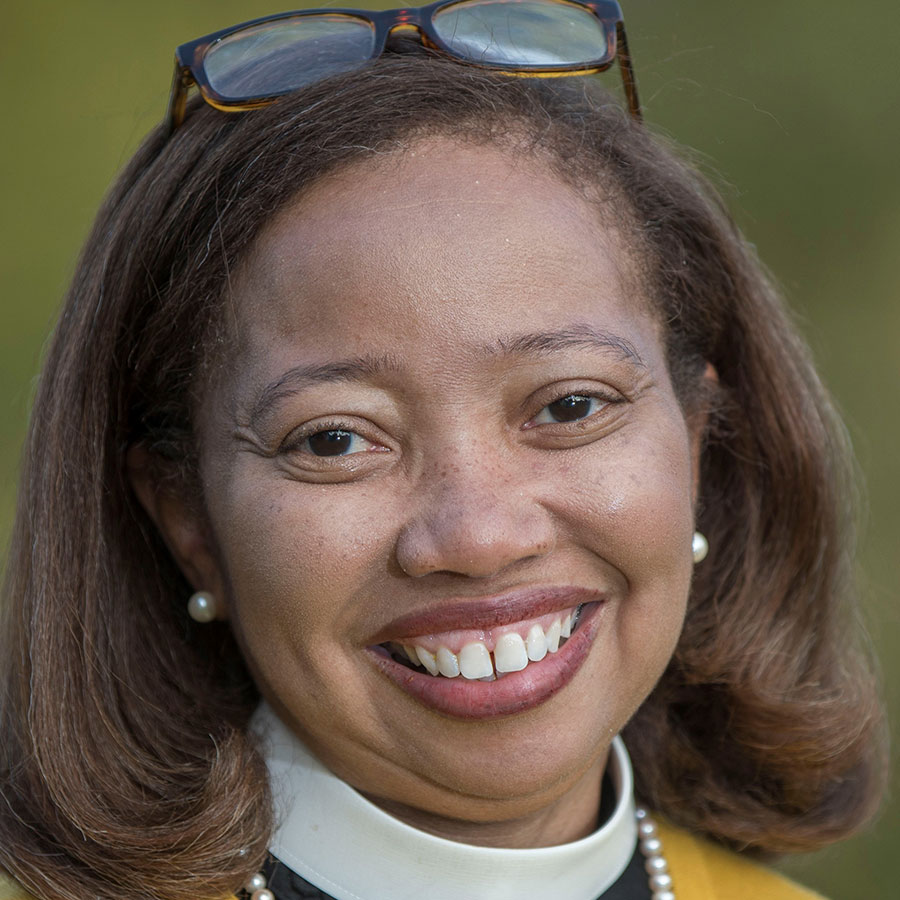
About Dorothy Sanders Wells
The Rev. Dr. Dorothy Sanders Wells is an Episcopal priest and pastor in Memphis, Tennessee. She enjoys writing about justice and equity issues for all of God's people. You can find more of her writing at https://dorothysmusings.wordpress.com/. You can read more about the author here.

Recent Comments
Browse Our Archives
Select a Category Christmas Easter family History religion Uncategorized
Select a Month May 2026 December 2025 May 2025 March 2025 February 2025 December 2024 April 2024 December 2023 November 2023 September 2023 August 2023 July 2023 June 2023 May 2023 April 2023 March 2023 February 2023 January 2023 December 2022
TAKE THE
Religious Wisdom Quiz
Who asked, "What is truth?" while questioning Jesus?
Select your answer to see how you score.
Pilate Peter Nicodemus Herod
Related posts from A Pastor's Musings
Speaking and hearing anew at Pentecost

60 Years of A Charlie Brown Christmas
Memphis, Mercy, and the Men We Remember

The harvest is plentiful, but the laborers are...
TRENDING AT PATHEOS General Christian

Emotion in Early Christianity by Andrew Crislip
Andrew Crislip’s Emotion in Early Christianity examines an often overlooked dimension of...

16 Spiritual Touchstones for a More Grounded Life
After decades of spiritual study, here are 16 principles I try...

Catholic Evangelization: Sharing Your Faith Every Day
Welcome back to the Graceful Awakening mini-series called, “From Faith to Mission.” ...

The Pillar of the Boatmen: the Ancient Monument...
The Pillar of the Boatmen is a Romano-Gaulish sculpture that dates from...

In one sense walking into Westminster Abbey is like walking down the...

'Super Scam Me' Exposes AI Jon Bon Jovi...
Leslie Pickett believed she was in a relationship with Jon Bon Jovi....
view all General Christian blogs
Ad-Free & Subscriber Log-In Subscription Support
- About Us
- 2026 Calendar
- Videos
- Podcasts
- Library of World Religions
- Faith In Media Tracker
- Advertise With Us
- Write for Us
- Privacy Policy
- Terms of Service
- Do Not Sell My Data
- Contact Us
- Radiant Digital
- Manage Newsletter Subscriptions
- Unsubscribe From Notifications
- Sitemap
Copyright 2008-2026, Patheos. All rights reserved.
Subscription Support Ad-Free & Subscriber Log-In
Follow Patheos