
BuddhistCatholicContemplativeEvangelicalGeneral ChristianHinduJewishLatter-day SaintMuslimNew VisionsProgressive Christian
Beliefs
- Buddhist
- Catholic
- Contemplative
- Evangelical
- General Christian
- Hindu
- Jewish
- Latter-day Saint
- More Voices
- Muslim
- New Visions
- Pagan
- Progressive Christian
Topics
- Religion News
- Food and Religion
- Sports and Religion
- Religious Art
- Religious Music and Entertainment
- Religious Events
- History and Religion
- Style and Religion
- Politics and Religion
- Women in Religion
- Recreation Outdoors and Religion
- Business Finance and Religion
- Careers Workplace and Religion
- Education and Religion
- Family Parenting and Religion
- Health Fitness and Religion
- Home and Religion
- Relationships and Religion
- Technology and Religion
- Travel and Religion
Columnists
- Buddhist Columnists
- Business Finance and Religion Columnists
- Careers Workplace and Religion Columnists
- Catholic Columnists
- Contemplative Columnists
- Education and Religion Columnists
- Evangelists Columnists
- Family Parenting and Religion Columnists
- General Christian Columnists
- Health Fitness and Religion Columnists
- Hindu Columnists
- History and Religion Columnists
- Home and Religion Columnists
- Jewish Columnists
- More Voices Columnists
- Latter Day Columnists
- Muslim Columnists
- New Visions Columnists
- Nonreligious Columnists
- Pagan Columnists
- Politics and Religion Columnists
- Progressive Columnists
- Recreation Outdoors and Religion Columnists
- Relationships and Religion Columnists
- Religion News Columnists
- Religious Art Columnists
- Religious Events Columnists
- Religious Music and Entertainment Columnists
- Sports and Religion Columnists
- Style and Religion Columnists
- Technology and Religion Columnists
- Travel and Religion Columnists
- Women in Religion Columnists
Resource Library
- 2026 Calendar
- Library of World Religions
- The 100 Most Holy Places on Earth
- Patheos Answers
- Podcasts
- Videos
- Faith Leaders Database
- Anglican Episcopalian
- Bahai
- Baptist
- Buddhism
- Christianity
- Confucianism
- Eastern Orthodoxy
- Hinduism
- Holiness and Pentecostal
- ISKCON
- Islam
- Judaism
- Lutheran
- Methodist
- The Church of Jesus Christ of Latter-day Saints
- New Age
- Paganism
- Presbytarian and Reformed
- Protestantism
- Religion Behind the Scenes
- Roman Catholic
- Scientology
- Shia Islam
- Sikhism
- Sufism
- Sunni Islam
- Taoism
- Zen
- See all religions
Research Tools
 Ad-Free & Subscriber Log-In Subscription Support
Follow Patheos 

- Trending:
- Advent
- |
- Forgiveness
- |
- Thanksgiving
- |
- Election
- |
- Seasonal Holidays
- |
- Marriage

-
About the Authors
- Home
- Evangelical
- Technology and Religion
- George Rogers and the Pentecostal Case Against Movies
George Rogers and the Pentecostal Case Against Movies
Last updated on: September 28, 2026 at 3:57 pm by Alex Mayfield
George Rogers and the Pentecostal Case Against Movies 2026-09-28T15:57:11-04:00 Alex Mayfield
Patheos Explore the world's faith through different perspectives on religion and spirituality! Patheos has the views of the prevalent religions and spiritualities of the world.
A Pentecostal in “Hellywood”
In my last post, I explored how early-20th-century conservative groups, like Pentecostals, reacted to the burgeoning movie industry, or as one Pentecostal minister referred to it, “Hellywood.” With that sort of wordplay being utilized, you can imagine their overall opinion.
In this post, I want to focus on one very interesting exploration of the topic that I found in a short-lived periodical of the Church of God (Cleveland). The article comes almost 10 years before the sea change in Pentecostal acceptance of the movies, and I think it gets at the surprisingly nuanced ways that Pentecostals and other conservatives were thinking about movie-going and the tides of cultural change in their time.
The Curious Case of George Rogers Pictures, Inc.
In 1922, the Church of God (Cleveland) launched The Faithful Standard, a brief experiment in running a for-profit monthly magazine. The paper ran a regular serialized fictional story titled “George Rogers – The Pentecostal Story.” The titular George is a Pentecostal everyman whose journey from his Pentecostal roots throughout the world paralleled that of Pentecostal young people. In the September and October issues, George finds himself kicked out of a prestigious teaching position after being accused of being a “religious fanatic.” Out on his luck, he travels to New York and goes on to establish “Rogers Pictures, Inc.” with the backing of a wealthy Methodist minister.
In all of this, George is well-intentioned, telling his Methodist backer that he decided on making films as “it’s a worthy way of preaching the gospel that has been neglected.” George goes on to meet a former Pentecostal movie producer, and he makes hit after hit of Biblical epics. His first, “Joseph,” screens for every clergy member in New York City, and they promptly promote it in their pulpits. All his films gain endorsements from the “Conferences of the Churches of Christ in America” and are promoted by the “International Sunday School Committee.” He eventually goes on to produce “proper” films about religion in foreign places and the great need there.
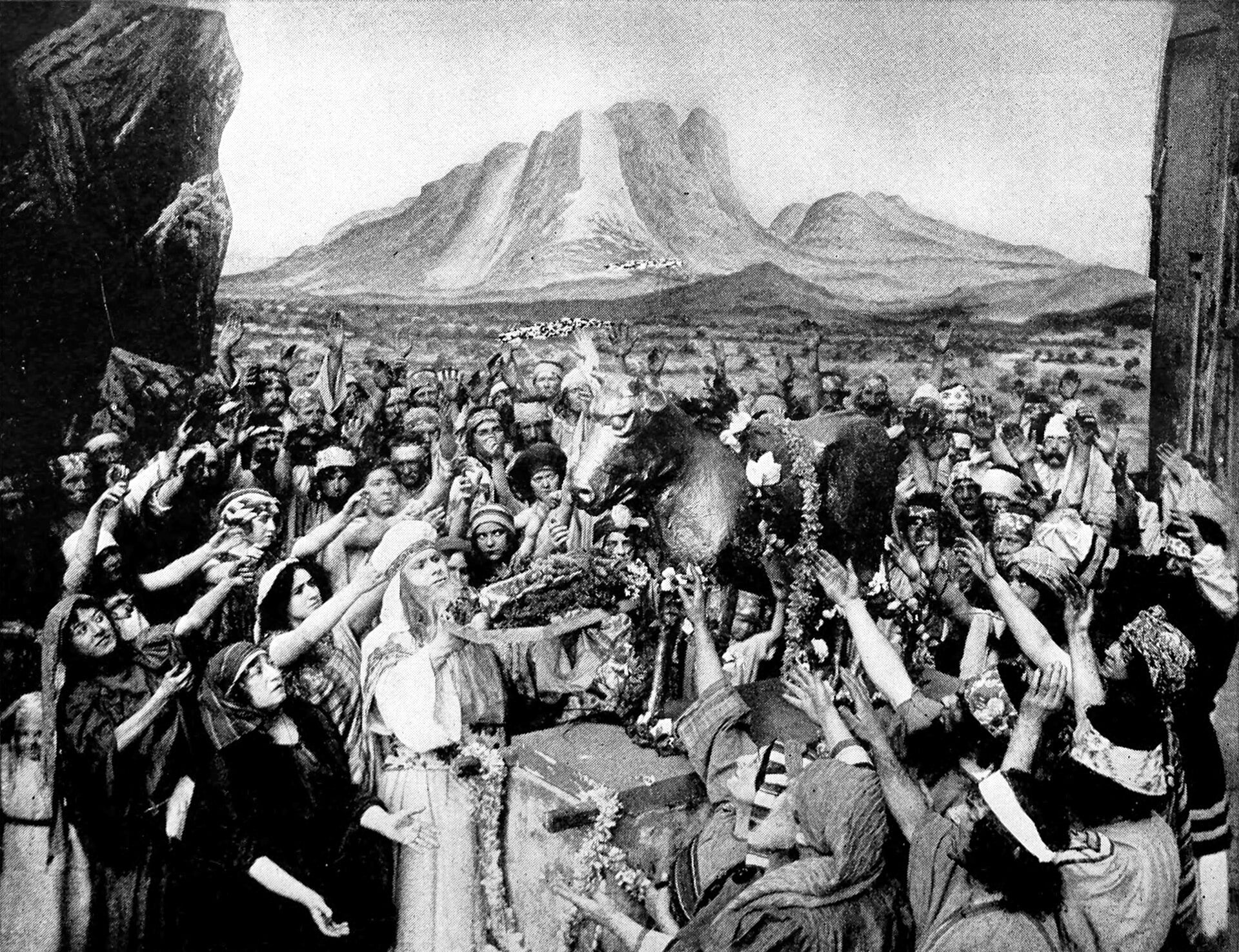
Still from the Life of Moses, 1909. Biblical epics were favorite stories of ambitious film makers. George was clearly meant to evoke this trend. Image curtesy of Wikimedia commons.
Like Joseph himself, George faces temptation when his secretary attempts to seduce him. He quickly hires a new secretary who happens to be a member of the Church of God. After testing her and other upright members of his household staff, George has a dramatic moment of repentance, realizing that despite all his successes, he had indeed backslidden.
As George ruminates on what to do, the Great War arrives on the shores of the United States, and he senses that his fate lies elsewhere. At a banquet for movie-makers joining the war effort, George gives a dramatic speech about the power of film:
When statesmen realize that the nations which maintain the highest morale will eventually win in this Great War that has swept beyond the confines of continents and encircled the world, they will find that motion pictures will be able to play no small part. This is to be a war of ideas and ideals, and that cause will survive whose people, strong in the righteousness of their purpose, shall fight with unbroken faith until victory comes. Human beings are appealed to by pictures so much more strongly than through the printed word alone. Pictures are a universal language.
Despite this moving overture to the power of film and a generous offer to be an Army Captain and produce war films, George decides his time in movies is done. After meeting his business partner at the club, he divests himself of the company stock, buys war bonds (which later make him even more wealthy), and enlists as a private to fight on the front.
What to Make of George, the Pentecostal Everyman?
George’s story continues, but we’ll leave it there. As a serialized column, I admit it was enjoyable to read as a historian of religion. It was engagingly written, with all sorts of humorous swipes at various ecumenical bodies and mainline denominations. It evoked many of the same sentiments as popular serialized novels, like Lewis Sinclair’s hit serial Free Air. But while Sinclair’s novel championed the working class and egalitarian, democratic aesthetics, George’s story was a working-class critique of upper-class religious and cultural mores.
Surprisingly, it was also a sincere story. The meandering set of events, mixed with minute details on the movie industry, left two impressions: (1) the author really did their homework for this piece, or (2) this is a veiled repackaging of someone’s—or several people’s—story. George is someone you do empathize with—or at least I did. His desire to make films was inspiringly evangelistic, and his moral conduct was upright at every turn. His movie industry partners were not horse thieves and cutthroats, as some Pentecostals alleged; they were just decent folk who wanted to make the world a better place and make money while doing it.
It could be easy, then, to read George’s experience as a success story of a Pentecostal boy made good, but that is not the moral of the tale. The arch of the story makes it clear. Those decent folk were in the wrong business, and George’s good intentions were paving the road to hell. He had to get out of the movie business to save his soul.
Most importantly for my purpose here, George’s conduct and final speech displayed a deep understanding of the power of film. It made no rebuttal to film boosters who lauded film’s potential to sway minds; indeed, it agreed with them. George, and the Pentecostals he represented, clearly recognized that moving pictures moved people, but not always in the ways intended. The medium had a message all its own, and it might best be avoided. We tend to dismiss this sort of technological hesitancy by crying “Luddite!”, but George’s rejection was heartfelt and labored, not a “know nothing” reactionary response.
Movies and the Danger of Leisure
In the last post, I detailed all the reasons Pentecostals cautioned against the dangers of “Hollywood.” Together, these reasons could broadly be conceptualized as a response to the growing leisure cultures of the late 19th- and early 20th-century Atlantic world. With successes in labor and growing economies, late-Victorians had more money in their pockets and more time to spend it. Recreation presented a new category of potential good and harm, and religious groups responded in various ways (there is a vast literature on this, but I found Paul Heintzman’s overview in the Oxford Handbook of 19th Century Christian Thought helpful). Conservative groups, like the Holiness and Pentecostals, tended to respond in opposition. Alongside bans on movie going were bans on “baseball games, picnics, circuses, dancing halls, pool rooms, billiard tables, gambling dens of all kinds, county and state fairs” and anything generally designed to distract you from spiritual things. Leisure was the primrose path to destruction.
George had household servants, met his friends at clubs, lived in fancy apartments, attended banquets, and was feted by the elites of society. He had all the leisure one could buy, and he produced objects of leisure that were intended to swoon people to Christ. But there was the rub. George’s story argued that this sort of leisure did not, in fact, produce real, sinewy Christians. It was no mistake, then, that his clarion call to repent came from both his working-class household staff and a war draft. George needed to work hard, to discipline himself, and to fight to follow God. Leisure was found in the Lord, and if you wanted a real moving picture, you needed to run the altar… or a battlefront.
An End to the “Hellywood” Panic?
As I said last time, I could not find any positive statements about movies in Pentecostal periodicals prior to 1931. I’ll talk more about that specific shift in the next post. For now, I find it interesting that Pentecostals only began moderating their official stances on movie-going after the stock market collapse of 1929 and the worldwide depression that followed. Richard Butsch has argued that while the Great Depression did lead to an initial drop in movie attendance, the latter half of the 1930s saw a dramatic increase in movie-going as companies moved away from selling movies as a form of luxury and pivoted to a strategy that married centrally controlled show bills with smaller, neighborhood theaters. In short, movies went mainstream and working-class.
You would think this shift might lead to an increased opposition to movies, and indeed, there was a continual stream of Pentecostal movie naysayers in the ensuing decades. At the same time, that shift in tone among Pentecostals and the broader shift in the American movie-viewing habits could not be a coincidence. While the power of film was easy to decry when it was a thing of luxury, it was harder to dismiss when film became the bread-and-butter entertainment of the masses. This is not truly an argument (not a good one anyway), just an observation and a hunch.
It seems reasonable, at least, to see George’s final speech as a begrudging recognition by at least one Pentecostal that the future lay in motion pictures. Despite the moral dangers of the theater and Hollywood, the moving picture was just too powerful a medium to ignore. And so, it is no small irony that just as George Rogers was abandoning his fictitious movie career, real flesh-and-blood Pentecostals around the world were about to pick up their own cameras and harness the taboo power of film. More in the next post.
Technology and Religion
History and Religion

About Alex Mayfield
Alex Mayfield is Assistant Professor of History at Asbury University and a Visiting Researcher at the Center for Global Christianity and Mission at Boston University. His research utilizes digital methodologies that enable the reconstruction of historical networks and movements within global Christianity. His research and teaching interests include global history, Pentecostal/Charismatic movements, mission history in East Asia, and the history of colonial Latin America. Much of his research is dedicated to collaborative digital projects. Currently, he is a principal investigator for the China Historical Christian Database, an NEH-funded, international collaborative project that seeks to identify Christian people, events, and institutions in China between 1550 and 1950. With his help, the project has become the largest collection of data on Christian actors in China’s past, and it continues to grow. Beyond this project, he continues to serve as a technical advisor to the Chinese Christian Posters projects and the Dictionary of African Christian Biography. Most recently, he began leading a team of scholars to produce a digital documentary edition of the correspondence of Robert Morrison, the first Protestant missionary to China. In his research, he explores the transnational dimensions of the early Pentecostal movement. His latest book, The Kaleidoscopic City, explores how changes in the structural and conceptual frameworks of foreign Pentecostals had a dramatic impact on the shape of Hong Kong Pentecostalism. Currently, he is researching how early Pentecostals theologized, utilized, and transformed network technologies in the 20th century. You can read more about the author here.
Previous Post

September 22, 2026
Origen, Eustathius, and the Witch of Endor
Next Post
September 24, 2026 How an Explosive Book Rewrote the Study of the Gospels
Recent Comments
"Every religion is "made up," even Adam and Eve were made up thousands of years ..."
Forging Druids and Inventing a Nation
"I have an identical twin, and Thomas was always the disciple I connected with most. ..."
In the Footsteps of Thomas: A ..."
"I've never thought of Constantine as a villain. Do Christians generally? Maybe the ones who ..."
"The TV sitcom BEWITCHED was an old favorite of mine"
How Scotland Gave Us Our Modern ..."
Browse Our Archives
Select a Category abolitionism Abortion Abraham Joshua Heschel Abraham Kuyper Abraham Lincoln Academia Activism Adam Renberg Advent Adventist africa African American Religion Agnes Howard Albert Camus American History American Religious History American Revolution American West Anabaptists Ancient History Andrea Turpin Andrei Tarkovsky Anglicanism Annales Ansley Lillian Quiros anti-Catholicism Antisemitism Anxious Bench apologetics Apparitions Arash Azizi Archaeology archives art Artificial Intelligence Asia Asian Americans Augustine Authors Bad Bunny Baptism Baptists Barack Obama Battle of Hastings Benjamin Franklin Bernard-Henri Levy Beth Allison Barr Beth Moore Bethany Mannon Bible Bill Cunningham Billy Graham Black Music Bob Dylan Body Boenhoffer Books Breastfeeding Bruce Springsteen C.S. Lewis Calvinism Cancel Culture Capitalism Carmelites Catholicism Cedric Robinson Cesar Chavez Charismaticism charity Charles Dickens Charles Lindbergh Che Guevara Chicago Children Chinese Christianity Chris Gehrz Christ Christian death Christian Higher Education Christian life Christian Nation Christian Nationalism Christianity Today Christmas Church life Church Practice cinema Civil Religion Civil Rights Movement Civil War civility Classics Climate Change Cold War Colonial Mexico colonialism Comer Communism community complementarianism Conference on Faith and History Congregationalism Conspiracies Conspiracy Conversion Narratives Coronavirus Costa Rica Council of Nicaea Covid-19 Creation Critical Race Theory Crusades Culture culture wars Daniel K. Williams David Barton David Swartz Death Ways death with dignity DEI democracy Democratic Party Devotion Digital Age Diplomacy discipleship diversity Donald Trump Drama Dua Lipa Early Church early modern Early modern Catholicism Easter Eastern Christianity economic exploitation Education elections Elie Wiesel Elizabeth II Elizabeth Taylor emotions Empire Engineering England enslavement Entertainment Episcopal Church Erica Ramirez eschatology Eurocentrism Evangelicalism Evangelicals Exegesis Family Feminism Film Flannery O'Connor folk music Food Foreign Policy founding fathers Franciscans Franciscus Junius fundamentalism Funerals G.K. Chesterton Gender Genocide genre geography George W. Bush George Washington George Whitefield Global Christianity Global church Grief Guadalupe Guest Post guest post gun control gun violence Gustavo Gutierrez Hamid Dabashi Harold John Ockenga Harvest Hate Hawaiian Christianity Healing health care Heather Cox Richardson Hell Heresy Hermeneutics Higher Education Hinduism Hippocratic oath Historical Fiction Historical Methodology Historical Profession Historical Profession Historical Theology Historical Thinking historiography Holidays Holocaust horror movies Human rights Humanitarian Work humanities Hummingbirds Hungary hymns Imago Dei Immigration Injustice Interviews Iran Islam Islamophobia Israel Ivan's Childhood Jacob Randolph James Bratt Janine Giordano Drake Japanese history Japanese Literature Jean Paul Sartre Jesse Miranda Jesus Jesus Christ Jimmy Carter Joan Baez Joan Didion Joanne Freeman João B. Chaves Joao Chaves Joey Cochran John Calvin John Fea John Tillotson John Turner Johnny Cash Jonathan Edwards Jonathan Tran Joseph Smith Josh Howerton Journalism Jr. Judaism Jürgen Moltmann Just War Justice Justin Brierley Karl Barth Katelyn Beaty koi ponds Kris Kristofferson Kristin Kobes Du Mez Latin American Religious History Latino Americans Lectio Divina Leisure Lent Leonard Cohen liberal arts liberalism Liberation Theology Linda Ronstadt Lisa Clark Diller Literature Lou Reed Lynchings Lynneth Miller Renberg Mainline Protestantism Malcolm Foley Marilyn Monroe Maritime history Mark Noll Marriage Martin Luther Martin Luther King Martyrdom Marxism Mary Masih Alinejad mass shootings material culture medieval Christianity Medieval Ethiopia Melissa Borja memory Mennonites Mental Health Mental Illness Methodism Mexican Americans Mexicans Mike Madrid Miles Mullin Min Jin Lee Miscarriage Missionaries Mister Rogers Mitt Romney modernity Monasticism Mormonism Motherhood Mothers of the Church Moving Music Musicals Nadya Williams Nahua Christianity Native Americans Natsume Sōseki New Contributor New England New Year New York Nico Non-Violent Protest Orthodoxy pacifism Paleo Evangelicals Palestinians Parenting Patti Smith Paul Kingsnorth Pedro Calderón de la Barca Pentecostalism Philip Jenkins Phillis Wheatley physician-assisted suicide pilgrimage Pilgrims Piracy pluralism Plutocracy Poetry Politics Pope Francis Pope Leo XIV post-modernism prayer preaching Presbyterians prosperity gospel Protest Public Executions Public history Publishing Puritans purity culture Quakers race Race Massacres Racial Capitalism racial reconciliation racialization Racism Raha Bahloulipour Re-Enchantment reading Reformation Refugees religion and the university religion and war Religious Freedom Religious Nones Religious Pluralism Religious Symbols religious violence Republican Party Revival Rita Coolidge Ritual Roger Williams Roman Catholic church Royalty Russell Moore same-sex marriage Sarah Irving-Stonebraker Scandinavia Science Science and Technology Scopes trial Scriptural Interpretation secularism Selena Quintanilla seminary Seventh-Day Adventists sexual morality Sexuality Sikhs Silence slaveholders theology Slavery Slavoj Zizek social justice Social Media Southern Baptist Convention Southern Religion Spain Spiritual Autobiography Spiritual but not religious Spiritual Discipline Sports Stanley Hauerwas Suffering Summer Camps Sunday Night Odds and Ends Supernatural Supreme Court Syriac Christianity Tal Howard Taylor Swift Teaching Technology Television Thanksgiving The Beatles The Mission theater TheoBros Theology Thomas Dixon Thomas Jefferson Thomas Kidd Thomas Merton Tim Gloege Tim Walz Tom Holland Tourism tradition Tragedy Translation Transnationalism Travel Trump Ukraine Uncategorized Unitarians United Methodist Church US History Vanessa Chan Velvet Underground Verónica A. Gutiérrez Veronica Gutierrez Vikings Violence Virgin Mary Virtue Virtue ethics Visions Voting War WCTU Wendell Berry Westminster Assembly White Evangelicalism Wildfires Winnie the Pooh Witches women Women in Ministry Women's and Gender Studies Work Worship writing Yasunari Kawabata Zena Hitz
Select a Month November 2026 October 2026 September 2026 August 2026 July 2026 June 2026 May 2026 April 2026 March 2026 February 2026 January 2026 December 2025 November 2025 October 2025 September 2025 August 2025 July 2025 June 2025 May 2025 April 2025 March 2025 February 2025 January 2025 December 2024 November 2024 October 2024 September 2024 August 2024 July 2024 June 2024 May 2024 April 2024 March 2024 February 2024 January 2024 December 2023 November 2023 October 2023 September 2023 August 2023 July 2023 June 2023 May 2023 April 2023 March 2023 February 2023 January 2023 December 2022 November 2022 October 2022 September 2022 August 2022 July 2022 June 2022 May 2022 April 2022 March 2022 February 2022 January 2022 December 2021 November 2021 October 2021 September 2021 August 2021 July 2021 June 2021 May 2021 April 2021 March 2021 February 2021 January 2021 December 2020 November 2020 October 2020 September 2020 August 2020 July 2020 June 2020 May 2020 April 2020 March 2020 February 2020 January 2020 December 2019 November 2019 October 2019 September 2019 August 2019 July 2019 June 2019 May 2019 April 2019 March 2019 February 2019 January 2019 December 2018 November 2018 October 2018 September 2018 August 2018 July 2018 June 2018 May 2018 April 2018 March 2018 February 2018 January 2018 December 2017 November 2017 October 2017 September 2017 August 2017 July 2017 June 2017 May 2017 April 2017 March 2017 February 2017 January 2017 December 2016 November 2016 October 2016 September 2016 August 2016 July 2016 June 2016 May 2016 April 2016 March 2016 February 2016 January 2016 December 2015 November 2015 October 2015 September 2015 August 2015 July 2015 June 2015 May 2015 April 2015 March 2015 February 2015 January 2015 December 2014 November 2014 October 2014 September 2014 August 2014 July 2014 June 2014 May 2014 April 2014 March 2014 February 2014 January 2014 December 2013 November 2013 October 2013 September 2013 August 2013 July 2013 June 2013 May 2013 April 2013 March 2013 February 2013 January 2013 December 2012 November 2012 October 2012 September 2012 August 2012 July 2012 June 2012 May 2012
Follow Us!
TAKE THE
Religious Wisdom Quiz
What does "Gethsemane" mean in Aramaic?
Select your answer to see how you score.
Olive press House of God Place of rest Holy ground
Related posts from Anxious Bench
When Pentecostals Took on “Hellywood”

Emulating Odysseus? Ancient History and Modern Politics

Field Report: Pentecostal Christianity and Global Modernity?
TRENDING AT PATHEOS Evangelical

Adventurous Lectionary -1st. Sunday of Advent - November...
The Adventurous Lectionary - The First Sunday of Advent – November 29,...

Will Islam become the world's biggest religion by 2035? Congo will replace...

The resilience of the Christian faith in the english speaking world of...

An Advent Calendar, and a Tree full of...
I've spent the weekend deeply invested in internet drama about a $150...

How to Have Financial Transparency in Marriage
Despite the fact that financial issues and money problems are the number...
The Healing Power of Forgiveness in Marriage
Learning how to give and accept apologies are essential ingredients of a...
view all Evangelical blogs
What Are Your Thoughts?leave a comment
Ad-Free & Subscriber Log-In Subscription Support
- About Us
- 2026 Calendar
- Videos
- Podcasts
- Library of World Religions
- Faith In Media Tracker
- Advertise With Us
- Write for Us
- Privacy Policy
- Terms of Service
- Do Not Sell My Data
- Contact Us
- Radiant Digital
- Manage Newsletter Subscriptions
- Unsubscribe From Notifications
- Sitemap
Copyright 2008-2026, Patheos. All rights reserved.
Subscription Support Ad-Free & Subscriber Log-In
Follow Patheos