
BuddhistCatholicContemplativeEvangelicalGeneral ChristianHinduJewishLatter-day SaintMuslimNew VisionsProgressive Christian
Beliefs
- Buddhist
- Catholic
- Contemplative
- Evangelical
- General Christian
- Hindu
- Jewish
- Latter-day Saint
- More Voices
- Muslim
- New Visions
- Pagan
- Progressive Christian
Topics
- Religion News
- Food and Religion
- Sports and Religion
- Religious Art
- Religious Music and Entertainment
- Religious Events
- History and Religion
- Style and Religion
- Politics and Religion
- Women in Religion
- Recreation Outdoors and Religion
- Business Finance and Religion
- Careers Workplace and Religion
- Education and Religion
- Family Parenting and Religion
- Health Fitness and Religion
- Home and Religion
- Relationships and Religion
- Technology and Religion
- Travel and Religion
Columnists
- Buddhist Columnists
- Business Finance and Religion Columnists
- Careers Workplace and Religion Columnists
- Catholic Columnists
- Contemplative Columnists
- Education and Religion Columnists
- Evangelists Columnists
- Family Parenting and Religion Columnists
- General Christian Columnists
- Health Fitness and Religion Columnists
- Hindu Columnists
- History and Religion Columnists
- Home and Religion Columnists
- Jewish Columnists
- More Voices Columnists
- Latter Day Columnists
- Muslim Columnists
- New Visions Columnists
- Nonreligious Columnists
- Pagan Columnists
- Politics and Religion Columnists
- Progressive Columnists
- Recreation Outdoors and Religion Columnists
- Relationships and Religion Columnists
- Religion News Columnists
- Religious Art Columnists
- Religious Events Columnists
- Religious Music and Entertainment Columnists
- Sports and Religion Columnists
- Style and Religion Columnists
- Technology and Religion Columnists
- Travel and Religion Columnists
- Women in Religion Columnists
Resource Library
- 2026 Calendar
- Library of World Religions
- The 100 Most Holy Places on Earth
- Patheos Answers
- Podcasts
- Videos
- Faith Leaders Database
- Anglican Episcopalian
- Bahai
- Baptist
- Buddhism
- Christianity
- Confucianism
- Eastern Orthodoxy
- Hinduism
- Holiness and Pentecostal
- ISKCON
- Islam
- Judaism
- Lutheran
- Methodist
- The Church of Jesus Christ of Latter-day Saints
- New Age
- Paganism
- Presbytarian and Reformed
- Protestantism
- Religion Behind the Scenes
- Roman Catholic
- Scientology
- Shia Islam
- Sikhism
- Sufism
- Sunni Islam
- Taoism
- Zen
- See all religions
Research Tools
 Ad-Free & Subscriber Log-In Subscription Support
Follow Patheos 

- Trending:
- Advent
- |
- Forgiveness
- |
- Thanksgiving
- |
- Election
- |
- Seasonal Holidays
- |
- Marriage

-
About the Authors
- Home
- Evangelical
- Singing Seafarers: Sailing a 16th-Century Spanish Galleon
Singing Seafarers: Sailing a 16th-Century Spanish Galleon
Last updated on: August 21, 2026 at 1:50 pm by Verónica A. Gutiérrez
Singing Seafarers: Sailing a 16th-Century Spanish Galleon 2026-08-21T13:50:36-04:00 Verónica A. Gutiérrez
Patheos Explore the world's faith through different perspectives on religion and spirituality! Patheos has the views of the prevalent religions and spiritualities of the world.
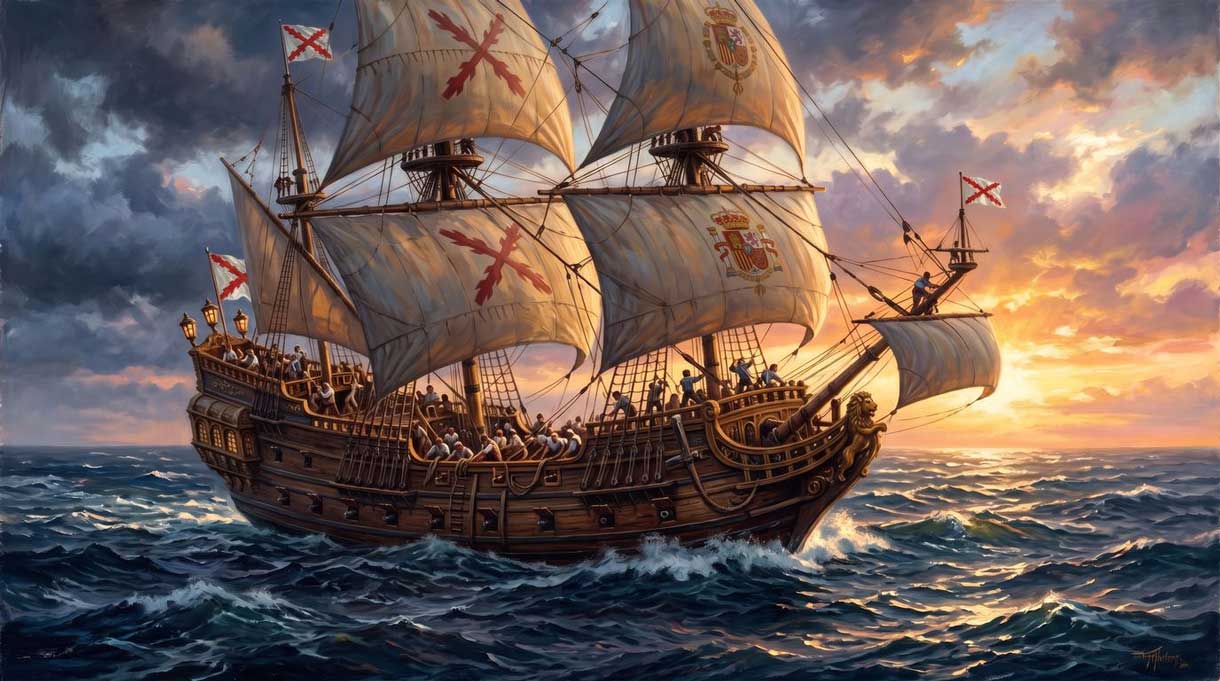
I imagine María de la Paz in that opening scene as a teenager, chaperoned by her aunt and uncle, a textile merchant from Guadalajara in the Crown of Castile, on her way to begin a new life in Puebla de los Ángeles, New Spain. | Image via Synaptic Image / Patheos.
— Oh, God! —Help us.
—Oh! Who are we? —I am your servant.
—Oh! We want… —to serve you well,
—Oh! Our faith… —to uphold,
—Oh! Our faith… —as Christians.
—Oh! May the wicked… —pay for it;
—May the Saracens… —be defeated,
—May he twist and die…, —great mastiff,
—Oh! Children… —of Abraham.
—Oh! They do not believe… —that it is good,
—Oh, they do not believe… —in the holy faith
—In the holy… —faith of Rome,
—Oh!, in Rome —lies forgiveness.
—Oh! Saint Peter…, —great man,
—Oh! Saint Paul…, —his companion,
—Oh! may he pray… —to God for us,
—Oh! for us… —sailors,
—Oh! in this world… —there are so many of us.
—Oh, west, —I say east,
—Oh, east, —the sun rises.
—Oh, west —radiance.
— 16th-century maritime chantey
From Eugenio de Salazar’s Textos Náuticos: Navegación del alma por el discurso de todas las edades del hombre (1600) y Carta al licenciado Miranda de Ron (1574), p. 277. Translated from “el lenguaje marino” using DeepL.com.

Title page captured from online pdf
I have been learning a lot about sixteenth-century Spanish galleons this summer. I have, in fact, immersed myself in Early Modern maritime history as I draft my current novel, The Inquisitor General’s Mother. Based on hundreds of documents I’ve gleaned in archives in Mexico and Spain, this historical fiction project – which I detailed in Extracting Voices from the Archives: María de la Paz’s Story – relates the life of a Castilian-born woman who emigrated to New Spain and became one of the wealthiest textile mill owners in Cholula, Puebla, Mexico. Several decades of her life are well-documented; as for the years she does not appear in the historical record, I am filling those archival silences with historically-appropriate imagination.
My story opens in 1565 with fifteen-year-old María de la Paz aboard a Spanish galleon. The date is accurate, for I found her name in Sevilla’s Archive of the Indies’ published catalog of passengers to New Spain on May 8 of that year. I know it’s her because the names of her parents match the parents she names in her 1595 will; recovering from that illness, she would dictate a second will in 1614:

Entry no. 3.776 in Catálogo de pasajeros a Indias durante los siglos XVI, XVII y XVIII. Vol. 4 (1560-1566); Translation: María de la Paz, native of Guadalajara, single, daughter of Juan de Córdoba and Catalina Diez, to New Spain. 8 May [1565].
The night I finally located her name my daughter jumped up and down with me in excitement.
Without additional details, I have imagined María de la Paz in that opening scene as a teenager chaperoned by her aunt and uncle, a textile merchant from Guadalajara in the Crown of Castile, on her way to begin a new life in Puebla de los Ángeles, New Spain. Like all passengers, she began her voyage in Sevilla, which the Catholic Monarchs Ferdinand and Isabela had designated in 1503 as the official port for embarking to the New World, despite being a two-day sail down the Guadalquivir River to the sea.
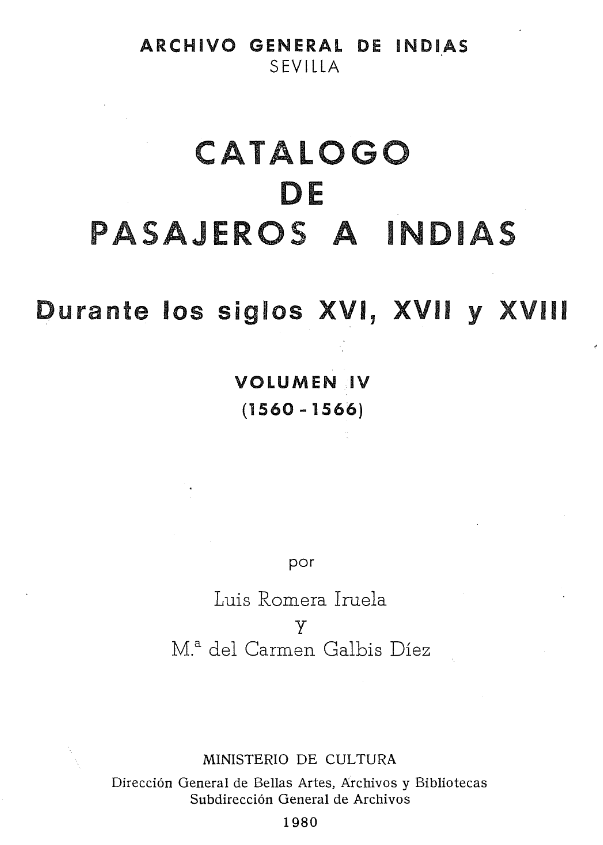
Cover page of the Sevilla’s Archive of the Indies’ published Catalog of Passengers to the Indies during the 16th through 18th centuries, volume 4 (1560-1566)
All immigrants to the New World were required to register for passage and process their papers in Sevilla’s Casa de Contratación [House of Trade], providing evidence, among other documentation, that they were Old Christians (i.e., not recent converts from Islam or Judaism). The passenger lists housed in the Archive of the Indies provide historians with vital information about transatlantic travel in the colonial period (1519-1821); it’s great fun recognizing names of historical figures who appear in my archival documents from Mexico. Bonus, the archive is a beautiful place to conduct research, located beside the delightful gardens of the Real Alcázar, the Moorish stronghold in whose chapel Columbus had attended Mass before sailing west to reach east and in whose rooms Queen Isabela had received him upon his return from the first voyage, and across from Sevilla’s cathedral, home to an enormous Columbus memorial.
Historian Andrés Reséndez’s A Land So Strange: The Epic Journey of Cabeza de Vaca (NY: Basic Books, 2007; pp. 39-42) provided me with a description of the bustling 16th-century port-city of Sevilla, particularly its section along the Guadalquivir River known as el Arenal (the sandy beach) from which María de la Paz’s galleon would have launched. Cover captured from Amazon.
Though trained in sixteenth-century Spain and Mexico, I struggled to find a workable entry point into Early Modern maritime history. After searching online and leafing through dozens of seafaring books in the maritime section of several SoCal libraries, I happened across Kenneth D. Schultz’s Magellan’s Navigator while browsing a used book sale. Though Magellan’s fleet launched in 1519, it was close enough to María de la Paz’s voyage to give me a sense of her experience on the sea. Perhaps more importantly, I gained a vocabulary upon which to draw.
Kenneth Schultz’s Magellan’s Navigator: A Historical Novel (Olympicvista Publishing, 2016) presents the compelling story of Magellan’s circumnavigation from the memoirs of Francisco Albo, a surviving Greek pilot. Cover captured from Amazon.
Of all I learned about seafaring in the sixteenth century from this novel, I found the call and response chanteys or salomas – like the one with which I opened this post – to be the most intriguing. In Chapter Six: We Leave the Canaries, Schultz’s protagonist Francisco Albo describes how “raising the anchor, like most aspects of shipboard life, had its rituals. I chanted, ‘o la fede.’ My men strained against the windlass on my ‘O’ and then finished the chantey with ‘de cristiano.’” And so it went… (p. 34).
Further investigation revealed that to coordinate their work aboard ship and avoid mishap, crewmen chanted or sang during any tasks requiring precision movement; the back-and-forth format ensured that the crew moved as one man. What a wonderful detail for my book.
The idea of synchronizing movement predates the Early Modern period, of course, with Nile river-workers and Greek rowers using rhythmic cues or ancient Mediterranean row-chants to keep time. And who can forget the scenes in Ben Hur with the drummer coordinating the speed of the enslaved rowers? The earliest known English-language sea song dates to a 15th century manuscript housed in Trinity College, Cambridge.
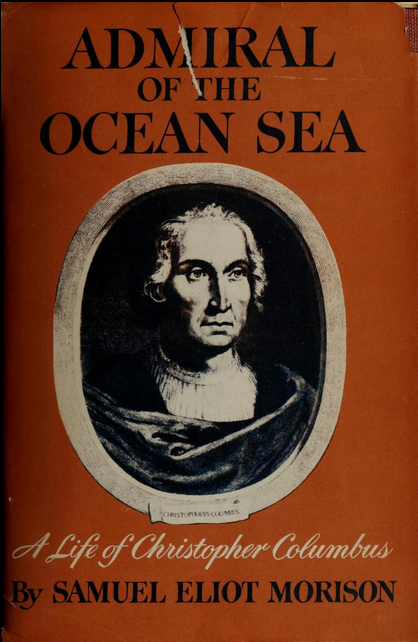
Cover captured from Internet Archive
Samuel Eliot Morison’s Admiral of the Ocean Sea: A Life of Christopher Columbus (Boston: Little, Brown, and Company, 1942), which details daily life aboard Columbus’ ships, describes the men singing at work, mentioning the same chantey which which I opened my post, which first appeared in print in Eugenio de Salazar’s Textos Náuticos: Navegación del alma por el discurso de todas las edades del hombre (1600) y Carta al licenciado Miranda de Ron (1574) cited above.
I couldn’t find much on Mediterranean chanteys, and Mollie Carlyle explained why. In her article, “Shanty Singing in the Mediterranean” (Journal of the Hakluyt Society, June 2025), a useful history of seafaring songs, she laments that “the historical record of shanty singing in the Mediterranean is relatively sparse compared to its Atlantic counterpart,” leading this “complex tradition to be understudied in maritime scholarship.” She argues that scholars should “reconsider Mediterranean maritime work songs through a broader lens, recognizing the cultural diversity of seafarers and the fluidity of musical exchange at sea” (14). There is still work to be done.
What intrigues me is the development of a Mediterranean Lingua Franca, a “marine language” whose blend of tongues reflected the cultures of the men who crewed together and who otherwise might not easily communicate with one another. Though the various versions of chanteys I’ve encountered thus far are imbued with Christian themes, which makes sense given the dangers on the sea, I have also seen “Bu izá,” an expression which appears – in my albeit preliminary research – to possibly mean Father of Glory in Arabic.
My growing knowledge of maritime history in the Spanish Main is giving me ideas for how to present María de la Paz’s experience aboard her Spanish galleon to the New World. What she will see. What she will hear. My children are helping by watching videos and documentaries about the history of shipbuilding and the construction of Spanish galleons and letting me know which ones I should see as part of my research.
If all goes as planned, in next month’s post I’ll describe my voyage on the San Salvador, Juan Rodríguez Cabrillo’s sixteenth-century Spanish galleon (replica), which is part of San Diego’s floating Maritime Museum. In 1542, Cabrillo sailed up the coast of southern California, reaching the mouth of the bay just three blocks from my home. I just love when the past touches our present.
Stay tuned!
Previous Post

August 13, 2026
The Rosicrucians: A 400-Year-Old Hoax That Worked
Next Post

August 17, 2026 The Abraham Kuyper You've Never Met
Recent Comments
"Every religion is "made up," even Adam and Eve were made up thousands of years ..."
Forging Druids and Inventing a Nation
"I have an identical twin, and Thomas was always the disciple I connected with most. ..."
In the Footsteps of Thomas: A ..."
"I've never thought of Constantine as a villain. Do Christians generally? Maybe the ones who ..."
"The TV sitcom BEWITCHED was an old favorite of mine"
How Scotland Gave Us Our Modern ..."
Browse Our Archives
Select a Category abolitionism Abortion Abraham Joshua Heschel Abraham Kuyper Abraham Lincoln Academia Activism Adam Renberg Advent Adventist africa African American Religion Agnes Howard Albert Camus American History American Religious History American Revolution American West Anabaptists Ancient History Andrea Turpin Andrei Tarkovsky Anglicanism Annales Ansley Lillian Quiros anti-Catholicism Antisemitism Anxious Bench apologetics Apparitions Arash Azizi Archaeology archives art Artificial Intelligence Asia Asian Americans Augustine Authors Bad Bunny Baptism Baptists Barack Obama Battle of Hastings Benjamin Franklin Bernard-Henri Levy Beth Allison Barr Beth Moore Bethany Mannon Bible Bill Cunningham Billy Graham Black Music Bob Dylan Body Boenhoffer Books Breastfeeding Bruce Springsteen C.S. Lewis Calvinism Cancel Culture Capitalism Carmelites Catholicism Cedric Robinson Cesar Chavez Charismaticism charity Charles Dickens Charles Lindbergh Che Guevara Chicago Children Chinese Christianity Chris Gehrz Christ Christian death Christian Higher Education Christian life Christian Nation Christian Nationalism Christianity Today Christmas Church life Church Practice cinema Civil Religion Civil Rights Movement Civil War civility Classics Climate Change Cold War Colonial Mexico colonialism Comer Communism community complementarianism Conference on Faith and History Congregationalism Conspiracies Conspiracy Conversion Narratives Coronavirus Costa Rica Council of Nicaea Covid-19 Creation Critical Race Theory Crusades Culture culture wars Daniel K. Williams David Barton David Swartz Death Ways death with dignity DEI democracy Democratic Party Devotion Digital Age Diplomacy discipleship diversity Donald Trump Drama Dua Lipa Early Church early modern Early modern Catholicism Easter Eastern Christianity economic exploitation Education elections Elie Wiesel Elizabeth II Elizabeth Taylor emotions Empire Engineering England enslavement Entertainment Episcopal Church Erica Ramirez eschatology Eurocentrism Evangelicalism Evangelicals Exegesis Family Feminism Film Flannery O'Connor folk music Food Foreign Policy founding fathers Franciscans Franciscus Junius fundamentalism Funerals G.K. Chesterton Gender Genocide genre geography George W. Bush George Washington George Whitefield Global Christianity Global church Grief Guadalupe Guest Post guest post gun control gun violence Gustavo Gutierrez Hamid Dabashi Harold John Ockenga Harvest Hate Hawaiian Christianity Healing health care Heather Cox Richardson Hell Heresy Hermeneutics Higher Education Hinduism Hippocratic oath Historical Fiction Historical Methodology Historical Profession Historical Profession Historical Theology Historical Thinking historiography Holidays Holocaust horror movies Human rights Humanitarian Work humanities Hummingbirds Hungary hymns Imago Dei Immigration Injustice Interviews Iran Islam Islamophobia Israel Ivan's Childhood Jacob Randolph James Bratt Janine Giordano Drake Japanese history Japanese Literature Jean Paul Sartre Jesse Miranda Jesus Jesus Christ Jimmy Carter Joan Baez Joan Didion Joanne Freeman João B. Chaves Joao Chaves Joey Cochran John Calvin John Fea John Tillotson John Turner Johnny Cash Jonathan Edwards Jonathan Tran Joseph Smith Josh Howerton Journalism Jr. Judaism Jürgen Moltmann Just War Justice Justin Brierley Karl Barth Katelyn Beaty koi ponds Kris Kristofferson Kristin Kobes Du Mez Latin American Religious History Latino Americans Lectio Divina Leisure Lent Leonard Cohen liberal arts liberalism Liberation Theology Linda Ronstadt Lisa Clark Diller Literature Lou Reed Lynchings Lynneth Miller Renberg Mainline Protestantism Malcolm Foley Marilyn Monroe Maritime history Mark Noll Marriage Martin Luther Martin Luther King Martyrdom Marxism Mary Masih Alinejad mass shootings material culture medieval Christianity Medieval Ethiopia Melissa Borja memory Mennonites Mental Health Mental Illness Methodism Mexican Americans Mexicans Mike Madrid Miles Mullin Min Jin Lee Miscarriage Missionaries Mister Rogers Mitt Romney modernity Monasticism Mormonism Motherhood Mothers of the Church Moving Music Musicals Nadya Williams Nahua Christianity Native Americans Natsume Sōseki New Contributor New England New Year New York Nico Non-Violent Protest Orthodoxy pacifism Paleo Evangelicals Palestinians Parenting Patti Smith Paul Kingsnorth Pedro Calderón de la Barca Pentecostalism Philip Jenkins Phillis Wheatley physician-assisted suicide pilgrimage Pilgrims Piracy pluralism Plutocracy Poetry Politics Pope Francis Pope Leo XIV post-modernism prayer preaching Presbyterians prosperity gospel Protest Public Executions Public history Publishing Puritans purity culture Quakers race Race Massacres Racial Capitalism racial reconciliation racialization Racism Raha Bahloulipour Re-Enchantment reading Reformation Refugees religion and the university religion and war Religious Freedom Religious Nones Religious Pluralism Religious Symbols religious violence Republican Party Revival Rita Coolidge Ritual Roger Williams Roman Catholic church Royalty Russell Moore same-sex marriage Sarah Irving-Stonebraker Scandinavia Science Science and Technology Scopes trial Scriptural Interpretation secularism Selena Quintanilla seminary Seventh-Day Adventists sexual morality Sexuality Sikhs Silence slaveholders theology Slavery Slavoj Zizek social justice Social Media Southern Baptist Convention Southern Religion Spain Spiritual Autobiography Spiritual but not religious Spiritual Discipline Sports Stanley Hauerwas Suffering Summer Camps Sunday Night Odds and Ends Supernatural Supreme Court Syriac Christianity Tal Howard Taylor Swift Teaching Technology Television Thanksgiving The Beatles The Mission theater TheoBros Theology Thomas Dixon Thomas Jefferson Thomas Kidd Thomas Merton Tim Gloege Tim Walz Tom Holland Tourism tradition Tragedy Translation Transnationalism Travel Trump Ukraine Uncategorized Unitarians United Methodist Church US History Vanessa Chan Velvet Underground Verónica A. Gutiérrez Veronica Gutierrez Vikings Violence Virgin Mary Virtue Virtue ethics Visions Voting War WCTU Wendell Berry Westminster Assembly White Evangelicalism Wildfires Winnie the Pooh Witches women Women in Ministry Women's and Gender Studies Work Worship writing Yasunari Kawabata Zena Hitz
Select a Month November 2026 October 2026 September 2026 August 2026 July 2026 June 2026 May 2026 April 2026 March 2026 February 2026 January 2026 December 2025 November 2025 October 2025 September 2025 August 2025 July 2025 June 2025 May 2025 April 2025 March 2025 February 2025 January 2025 December 2024 November 2024 October 2024 September 2024 August 2024 July 2024 June 2024 May 2024 April 2024 March 2024 February 2024 January 2024 December 2023 November 2023 October 2023 September 2023 August 2023 July 2023 June 2023 May 2023 April 2023 March 2023 February 2023 January 2023 December 2022 November 2022 October 2022 September 2022 August 2022 July 2022 June 2022 May 2022 April 2022 March 2022 February 2022 January 2022 December 2021 November 2021 October 2021 September 2021 August 2021 July 2021 June 2021 May 2021 April 2021 March 2021 February 2021 January 2021 December 2020 November 2020 October 2020 September 2020 August 2020 July 2020 June 2020 May 2020 April 2020 March 2020 February 2020 January 2020 December 2019 November 2019 October 2019 September 2019 August 2019 July 2019 June 2019 May 2019 April 2019 March 2019 February 2019 January 2019 December 2018 November 2018 October 2018 September 2018 August 2018 July 2018 June 2018 May 2018 April 2018 March 2018 February 2018 January 2018 December 2017 November 2017 October 2017 September 2017 August 2017 July 2017 June 2017 May 2017 April 2017 March 2017 February 2017 January 2017 December 2016 November 2016 October 2016 September 2016 August 2016 July 2016 June 2016 May 2016 April 2016 March 2016 February 2016 January 2016 December 2015 November 2015 October 2015 September 2015 August 2015 July 2015 June 2015 May 2015 April 2015 March 2015 February 2015 January 2015 December 2014 November 2014 October 2014 September 2014 August 2014 July 2014 June 2014 May 2014 April 2014 March 2014 February 2014 January 2014 December 2013 November 2013 October 2013 September 2013 August 2013 July 2013 June 2013 May 2013 April 2013 March 2013 February 2013 January 2013 December 2012 November 2012 October 2012 September 2012 August 2012 July 2012 June 2012 May 2012
Follow Us!
TAKE THE
Religious Wisdom Quiz
Who said, "You come against me with sword and spear, but I come against you in the name of the Lord Almighty"?
Select your answer to see how you score.
Saul David Eli Jonathan
Related posts from Anxious Bench
Guadalupe's Pilgrim Image Visits Our Parish School

Heralds of Heaven: Hummingbirds on a Hillside
¡Que Viva Cristo Rey! La Cristiada martyrs 100...
Cracking Cascarones in a Cemetery
TRENDING AT PATHEOS Evangelical

Reasons for Restraint: Ricardo Gonzalez, Florida and Dec...
The Morning of January 3 I begin with the dead. On the...

I published this column for Thanksgiving 2012 in the Deseret News....

For many years, Catholicism has been caught up in division over the...

'Statements of Faith' never get shorter
Nothing demonstrates a conservative commitment to faith and faithfulness like a "statement...

Michele's Reviews - Future Grace by John Piper
In God's Place, at God's Pace, by Future Grace Impatience is...

Bama Gramma's Blackout Christmas: the Power of Light...
Another Christmas Skit: I have an alter ego: Bama Gramma. She shows...
view all Evangelical blogs
What Are Your Thoughts?leave a comment
Ad-Free & Subscriber Log-In Subscription Support
- About Us
- 2026 Calendar
- Videos
- Podcasts
- Library of World Religions
- Faith In Media Tracker
- Advertise With Us
- Write for Us
- Privacy Policy
- Terms of Service
- Do Not Sell My Data
- Contact Us
- Radiant Digital
- Manage Newsletter Subscriptions
- Unsubscribe From Notifications
- Sitemap
Copyright 2008-2026, Patheos, part of the Radiant Digital network of media brands. All rights reserved.
Subscription Support Ad-Free & Subscriber Log-In
Follow Patheos