
BuddhistCatholicContemplativeEvangelicalGeneral ChristianHinduJewishLatter-day SaintMuslimNew VisionsProgressive Christian
Beliefs
- Buddhist
- Catholic
- Contemplative
- Evangelical
- General Christian
- Hindu
- Jewish
- Latter-day Saint
- More Voices
- Muslim
- New Visions
- Pagan
- Progressive Christian
Topics
- Religion News
- Food and Religion
- Sports and Religion
- Religious Art
- Religious Music and Entertainment
- Religious Events
- History and Religion
- Style and Religion
- Politics and Religion
- Women in Religion
- Recreation Outdoors and Religion
- Business Finance and Religion
- Careers Workplace and Religion
- Education and Religion
- Family Parenting and Religion
- Health Fitness and Religion
- Home and Religion
- Relationships and Religion
- Technology and Religion
- Travel and Religion
Columnists
- Buddhist Columnists
- Business Finance and Religion Columnists
- Careers Workplace and Religion Columnists
- Catholic Columnists
- Contemplative Columnists
- Education and Religion Columnists
- Evangelists Columnists
- Family Parenting and Religion Columnists
- General Christian Columnists
- Health Fitness and Religion Columnists
- Hindu Columnists
- History and Religion Columnists
- Home and Religion Columnists
- Jewish Columnists
- More Voices Columnists
- Latter Day Columnists
- Muslim Columnists
- New Visions Columnists
- Nonreligious Columnists
- Pagan Columnists
- Politics and Religion Columnists
- Progressive Columnists
- Recreation Outdoors and Religion Columnists
- Relationships and Religion Columnists
- Religion News Columnists
- Religious Art Columnists
- Religious Events Columnists
- Religious Music and Entertainment Columnists
- Sports and Religion Columnists
- Style and Religion Columnists
- Technology and Religion Columnists
- Travel and Religion Columnists
- Women in Religion Columnists
Resource Library
- 2026 Calendar
- Library of World Religions
- The 100 Most Holy Places on Earth
- Patheos Answers
- Podcasts
- Videos
- Faith Leaders Database
- Anglican Episcopalian
- Bahai
- Baptist
- Buddhism
- Christianity
- Confucianism
- Eastern Orthodoxy
- Hinduism
- Holiness and Pentecostal
- ISKCON
- Islam
- Judaism
- Lutheran
- Methodist
- The Church of Jesus Christ of Latter-day Saints
- New Age
- Paganism
- Presbytarian and Reformed
- Protestantism
- Religion Behind the Scenes
- Roman Catholic
- Scientology
- Shia Islam
- Sikhism
- Sufism
- Sunni Islam
- Taoism
- Zen
- See all religions
Research Tools
 Ad-Free & Subscriber Log-In Subscription Support
Ad-Free & Subscriber Log-In Subscription Support
Follow Patheos 

- Trending:
- Forgiveness
- |
- Marriage
- |
- Consciousness
- |
- Death Penalty
- |
- Election
- |
- Halloween

-
About the Authors
- Home
- Evangelical
- White Whales and Early Republic Indian Rights Petitions
White Whales and Early Republic Indian Rights Petitions
Last updated on: May 12, 2026 at 2:00 am by Wyatt Reynolds
White Whales and Early Republic Indian Rights Petitions 2026-05-11T23:29:02-04:00 Wyatt Reynolds
Patheos Explore the world's faith through different perspectives on religion and spirituality! Patheos has the views of the prevalent religions and spiritualities of the world.
“Your Petitioners believe in the Republican doctrine that all men are born free and are entitled to protection by Law, in person and property —” ~Citizens of Plympton, MA
“It is not down in any map; true places never are.” ~Herman Melville, Moby Dick
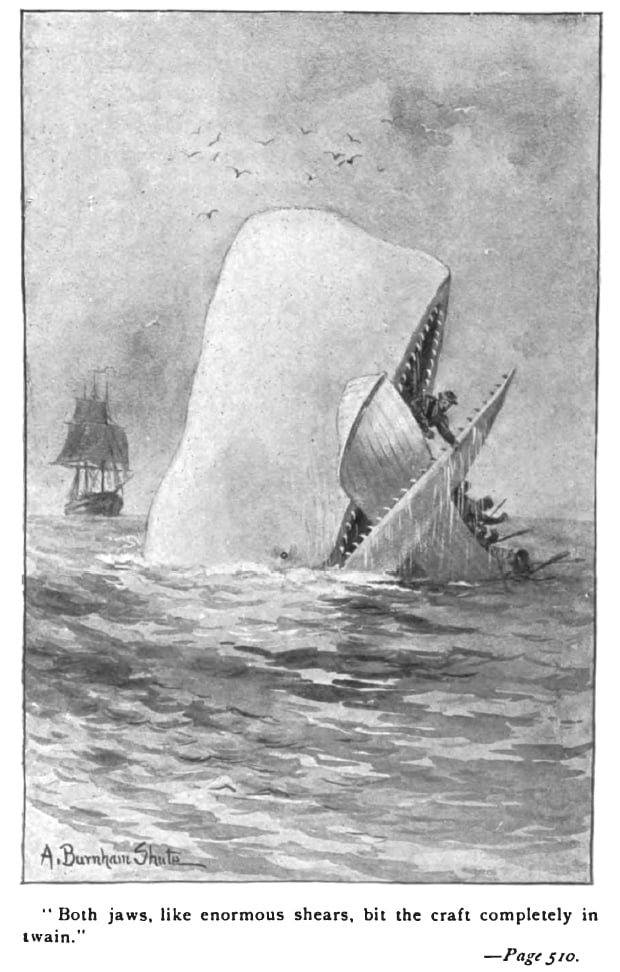 I’ve been joking with friends recently that I’m hunting a white whale. My whale though is an enormous scroll of paper that may or may not have survived to today. If it has, it would be nearly two hundred years old, yellowed, and likely beginning to fall apart. I first became aware of this document when reading the rough journal of the congressional clerk for the House of Representatives. A brief note mentioned that John Quincy Adams introduced a petition in support of the Cherokee from the Citizens of New York City, and that it was forty-seven yards long. This excited me in way you may only understand if you’ve spent time in an archive. I immediately decided to cross check this with John Quincy Adams’s diaries, which are legendarily detailed and entirely digitized. In Adams’s diary, I found this from an entry dated March 4, 1832—just a day before he introduced the petition in the House.
“I received by the Mail several Letters, and with one of them a Memorial signed by several thousand persons upon the existing relations between the United States and the Cherokee Tribe of Indians, and the imprisonment of the Missionaries. The Memorial was the result of a very numerous Meeting at New-York, and a Letter from a Committee of the Signers requested me to present and support it — Blunt wrote to me some days since…”[1]
A second reference in a trusted source was enough to convince me that this document existed at some point. I remain uncertain if it has survived but exploring it theoretically here will allow me to explain a bit more about the work I am doing around related petitions for my dissertation. If you’ve followed my writings here, you’ll know that this was not an isolated petition, nor is the date it appeared unremarkable. Beginning as early as 1829, before the election of Andrew Jackson to the presidency, Evangelical and Quaker organizations were petitioning Congress on behalf of the Cherokee Nation. I’ve read through and am in the process of digitizing hundreds (if not thousands) of these petitions. For the purposes of this article though, I’ll be working with nineteen petitions that I’ve picked essentially at random from the dataset. Here I want to explore the arguments used by these petitions and the beginnings of an argument about kinship and community within them. Many of the petitions were created following a prompt from Jeremiah Evarts, correspondence secretary of the ABCFM. These petitions (including five of the nineteen examined here) all began with these words: “your memorialists feel constrained to come before the National Legislature, with an earnest request that the publick faith may be preserved inviolate, in all the transactions of the Government with the Indians.”[2]
Arguments
Arguments within these petitions fall into a few buckets with many petitions layering several different moves for rhetorical power. Legal/constitutional, civic, theological, and civilizational progress are all registers of argument used to argue that Indian rights and particularly the rights of the Cherokee nation must be respected by the United States. I could easily expand these categories (in fact, I think there are closer to seven) and give more examples beyond those I will here, but again, this is a first foray into the petitions and only a few initial observations. As I delve further into them, I will return both in my dissertation and here to explain what I am learning.
Legal arguments on behalf of the Indians are most often framed in terms of both treaty law and natural law. Take for example a petition from the citizens of Canton, CT. They wrote “the Indians have an indisputable title to their territory your memorialists believe cannot be questioned, since it has been distinctly recognized by our government in all their negotiations with them.”[3] The inhabitants of Aurora, OH were among the most intellectually sophisticated and radical of the memorialists, writing
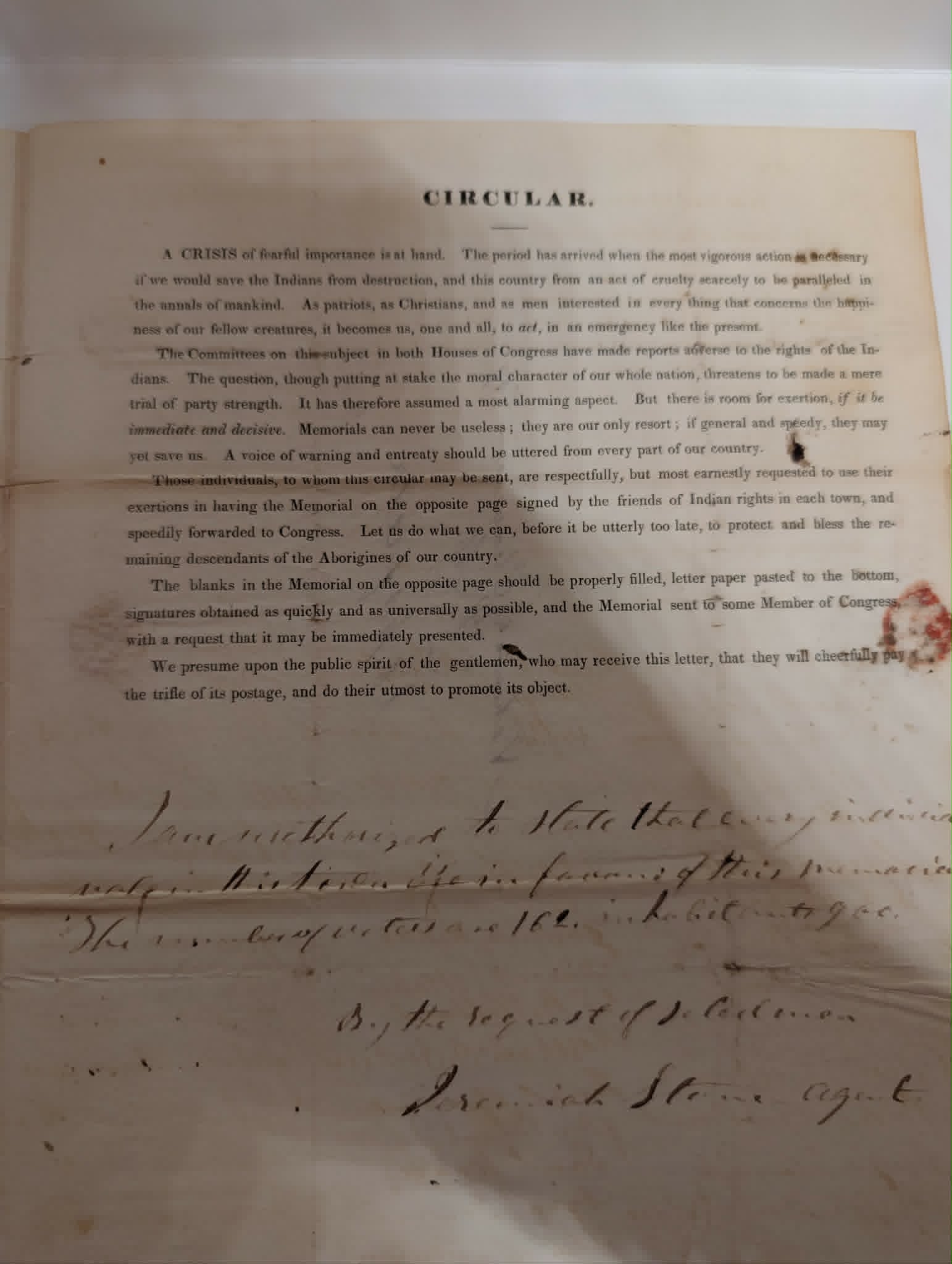
A circular from the ABCFM soliciting petitions and offering a form to work from. Almost certain authored by Jeremiah Evarts
“1st That these several tribes are sovereign and independent nations. 2d That the State of Georgia has no right to extend her jurisdiction over the Indians residing within the chartered limits of that State 3d That consequently the laws of the State of Georgia in reference to the Indians are unconstitutional and void 4th That as the Indians hold their lands both by occupancy and inheritance, for no prior right or claim can be produced and consequently are the rightful owners of the soil and cannot be disinherited or denationalized unless it be through the abuse of power 5th That the general government has power to protect and therefore should protect the Indians from all oppression.[4]
It is worth noting that Aurora is part of the Western Reserve, lands whose earliest white inhabitants were New Englanders from Connecticut. The Aurora memorial’s numbered-proposition format is rhetorically singular in the corpus — it articulates as a citizen petition the legal-philosophical structure that John Marshall would later formalize in Worcester v. Georgia (March 1832). The fact that an Ohio Western Reserve town deploys this argument in citizen-petition form before the Marshall opinion is independent evidence of how rapidly the legal vocabulary of Indigenous sovereignty had become a working language of evangelical-(post-Federalist) Whig political mobilization. Similarly, Newport, RI directly quoted John Marshall, explaining that the Indians “in the language of the Chief Justice [they] have a ‘legal & just Claim’ independently of any guarantee from the United States.”[5]
Theological arguments were often framed as guiding the nation to avoid judgement from the heavens. Durham, NH spoke of “the fearful judgments of Heaven which we may expect” while another town in New York wrote that they were provoked to write by “the apprehension of the Divine displeasure, which will not fail to punish a Nation that, unmindful of its engagements…”[6] In these nineteen petitions, I only find two scriptures quoted, and they both come in edge cases. The golden rule is quoted in a women’s petition from Farmington, ME: “the moral obligation we are under to ‘do unto others as we would that they should do unto us’”[7] Two different Quaker petitions from the Ohio and Philadelphia yearly meetings quote Job 29:13 invoking on behalf of Congress that “the blessing of them that are ready to perish may come upon you.”[8] The same biblical citation closing both Yearly Meeting memorials, drafted one day apart in locations 500 miles distant, is striking and perhaps evidence of denominational coordination through the Orthodox Friends’ Meeting for Sufferings correspondence.
The argument cluster I am referring to as “civic” refers to petitions which appeal to the national honor and its reputation amongst other nations. The Ohio Quakers describe “the crime and the indelible disgrace of having exterminated a whole race of people.”[9] A petition from Abington, PA described the duties of the United States as a Christian nation: “not only justice and good faith demand of a Christian Nation the fulfilment of all its contracts, but that a powerful and generous people must feel, if possible, a still stronger obligation to regard with the most scrupulous fidelity, all its engagements with a poor, weak, and, on their part, faithful and confiding community.”[10] While Newport, NH emphasized that the Cherokee were allies, “the offence is committed against weak and defenceless allies, in whom no offence is found, or even suspected.”[11] The asymmetry-of-power argument—that the United States’s strength compounds rather than mitigates its obligations—appears in both major printed circulars. It also follows an argument made by Evarts in his essays defending Indian Rights. Here he had directly addressed the nation, asking “How shall we as a great, powerful, intelligent, and prosperous people discharge towards their comparatively small communities, the duties which we owe them?”[12]
A particular move credited primarily to Quakers, who deploy direct experiential authority: “as a religious Society, we have long been engaged in the work of Indian civilization; nor is this the first time that we have petitioned Congress in their favour” “have moreover, at the suggestion and by the assistance of the Federal Government, relinquished the pursuits of savage life, and become, to a great extent, civilized artisans and cultivators of the soil”[13] The “civilization” register is double-edged—it obviously operates within an assimilationist frame (“relinquished the pursuits of savage life”) even as it argues against dispossession. It is also an evidentiary move: by establishing that Indigenous peoples have done what the United States asked them to do (adopted agriculture, governance, Christianity), the petitions render the Removal proposal as breach of contract by the United States, not refusal-to-civilize by Indigenous nations.
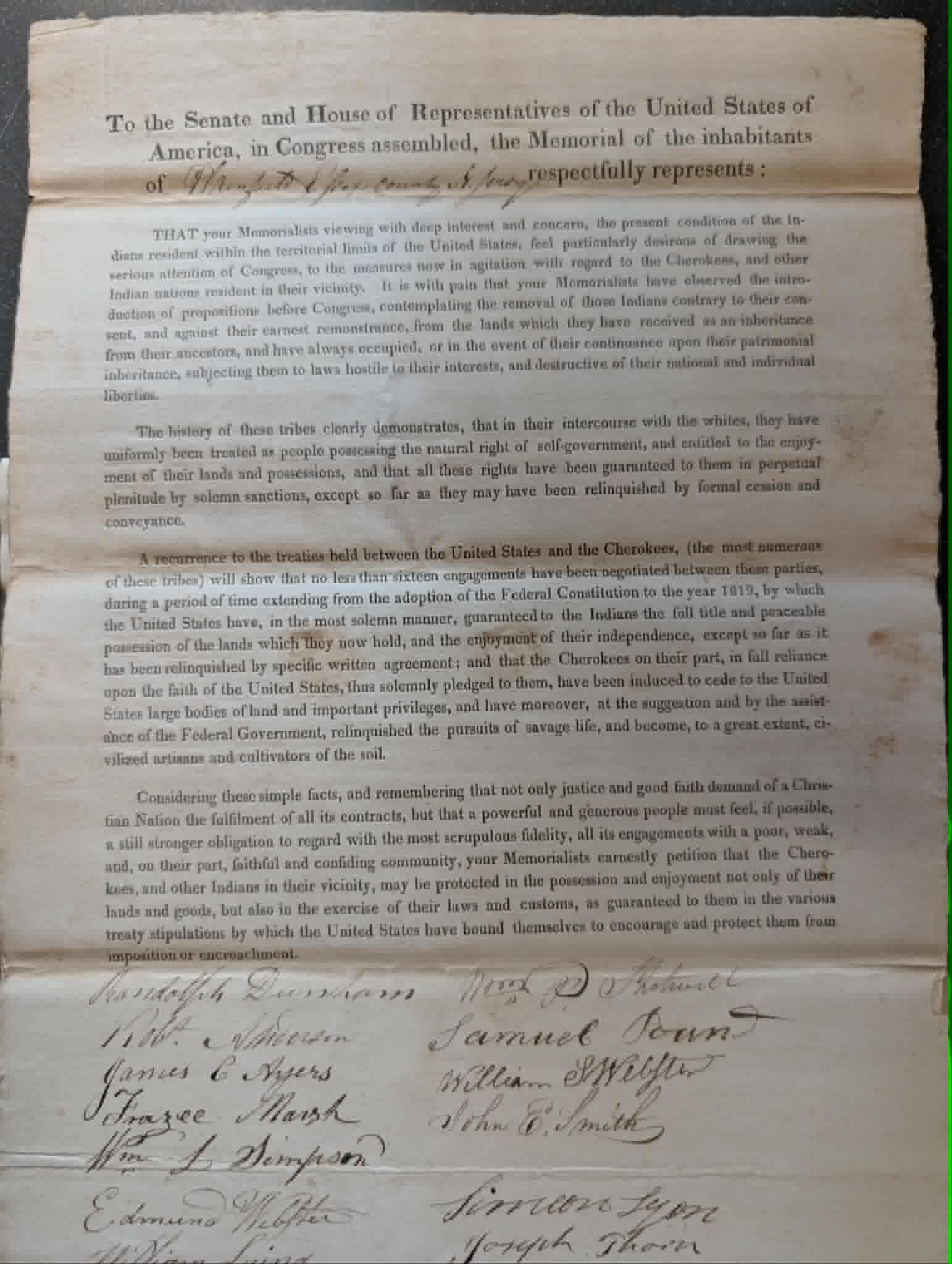
A printed petition from the period following the ABCFM form.
Prosopography
These petitions aren’t a mere count of consciences but a map of a network. I realize it’s easy to get lost here in jargon between Newport NH and RI and between Plymouth and Plympton, but hang with me. Kinship clusters—the brothers, the in-laws, the father-and-son signatures—make the household visible as the unit of mobilization. That’s evangelical politics in 1830: not individuals choosing positions but families enacting them, through the meetinghouse, the voluntary society, the religious press. In many of these petitions, we find clusters of between three and eight members of the same family signing the petitions back-to-back. Lexington, NY has the highest kin density in the entire dataset, seventy-five percent. Seven Pecks on one 53-signer petition is the most concentrated single-surname showing in this sample of petitions. Add to that five Johnsons, three each of Baldwin/Beach/Pond/Wolcott, then a long tail of pairs. Lexington is a Catskill backcountry town in Greene County.
Kingston and Plympton Massachusetts are helpful for seeing these kin networks play out. The closing of the Kingston petition is a detail to mark. Positions #98 and #99—the last two signatures on the entire 99-signer document—are Stephen Bradford and Stephen Bradford 2d. A father-son pair, both bearing the name of the Plymouth Colony governor, closing out a petition signed by 99 Plymouth-descended men against the dispossession of Indigenous nations. The Plympton kin clusters confirm the Plymouth-Colony-genealogical-royalty pattern. Six Bradfords, five Bryants, five Wrights, plus the long tail of three-counts (Ellis, Lobdell, Loring, Parker, Perkins, Sampson) and pairs (Bosworth, Churchill, Holmes, Sherman, Thomas). Three consecutive runs are particularly telling: Signatures #55-57 (run of 3): Samuel Bryant → Zenas Bryant → Zenas Bryant 2d —almost certainly a three-generation family group signing in immediate sequence, the closest thing yet to a household-line mobilization made visible in the data. Signatures #58-59 (run of 2): Ebenezer Lobdell → Charles H. Lobdell — likely father and son closing the petition, the same “kin-pair finale” pattern Kingston (Bradford → Bradford 2d at #98-99) and Newport NH (Wilcox → Wilcox at #101-102) showed #51-52 (run of 2): Bela Bosworth → Henry E. Bosworth—likely brothers.
This suggests the petitions were passed around in particular churches or community meetings in which extended families sat together. I hope to prove or disprove this argument over the summer through examining church membership records for relevant denominations in the towns petitions originated from.
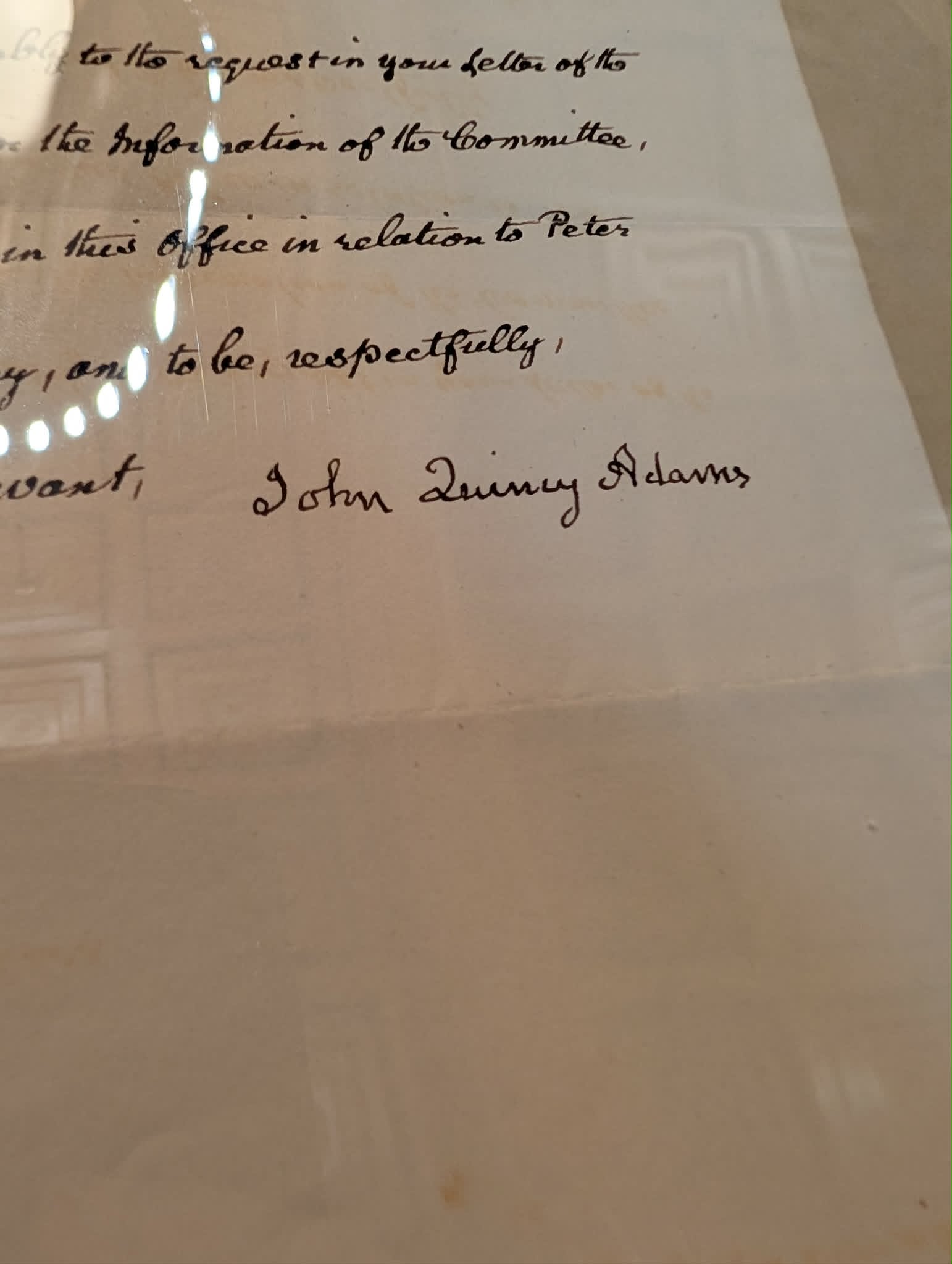
John Quincy Adams’s signature on a report regarding the Cherokee from his presidency.
Conclusion
As a friend opined to me recently, to be an activist in any time is to be strangely obsessed in ways obscure to your contemporaries. All of this brings us back to the former president in the House of Representatives. Even John Quincy Adams looked at those defending Indian rights a bit askance. This was not yet the Quincy Adams who would defend the Amistad prisoners or radically fight against slavery, claiming he would spend the blood of a million white men to end it. In 1832, he was a defeated, single-term president and newly elected congressman, still finding his feet. Indeed, while those defending Indian rights were all in ecstasy in early March, 1832—Adams already saw defeat on the horizon. On Friday March 3, the Worcester decision had been decided by the Supreme Court—deciding finally that Georgia could not extend her laws over the Cherokee. Despite this, that Sunday morning, Adams was not optimistic. Continuing from the earlier quote of his diary, he writes
Blunt wrote to me some days since, and mentioned that this Memorial would be sent to me, and I had intended to answer him, declining to present it— But his Letter had escaped from my memory, and remained unanswered— I now concluded, though after much hesitation to present it to-morrow Morning, well assured that it will be of no avail, but willing to perform to the utmost of my power, my duty.[14]
I still don’t know where my white whale is. The more I think about it though, the disappearance feels sadly appropriate, even painful. The largest evangelical political mobilization of the early republic produced a forty-seven-yard scroll, perhaps the crowning achievement of the coalition fighting for Indian rights, that has been lost in the waves of history. But like Adams, I hope my duty and power may be enough to keep looking.
[1] https://www.primarysourcecoop.org/publications/jqa/document/jqadiaries-v38-1832-03-p389–entry4?navmode=searchresults&doci=114&ss=Cherokee
[2] Evarts circular form, found in: Francestown, NH (1830); Kingston, MA (Feb 1831); Newport, RI (Jan 1831); Sheffield, MA (1831)
[3] Canton, CT (Jan 25, 1829 or 1830 — date pending verification)
[4] Aurora, Portage County, OH –date pending
[5] Newport, RI (Jan 1831)
[6] Durham, NH (Feb 23, 1831), handwritten memorial Lexington, NY—date uncertain.
[7] Farmington, ME women (Jan 6, 1830)
[8] Ohio Yearly Meeting (Jan 21, 1830); Philadelphia Yearly Meeting (Jan 22, 1830)
[9] Ohio Yearly Meeting (Jan 21, 1830)
[10] Abington, PA printed circular (Jan 26, 1830 et al.)
[11] Newport, NH printed circular (Feb 23, 1831)
[12] Andrew III, John A. 1992. From Revival to Removal: Jeremiah Evarts, the Cherokee Nation, and the Search for the Soul of America. Athens: The University of Georgia Press. p 209
[13] Ohio Yearly Meeting (Jan 21, 1830), Abington, PA printed circular (Jan 26, 1830 et al.)
[14] https://www.primarysourcecoop.org/publications/jqa/document/jqadiaries-v38-1832-03-p389–entry4?navmode=searchresults&doci=114&ss=Cherokee
Previous Post
May 11, 2026
Protestant-Catholic Reconciliation in Europe?
Next Post

May 13, 2026 Has-been (You're only as hot as your last hit, baby)
Recent Comments
"The Scottish author George MacDonald integrated fairy world into his fiction in a way that ..."
Fairies, Witches, Folk Horror, and the ..."
"I like the idea that we can have different streams. The coffee analogy is genius."
How Do You Take Your Evangelicalism?
"Geography lesson: Southern California is actually in North Texas. I've lived her for 40 years, ..."
How Do You Take Your Evangelicalism?
"So much Rush love going on in the 90s and Obama Antichrist in the 00s. ..."
A Casserole is Not a Counterpoint
Browse Our Archives
Select a Category abolitionism Abortion Abraham Joshua Heschel Abraham Kuyper Abraham Lincoln Academia Activism Adam Renberg Advent Adventist africa African American Religion Agnes Howard Albert Camus American History American Religious History American Revolution American West Anabaptists Ancient History Andrea Turpin Andrei Tarkovsky Anglicanism Annales Ansley Lillian Quiros anti-Catholicism Antisemitism Anxious Bench apologetics Apparitions Arash Azizi Archaeology archives art Artificial Intelligence Asia Asian Americans Augustine Authors Bad Bunny Baptism Baptists Barack Obama Battle of Hastings Benjamin Franklin Bernard-Henri Levy Beth Allison Barr Beth Moore Bethany Mannon Bible Bill Cunningham Billy Graham Black Music Bob Dylan Body Boenhoffer Books Breastfeeding Bruce Springsteen C.S. Lewis Calvinism Cancel Culture Capitalism Carmelites Catholicism Cedric Robinson Cesar Chavez Charismaticism charity Charles Dickens Charles Lindbergh Che Guevara Chicago Children Chinese Christianity Chris Gehrz Christ Christian death Christian Higher Education Christian life Christian Nation Christian Nationalism Christianity Today Christmas Church life Church Practice cinema Civil Religion Civil Rights Movement Civil War civility Classics Climate Change Cold War Colonial Mexico colonialism Comer Communism community complementarianism Conference on Faith and History Congregationalism Conspiracies Conspiracy Conversion Narratives Coronavirus Costa Rica Council of Nicaea Covid-19 Creation Critical Race Theory Crusades Culture culture wars Daniel K. Williams David Barton David Swartz Death Ways death with dignity DEI democracy Democratic Party Devotion Digital Age Diplomacy discipleship diversity Donald Trump Drama Dua Lipa Early Church early modern Early modern Catholicism Easter Eastern Christianity economic exploitation Education elections Elie Wiesel Elizabeth II Elizabeth Taylor emotions Empire Engineering England enslavement Entertainment Episcopal Church Erica Ramirez eschatology Eurocentrism Evangelicalism Evangelicals Exegesis Family Feminism Film Flannery O'Connor folk music Food Foreign Policy founding fathers Franciscans Franciscus Junius fundamentalism Funerals G.K. Chesterton Gender Genocide genre geography George W. Bush George Washington George Whitefield Global Christianity Global church Grief Guadalupe Guest Post guest post gun control gun violence Gustavo Gutierrez Hamid Dabashi Harold John Ockenga Harvest Hate Hawaiian Christianity Healing health care Heather Cox Richardson Hell Heresy Hermeneutics Higher Education Hinduism Hippocratic oath Historical Fiction Historical Methodology Historical Profession Historical Profession Historical Theology Historical Thinking historiography Holidays Holocaust horror movies Human rights Humanitarian Work humanities Hummingbirds Hungary hymns Imago Dei Immigration Injustice Interviews Iran Islam Islamophobia Israel Ivan's Childhood Jacob Randolph James Bratt Janine Giordano Drake Japanese history Japanese Literature Jean Paul Sartre Jesse Miranda Jesus Jesus Christ Jimmy Carter Joan Baez Joan Didion Joanne Freeman João B. Chaves Joao Chaves Joey Cochran John Calvin John Fea John Tillotson John Turner Johnny Cash Jonathan Edwards Jonathan Tran Joseph Smith Josh Howerton Journalism Jr. Judaism Jürgen Moltmann Just War Justice Justin Brierley Karl Barth Katelyn Beaty koi ponds Kris Kristofferson Kristin Kobes Du Mez Latin American Religious History Latino Americans Lectio Divina Leisure Lent Leonard Cohen liberal arts liberalism Liberation Theology Linda Ronstadt Lisa Clark Diller Literature Lou Reed Lynchings Lynneth Miller Renberg Mainline Protestantism Malcolm Foley Marilyn Monroe Maritime history Mark Noll Marriage Martin Luther Martin Luther King Martyrdom Marxism Mary Masih Alinejad mass shootings material culture medieval Christianity Medieval Ethiopia Melissa Borja memory Mennonites Mental Health Mental Illness Methodism Mexican Americans Mexicans Mike Madrid Miles Mullin Min Jin Lee Miscarriage Missionaries Mister Rogers Mitt Romney modernity Monasticism Mormonism Motherhood Mothers of the Church Moving Music Musicals Nadya Williams Nahua Christianity Native Americans Natsume Sōseki New Contributor New England New Year New York Nico Non-Violent Protest Orthodoxy pacifism Paleo Evangelicals Palestinians Parenting Patti Smith Paul Kingsnorth Pedro Calderón de la Barca Pentecostalism Philip Jenkins Phillis Wheatley physician-assisted suicide pilgrimage Pilgrims pluralism Plutocracy Poetry Politics Pope Francis Pope Leo XIV post-modernism prayer preaching Presbyterians prosperity gospel Protest Public history Publishing Puritans purity culture Quakers race Race Massacres Racial Capitalism racial reconciliation racialization Racism Raha Bahloulipour Re-Enchantment reading Reformation Refugees religion and the university religion and war Religious Freedom Religious Nones Religious Pluralism Religious Symbols religious violence Republican Party Revival Rita Coolidge Ritual Roger Williams Roman Catholic church Royalty Russell Moore same-sex marriage Sarah Irving-Stonebraker Scandinavia Science Science and Technology Scopes trial Scriptural Interpretation secularism Selena Quintanilla seminary Seventh-Day Adventists sexual morality Sexuality Sikhs Silence slaveholders theology Slavery Slavoj Zizek social justice Social Media Southern Baptist Convention Southern Religion Spain Spiritual Autobiography Spiritual but not religious Spiritual Discipline Sports Stanley Hauerwas Suffering Summer Camps Sunday Night Odds and Ends Supernatural Supreme Court Syriac Christianity Tal Howard Taylor Swift Teaching Technology Television Thanksgiving The Beatles The Mission theater TheoBros Theology Thomas Dixon Thomas Jefferson Thomas Kidd Thomas Merton Tim Gloege Tim Walz Tom Holland Tourism tradition Tragedy Translation Transnationalism Travel Trump Ukraine Uncategorized Unitarians United Methodist Church US History Vanessa Chan Velvet Underground Verónica A. Gutiérrez Veronica Gutierrez Vikings Violence Virgin Mary Virtue Virtue ethics Visions Voting War WCTU Wendell Berry Westminster Assembly White Evangelicalism Wildfires Winnie the Pooh Witches women Women in Ministry Women's and Gender Studies Work Worship writing Yasunari Kawabata Zena Hitz
Select a Month October 2026 September 2026 August 2026 July 2026 June 2026 May 2026 April 2026 March 2026 February 2026 January 2026 December 2025 November 2025 October 2025 September 2025 August 2025 July 2025 June 2025 May 2025 April 2025 March 2025 February 2025 January 2025 December 2024 November 2024 October 2024 September 2024 August 2024 July 2024 June 2024 May 2024 April 2024 March 2024 February 2024 January 2024 December 2023 November 2023 October 2023 September 2023 August 2023 July 2023 June 2023 May 2023 April 2023 March 2023 February 2023 January 2023 December 2022 November 2022 October 2022 September 2022 August 2022 July 2022 June 2022 May 2022 April 2022 March 2022 February 2022 January 2022 December 2021 November 2021 October 2021 September 2021 August 2021 July 2021 June 2021 May 2021 April 2021 March 2021 February 2021 January 2021 December 2020 November 2020 October 2020 September 2020 August 2020 July 2020 June 2020 May 2020 April 2020 March 2020 February 2020 January 2020 December 2019 November 2019 October 2019 September 2019 August 2019 July 2019 June 2019 May 2019 April 2019 March 2019 February 2019 January 2019 December 2018 November 2018 October 2018 September 2018 August 2018 July 2018 June 2018 May 2018 April 2018 March 2018 February 2018 January 2018 December 2017 November 2017 October 2017 September 2017 August 2017 July 2017 June 2017 May 2017 April 2017 March 2017 February 2017 January 2017 December 2016 November 2016 October 2016 September 2016 August 2016 July 2016 June 2016 May 2016 April 2016 March 2016 February 2016 January 2016 December 2015 November 2015 October 2015 September 2015 August 2015 July 2015 June 2015 May 2015 April 2015 March 2015 February 2015 January 2015 December 2014 November 2014 October 2014 September 2014 August 2014 July 2014 June 2014 May 2014 April 2014 March 2014 February 2014 January 2014 December 2013 November 2013 October 2013 September 2013 August 2013 July 2013 June 2013 May 2013 April 2013 March 2013 February 2013 January 2013 December 2012 November 2012 October 2012 September 2012 August 2012 July 2012 June 2012 May 2012
Follow Us!
TAKE THE
Religious Wisdom Quiz
What does Jesus teach about forgiving others?
Select your answer to see how you score.
Forgive seventy times seven Only forgive friends Once is enough Never forgive
Related posts from Anxious Bench
Origen, Eustathius, and the Witch of Endor

Angelina Grimké's Forgotten Turn to Apocalyptic Faith

What to the Black Christian Historian is America's...
Candles in the Darkness: Ephrem on the Incarnation
TRENDING AT PATHEOS Evangelical

In "Irreplaceable," our book on vocation and technology, Trevor Sutton and I...

I was strolling through the top floor of the brand new Parthenon...

What Does Gêvâh Mean For Kimberley Guifoyle &...
This week, a lot of the news is focused on Kimberly Guilfoyle....

INNER CIRCLE: Profound Mystery (Of Christ In All...
Ephesians 5:31-32 “For this reason, a man will leave his father and...

Do Not Rejoice When Your Enemy Falls: The...
Turning an execution into a public spectacle is a disturbing expression of...

'The Chosen' S6 Trailer: The Passion Gets Very...
Not many watching 'The Chosen' worry about spoilers, but just because they...
view all Evangelical blogs
What Are Your Thoughts?leave a comment
Ad-Free & Subscriber Log-In Subscription Support
- About Us
- 2026 Calendar
- Videos
- Podcasts
- Library of World Religions
- Faith In Media Tracker
- Advertise With Us
- Write for Us
- Privacy Policy
- Terms of Service
- Do Not Sell My Data
- Contact Us
- Radiant Digital
- Manage Newsletter Subscriptions
- Unsubscribe From Notifications
- Sitemap
Copyright 2008-2026, Patheos. All rights reserved.
Subscription Support Ad-Free & Subscriber Log-In
Follow Patheos