
BuddhistCatholicContemplativeEvangelicalGeneral ChristianHinduJewishLatter-day SaintMuslimNew VisionsProgressive Christian
Beliefs
- Buddhist
- Catholic
- Contemplative
- Evangelical
- General Christian
- Hindu
- Jewish
- Latter-day Saint
- More Voices
- Muslim
- New Visions
- Pagan
- Progressive Christian
Topics
- Religion News
- Food and Religion
- Sports and Religion
- Religious Art
- Religious Music and Entertainment
- Religious Events
- History and Religion
- Style and Religion
- Politics and Religion
- Women in Religion
- Recreation Outdoors and Religion
- Business Finance and Religion
- Careers Workplace and Religion
- Education and Religion
- Family Parenting and Religion
- Health Fitness and Religion
- Home and Religion
- Relationships and Religion
- Technology and Religion
- Travel and Religion
Columnists
- Buddhist Columnists
- Business Finance and Religion Columnists
- Careers Workplace and Religion Columnists
- Catholic Columnists
- Contemplative Columnists
- Education and Religion Columnists
- Evangelists Columnists
- Family Parenting and Religion Columnists
- General Christian Columnists
- Health Fitness and Religion Columnists
- Hindu Columnists
- History and Religion Columnists
- Home and Religion Columnists
- Jewish Columnists
- More Voices Columnists
- Latter Day Columnists
- Muslim Columnists
- New Visions Columnists
- Nonreligious Columnists
- Pagan Columnists
- Politics and Religion Columnists
- Progressive Columnists
- Recreation Outdoors and Religion Columnists
- Relationships and Religion Columnists
- Religion News Columnists
- Religious Art Columnists
- Religious Events Columnists
- Religious Music and Entertainment Columnists
- Sports and Religion Columnists
- Style and Religion Columnists
- Technology and Religion Columnists
- Travel and Religion Columnists
- Women in Religion Columnists
Resource Library
- 2026 Calendar
- Library of World Religions
- The 100 Most Holy Places on Earth
- Patheos Answers
- Podcasts
- Videos
- Faith Leaders Database
- Anglican Episcopalian
- Bahai
- Baptist
- Buddhism
- Christianity
- Confucianism
- Eastern Orthodoxy
- Hinduism
- Holiness and Pentecostal
- ISKCON
- Islam
- Judaism
- Lutheran
- Methodist
- The Church of Jesus Christ of Latter-day Saints
- New Age
- Paganism
- Presbytarian and Reformed
- Protestantism
- Religion Behind the Scenes
- Roman Catholic
- Scientology
- Shia Islam
- Sikhism
- Sufism
- Sunni Islam
- Taoism
- Zen
- See all religions
Research Tools
 Ad-Free & Subscriber Log-In Subscription Support
Ad-Free & Subscriber Log-In Subscription Support
Follow Patheos 

- Trending:
- Forgiveness
- |
- Marriage
- |
- Consciousness
- |
- Death Penalty
- |
- Election
- |
- Halloween

-
About the Authors
- Home
- Evangelical
- History and Religion
- An Epilogue to Our God Is an Awesome Brand
An Epilogue to Our God Is an Awesome Brand
Last updated on: April 27, 2026 at 2:37 pm by Joey Cochran
An Epilogue to Our God Is an Awesome Brand 2026-04-27T14:37:41-04:00 Joey Cochran
Patheos Explore the world's faith through different perspectives on religion and spirituality! Patheos has the views of the prevalent religions and spiritualities of the world.
I turned in my manuscript to Our God Is an Awesome Brand on the twilight of Eastertide earlier this month. When I sent in the manuscript to my editor at Brazos Press, I didn’t include a conclusion outside of the concluding chapter of the book. Since turning in the manuscript, I’ve spent some considerable time thinking about what an epilogue to the book would have looked like.
I’ve tried to demonstrate restraint in providing too many spoilers about the book, over the last couple years that I have been drafting it, in an effort to allow mystery and surprise to drive continued interest in the project. Frankly, I also have restrained from joining in a few recent public conversations about evangelical history because I also didn’t really want to reveal my hand to early and undercut the significance of this project as a contribution to the writing of evangelical history. However, I think now is a good and fitting time to unveil some of this material, even if intentionally obscured enough to not give away too much about it.
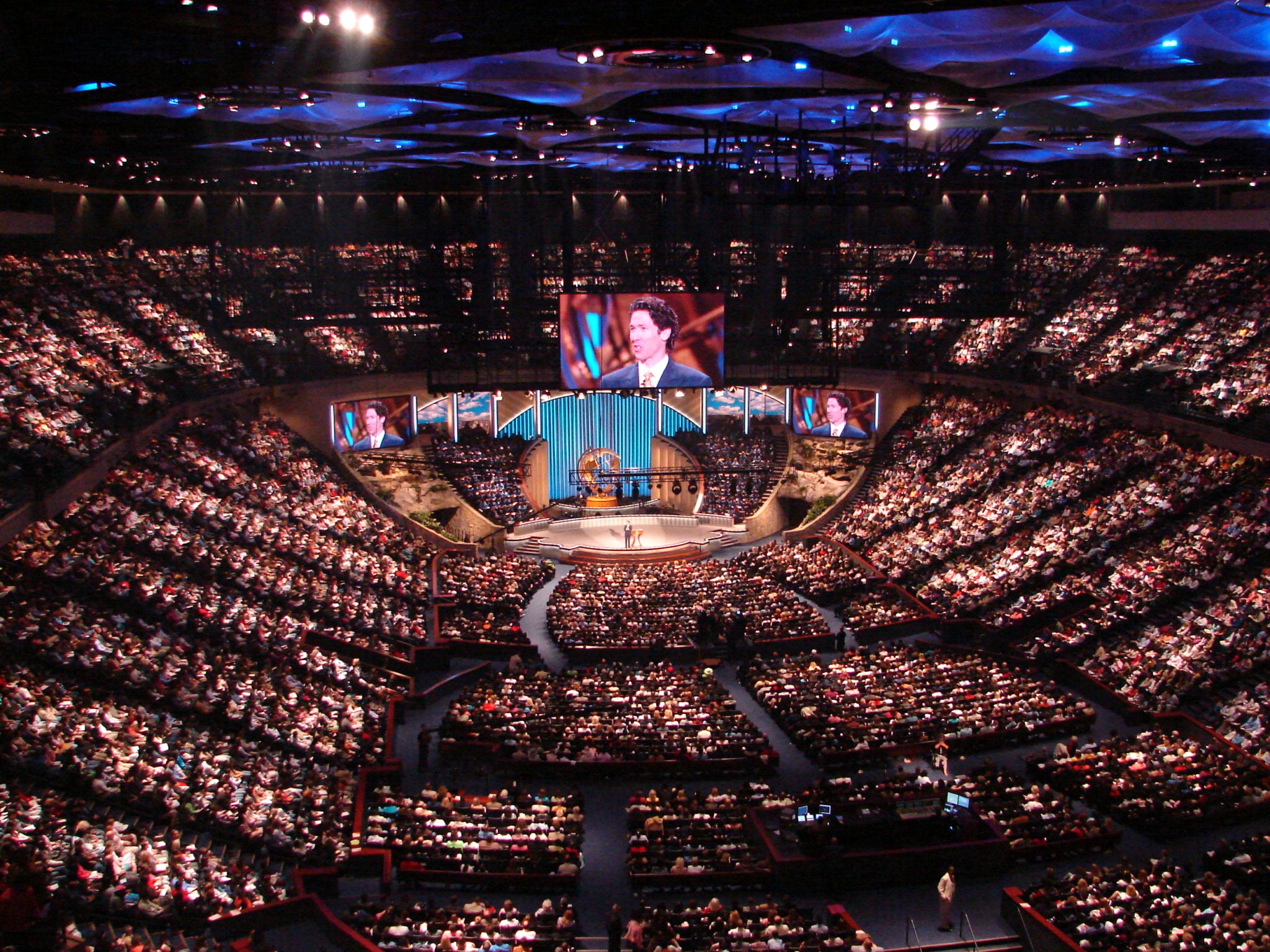
Joel Osteen Arena Preaching
An Epilogue to Our God Is an Awesome Brand
You’re not supposed to save important arguments for after you’ve told the whole story. Usually, you foreground the story in those arguments, just in case you lost people along the way. I chose not to do this because I wanted my arguments to emerge inductively out of my research and storytelling. Moreover, I didn’t wish to make claims that historical evidence did not support. Thus, an epilogue proves to be a helpful addition to this book.
On the other hand, an epilogue is also a fitting place to say mea culpa (my bad). I anticipate that Our God Is an Awesome Brand will not meet everyone’s expectations. I know that I did not write the book some readers wanted. Perhaps they will think I pulled my punches or that I punched too hard. Perhaps my coverage did not meet expectations. Perhaps I didn’t talk about the heroes or the villains of some readers’ evangelical stories.
Candidly, writing the exhaustive and definitive historical treatment on evangelicals is as probable as reconciling an optical illusion in a piece of M. E. Escher art. Nonetheless, briefly I will attempt to justify and explain what I intended to accomplish in this book and why I underwent the journey to craft this history.
Many scholars have contributed delicious items for us to taste, to have a more robust flavor profile of who evangelicals are. The skillful and creative scholarship of R. Lawrence Moore, Bethany Moreton, Tim Gloege, Kathryn Lofton, Matt Sutton, Kristin Du Mez, Darren Dochuk, Nicole Kirk, Daniel Vaca, Molly Worthen, Isaac Sharp, Kate Bowler, William Schultz, and Sarah Hammond sat in the background and inspired this project. This book would not have become what it is without having first learned from these scholars. Some of these scholars focused on fundamentalists rather than evangelicals. Others looked at later evangelicals. I hope what I have accomplished is that I have pulled together some of the underlying tasty morsels that these scholars have produced and then set the table for an ongoing feast.
I provided a series of origin stories that demonstrated the function of the liminal second world wartime era in the making of the evangelical brand. Doing so ought to have demonstrated continuity from the fundamentalists to the evangelicals, especially in regards to the militant and political undertones of evangelical culture and how that shaped the brand and its expression. I highlighted the transition from premillennial fundamentalists to reformed evangelicals functioning as caretakers of the brand. I also highlighted the painstaking process of crafting a brand history that reflected the ideal values of a certain sort of evangelicals—white, male, reformed, respectable, middle-class protestants.
The stories I told highlighted this establishment leadership and the ones who exerted an oversized influence over the brand. I especially emphasized their role as spokespersons, institutional organizers and leaders, publicists, and makers of the brand and writers of its history. One might say that this was a self-consciously evangelical whig history for the sake of interrogating the project of evangelical whig history and how it evolved.
Because I foregrounded one particular segment of the brand, I underdelivered on offering the full scope of the evangelical brand. Some of this was intentional. Part of brand segmentation is that there is never an exhaustive list of segments, companies, goods, and services. There are always newcomers who enter into markets. There are new technologies that redefine markets. There are also new markets created to draw in new makers and products. The openness of the market orientation prevents the possibility of providing an exhaustive and definitive statement about the evangelical brand.
Furthermore, at no point did I attempt to define evangelicals or claim that evangelicals can be reduced wholly and exclusively to a market-oriented definition. Evangelicals defy definition. As a social movement and -ism among all the other -isms of the nineteenth century, evangelicals have proven to be nimble. They pivot and evolve from one generation to the next. They have a heritage of being cautious to not allow themselves to be “canceled” or to be on the wrong side of history; nearly to a fault they have been non-committal in respect to certain culture issues, until they have been able to read the winds and forecast the current of culture. Once cultural and political virtues or winners are identified, evangelicals tend to enter the fray late and loud, as if they always had been there. When evangelicals have been on the wrong side of an issue, they later diminish this failing or revise this past to understate their role in it. Bearing these impulses in mind, at any given time in evangelical history and in any given geography where evangelicals have been present, at best we can describe them, as they really lived, in that time and place.
Throughout their history we might be able to identify the following evangelical segments: 1) Reformed, 2) Methodist, 3) Holiness, 4) Premillennial/Fundamentalist, 6) Pentecostal/Charismatic, 7) Mainstream, 8) Anabaptist, 9) Cathlo/Anglo-liturgic, 10) Christian Nationalist. Again, this is in no way an exhaustive list. Nor did I successfully provide a full profile of these segments. Some of these segments were not discussed in this book. Perhaps one day I will do so. These segments fall along continuums that may be described as politically left or right, and they may be pacifist or militarist. Some of these segments span these spectrums and have constituents at various points along that spectrum. Some segments focus on more of an organic and vineyard mindset as opposed to a trellis or factory mindset, of institutional and organizational philosophy and structure. Certain segments may be more inclined to statist rather than anti-statist mindsets.
Evangelical origin stories have been inspired by key figures who felt called to disrupt and challenge the establishment or status quo. Thus, throughout evangelical history, developments in the brand have involved anti-clerical clericalism. Disruptors challenged the establishment clerics and created new pathways for new sorts or styles of clerical leadership. Because disruptors have to create new institutions and structures, they often have a self-conscious obscurantist and anti-intellectual identity, until they may go about the hard work of creating new intellectual institutions that dogmatize and indoctrinate their followers into a new order of being. So, there is also a kind of anti-intellectual intellectualism that exists from generation to generation of evangelicals, which might be demarcated by the birth of new evangelical educational institutions or movements to purge and purify traditional institutions that have become liberal or experienced a perceived spiritual or theological declension. Ultimately, every new development in the evangelical tradition has involved a sort of disestablishment establishmentarianism. The anticlerical disruptors have critiqued establishments and deconstructed them. They are those whose cries have been: “Tear the whole thing down and burn it to the ground.” In their minds a phoenix of genuine evangelical belief will re-emerge from the ashes. From those ashes a new, purer, and better establishment may emerge. These figures go on to creating new structures, organizations, publications, and centers of education to accomplish this mission.
In the writing of the evangelical past, some of the key figures who have disrupted the established order have included men like Philipp Jacob Spener, Count von Zinzendorf, George Whitefield, John Wesley, and Charles Grandison Finney. Again, the former list reflects the default establishment makeup of leadership. Later will come women like Phoebe Palmer and people of color like William J. Seymour, who will oversee major transitions in what it means to be evangelical.
Figures who have helped make and evolve evangelical identity organized meetings and conferences, crafted distinguishing statements of beliefs and practices, birthed societies and organizations, started publishing mills, educational environments, became cutting edge adopters and users of new technologies, or innovators of products and goods for evangelicals. Aimee Semple-McPherson adopted radio ministry as a cutting-edge way to build an audience. C. I. Scofield developed the bible study system credited to his name. Billy Graham filled stadiums as venues for conversion. Ken Taylor developed the New Living Translation. Beth Moore filled stadiums for women to study the bible. SBC pastors started a prayer movement at school flagpoles. Rachel Held Evans leveraged social media and blogging to reach new audiences and get them to think differently about evangelical culture and theology. Charlie Kirk activated young people to be politically motivated, and their MAGA activity became inseparably intertwined and synonymous with evangelical identity. John Mark Comer rebooted interest in ancient practices of spiritual disciplines. I have told some of these stories in this book, but many of them I intentionally left out because others have told these stories or will tell them better than I. The parts of the evangelical brand story that have yet to be told I leave either for another installment to be written by me or for others far better equipped than me to tell those stories.
For those who have not been convinced that other tellings of the evangelical past shed as much if not more light upon the story than what a mere theological account of evangelicals can do, I leave you with a final insight. Fruits reveal roots. If the roots are theological rot, then the cultural fruits will be bad and should be burned up. While this is a profound biblical insight (Mt. 7.16–20), I sourced it more immediately from the pervasive attitude that overtook the American mindset at the dawn of the twentieth century. This American mood eventually propelled the evangelical brand and its makers forward up to the present.
At the turn of the twentieth century, William James, an American intellectual successor to Jonathan Edwards, articulated this insight in the first of his Gifford Lectures given at the University of Edinburgh. We might say that when James accepted the task to safeguard the inner life of the American mind, he borrowed largely from Jonathan Edwards to make a compelling argument, a pragmatic argument, that we would be known by our fruits; in other words, our experiences reveal our identities. James argued:
In the end it had to come to our empiricist criterion: By their fruits ye shall know them, not by their roots. Jonathan Edwards’s Treatise on Religious Affections is an elaborate working out of this thesis. The roots of a man’s virtue are inaccessible to us. No appearances whatever are infallible proofs of grace. Our practice is the only sure evidence, even to ourselves, that we are genuinely Christians.
“In forming a judgment of ourselves now,” Edwards writes, “we should certainly adopt that evidence which our supreme Judge will chiefly make use of when we come to stand before him at the last day.… There is not one grace of the Spirit of God, of the existence of which, in any professor of religion, Christian practice is not the most decisive evidence.… The degree in which our experience is productive of practice shows the degree in which our experience is spiritual and divine.”[1]
James was no evangelical by the standards of the day. In fact, the arguments he made here took his peers entirely by surprise. William James emerged as one of the early spiritual but not really religious, at least in the way we understand religion, figures of his day. He became a bit of a secular mystic. It is difficult to overstate the significance of his contributions to the fields of psychology and philosophy. This notion, that you will know them by their fruits, is possibly his earliest public articulation and commitment to what becomes known as philosophical pragmatism.
Those of us who are part of the inheritance of the American mind intuitively knows this as: if it works and is profitable, it must be true, right, and good. While aspects of this philosophical presupposition prove to be true, perhaps evangelicals uncritically have adopted this mindset to their detriment. You see, when other values intrude into the evangelical system, values that are part of economic and political systems that are not derivatively Christian, then the system itself becomes polluted with impurities. While on the surface the whole pragmatic system appears to thrive, it actually has been defiled and prevented from meeting its intended end.
I have done what I can to tell the story of twentieth-century origins of evangelicals and the worldview that they built. From its origins, there have been non-Christian values that have been integrated into evangelical identity and taken for granted as being distinctly evangelical characteristics. While they may have been distinctly American values, they nevertheless failed to meet the criteria of being genuinely Christian values. Evangelicals have not been able to eradicate these intrusions. Because these values have been fixtures to evangelical identity from its origin, they sometimes are not recognized as idols that have been smuggled into the evangelical temple. I hope I have, in some measure, identified these intrusions and indicated that they, indeed, are not unprecedented. I also hope I have helped you recognize some of the ways in which the evangelical establishment attempted to conceal unseemly aspects of evangelical identity in order to curate its brand image. May this revisionist intervention in evangelical history prove to be of some worth to assist genuine Christians to best move forward and construct a vision of Christianity that reflects the scope of the redemptive story and adopt the image of its main character, Jesus Christ.
[1] William James, The Varieties of Religious Experience: A Study in Human Nature (New York: Longmans, Green, and Co., 1902), 20. See Jonathan Edwards, Religious Affections, WJE, 2:441.
History and Religion
Previous Post
April 24, 2026
Conversion from Below
Next Post
April 30, 2026 7,000 Lines of Homer, and Only One Survived
Recent Comments
Browse Our Archives
Select a Category abolitionism Abortion Abraham Joshua Heschel Abraham Kuyper Abraham Lincoln Academia Activism Adam Renberg Advent Adventist africa African American Religion Agnes Howard Albert Camus American History American Religious History American Revolution American West Anabaptists Ancient History Andrea Turpin Andrei Tarkovsky Anglicanism Annales Ansley Lillian Quiros anti-Catholicism Antisemitism Anxious Bench apologetics Apparitions Arash Azizi Archaeology archives art Artificial Intelligence Asia Asian Americans Augustine Authors Bad Bunny Baptism Baptists Barack Obama Battle of Hastings Benjamin Franklin Bernard-Henri Levy Beth Allison Barr Beth Moore Bethany Mannon Bible Bill Cunningham Billy Graham Black Music Bob Dylan Body Boenhoffer Books Breastfeeding Bruce Springsteen C.S. Lewis Calvinism Cancel Culture Capitalism Carmelites Catholicism Cedric Robinson Cesar Chavez Charismaticism charity Charles Dickens Charles Lindbergh Che Guevara Chicago Children Chinese Christianity Chris Gehrz Christ Christian death Christian Higher Education Christian life Christian Nation Christian Nationalism Christianity Today Christmas Church life Church Practice cinema Civil Religion Civil Rights Movement Civil War civility Classics Climate Change Cold War Colonial Mexico colonialism Comer Communism community complementarianism Conference on Faith and History Congregationalism Conspiracies Conspiracy Conversion Narratives Coronavirus Costa Rica Council of Nicaea Covid-19 Creation Critical Race Theory Crusades Culture culture wars Daniel K. Williams David Barton David Swartz Death Ways death with dignity DEI democracy Democratic Party Devotion Digital Age Diplomacy discipleship diversity Donald Trump Drama Dua Lipa Early Church early modern Early modern Catholicism Easter Eastern Christianity economic exploitation Education elections Elie Wiesel Elizabeth II Elizabeth Taylor emotions Empire Engineering England enslavement Entertainment Episcopal Church Erica Ramirez eschatology Eurocentrism Evangelicalism Evangelicals Exegesis Family Feminism Film Flannery O'Connor folk music Food Foreign Policy founding fathers Franciscans Franciscus Junius fundamentalism Funerals G.K. Chesterton Gender Genocide genre geography George W. Bush George Washington George Whitefield Global Christianity Global church Grief Guadalupe Guest Post guest post gun control gun violence Gustavo Gutierrez Hamid Dabashi Harold John Ockenga Harvest Hate Hawaiian Christianity Healing health care Heather Cox Richardson Hell Heresy Hermeneutics Higher Education Hinduism Hippocratic oath Historical Fiction Historical Methodology Historical Profession Historical Profession Historical Theology Historical Thinking historiography Holidays Holocaust horror movies Human rights Humanitarian Work humanities Hummingbirds Hungary hymns Imago Dei Immigration Injustice Interviews Iran Islam Islamophobia Israel Ivan's Childhood Jacob Randolph James Bratt Janine Giordano Drake Japanese history Japanese Literature Jean Paul Sartre Jesse Miranda Jesus Jesus Christ Jimmy Carter Joan Baez Joan Didion Joanne Freeman João B. Chaves Joao Chaves Joey Cochran John Calvin John Fea John Tillotson John Turner Johnny Cash Jonathan Edwards Jonathan Tran Joseph Smith Josh Howerton Journalism Jr. Judaism Jürgen Moltmann Just War Justice Justin Brierley Karl Barth Katelyn Beaty koi ponds Kris Kristofferson Kristin Kobes Du Mez Latin American Religious History Latino Americans Lectio Divina Leisure Lent Leonard Cohen liberal arts liberalism Liberation Theology Linda Ronstadt Lisa Clark Diller Literature Lou Reed Lynchings Lynneth Miller Renberg Mainline Protestantism Malcolm Foley Marilyn Monroe Maritime history Mark Noll Marriage Martin Luther Martin Luther King Martyrdom Marxism Mary Masih Alinejad mass shootings material culture medieval Christianity Medieval Ethiopia Melissa Borja memory Mennonites Mental Health Mental Illness Methodism Mexican Americans Mexicans Mike Madrid Miles Mullin Min Jin Lee Miscarriage Missionaries Mister Rogers Mitt Romney modernity Monasticism Mormonism Motherhood Mothers of the Church Moving Music Musicals Nadya Williams Nahua Christianity Native Americans Natsume Sōseki New Contributor New England New Year New York Nico Non-Violent Protest Orthodoxy pacifism Paleo Evangelicals Palestinians Parenting Patti Smith Paul Kingsnorth Pedro Calderón de la Barca Pentecostalism Philip Jenkins Phillis Wheatley physician-assisted suicide pilgrimage Pilgrims pluralism Plutocracy Poetry Politics Pope Francis Pope Leo XIV post-modernism prayer preaching Presbyterians prosperity gospel Protest Public history Publishing Puritans purity culture Quakers race Race Massacres Racial Capitalism racial reconciliation racialization Racism Raha Bahloulipour Re-Enchantment reading Reformation Refugees religion and the university religion and war Religious Freedom Religious Nones Religious Pluralism Religious Symbols religious violence Republican Party Revival Rita Coolidge Ritual Roger Williams Roman Catholic church Royalty Russell Moore same-sex marriage Sarah Irving-Stonebraker Scandinavia Science Science and Technology Scopes trial Scriptural Interpretation secularism Selena Quintanilla seminary Seventh-Day Adventists sexual morality Sexuality Sikhs Silence slaveholders theology Slavery Slavoj Zizek social justice Social Media Southern Baptist Convention Southern Religion Spain Spiritual Autobiography Spiritual but not religious Spiritual Discipline Sports Stanley Hauerwas Suffering Summer Camps Sunday Night Odds and Ends Supernatural Supreme Court Syriac Christianity Tal Howard Taylor Swift Teaching Technology Television Thanksgiving The Beatles The Mission theater TheoBros Theology Thomas Dixon Thomas Jefferson Thomas Kidd Thomas Merton Tim Gloege Tim Walz Tom Holland Tourism tradition Tragedy Translation Transnationalism Travel Trump Ukraine Uncategorized Unitarians United Methodist Church US History Vanessa Chan Velvet Underground Verónica A. Gutiérrez Veronica Gutierrez Vikings Violence Virgin Mary Virtue Virtue ethics Visions Voting War WCTU Wendell Berry Westminster Assembly White Evangelicalism Wildfires Winnie the Pooh Witches women Women in Ministry Women's and Gender Studies Work Worship writing Yasunari Kawabata Zena Hitz
Select a Month October 2026 September 2026 August 2026 July 2026 June 2026 May 2026 April 2026 March 2026 February 2026 January 2026 December 2025 November 2025 October 2025 September 2025 August 2025 July 2025 June 2025 May 2025 April 2025 March 2025 February 2025 January 2025 December 2024 November 2024 October 2024 September 2024 August 2024 July 2024 June 2024 May 2024 April 2024 March 2024 February 2024 January 2024 December 2023 November 2023 October 2023 September 2023 August 2023 July 2023 June 2023 May 2023 April 2023 March 2023 February 2023 January 2023 December 2022 November 2022 October 2022 September 2022 August 2022 July 2022 June 2022 May 2022 April 2022 March 2022 February 2022 January 2022 December 2021 November 2021 October 2021 September 2021 August 2021 July 2021 June 2021 May 2021 April 2021 March 2021 February 2021 January 2021 December 2020 November 2020 October 2020 September 2020 August 2020 July 2020 June 2020 May 2020 April 2020 March 2020 February 2020 January 2020 December 2019 November 2019 October 2019 September 2019 August 2019 July 2019 June 2019 May 2019 April 2019 March 2019 February 2019 January 2019 December 2018 November 2018 October 2018 September 2018 August 2018 July 2018 June 2018 May 2018 April 2018 March 2018 February 2018 January 2018 December 2017 November 2017 October 2017 September 2017 August 2017 July 2017 June 2017 May 2017 April 2017 March 2017 February 2017 January 2017 December 2016 November 2016 October 2016 September 2016 August 2016 July 2016 June 2016 May 2016 April 2016 March 2016 February 2016 January 2016 December 2015 November 2015 October 2015 September 2015 August 2015 July 2015 June 2015 May 2015 April 2015 March 2015 February 2015 January 2015 December 2014 November 2014 October 2014 September 2014 August 2014 July 2014 June 2014 May 2014 April 2014 March 2014 February 2014 January 2014 December 2013 November 2013 October 2013 September 2013 August 2013 July 2013 June 2013 May 2013 April 2013 March 2013 February 2013 January 2013 December 2012 November 2012 October 2012 September 2012 August 2012 July 2012 June 2012 May 2012
Follow Us!
TAKE THE
Religious Wisdom Quiz
What Christian group is known for large-scale evangelistic crusades?
Select your answer to see how you score.
Methodists Quakers Evangelicals Orthodox
Related posts from Anxious Bench

What Coffee Reveals About America's Evangelical Varieties

A Casserole is Not a Counterpoint

Whence AI Apostle Ron? A Christian History of...
TRENDING AT PATHEOS Evangelical

Pope Leo Celebrates Mass for Nurses & Docs...
I don't have any idea how he did it, but Pope Leo...

The Sermon on the Mount, Part I: Matthew...
The Sermon on the Mount, Part I (Matthew 4:12-5:12) St. Matthew moves...

What's up from Crossway: Reviewing some of their latest A few weeks...

Janie Learns the Way of the Cross: A...
Teaching children about Jesus' Passion can be challenging. Many parents and educators...

Looking For Good Catholic Writing - October 2026
He alone extends the heavens, and he walks upon the waves of...

In "Irreplaceable," our book on vocation and technology, Trevor Sutton and I...
view all Evangelical blogs
What Are Your Thoughts?leave a comment
Ad-Free & Subscriber Log-In Subscription Support
- About Us
- 2026 Calendar
- Videos
- Podcasts
- Library of World Religions
- Faith In Media Tracker
- Advertise With Us
- Write for Us
- Privacy Policy
- Terms of Service
- Do Not Sell My Data
- Contact Us
- Radiant Digital
- Manage Newsletter Subscriptions
- Unsubscribe From Notifications
- Sitemap
Copyright 2008-2026, Patheos. All rights reserved.
Subscription Support Ad-Free & Subscriber Log-In
Follow Patheos