
BuddhistCatholicContemplativeEvangelicalGeneral ChristianHinduJewishLatter-day SaintMuslimNew VisionsProgressive Christian
Beliefs
- Buddhist
- Catholic
- Contemplative
- Evangelical
- General Christian
- Hindu
- Jewish
- Latter-day Saint
- More Voices
- Muslim
- New Visions
- Pagan
- Progressive Christian
Topics
- Religion News
- Food and Religion
- Sports and Religion
- Religious Art
- Religious Music and Entertainment
- Religious Events
- History and Religion
- Style and Religion
- Politics and Religion
- Women in Religion
- Recreation Outdoors and Religion
- Business Finance and Religion
- Careers Workplace and Religion
- Education and Religion
- Family Parenting and Religion
- Health Fitness and Religion
- Home and Religion
- Relationships and Religion
- Technology and Religion
- Travel and Religion
Columnists
- Buddhist Columnists
- Business Finance and Religion Columnists
- Careers Workplace and Religion Columnists
- Catholic Columnists
- Contemplative Columnists
- Education and Religion Columnists
- Evangelists Columnists
- Family Parenting and Religion Columnists
- General Christian Columnists
- Health Fitness and Religion Columnists
- Hindu Columnists
- History and Religion Columnists
- Home and Religion Columnists
- Jewish Columnists
- More Voices Columnists
- Latter Day Columnists
- Muslim Columnists
- New Visions Columnists
- Nonreligious Columnists
- Pagan Columnists
- Politics and Religion Columnists
- Progressive Columnists
- Recreation Outdoors and Religion Columnists
- Relationships and Religion Columnists
- Religion News Columnists
- Religious Art Columnists
- Religious Events Columnists
- Religious Music and Entertainment Columnists
- Sports and Religion Columnists
- Style and Religion Columnists
- Technology and Religion Columnists
- Travel and Religion Columnists
- Women in Religion Columnists
Resource Library
- 2026 Calendar
- Library of World Religions
- The 100 Most Holy Places on Earth
- Patheos Answers
- Podcasts
- Videos
- Faith Leaders Database
- Anglican Episcopalian
- Bahai
- Baptist
- Buddhism
- Christianity
- Confucianism
- Eastern Orthodoxy
- Hinduism
- Holiness and Pentecostal
- ISKCON
- Islam
- Judaism
- Lutheran
- Methodist
- The Church of Jesus Christ of Latter-day Saints
- New Age
- Paganism
- Presbytarian and Reformed
- Protestantism
- Religion Behind the Scenes
- Roman Catholic
- Scientology
- Shia Islam
- Sikhism
- Sufism
- Sunni Islam
- Taoism
- Zen
- See all religions
Research Tools
 Ad-Free & Subscriber Log-In Subscription Support
Ad-Free & Subscriber Log-In Subscription Support
Follow Patheos 

- Trending:
- Forgiveness
- |
- Marriage
- |
- Consciousness
- |
- Death Penalty
- |
- Election
- |
- Halloween

-
About the Authors
- Home
- Evangelical
- Discovering Christmas in a Classic Episcopal Novel
Discovering Christmas in a Classic Episcopal Novel
Last updated on: December 14, 2025 at 4:57 pm by Philip Jenkins
Discovering Christmas in a Classic Episcopal Novel 2025-12-14T16:57:24-04:00 Philip Jenkins
Patheos Explore the world's faith through different perspectives on religion and spirituality! Patheos has the views of the prevalent religions and spiritualities of the world.
Today’s post concerns a nineteenth century American novel that few non-specialists will have heard of. If it is not great literature, it is a phenomenally useful (and under-used) resource for the country’s religious history in that era, for Protestant denominations in general, but specifically for my own Episcopal Church. More important, discussing it really gets to the question of how we write that history, moving away from the role of great preachers and revivalists to studying the role of ordinary religious experience, of aesthetic and spiritual sensibilities, of lived religion.
The book in question is Poganuc People: Their Loves and Lives, published in 1878 by Harriet Beecher Stowe (1811-1896: hereafter in this post, HBS). I have described it as a classic novel, and I think it deserves that label, but it is also a lost or forgotten classic. How obscure is it these days? It does not even have its own Wikipedia page.
I will focus today on the role of Christmas, which is so absolutely central to the book, and next time I will speak more generally about the religious environment, and the book’s lessons for historians. But my point today is what a wonderful seasonal reading it makes for an Episcopalian, or indeed for anyone who is liturgically-oriented. One long section in particular – quoted below as “The Night Before Christmas” – is very evocative. Just imagine a world that has no idea whatever of Christmas, has really never heard of the idea, and then think of the impact of witnessing all the celebrations and ceremonial on a child’s mind. What could that have been like? It would be life-changing, and indeed might drive a full religious conversion.
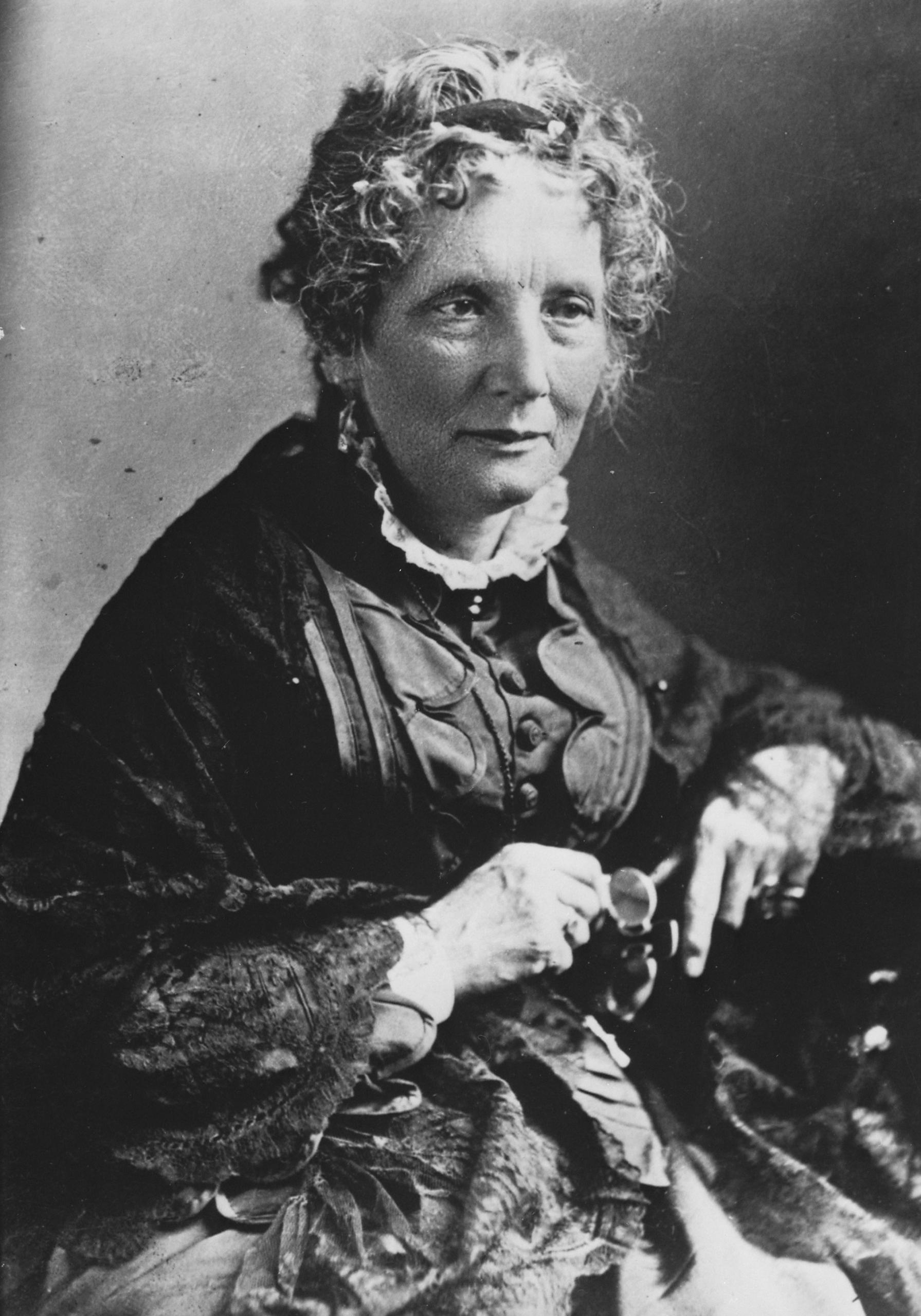
All images are in the public domain
The Early Days of an “Odd Little Girl”
Harriet Beecher Stowe was one of the greatest literary celebrities of her time, whose Uncle Tom’s Cabin (1852) was by far the largest American best-seller of the whole century, but she had some thirty lesser titles to her credit. For present purposes, her family background is critical. Born in Litchfield, Connecticut, she was the daughter of celebrity Congregationalist preacher Lyman Beecher, who served the church in that community from 1810 through 1826. This placed her at the center of a whole clan of hyperactive siblings and relatives who were central to religious life and to reform movements, notably abolitionism. Her husband, Calvin Ellis Stowe, was a prominent Biblical scholar who taught at the nation’s leading seminaries and divinity schools.
Standing as she did at the heart of the Calvinist/Congregationalist elite, it was difficult for HBS to come out of the closet with her true religious identity, which was Episcopalian. In fact, she could not really do this until her father died in 1863, and her husband retired from teaching in 1864. Poganuc People was thus written at a time when she was fully and decisively “out” as an Episcopalian.
If Poganuc People is in no sense an autobiography, the personal element is unavoidable. As she wrote when she was originally planning the project, “It will be my own remembrances of life & times. I have thought of calling it Early Days of an odd little girl— … I have so often made my family laugh over these sketches that they insist that I shall write them.” The book thus tells the story of “Dolly,” a highly intelligent girl who is the daughter of the distinguished Calvinist minister, Parson Cushing, in the small town of Poganuc, which looks uncommonly like Litchfield c.1820. Although we would call his church Congregationalist, the author remarks that this denomination was “as it was then called by the common people, Presbyterianism” which modern readers will find willfully confusing. It is accurate, however, as the two churches at the time operated under a plan of union. (The famous American Board of Commissioners for Foreign Missions (ABCFM), created in 1810, was a joint creation of Congregationalists and Presbyterians). Lyman Beecher himself – the original for Parson Cushing – served both churches during his ministry.

Poganuc People
Like HBS, Dolly is born around 1811, and the book tells her story until her move to Boston as a young woman. Most of the book is a loving recreation of small town New England in that era, roughly the 1820s, focusing on the cycles of the agricultural year, and the town’s festivals and celebrations, above all the Fourth of July. As Edmund Wilson wrote, the book “is full of solidly remembered scenes – of candlemakings, quiltings, and apple bees, chestnuttings and huckleberryings: the whole life of a country parsonage, with the children playing at town meetings or preaching and singing hymns, the minister providing himself with Latin and Greek quotations to be used in next Sunday’s sermon, while his wife packs the doughnuts for a picnic; with the trumpet-blossomed squash vines in the garden, the spinning wheels and corn in the garret, the cider barrels and rats in the cellar.” Although I enjoy the book greatly, I do get seriously irritated by the extensive passages in which HBS tries to record the dialect of her neighbors in some kind of phonetic rendering, which almost requires a translation app in its own right. It gets wearing.
Given her family background, religious themes naturally feature very strongly throughout the book. Parson Cushing is generous and highly educated, and is devoted to promoting his daughter’s education. At the same time, he has no sympathy for some of the foolish ways that are creeping into the once-homogeneous community of faithful Puritan believers. As I will explain next time, these were the years when the Congregationalists were losing their official hold on Connecticut public life.
Moreover, a strange new factor was appearing in the form of a very small and marginal Episcopal presence, which initially was associated with a couple of wealthy families, who build a church. “It was a small, insignificant building compared with the great square three-decker of a meeting-house which occupied conspicuously the green in Poganuc Center.” Even so, that new church gradually draws in several local people who for various reasons are disaffected with the Calvinist establishment. A row with a deacon over a load of potatoes drives one Calvinist believer from his old church to a new Episcopal loyalty. The town thus has both Presbyterians and ‘Piscopals. (Litchfield’s historic Episcopal church traces its post-revolutionary history to a building completed in 1812, which fits the story neatly).

Christmas in Poganuc
The young Dolly herself is increasingly drawn to that upstart church, or more specifically, to one aspect of its life, which is the Christmas celebrations, which are utterly different from anything known elsewhere in the region. For HBS, Christmas is the gateway drug that would one day lead her into full-blown Episcopalianism. The book in fact originated as a short Christmas work, but was nursed into a full-fledged novel to meet the needs of publishers in quest of a more substantial serial.
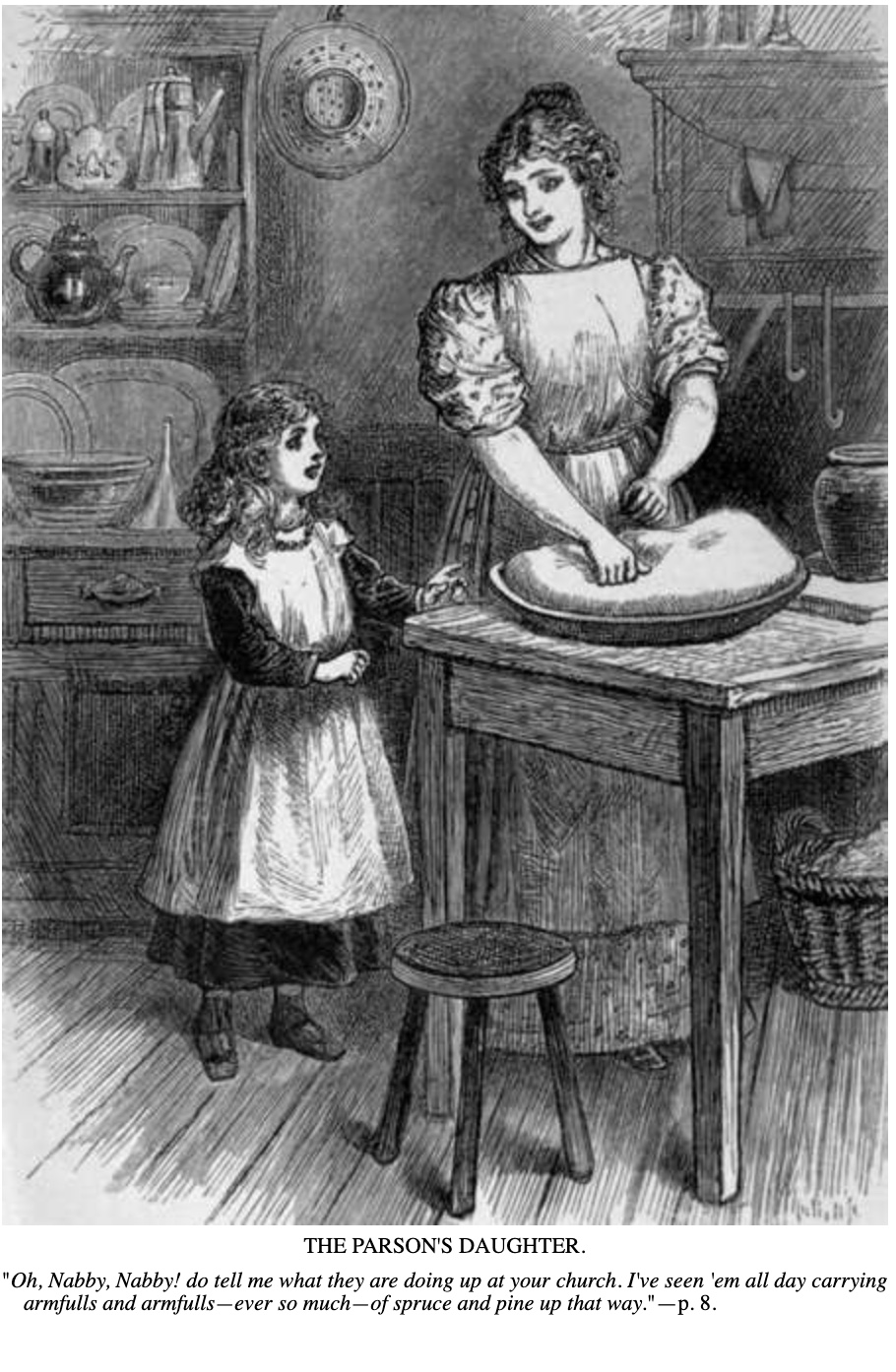
Poganuc People begins with the family servant Nabby Higgins explaining to an intrigued Dolly about the forthcoming events:
“Well, you see,” said Nabby, “to-morrow’s Christmas; and they’ve been dressin’ the church with ground pine and spruce boughs, and made it just as beautiful as can be, and they’re goin’ to have a great gold star over the chancel. General Lewis sent clear to Boston to get the things to make it of, and Miss Ida Lewis she made it; and to-night they’re going to ‘luminate. They put a candle in every single pane of glass in that ‘air church, and it’ll be all just as light as day. When they get ’em all lighted up you can see that ‘air church clear down to North Poganuc.”
Now this sentence was a perfect labyrinth of mystery to Dolly; for she did not know what Christmas was, she did not know what the chancel was, she never saw anything dressed with pine, and she was wholly in the dark what it was all about; and yet her bosom heaved, her breath grew short, her color came and went, and she trembled with excitement. Something bright, beautiful, glorious, must be coming into her life, and oh, if she could only see it!
 HBS describes the church in loving detail:
The little edifice at Poganuc had been trimmed and arranged with taste and skill. For that matter, it would seem as if the wild woods of New England were filled with garlands and decorations already made and only waiting to be used in this graceful service. Under the tall spruces the ground was all ruffled with the pretty wreaths of ground-pine; the arbor vitæ, the spruce, the cedar and juniper, with their balsamic breath, filled the aisles with a spicy fragrance. It was a cheaply built little church, in gothic forms, with pointed windows and an arch over the chancel; and every arch was wreathed with green, and above the chancel glittered a great gold star, manufactured by Miss Ida Lewis out of pasteboard and gilt paper ordered in Boston. It was not gold, but it glittered, and the people that looked on it were not _blasé_, as everybody in our days is, with sight seeing. The innocent rustic life of Poganuc had no pageants, no sights, no shows, except the eternal blazonry of nature; and therefore the people were prepared to be dazzled and delighted with a star cut out of gilt paper. There was bustling activity of boys and men in lighting the windows, and a general rush of the populace to get the best seats.
Dr. Cushing Strikes Back
Living as we do in an age when virtually all churches at least make some nod to Christmas symbolism – to trees and sleighs – it is almost impossible to convey the total ignorance of such things in New England societies of this era, and Dr. Cushing knows scarcely more about the upcoming events than his daughter. For him, a Christmas celebration is not actively Satanic, but it is utterly foolish, and the vestige of silly pagan revelries. As he explains at length to his daughter, we do not even know the date of Christ’s birth, and an extensive study of Patristic literature confirms his theory of the pagan origins of that festivity:
He had heard incidentally that they were dressing the church with pines and going to have a Christmas service, but he only murmured something about tolerabiles ineptiæ [Bearable absurdities] to the officious deacon who had called his attention to the fact. The remark, being in Latin, impressed the Deacon with a sense of profound and hidden wisdom. The people of Poganuc Center paid a man a salary for knowing more than they did, and they liked to have a scrap of Latin now and then to remind them of this fact.
It would be absolutely wrong even to acknowledge December 25 as anything special, and children who fail to attend school on that day are duly punished for their absence. He preaches a brilliant and erudite sermon on the evil foolishness of this Christmas custom, and his hearers urge him to publish it. The sermon has its impact:
Old ladies in their tea-drinkings talked about the danger of making a righteousness of forms and rites and ceremonies, and seemed of opinion that the proceedings at the Episcopal church, however attractive, were only an insidious putting forth of one paw of the Scarlet Beast of Rome, and that if not vigorously opposed the whole quadruped, tooth and claw, would yet be upon their backs.
The real-life Lyman Beecher was a devout anti-Papist, author of a florid Plea For The West (1835) that became holy writ for America’s flourishing anti-Catholic politics.

Personally, however, the Parson is a kind father:
He rose up early, however, and proceeded to buy a sugar dog at the store of Lucius Jenks, and when Dolly came down to breakfast he called her to him and presented it, saying as he kissed her, “Papa gives you this, not because it is Christmas, but because he loves his little Dolly.”
“But _isn’t_ it Christmas?” asked Dolly, with a puzzled air.
“No, child; nobody knows when Christ was born, and there is nothing in the Bible to tell us _when_ to keep Christmas.”
A dutiful daughter, she totally accepts his explanation, along with the chocolate dog. But like many others, she finds herself ever more seduced by what is happening in that Episcopal church, although she cannot explain its deep appeal to her soul. Even in this tiny church, ignored and condemned by her family and friends, she sees something that is quite wonderful, and which speaks to a spirituality that she has never before encountered. It is no longer the religious life that she sees in the Calvinist church, with its exclusive emphasis on the cerebral and intellectual to the denial of the material and sacramental. What she sees in the Christmas celebrations in the small Episcopal church is nothing less than the beauty of holiness, and it supplies memories that will last throughout her life.

The Night Before Christmas
In this short post, I have to resist the temptation to quote extensively, but it is tough because the material is so rich. That Episcopal Christmas occupies the first quarter or so of the book – roughly, the Christmas story that HBS originally contemplated before it expanded. I will ration myself to one favorite passage, when a sleepless Dolly is so obsessed with the illuminated church nearby that she rises from bed to look at it from afar,. She then decides that it would do no harm actually to wander over the short distance and see it.
There it was, to be sure–the little church with its sharp-pointed windows every pane of which was sending streams of light across the glittering snow. There was a crowd around the door, and men and boys looking in at the windows. Dolly’s soul was fired. But the elm-boughs a little obstructed her vision; she thought she would go down and look at it from the yard. So down stairs she ran, but as she opened the door the sound of the chant rolled out into the darkness with a sweet and solemn sound:
“_Glory be to God on high; and on earth peace, good will towards men._”
Dolly’s soul was all aglow–her nerves tingled and vibrated; she thought of the bells ringing in the celestial city; she could no longer contain herself, but faster and faster the little hooded form scudded across the snowy plain and pushed in among the dark cluster of spectators at the door. All made way for the child, and in a moment, whether in the body or out she could not tell, Dolly was sitting in a little nook under a bower of spruce, gazing at the star and listening to the voices:
“_We praise Thee, we bless Thee, we worship Thee, we glorify Thee, we give thanks to thee for thy great glory, O Lord God, Heavenly King, God, the Father Almighty._”
Her heart throbbed and beat; she trembled with a strange happiness and sat as one entranced till the music was over. Then came reading, the rustle and murmur of people kneeling, and then they all rose and there was the solemn buzz of voices repeating the Creed with a curious lulling sound to her ear. There was old Mr. Danforth with his spectacles on, reading with a pompous tone, as if to witness a good confession for the church; and there was Squire Lewis and old Ma’am Lewis; and there was one place where they all bowed their heads and all the ladies made courtesies–all of which entertained her mightily. When the sermon began Dolly got fast asleep and slept as quietly as a pet lamb in a meadow, lying in a little warm roll back under the shadows of the spruces.
She is amicably woken by her dog.
This passage contains so many references that would be easy to miss. “The bells ringing in the celestial city” quotes Pilgrim’s Progress. Do especially note the line about “whether in the body or out she could not tell,” which is a straight reference to St. Paul’s words in 2 Corinthians 12.2. How incredibly bold it was at this time to compare that tremendous ecstatic experience, that apostolic vision, with what happens to this “odd little girl” in a Connecticut church in 1820!
Dolly will not easily forget her experience, and above all, the music:
The child had a vibrating, musical organization, and the sway and rush of the chanting still sounded in her ears and reminded her of that wonderful story in the “Pilgrim’s Progress,” where the gate of the celestial city swung open, and there were voices that sung, “Blessing and honor and glory and power be unto Him who sitteth on the throne.” And then that wonderful star, that shone just as if it were a real star–how could it be! For Miss Ida Lewis, being a young lady of native artistic genius, had cut a little hole in the center of her gilt paper star, behind which was placed a candle, so that it gave real light, in a way most astonishing to untaught eyes. In Dolly’s simple view it verged on the supernatural–perhaps it was _the_ very real star read about in the gospel story. Why not?
At this point, you are undoubtedly seeking the answer to a question, namely, is this a genuine memory of an actual experience, or is it wholly fictional? Is HBS reporting an adventure that she actually undertook, as the “odd little girl”? Nothing in her extensive writing offers any firm guidance as to this point. Clearly, it is always tempting to assume that any author is reporting something that actually occurred, and writers are far more creative, and subtler, than this approach might suggest. We should never identify the author with her characters. Having said this, I am very tempted to believe that much in the account might well have some basis in reality – the curiosity about the Christmas decorations, hearing the music and seeing the illuminations, the conversations with her father, and who knows what else? And as we will see, the Christmas theme really seems to have played a major part in HBS’s later spiritual life.
So did young Harriet actually run away to witness the Christmas Eve services? I don’t know for certain, but I strongly suspect that the account is autobiographical. Call me a Romantic.
Being In A Great Army – One Of A Great Host
I don’t think this calls for a spoiler alert, but when the fictional Dolly reaches adulthood she goes to stay with her aunt in Boston, and being a fashionable lady, that aunt is an Episcopalian. (The real life Harriet also had a doggedly Episcopal aunt). This is wonderful news for Dolly, who recalls that amazing childhood experience as she writes to her parents:
This Christmas puts me in mind of the time years ago when they dressed the little church in Poganuc, and I ran away, over to the church, and got asleep under a great cedar-bush, listening to the Christmas music. It affected me then just as it has done now. Is it not beautiful to think we are singing words that Christians have been singing for more than a thousand years! It gives you the feeling of being in a great army–one of a great host; and for a poor little insignificant thing like me it is a joyful feeling.
Is there a better statement of the appeal of tradition within a liturgical service? She continues,
You ought to see how delighted Aunt Deborah is that I take so kindly to the prayer-book and the service. She gives me little approving nods now and then, and taps me on the shoulder in a patronizing way and says there is good blood in my veins, for all I was brought up a Presbyterian!
And she concludes:
But it is past midnight and I must not sit up writing any longer. Dear parents, I wish you a happy Christmas!
And there is a happy ending in terms of family relationships. As her father writes, magnanimously,
Of course, while with them you will attend the services of the Episcopal Church; for that you have my cordial consent and willingness. The liturgy of the church is full of devout feelings, and the Thirty-nine Articles (with some few slight exceptions) are a very excellent statement of truth. In adopting the spirit and language of the prayers in the service you cannot go amiss; very excellent Christians have been nourished and brought up upon them.
The Author as Episcopalian
As I said, family pressures meant that HBS had to be diplomatic about her Episcopal sympathies, although she went so far in 1854 as to have bought a Christmas tree (!) Through the 1850s, she invokes that dreaded C-word ever more frequently in her correspondence, and in 1859, she wrote from Florence to “My dear Husband,—I wish you all a Merry Christmas, hoping to spend the next one with you.”
In The Minister’s Wooing, from 1859, she describes preparations for a wedding, and remarks in passing,
Well, you see, come to get all things together that were to be done, we concluded to put off the wedding till Tuesday; and Madame de Frontignac she would dress the best room for it herself, and she spent nobody knows what time in going round and getting evergreens, and making wreaths, and putting up green boughs over the pictures, so that the room looked just like the Episcopal Church at Christmas.
When Episcopal historian Robert Prichard quotes this passage, he aptly remarks that all her readers would have known what she meant by that: that was the sort of thing the Episcopal Church was famous for. Do note that once again, it is the Christmas decorations that so dominate the author’s impressions of that church.
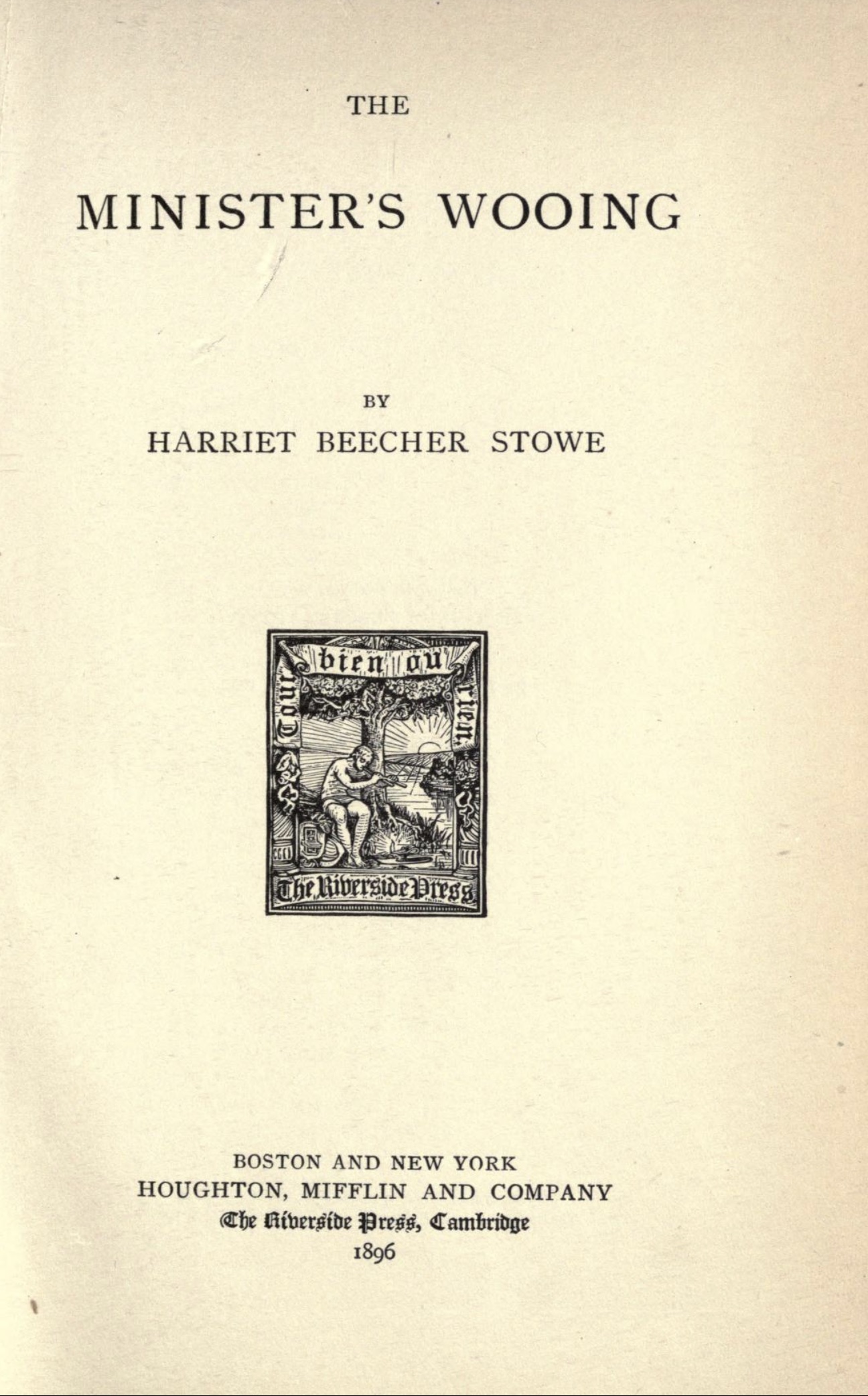
This book, The Minister’s Wooing, plainly shows her growing distaste for Calvinism, and its theology of conversion. Whether or not we can legitimately connect this to her Episcopal leanings, she shows here a strong preference for a more feminized or egalitarian spirituality, in contrast to the hard edged masculine character of the Calvinist deity. She was irresistibly drawn to “the balm of devotional liturgy and the cool shadowy indefiniteness of more æsthetic forms of worship.” And what a lovely description that is! Sign me up.
HBS discusses her early theological roots in other novels, including The Pearl of Orr’s Island (1862) and Oldtown Folks (1869), but Poganuc People brings out that Episcopal theme powerfully and centrally. Her Episcopal identity became more overt, as she formally joined the church, in solidarity with her two daughters, Hattie and Eliza, who had preceded her in 1862. As she wrote on that occasion, “In my heart and belief I am an Episcopalian – and if ever I leave this position here shall fully unite with that church whither I should be happy to have all my children go.” The particular congregation she joined was St. John’s in Hartford.
Her older sister, Catharine Beecher, a noted educational reformer, also joined the church around this time. Explaining that decision, Catharine wrote, “I have entered the Episcopal church, not as a controversialist, but as an educator, seeking for a measure of liberty I can find no where else.”
Looking Backward From Florida
With her husband, in 1867 HBS moved to Mandarin, Florida, partly to seek a winter home, but also with a goal of working for the improvement of local freed Black people. Intentionally or not, her writings did much to encourage tourism and investment in their new state. As she wrote,
The Episcopal Church is, however, undertaking, under direction of the future Bishop of Florida, a wide-embracing scheme of Christian activity for the whole State. In this work I desire to be associated, and my plan is to locate at some salient point on the St. John’s River, where I can form the nucleus of a Christian neighborhood, whose influence shall be felt far beyond its own limits.
On a trivia point, the bishop referred to here was John Freeman Young, whose claim to lasting fame was as the English translator of the hymn Silent Night.
In 1867, she wrote to her brother Charles Beecher to lure him to join the church, and to build the grand project:
I am now in correspondence with the Bishop of Florida, with a view to establishing a line of churches along the St. John’s River, and if I settle at Mandarin, it will be one of my stations. Will you consent to enter the Episcopal Church and be our clergyman? You are just the man we want.
Charles did not accept the invitation to convert, but he did move to Florida to work with Freedmen under the Reconstruction regime.
HBS’s letter to Charles then continued with praise of the Episcopal Church that reads sadly to a modern audience:
If my tasks and feelings did not incline me toward the Church, I should still choose it as the best system for training immature minds such as those of our Negroes. The system was composed with reference to the wants of the laboring class of England, at a time when they were as ignorant as our Negroes now are.
Writing Poganuc People
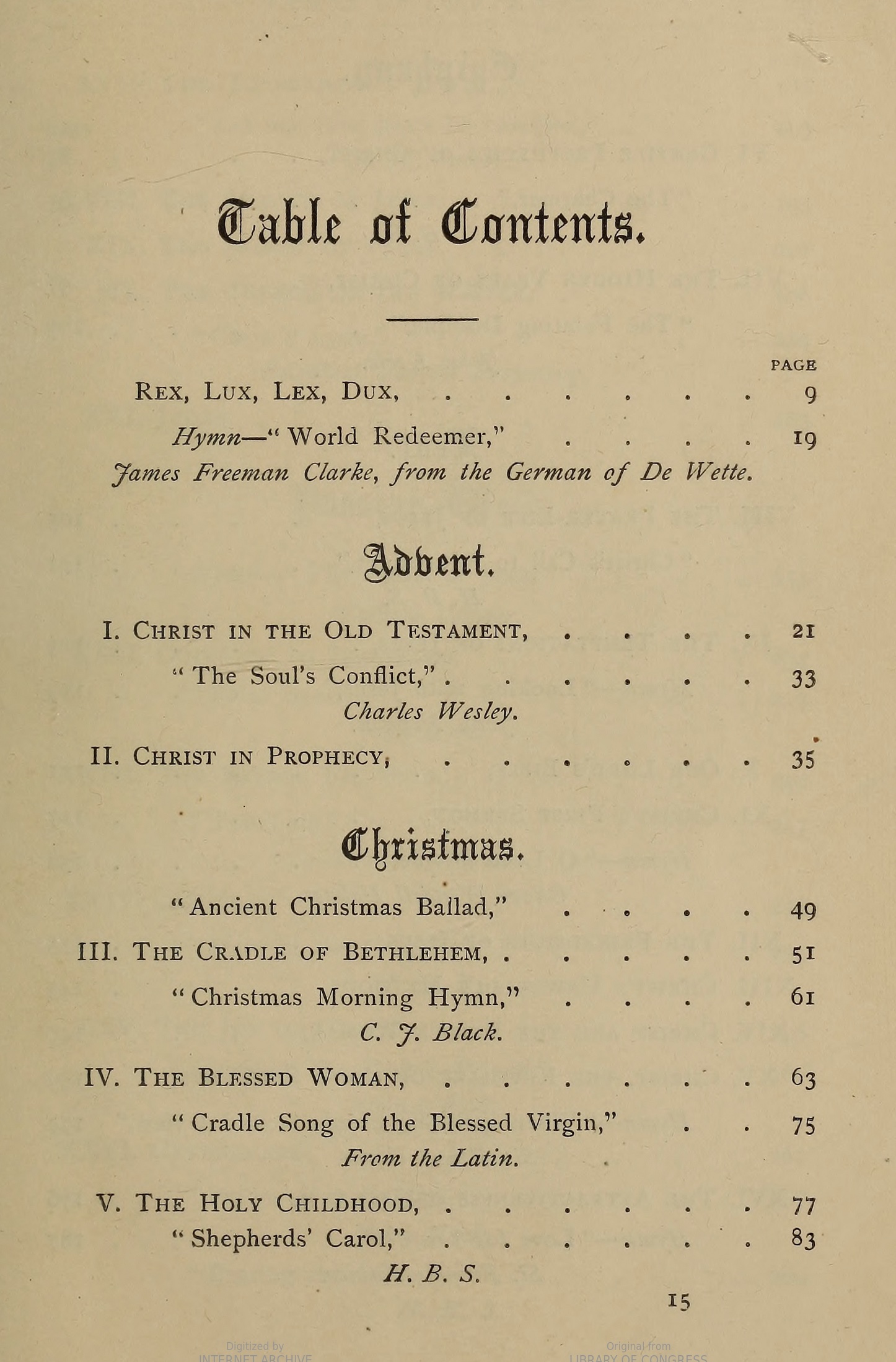
In 1877, HBS published the devotional anthology Footsteps of the Master, a collection of hymns, poems and meditations, which was very high church Anglican indeed both in contents and organization. The book was structured according to the liturgical year – Advent, Epiphany, Lent, Easter, and so on – and the hymn-writers and poets that she used included such distinguished Anglicans as John Keble and J. M. Neale, as well as the Catholics Frederick Faber and even Ignatius Loyola. That clearly suggests where she stood on the ecclesiastical spectrum when she turned her attention to writing Poganuc People, and how highly she valued such great feasts as Christmas.
It was in Florida that she wrote Poganuc People, which became a solid late career success. As her son remarks, this became “that series of delightful reminiscences of the New England life of nearly a century ago, that has proved so fascinating to many thousands of readers.” As HBS explained,
I am again entangled in writing a serial, a thing I never mean to do again, but the story, begun for a mere Christmas brochure, grew so under my hands that I thought I might as well fill it out and make a book of it. It is the last thing of the kind I ever expect to do. In it I condense my recollections of a bygone era, that in which I was brought up, the ways and manners of which are now as nearly obsolete as the Old England of Dickens’s stories is.
Or to quote Edmund Wilson, “At last, at the very end, Mrs. Stowe writes an excellent book – possibly her best novel, as a novel, since Uncle Tom’s Cabin.”
In the 1880s, HBS’s family organized the Episcopal Church of Our Savior, where long after her death, in 1916, Louis Comfort Tiffany installed a fine window to commemorate the faithful couple. If HBS is not exactly canonized in the modern-day Episcopal church, she is now commemorated on July 1 as a “Writer and Prophetic Witness.”
I will have more to say about Poganuc People next time, with a focus on what it says about American religious history in this era.
SOURCES
James Bratt, “The Reorientation of American Protestantism, 1835-1845,” Church History 67 (1998): 52-82.
Lorinda B. Cohoon, “Stowe, Harriet Beecher,” in Oxford Research Encyclopedia of Literature. I don’t understand why the author states that “Poganuc People examines religious life in New England during Jonathan Edwards’s Great Awakening,” which it assuredly does not.
John Gatta, “The Anglican Aspect of Harriet Beecher Stowe,” The New England Quarterly 73(3)(2000) 412-433
Joan D. Hedrick, Harriet Beecher Stowe: A Life (New York: Oxford University Press, 1994)
Nancy Koester, Harriet Beecher Stowe: A Spiritual Life (Eerdman’s, 2014)
Robert W. Prichard, A History of the Episcopal Church, 3rd edition (Harrisburg: Morehouse, 2014)
Charles Edward Stowe, Life Of Harriet Beecher Stowe: Compiled From Her Letters And Journals (Boston and New York: Houghton Mifflin, 1890)
Edward Tang, “Making Declarations of Her Own: Harriet Beecher Stowe as New England Historian,” The New England Quarterly 71(1)(1998): 77-96
Obbie Tyler Todd, The Beechers: America’s Most Influential Family (Louisiana State University Press, 2024)
Edmund Wilson, “Harriet Beecher Stowe,” New Yorker, September 3, 1955
Previous Post
December 2, 2025
Candles in the Darkness: Advent, Hope, and Church History
Next Post

December 8, 2025 Education, Politics, and DEI . . . Again
Recent Comments
"Very good point about MacDonald.I am certainly a Machen fan!"
Fairies, Witches, Folk Horror, and the ..."
"The Scottish author George MacDonald integrated fairy world into his fiction in a way that ..."
Fairies, Witches, Folk Horror, and the ..."
"I like the idea that we can have different streams. The coffee analogy is genius."
How Do You Take Your Evangelicalism?
"Geography lesson: Southern California is actually in North Texas. I've lived her for 40 years, ..."
How Do You Take Your Evangelicalism?
Browse Our Archives
Select a Category abolitionism Abortion Abraham Joshua Heschel Abraham Kuyper Abraham Lincoln Academia Activism Adam Renberg Advent Adventist africa African American Religion Agnes Howard Albert Camus American History American Religious History American Revolution American West Anabaptists Ancient History Andrea Turpin Andrei Tarkovsky Anglicanism Annales Ansley Lillian Quiros anti-Catholicism Antisemitism Anxious Bench apologetics Apparitions Arash Azizi Archaeology archives art Artificial Intelligence Asia Asian Americans Augustine Authors Bad Bunny Baptism Baptists Barack Obama Battle of Hastings Benjamin Franklin Bernard-Henri Levy Beth Allison Barr Beth Moore Bethany Mannon Bible Bill Cunningham Billy Graham Black Music Bob Dylan Body Boenhoffer Books Breastfeeding Bruce Springsteen C.S. Lewis Calvinism Cancel Culture Capitalism Carmelites Catholicism Cedric Robinson Cesar Chavez Charismaticism charity Charles Dickens Charles Lindbergh Che Guevara Chicago Children Chinese Christianity Chris Gehrz Christ Christian death Christian Higher Education Christian life Christian Nation Christian Nationalism Christianity Today Christmas Church life Church Practice cinema Civil Religion Civil Rights Movement Civil War civility Classics Climate Change Cold War Colonial Mexico colonialism Comer Communism community complementarianism Conference on Faith and History Congregationalism Conspiracies Conspiracy Conversion Narratives Coronavirus Costa Rica Council of Nicaea Covid-19 Creation Critical Race Theory Crusades Culture culture wars Daniel K. Williams David Barton David Swartz Death Ways death with dignity DEI democracy Democratic Party Devotion Digital Age Diplomacy discipleship diversity Donald Trump Drama Dua Lipa Early Church early modern Early modern Catholicism Easter Eastern Christianity economic exploitation Education elections Elie Wiesel Elizabeth II Elizabeth Taylor emotions Empire Engineering England enslavement Entertainment Episcopal Church Erica Ramirez eschatology Eurocentrism Evangelicalism Evangelicals Exegesis Family Feminism Film Flannery O'Connor folk music Food Foreign Policy founding fathers Franciscans Franciscus Junius fundamentalism Funerals G.K. Chesterton Gender Genocide genre geography George W. Bush George Washington George Whitefield Global Christianity Global church Grief Guadalupe guest post Guest Post gun control gun violence Gustavo Gutierrez Hamid Dabashi Harold John Ockenga Harvest Hate Hawaiian Christianity Healing health care Heather Cox Richardson Hell Heresy Hermeneutics Higher Education Hinduism Hippocratic oath Historical Fiction Historical Methodology Historical Profession Historical Profession Historical Theology Historical Thinking historiography Holidays Holocaust horror movies Human rights Humanitarian Work humanities Hummingbirds Hungary hymns Imago Dei Immigration Injustice Interviews Iran Islam Islamophobia Israel Ivan's Childhood Jacob Randolph James Bratt Janine Giordano Drake Japanese history Japanese Literature Jean Paul Sartre Jesse Miranda Jesus Jesus Christ Jimmy Carter Joan Baez Joan Didion Joanne Freeman João B. Chaves Joao Chaves Joey Cochran John Calvin John Fea John Tillotson John Turner Johnny Cash Jonathan Edwards Jonathan Tran Joseph Smith Josh Howerton Journalism Jr. Judaism Jürgen Moltmann Just War Justice Justin Brierley Karl Barth Katelyn Beaty koi ponds Kris Kristofferson Kristin Kobes Du Mez Latin American Religious History Latino Americans Lectio Divina Leisure Lent Leonard Cohen liberal arts liberalism Liberation Theology Linda Ronstadt Lisa Clark Diller Literature Lou Reed Lynchings Lynneth Miller Renberg Mainline Protestantism Malcolm Foley Marilyn Monroe Maritime history Mark Noll Marriage Martin Luther Martin Luther King Martyrdom Marxism Mary Masih Alinejad mass shootings material culture medieval Christianity Medieval Ethiopia Melissa Borja memory Mennonites Mental Health Mental Illness Methodism Mexican Americans Mexicans Mike Madrid Miles Mullin Min Jin Lee Miscarriage Missionaries Mister Rogers Mitt Romney modernity Monasticism Mormonism Motherhood Mothers of the Church Moving Music Musicals Nadya Williams Nahua Christianity Native Americans Natsume Sōseki New Contributor New England New Year New York Nico Non-Violent Protest Orthodoxy pacifism Paleo Evangelicals Palestinians Parenting Patti Smith Paul Kingsnorth Pedro Calderón de la Barca Pentecostalism Philip Jenkins Phillis Wheatley physician-assisted suicide pilgrimage Pilgrims pluralism Plutocracy Poetry Politics Pope Francis Pope Leo XIV post-modernism prayer preaching Presbyterians prosperity gospel Protest Public history Publishing Puritans purity culture Quakers race Race Massacres Racial Capitalism racial reconciliation racialization Racism Raha Bahloulipour Re-Enchantment reading Reformation Refugees religion and the university religion and war Religious Freedom Religious Nones Religious Pluralism Religious Symbols religious violence Republican Party Revival Rita Coolidge Ritual Roger Williams Roman Catholic church Royalty Russell Moore same-sex marriage Sarah Irving-Stonebraker Scandinavia Science Science and Technology Scopes trial Scriptural Interpretation secularism Selena Quintanilla seminary Seventh-Day Adventists sexual morality Sexuality Sikhs Silence slaveholders theology Slavery Slavoj Zizek social justice Social Media Southern Baptist Convention Southern Religion Spain Spiritual Autobiography Spiritual but not religious Spiritual Discipline Sports Stanley Hauerwas Suffering Summer Camps Sunday Night Odds and Ends Supernatural Supreme Court Syriac Christianity Tal Howard Taylor Swift Teaching Technology Television Thanksgiving The Beatles The Mission theater TheoBros Theology Thomas Dixon Thomas Jefferson Thomas Kidd Thomas Merton Tim Gloege Tim Walz Tom Holland Tourism tradition Tragedy Translation Transnationalism Travel Trump Ukraine Uncategorized Unitarians United Methodist Church US History Vanessa Chan Velvet Underground Verónica A. Gutiérrez Veronica Gutierrez Vikings Violence Virgin Mary Virtue Virtue ethics Visions Voting War WCTU Wendell Berry Westminster Assembly White Evangelicalism Wildfires Winnie the Pooh Witches women Women in Ministry Women's and Gender Studies Work Worship writing Yasunari Kawabata Zena Hitz
Select a Month October 2026 September 2026 August 2026 July 2026 June 2026 May 2026 April 2026 March 2026 February 2026 January 2026 December 2025 November 2025 October 2025 September 2025 August 2025 July 2025 June 2025 May 2025 April 2025 March 2025 February 2025 January 2025 December 2024 November 2024 October 2024 September 2024 August 2024 July 2024 June 2024 May 2024 April 2024 March 2024 February 2024 January 2024 December 2023 November 2023 October 2023 September 2023 August 2023 July 2023 June 2023 May 2023 April 2023 March 2023 February 2023 January 2023 December 2022 November 2022 October 2022 September 2022 August 2022 July 2022 June 2022 May 2022 April 2022 March 2022 February 2022 January 2022 December 2021 November 2021 October 2021 September 2021 August 2021 July 2021 June 2021 May 2021 April 2021 March 2021 February 2021 January 2021 December 2020 November 2020 October 2020 September 2020 August 2020 July 2020 June 2020 May 2020 April 2020 March 2020 February 2020 January 2020 December 2019 November 2019 October 2019 September 2019 August 2019 July 2019 June 2019 May 2019 April 2019 March 2019 February 2019 January 2019 December 2018 November 2018 October 2018 September 2018 August 2018 July 2018 June 2018 May 2018 April 2018 March 2018 February 2018 January 2018 December 2017 November 2017 October 2017 September 2017 August 2017 July 2017 June 2017 May 2017 April 2017 March 2017 February 2017 January 2017 December 2016 November 2016 October 2016 September 2016 August 2016 July 2016 June 2016 May 2016 April 2016 March 2016 February 2016 January 2016 December 2015 November 2015 October 2015 September 2015 August 2015 July 2015 June 2015 May 2015 April 2015 March 2015 February 2015 January 2015 December 2014 November 2014 October 2014 September 2014 August 2014 July 2014 June 2014 May 2014 April 2014 March 2014 February 2014 January 2014 December 2013 November 2013 October 2013 September 2013 August 2013 July 2013 June 2013 May 2013 April 2013 March 2013 February 2013 January 2013 December 2012 November 2012 October 2012 September 2012 August 2012 July 2012 June 2012 May 2012
Follow Us!
TAKE THE
Religious Wisdom Quiz
Who said, "Come, follow me, and I will make you fishers of men"?
Select your answer to see how you score.
John the Baptist Peter Paul Jesus
Related posts from Anxious Bench

Fairies, Witches, Folk Horror, and the Secret Commonwealth

Hogg’s Justified Sinner: A Gothic Classic for Halloween

James Hogg, Weird Wives, and Feminist Witches

How an Explosive Book Rewrote the Study of...
TRENDING AT PATHEOS Evangelical

The Sermon on the Mount, Part I: Matthew...
The Sermon on the Mount, Part I (Matthew 4:12-5:12) St. Matthew moves...

What's up from Crossway: Reviewing some of their latest A few weeks...

Janie Learns the Way of the Cross: A...
Teaching children about Jesus' Passion can be challenging. Many parents and educators...

Looking For Good Catholic Writing - October 2026
He alone extends the heavens, and he walks upon the waves of...

In "Irreplaceable," our book on vocation and technology, Trevor Sutton and I...

I was strolling through the top floor of the brand new Parthenon...
view all Evangelical blogs
What Are Your Thoughts?leave a comment
Ad-Free & Subscriber Log-In Subscription Support
- About Us
- 2026 Calendar
- Videos
- Podcasts
- Library of World Religions
- Faith In Media Tracker
- Advertise With Us
- Write for Us
- Privacy Policy
- Terms of Service
- Do Not Sell My Data
- Contact Us
- Radiant Digital
- Manage Newsletter Subscriptions
- Unsubscribe From Notifications
- Sitemap
Copyright 2008-2026, Patheos. All rights reserved.
Subscription Support Ad-Free & Subscriber Log-In
Follow Patheos