
BuddhistCatholicContemplativeEvangelicalGeneral ChristianHinduJewishLatter-day SaintMuslimNew VisionsProgressive Christian
Beliefs
- Buddhist
- Catholic
- Contemplative
- Evangelical
- General Christian
- Hindu
- Jewish
- Latter-day Saint
- More Voices
- Muslim
- New Visions
- Pagan
- Progressive Christian
Topics
- Religion News
- Food and Religion
- Sports and Religion
- Religious Art
- Religious Music and Entertainment
- Religious Events
- History and Religion
- Style and Religion
- Politics and Religion
- Women in Religion
- Recreation Outdoors and Religion
- Business Finance and Religion
- Careers Workplace and Religion
- Education and Religion
- Family Parenting and Religion
- Health Fitness and Religion
- Home and Religion
- Relationships and Religion
- Technology and Religion
- Travel and Religion
Columnists
- Buddhist Columnists
- Business Finance and Religion Columnists
- Careers Workplace and Religion Columnists
- Catholic Columnists
- Contemplative Columnists
- Education and Religion Columnists
- Evangelists Columnists
- Family Parenting and Religion Columnists
- General Christian Columnists
- Health Fitness and Religion Columnists
- Hindu Columnists
- History and Religion Columnists
- Home and Religion Columnists
- Jewish Columnists
- More Voices Columnists
- Latter Day Columnists
- Muslim Columnists
- New Visions Columnists
- Nonreligious Columnists
- Pagan Columnists
- Politics and Religion Columnists
- Progressive Columnists
- Recreation Outdoors and Religion Columnists
- Relationships and Religion Columnists
- Religion News Columnists
- Religious Art Columnists
- Religious Events Columnists
- Religious Music and Entertainment Columnists
- Sports and Religion Columnists
- Style and Religion Columnists
- Technology and Religion Columnists
- Travel and Religion Columnists
- Women in Religion Columnists
Resource Library
- 2026 Calendar
- Library of World Religions
- The 100 Most Holy Places on Earth
- Patheos Answers
- Podcasts
- Videos
- Faith Leaders Database
- Anglican Episcopalian
- Bahai
- Baptist
- Buddhism
- Christianity
- Confucianism
- Eastern Orthodoxy
- Hinduism
- Holiness and Pentecostal
- ISKCON
- Islam
- Judaism
- Lutheran
- Methodist
- The Church of Jesus Christ of Latter-day Saints
- New Age
- Paganism
- Presbytarian and Reformed
- Protestantism
- Religion Behind the Scenes
- Roman Catholic
- Scientology
- Shia Islam
- Sikhism
- Sufism
- Sunni Islam
- Taoism
- Zen
- See all religions
Research Tools
 Ad-Free & Subscriber Log-In Subscription Support
Follow Patheos 

- Trending:
- Advent
- |
- Forgiveness
- |
- Thanksgiving
- |
- Election
- |
- Seasonal Holidays
- |
- Marriage

-
About the Authors
- Home
- Evangelical
- Technology and Religion
- Zion: Televangelists and Worldwide Theocracy
Zion: Televangelists and Worldwide Theocracy
Last updated on: August 20, 2025 at 12:01 pm by Alex Mayfield
Zion: Televangelists and Worldwide Theocracy 2025-08-20T12:01:06-04:00 Alex Mayfield
Patheos Explore the world's faith through different perspectives on religion and spirituality! Patheos has the views of the prevalent religions and spiritualities of the world.
[This is the third part in a three-part series that delves into the story of Zion, Illinois, and its founder, John Alexander Dowie. This series explores the oft-misunderstood relationship between charismatic Christianity and modernity. Click here for the first part, or here for the second part.]
They had removed two of the three bullets from his body, but Senior Sergeant Sauer was now refusing further treatment.
“Do not touch me,” he said, “I want no drugs. Telephone Dr. Dowie and ask him to pray for me!”
A few of the nurses offered nervous laughs, unsure what to say. The surgeon could not retrieve the deeper bullets without some sort of sedative or pain reliever being administered, and the man would not take anything.
Sauer entered the gap, “God is the Healer, and Jesus is still the same. Ask Dr. Dowie to pray.”
Partly bemused, partly resigned, one of the nursing staff walked to the nearby telephone and picked up the earpiece. That church was across from the husk of the burned-out fairgrounds. Services ran almost every night. Someone would pick up.
“Zion Tabernacle, please.”
Alexander Dowie is remembered for many things: cult-like devotion, staged healings, fancy robes, and securities fraud, to name just a few. In short, he is recalled for his extremities and abuses. He—and His Zion—are cautionary tales; they are emblems of excess and zealotry, of hucksterism and a particular strain of American utopian delusion. This is unfortunate.
In treating them this way, we can easily miss their broader importance for global religious history writ large. Dowie may have been a saint or a charlatan; Zion might have been a scam or a utopia. Regardless, they were signs of things to come.
For me, what their story illustrates is the importance of the emerging synergistic power of media and communication at the turn of the century.
Dowie, the First Tel-Evangelist
If Dowie was a genius at anything, it was publicity.
Early in his career, Dowie had developed a knack for generating local and national publicity. Through editorials, public spectacle, and pamphlet wars, Dowie learned to draw people’s attention to himself. While his critics might have called his tracts “ill-printed, ill-written, and ill-looking,” they nonetheless drew a crowd, and Dowie would not forget the power of the printed word. By 1890, he established himself in America and began printing the Leaves of Healing newspaper to connect his growing trans-Pacific faith healing organization. In 1894, he established the Zion Publishing House and began pumping out millions of pages of print. The publishing house would go on to print book after book, several more English-language newspapers, and translations of Leaves in German, Dutch, Swedish, and French.
The embrace of print within turn-of-the-century evangelical circles was common. Everyone believed in the power of print, but not everyone understood the ways it could be combined with other forms of communication to foster even deeper senses of personal connection. This was what Dowie understood intuitively.
A quick browse through Leaves reveals an unrivaled interest in the newer technologies of telegraphy and telephones. Through testimonies and verbatim instructions, Dowie insisted that readers of his papers should use these technologies to contact him (or at least his offices) with their prayers, their testimonies, and their wallets. When telephone calls were received, Dowie affirmed how “touching” it was “to hear the ringing, grateful sound of the hearty “Amen” from the friends in distant cities.” When he received telegrams, he responded with an hour that he would pray for the afflicted, and testimonies later affirmed that healing came at just that hour. In short, these new modes of communication allowed Dowie to develop personal connections with individuals across vast distances, to collapse space and time, and to create a community focused on his brand of faith healing, his various enterprises, and his cult of personality. As Senior Sergeant Sauer’s story illustrates, people were willing to bet their lives on those connections.
This cross-platform, engagement-driven approach formed a playbook that every future televangelist—or politician and social media influencers for that matter—would eventually come to know well.
Zion’s Grapho-Tele-Phone and World-Wide Theocracy
Obviously, this playbook meant that Dowie’s utopian Zion City was all but required to have its own “perfect system” of telephones and telegraphs, where every resident could have a phone line, if they desired. Erected without the aid of outside companies, Zion’s system was “installed and maintained” by its own electrical engineers. This ensured that no one could deny them access to the wires over doctrinal or legal disputes (an issue Zion faced when the British government denied them access to the South African wire system).
The importance of the wires was underscored by the mythical founder’s own presence in the city. While Zion was founded in 1900, Dowie did not relocate until after the telecommunication wires were connected to Chicago in 1902. After some haggling with the Chicago Telephone Company, Zion was connected directly to the world by 1903, and Dowie could triumphantly write that his home telephone allowed him to be “in communication with… every part of the civilized world,” and that “modern science, invention and progress have made possible the establishment of a world-wide Theocracy.”
Zion was the center of Dowie’s increasingly grandiose vision of worldwide influence. After his 1901 declaration of himself as the spiritual return of Elijah, Zion’s periodicals began to increasingly focus on the concept of Theocracy. Ideally, the concept meant a form of “government of the people by immediate direction of the Almighty.” In practice, it meant an even more autocratic form of leadership centered on Dowie, who wielded almost absolute authority over the financial, governmental, and ecclesiastical arms of his now global Christian Catholic Apostolic Church in Zion.
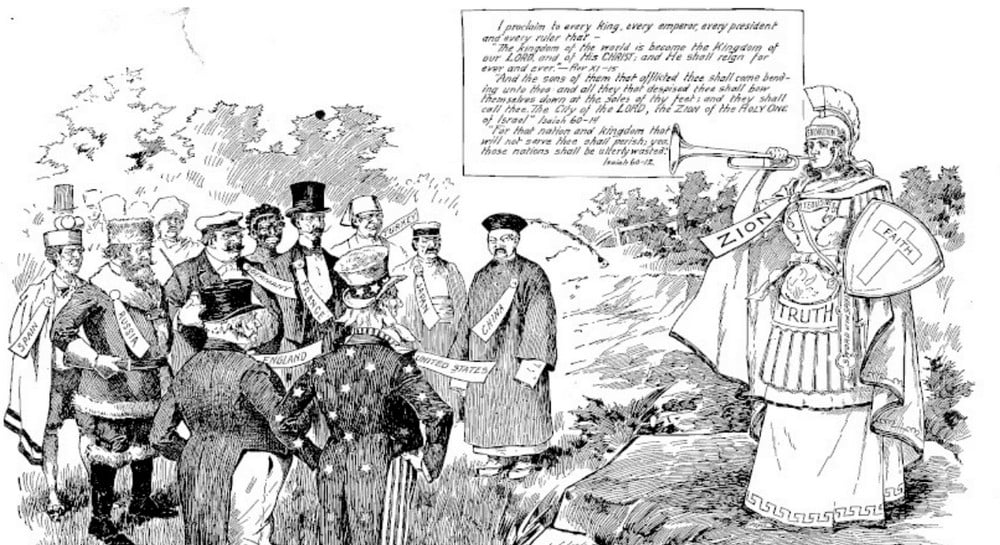
from Leaves of Healing, 28 July 1900, https://pentecostalarchives.org/.
No longer a global fellowship dedicated to faith healing, Dowie’s Church was part of God’s end-time vision for the world, and Zion City was an essential part of that vision. It was to be the first of many.
This Zion is being established by God as the first of many Zion Cities. From these Zion Cities shall flow back to that Ancient Zion, the Glory of all the Nations, the Chosen from the Twelve Tribes of God’s Israel, the best, the purest, the holiest, the strongest, the noblest of the redeemed, until they stand with the Lamb on Mount Zion.
He then proclaimed that these cities were the 144,000 referred to in the Book of Revelation.
Here again, it is tempting to think about Dowie in his obvious excesses, but to do so would miss the ways he was a harbinger of things to come (just not the things he thought).
Dowie’s end-time vision was of a global fellowship of holy cities and holy people, united across race, class, and gender. It was a form of what Joel Cabrita called Christian cosmopolitanism, where all distinctions and diversities were subsumed into one Christian community. Zion was intended to be the “metropolis of the Universe,” and for a time, it seemed like it might be. Zion City had people representing nationalities from over 60 nations, and the Zion message was growing rapidly among black South African peoples. Dowie even hoped that the emerging technology of wireless telegraphy [radio] might help spread his message to Mars and any unsaved people who might be there.
Dowie’s global (and Martian) vision illustrates his belief that innovations in telecommunication were a form of divine Providence, that these technologies were part of God’s plan, visible manifestations of His power. In one particularly flowery ode to innovation in 1901, Dowie lionizes the power of the printing press and extols the even greater power of telegraphy and telephones. Then, he looks to the future. I include the extract in full because it is simply too glorious:
We see another great Power beginning to appear, by means of which, we cannot doubt, the Printing Press will be gloriously supplemented. It is the Grapho-Tele-Phone, by means of which the songs sung and the words spoken in Zion Temple, and even in our Editorial Room, will be recorded upon cylinders and transferred, as is even now done, to hundreds of thousands of other cylinders, and also transmitted by electric wires to earth’s remotest bounds, so that not only will Zion read, but Zion will one day hear, the words spoken in Zion Temple and elsewhere. … How glorious will it be when the King Himself, therefore, shall come, and His redeemed o’er all the Earth shall hear, as well as read His Messages. … The graphophone and telephone may soon find their completion in photo-telegraphy, so that the words spoken shall not only be transmitted, but the speaker himself be seen, and every gesture and every look shall be imperishably imprinted, preserved, and transmitted o’er all the earth. … All hail to the Printing Press and all its beautiful adjuncts, and all hail to the coming Grapho-Tele-Phone and Photo-Telegraph-the Speech-Recorder and Transmitter, and the Picture-Producer ! We hope that Zion City will yet produce that glorious combination…
If the telephone rendered, “time and space … bridged by the use of these Wonderful Invisible Powers,” then the grapho-tele-phone and photo-telegraphy would make the circulation of information practically instantaneous. Just as telegraphs and telephones allowed Dowie to create a worldwide network, the technologies of the future would allow him, as God’s messenger, to rule it. Even the end-time vision of Christ’s return is cast in technological terms. Of course, the Coming King will issue decrees on the grapho-tele-phone, and of course, Zion City would have one.
Techno-utopias and Our Failed Visions
Dowie, of course, was not quite right. Christ has not returned just yet, and the grapho-tele-phone was not just around the corner. That said, I do have something like a grapho-tele-phone in my pocket as I write, and I cannot be quite sure of Christ’s communication preferences on the Day of Judgment. Dowie did not create a new techno-divine world order, but he did foreshadow the modern televangelist and the social influencer, potent and enduring orders all their own.
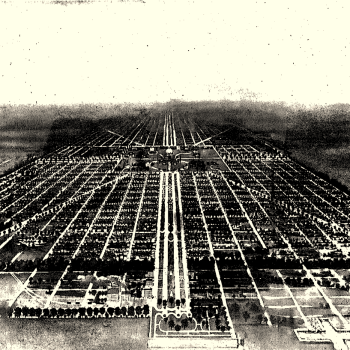
Similarly, Dowie’s Zion was intended to be a techno-utopia, a place where the best of technology, human engineering, and holy living created a new way of life. It was and it wasn’t. Soon after his death in 1904, the city faced bankruptcy and was quickly fractured as succession crises roiled the organization. The city never fully embodied the careful plan that its Chief Engineer, Burton J. Ashley, imagined. Still, it was an early sign of the future suburban sprawl, of carefully manicured lawns, home telephones, and easy commutes into the city.
And, of course, the interconnected network of Zion Cities never came into being. With Dowie’s Elijah Declaration and then death, the global fraternity of Zion churches broke apart as generational and leadership disputes ruptured communions and the nascent Pentecostal movement tore through the network, especially in South Africa. Nevertheless, Zionism remains one of the most important strains of charismatic Christianity in Africa today.
In her work, When the Medium Was the Message, Jenna Supp-Montgomerie argued that religious actors helped form modern network culture and our very conceptions of network technology. Dowie and Zion exemplify this same dynamic. Like so many of their peers, Dowie and his followers believed that technology could translate directly to divine destiny. Progress was possible if only it could be harnessed to the right ends. They did harness it, but not to the ends they imagined.
If there is a lesson in Dowie and Zion, it is perhaps this: The effects of technological change on religious communities are not so easy to predict, but they are important. If we do not pay attention to these relationships, then we run the risk of misunderstanding Dowie, Zion, and even Christianity today.
Technology and Religion
Previous Post

August 19, 2025
Is Faith Required for Reading the Bible Properly?
Next Post
August 21, 2025 Rediscovering Lost Scriptures: Two Astonishing Years
Recent Comments
"Every religion is "made up," even Adam and Eve were made up thousands of years ..."
Forging Druids and Inventing a Nation
"I have an identical twin, and Thomas was always the disciple I connected with most. ..."
In the Footsteps of Thomas: A ..."
"I've never thought of Constantine as a villain. Do Christians generally? Maybe the ones who ..."
"The TV sitcom BEWITCHED was an old favorite of mine"
How Scotland Gave Us Our Modern ..."
Browse Our Archives
Select a Category abolitionism Abortion Abraham Joshua Heschel Abraham Kuyper Abraham Lincoln Academia Activism Adam Renberg Advent Adventist africa African American Religion Agnes Howard Albert Camus American History American Religious History American Revolution American West Anabaptists Ancient History Andrea Turpin Andrei Tarkovsky Anglicanism Annales Ansley Lillian Quiros anti-Catholicism Antisemitism Anxious Bench apologetics Apparitions Arash Azizi Archaeology archives art Artificial Intelligence Asia Asian Americans Augustine Authors Bad Bunny Baptism Baptists Barack Obama Battle of Hastings Benjamin Franklin Bernard-Henri Levy Beth Allison Barr Beth Moore Bethany Mannon Bible Bill Cunningham Billy Graham Black Music Bob Dylan Body Boenhoffer Books Breastfeeding Bruce Springsteen C.S. Lewis Calvinism Cancel Culture Capitalism Carmelites Catholicism Cedric Robinson Cesar Chavez Charismaticism charity Charles Dickens Charles Lindbergh Che Guevara Chicago Children Chinese Christianity Chris Gehrz Christ Christian death Christian Higher Education Christian life Christian Nation Christian Nationalism Christianity Today Christmas Church life Church Practice cinema Civil Religion Civil Rights Movement Civil War civility Classics Climate Change Cold War Colonial Mexico colonialism Comer Communism community complementarianism Conference on Faith and History Congregationalism Conspiracies Conspiracy Conversion Narratives Coronavirus Costa Rica Council of Nicaea Covid-19 Creation Critical Race Theory Crusades Culture culture wars Daniel K. Williams David Barton David Swartz Death Ways death with dignity DEI democracy Democratic Party Devotion Digital Age Diplomacy discipleship diversity Donald Trump Drama Dua Lipa Early Church early modern Early modern Catholicism Easter Eastern Christianity economic exploitation Education elections Elie Wiesel Elizabeth II Elizabeth Taylor emotions Empire Engineering England enslavement Entertainment Episcopal Church Erica Ramirez eschatology Eurocentrism Evangelicalism Evangelicals Exegesis Family Feminism Film Flannery O'Connor folk music Food Foreign Policy founding fathers Franciscans Franciscus Junius fundamentalism Funerals G.K. Chesterton Gender Genocide genre geography George W. Bush George Washington George Whitefield Global Christianity Global church Grief Guadalupe Guest Post guest post gun control gun violence Gustavo Gutierrez Hamid Dabashi Harold John Ockenga Harvest Hate Hawaiian Christianity Healing health care Heather Cox Richardson Hell Heresy Hermeneutics Higher Education Hinduism Hippocratic oath Historical Fiction Historical Methodology Historical Profession Historical Profession Historical Theology Historical Thinking historiography Holidays Holocaust horror movies Human rights Humanitarian Work humanities Hummingbirds Hungary hymns Imago Dei Immigration Injustice Interviews Iran Islam Islamophobia Israel Ivan's Childhood Jacob Randolph James Bratt Janine Giordano Drake Japanese history Japanese Literature Jean Paul Sartre Jesse Miranda Jesus Jesus Christ Jimmy Carter Joan Baez Joan Didion Joanne Freeman João B. Chaves Joao Chaves Joey Cochran John Calvin John Fea John Tillotson John Turner Johnny Cash Jonathan Edwards Jonathan Tran Joseph Smith Josh Howerton Journalism Jr. Judaism Jürgen Moltmann Just War Justice Justin Brierley Karl Barth Katelyn Beaty koi ponds Kris Kristofferson Kristin Kobes Du Mez Latin American Religious History Latino Americans Lectio Divina Leisure Lent Leonard Cohen liberal arts liberalism Liberation Theology Linda Ronstadt Lisa Clark Diller Literature Lou Reed Lynchings Lynneth Miller Renberg Mainline Protestantism Malcolm Foley Marilyn Monroe Maritime history Mark Noll Marriage Martin Luther Martin Luther King Martyrdom Marxism Mary Masih Alinejad mass shootings material culture medieval Christianity Medieval Ethiopia Melissa Borja memory Mennonites Mental Health Mental Illness Methodism Mexican Americans Mexicans Mike Madrid Miles Mullin Min Jin Lee Miscarriage Missionaries Mister Rogers Mitt Romney modernity Monasticism Mormonism Motherhood Mothers of the Church Moving Music Musicals Nadya Williams Nahua Christianity Native Americans Natsume Sōseki New Contributor New England New Year New York Nico Non-Violent Protest Orthodoxy pacifism Paleo Evangelicals Palestinians Parenting Patti Smith Paul Kingsnorth Pedro Calderón de la Barca Pentecostalism Philip Jenkins Phillis Wheatley physician-assisted suicide pilgrimage Pilgrims Piracy pluralism Plutocracy Poetry Politics Pope Francis Pope Leo XIV post-modernism prayer preaching Presbyterians prosperity gospel Protest Public Executions Public history Publishing Puritans purity culture Quakers race Race Massacres Racial Capitalism racial reconciliation racialization Racism Raha Bahloulipour Re-Enchantment reading Reformation Refugees religion and the university religion and war Religious Freedom Religious Nones Religious Pluralism Religious Symbols religious violence Republican Party Revival Rita Coolidge Ritual Roger Williams Roman Catholic church Royalty Russell Moore same-sex marriage Sarah Irving-Stonebraker Scandinavia Science Science and Technology Scopes trial Scriptural Interpretation secularism Selena Quintanilla seminary Seventh-Day Adventists sexual morality Sexuality Sikhs Silence slaveholders theology Slavery Slavoj Zizek social justice Social Media Southern Baptist Convention Southern Religion Spain Spiritual Autobiography Spiritual but not religious Spiritual Discipline Sports Stanley Hauerwas Suffering Summer Camps Sunday Night Odds and Ends Supernatural Supreme Court Syriac Christianity Tal Howard Taylor Swift Teaching Technology Television Thanksgiving The Beatles The Mission theater TheoBros Theology Thomas Dixon Thomas Jefferson Thomas Kidd Thomas Merton Tim Gloege Tim Walz Tom Holland Tourism tradition Tragedy Translation Transnationalism Travel Trump Ukraine Uncategorized Unitarians United Methodist Church US History Vanessa Chan Velvet Underground Verónica A. Gutiérrez Veronica Gutierrez Vikings Violence Virgin Mary Virtue Virtue ethics Visions Voting War WCTU Wendell Berry Westminster Assembly White Evangelicalism Wildfires Winnie the Pooh Witches women Women in Ministry Women's and Gender Studies Work Worship writing Yasunari Kawabata Zena Hitz
Select a Month November 2026 October 2026 September 2026 August 2026 July 2026 June 2026 May 2026 April 2026 March 2026 February 2026 January 2026 December 2025 November 2025 October 2025 September 2025 August 2025 July 2025 June 2025 May 2025 April 2025 March 2025 February 2025 January 2025 December 2024 November 2024 October 2024 September 2024 August 2024 July 2024 June 2024 May 2024 April 2024 March 2024 February 2024 January 2024 December 2023 November 2023 October 2023 September 2023 August 2023 July 2023 June 2023 May 2023 April 2023 March 2023 February 2023 January 2023 December 2022 November 2022 October 2022 September 2022 August 2022 July 2022 June 2022 May 2022 April 2022 March 2022 February 2022 January 2022 December 2021 November 2021 October 2021 September 2021 August 2021 July 2021 June 2021 May 2021 April 2021 March 2021 February 2021 January 2021 December 2020 November 2020 October 2020 September 2020 August 2020 July 2020 June 2020 May 2020 April 2020 March 2020 February 2020 January 2020 December 2019 November 2019 October 2019 September 2019 August 2019 July 2019 June 2019 May 2019 April 2019 March 2019 February 2019 January 2019 December 2018 November 2018 October 2018 September 2018 August 2018 July 2018 June 2018 May 2018 April 2018 March 2018 February 2018 January 2018 December 2017 November 2017 October 2017 September 2017 August 2017 July 2017 June 2017 May 2017 April 2017 March 2017 February 2017 January 2017 December 2016 November 2016 October 2016 September 2016 August 2016 July 2016 June 2016 May 2016 April 2016 March 2016 February 2016 January 2016 December 2015 November 2015 October 2015 September 2015 August 2015 July 2015 June 2015 May 2015 April 2015 March 2015 February 2015 January 2015 December 2014 November 2014 October 2014 September 2014 August 2014 July 2014 June 2014 May 2014 April 2014 March 2014 February 2014 January 2014 December 2013 November 2013 October 2013 September 2013 August 2013 July 2013 June 2013 May 2013 April 2013 March 2013 February 2013 January 2013 December 2012 November 2012 October 2012 September 2012 August 2012 July 2012 June 2012 May 2012
Follow Us!
TAKE THE
Religious Wisdom Quiz
I lift my eyes to the _________, where does my help come from? My help comes from the LORD.
Select your answer to see how you score.
Sky Heavens Hills Seas
Related posts from Anxious Bench

Should Christians Smash the Machine? Ask Mister Rogers
Yes, Pentecostals Really Do Need Those Airplanes
Zion: America’s First Techno-Utopia
TRENDING AT PATHEOS Evangelical
"Three B's" of My Apologetics Ministry (+ VIDEO)
In early December 2026 (less than a week from the time...

James Ishmael Ford's books on Zen
James Ishmael Ford's Official Website provides the most complete annotated list of...
The Trouble with Taking Chesterton Literally
Guest writer: Pilgrim. On paradox, human nature and the art of seeing...

Somewhere right now, someone is sitting in a parked car with a...

Just as the emergence of leaves on the fig tree signals the...
Belief and Disbelief in Christ's Presence in Holy...
A study found that only 29% of Catholics believe that the bread...
view all Evangelical blogs
What Are Your Thoughts?leave a comment
Ad-Free & Subscriber Log-In Subscription Support
- About Us
- 2026 Calendar
- Videos
- Podcasts
- Library of World Religions
- Faith In Media Tracker
- Advertise With Us
- Write for Us
- Privacy Policy
- Terms of Service
- Do Not Sell My Data
- Contact Us
- Radiant Digital
- Manage Newsletter Subscriptions
- Unsubscribe From Notifications
- Sitemap
Copyright 2008-2026, Patheos, part of the Radiant Digital network of media brands. All rights reserved.
Subscription Support Ad-Free & Subscriber Log-In
Follow Patheos