
BuddhistCatholicContemplativeEvangelicalGeneral ChristianHinduJewishLatter-day SaintMuslimNew VisionsProgressive Christian
Beliefs
- Buddhist
- Catholic
- Contemplative
- Evangelical
- General Christian
- Hindu
- Jewish
- Latter-day Saint
- More Voices
- Muslim
- New Visions
- Pagan
- Progressive Christian
Topics
- Religion News
- Food and Religion
- Sports and Religion
- Religious Art
- Religious Music and Entertainment
- Religious Events
- History and Religion
- Style and Religion
- Politics and Religion
- Women in Religion
- Recreation Outdoors and Religion
- Business Finance and Religion
- Careers Workplace and Religion
- Education and Religion
- Family Parenting and Religion
- Health Fitness and Religion
- Home and Religion
- Relationships and Religion
- Technology and Religion
- Travel and Religion
Columnists
- Buddhist Columnists
- Business Finance and Religion Columnists
- Careers Workplace and Religion Columnists
- Catholic Columnists
- Contemplative Columnists
- Education and Religion Columnists
- Evangelists Columnists
- Family Parenting and Religion Columnists
- General Christian Columnists
- Health Fitness and Religion Columnists
- Hindu Columnists
- History and Religion Columnists
- Home and Religion Columnists
- Jewish Columnists
- More Voices Columnists
- Latter Day Columnists
- Muslim Columnists
- New Visions Columnists
- Nonreligious Columnists
- Pagan Columnists
- Politics and Religion Columnists
- Progressive Columnists
- Recreation Outdoors and Religion Columnists
- Relationships and Religion Columnists
- Religion News Columnists
- Religious Art Columnists
- Religious Events Columnists
- Religious Music and Entertainment Columnists
- Sports and Religion Columnists
- Style and Religion Columnists
- Technology and Religion Columnists
- Travel and Religion Columnists
- Women in Religion Columnists
Resource Library
- 2026 Calendar
- Library of World Religions
- The 100 Most Holy Places on Earth
- Patheos Answers
- Podcasts
- Videos
- Faith Leaders Database
- Anglican Episcopalian
- Bahai
- Baptist
- Buddhism
- Christianity
- Confucianism
- Eastern Orthodoxy
- Hinduism
- Holiness and Pentecostal
- ISKCON
- Islam
- Judaism
- Lutheran
- Methodist
- The Church of Jesus Christ of Latter-day Saints
- New Age
- Paganism
- Presbytarian and Reformed
- Protestantism
- Religion Behind the Scenes
- Roman Catholic
- Scientology
- Shia Islam
- Sikhism
- Sufism
- Sunni Islam
- Taoism
- Zen
- See all religions
Research Tools
 Ad-Free & Subscriber Log-In Subscription Support
Ad-Free & Subscriber Log-In Subscription Support
Follow Patheos 

- Trending:
- Forgiveness
- |
- Marriage
- |
- Consciousness
- |
- Death Penalty
- |
- Election
- |
- Halloween

-
About the Authors
- Home
- Evangelical
- Technology and Religion
- Zion: The Garden City of God
Zion: The Garden City of God
Last updated on: July 16, 2025 at 11:18 am by Alex Mayfield
Zion: The Garden City of God 2025-07-16T11:18:27-04:00 Alex Mayfield
Patheos Explore the world's faith through different perspectives on religion and spirituality! Patheos has the views of the prevalent religions and spiritualities of the world.
“The task of city design involves the vaster task of rebuilding our civilization.”
Lewis Mumford, The Culture of Cities
In the wee hours of the morning of January 1, 1900, civil engineer Burton J. Ashley stood among hundreds of his brothers and sisters in Zion Tabernacle. They were tired from the all-day consecration service that had begun at 6:30 a.m. on the previous day. Ashley, however, felt energetic. His moment had come.
Just before the pause for refreshments at 2 a.m., the “concealed mechanism” behind the stage slowly began letting down a giant map of Lake Michigan and its surrounding environs. At its center, lit by the glow of an electric light, was a single dot and the bold letters “ZION.” Then the “brilliant rays of a calcium searchlight” flashed into life, lighting the screen so all could behold the location of the Coming City—a site chosen by Ashley. Dr. Dowie took to the stage with an electrified pointer to explain the map in detail, and when he finished, another map miraculously unfurled itself. This time, a detailed diagram of the Coming City’s streets, institutions, and gardens—a design created by Ashley. And when Dowie’s explanation had run its course once again, a final great image unrolled, an enormous painted vista of that Coming City—a vision that had, up to then, only lived in Ashley’s mind.
Thunderous applause shook the building as Ashley made his way to sit at the front of the platform.
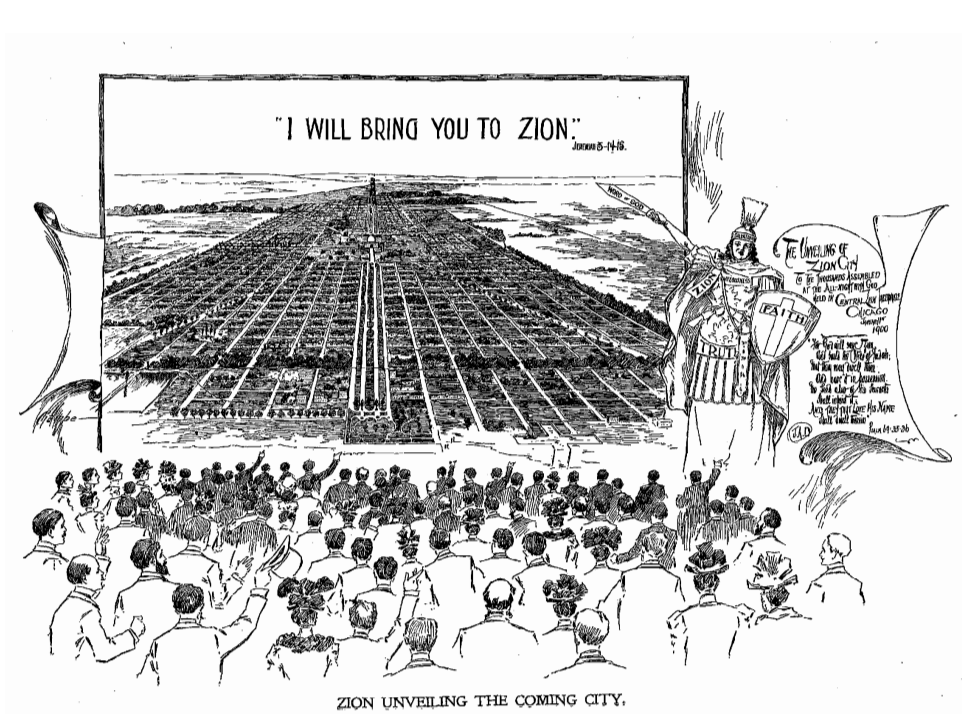
from Leaves of Healing, 6 January 1900, https://pentecostalarchives.org/.
Born in 1857 in Sparta, Ohio, Burton J. Ashley was not on a course to become the visionary behind one of America’s most memorable utopian experiments. By 1900, Ashley had made a name for himself through a distinguished career in engineering. Serving for six years as the county engineer for Morrow, Ohio, Ashley relocated with his family in 1880 to the booming city of Chicago. Still rebuilding from the fire of 1871, the city was intent on creating a modern city with civic regulations and building codes that would ensure such a disaster would never occur again. It was a dream for engineers on the make, and one that only became better as the city prepared for the Columbian Exposition of 1893. Ashley served as the arbitrating engineer for the fair’s Casino Pier and the superintending engineer for the World’s Congress Auxiliary Building, today known as the Art Institute of Chicago. It was a career any engineer would envy, but its future lay further down Michigan Avenue.
By 1895, Ashley had been drawn into the orbit of J. Alexander Dowie, the famous faith healer. Reportedly, his daughter had been healed at a Zion Tabernacle service. Perhaps hoping to pay his debt, Ashley served as a secretary that year for a meeting dedicated to defending Dowie against several public lawsuits. In 1897, he joined the church and was quickly drafted into efforts to establish Zion City.
As Dowie invited Ashley to address the crowd at the unveiling, he confessed his own lack or oratory skills, but assured the crowd that, “As soon as I was appointed to this position, my mind at once began to look toward the matters of reform that are necessary in the building up of a city.” His simple commitment echoed the Zion Land and Investment Association’s objective of making all “public improvements needful in establishing a large, clean and enterprising Modern City.”
Ashley’s desire to build a modern city might stand out for its religious context, but not for its content.
Garden Cities and Company Towns
As discussed in the last post, by the late-19th century, the industrialized world was reeling from the social upheavals of the Second Industrial Revolution. Along with economic growth, the rapid rise of industry has brought urban hellscapes where cesspools and disease were married to crushing poverty and industrial disasters.
Everyone knew there was a problem, and many sought to fix it. Socially and economically-minded industrialists arrived first on the scene. Marrying reform with the theories of scientific management, titans of industry built entire new towns for their workers, replete with good schools, public gardens, well-designed homes, and public utilities. Model towns like Pullman, Illinois, or Kohler, Wisconsin, were meant to provide all that workers needed; the theory being that happy workers enhanced efficiency and led to greater profits.
Yet, these company towns were costly experiments in suburban living and could not solve the pressing crisis of the city. In stepped legions of urban planners and engineers who began searching for attainable alternatives.
Perhaps the most famous was Ebenezer Howard, the father of the Garden City movement, founded in Britain in 1899. Howard’s ambitious plan reimagined a new relationship between town and county where urban industrial centers would be surrounded by planned suburban townships and everything would be connected by rail. In America, the idea wedded itself to the automobile and gave rise to the modern suburb.
Still others sought to save the city itself. Within the City Beautiful movement, men like Frederick Law Olmsted and Daniel Burnham wanted to “[vivify] the national desire for civic beauty” by populating cities with grandiose architecture, public parks, and grand urban vistas, all towards the goal of fostering a greater sense of civic responsibility and an enlightened citizenry. Daniel Burnham served as the chief architect for the Chicago’s Columbian Exposition and the Chicago Plan, both of which became crowning achievements of the movement and a vision of what could be.
Ashley’s Coming City was just one more experiment in the quest for the Modern City.
The Utopian Techno-Religion of City Planning
Yet, Ashley’s experiment in Zion tends to be left out of the urban planning narrative due to its religious utopianism and ultimate failure. Conversely, urban planners and landscape architects like Howler, Olmsted, and Burnham are hailed as visionaries and celebrated for their lasting influence. This difference says more about present perceptions of religion than historical realities.
As Stanley Buder has argued, Ebenezer Howard’s work was shot through with utopian ideals, and his career was set in motion only after his own spiritual experiences in Chicago. While living in the city from 1871-78, Howard grew close to the spiritualist Cora Richmond. Despondent over his flagging faith in God and humanity, Richmond convinced him “of life’s higher purpose and of the working of cosmic forces that were pushing humanity in the direction of altruism.” (11) Similarly, Francis Knight has observed that Howard’s now famous To-morrow: A Peaceful Path to Real Reform was only published thanks to his ties with the spiritualist network. Howard himself attributed his Garden City idea to the supernatural, telling the London Spiritualist Alliance that “I knew then, and I know with still greater certainty now, that the idea exists in the spiritual atmosphere which envelopes and pervades the lives of us all.”
Howard was not alone. Daniel Burnham was raised in the Swedenborg Church, a sect founded on the teaching of scientist and mystic Emanuel Swedenborg. Burnham was keen to spiritualize his famous Chicago Plan, proclaiming that the “spirit of Chicago” impelled its citizenry to create the “very best conditions of city life for all the people.” Similarly, Frederick Law Olmsted developed a deep evangelical piety in his youth, which was cultivated through a close relationship with the well-known congregationalist minister, Horace Bushnell. A “great purpose” of his most famous work, Central Park, was to provide tired workers “a specimen of God’s handiwork.”
What ties Ashley to Howard, Burnham, and Olmsted is not just a belief in progress and the possibility of urban space, it was also the almost religious belief in the ability of cities to shape and give rise to a higher form of life. As Burnham reminded his listeners in 1910, “a noble, logical diagram once recorded will never die, but long after we are gone will be a living thing asserting itself with ever-growing insistency.” In other words, the layout of streets and the placement of parks and utility poles have a power all their own, a power to shape and insist on a particular vision of the future.
Thus, Ashley could claim, in full confidence, that “The carrying out of sanitary laws is sure to produce a higher and better condition of health, and therefore a higher standard of Christianity,” and “the first necessity, therefore that confronts us in the occupying and building up of a Model City, is to erect the bulwark of cleanliness.” Proving his belief, Ashley published detailed analyses on the “Question of Sanitation” in the Zion Banner, a periodical dedicated to the city. In column after column, Ashley gave lengthy, well-researched accounts of the latest research on waste disposal, the correct use of alleyways, and the principles of landscape architecture.
What Ashley and his peers understood was that urban planning is not just the polite and logical ordering of a city. Instead, it is a grand technology, a mega-machine that seeks to shape the life of society itself. As Lewis Mumford observed, every urban plan is an experiment in utopia, an attempt to project the “pattern of an ideal community” onto a real one because this projection tends to “warp our conduct in conformity with that pattern” and enable us to “overcome the momentum of actual institutions.” Though a city plan may begin as a utopia, it may also create one, in time.
This firm belief in the power of planned space to create a renewed form of social life is what anchored Zion, Chicago, and New York. In a very real way, Chicago’s urban plan was no less religious or utopic than Zion’s, nor was Olmsted’s Central Park less ardent and faith-filled than Zion’s Temple Gardens. They merely sought different ends. As Chicago and Central Park sought divine beauty and civic responsibility, Zion chased after spiritual purity and end-times prophecy.
Of course, in their utopic visions, each urban planning experiment experienced a degree of disappointment. Chicago’s fairgrounds burned, Central Park became a breeding ground for invasive species, and Zion went bankrupt. Urban planning is a powerful technology, but—as with any technology—its outcomes are not as easy to predict as its champions would suppose.
Ashley believed that clean streets would make clean souls in the Coming City, but those streets would have far less to say about Zion’s legacy than other technologies that would call the city home.
[This is the second part in a three-part series, that delves into the story of Zion, Illinois, and its founder John Alexander Dowie. This series explores the oft-misunderstood relationship between charismatic Christianity and modernity. Click here to read the first part. ]
Technology and Religion
Previous Post

July 15, 2025
Interpreting Christ’s Weakness: On Partitive Exegesis
Next Post

July 17, 2025 1893: The Revolution in Understanding Crime and Sexuality
Recent Comments
"Very good point about MacDonald.I am certainly a Machen fan!"
Fairies, Witches, Folk Horror, and the ..."
"The Scottish author George MacDonald integrated fairy world into his fiction in a way that ..."
Fairies, Witches, Folk Horror, and the ..."
"I like the idea that we can have different streams. The coffee analogy is genius."
How Do You Take Your Evangelicalism?
"Geography lesson: Southern California is actually in North Texas. I've lived her for 40 years, ..."
How Do You Take Your Evangelicalism?
Browse Our Archives
Select a Category abolitionism Abortion Abraham Joshua Heschel Abraham Kuyper Abraham Lincoln Academia Activism Adam Renberg Advent Adventist africa African American Religion Agnes Howard Albert Camus American History American Religious History American Revolution American West Anabaptists Ancient History Andrea Turpin Andrei Tarkovsky Anglicanism Annales Ansley Lillian Quiros anti-Catholicism Antisemitism Anxious Bench apologetics Apparitions Arash Azizi Archaeology archives art Artificial Intelligence Asia Asian Americans Augustine Authors Bad Bunny Baptism Baptists Barack Obama Battle of Hastings Benjamin Franklin Bernard-Henri Levy Beth Allison Barr Beth Moore Bethany Mannon Bible Bill Cunningham Billy Graham Black Music Bob Dylan Body Boenhoffer Books Breastfeeding Bruce Springsteen C.S. Lewis Calvinism Cancel Culture Capitalism Carmelites Catholicism Cedric Robinson Cesar Chavez Charismaticism charity Charles Dickens Charles Lindbergh Che Guevara Chicago Children Chinese Christianity Chris Gehrz Christ Christian death Christian Higher Education Christian life Christian Nation Christian Nationalism Christianity Today Christmas Church life Church Practice cinema Civil Religion Civil Rights Movement Civil War civility Classics Climate Change Cold War Colonial Mexico colonialism Comer Communism community complementarianism Conference on Faith and History Congregationalism Conspiracies Conspiracy Conversion Narratives Coronavirus Costa Rica Council of Nicaea Covid-19 Creation Critical Race Theory Crusades Culture culture wars Daniel K. Williams David Barton David Swartz Death Ways death with dignity DEI democracy Democratic Party Devotion Digital Age Diplomacy discipleship diversity Donald Trump Drama Dua Lipa Early Church early modern Early modern Catholicism Easter Eastern Christianity economic exploitation Education elections Elie Wiesel Elizabeth II Elizabeth Taylor emotions Empire Engineering England enslavement Entertainment Episcopal Church Erica Ramirez eschatology Eurocentrism Evangelicalism Evangelicals Exegesis Family Feminism Film Flannery O'Connor folk music Food Foreign Policy founding fathers Franciscans Franciscus Junius fundamentalism Funerals G.K. Chesterton Gender Genocide genre geography George W. Bush George Washington George Whitefield Global Christianity Global church Grief Guadalupe guest post Guest Post gun control gun violence Gustavo Gutierrez Hamid Dabashi Harold John Ockenga Harvest Hate Hawaiian Christianity Healing health care Heather Cox Richardson Hell Heresy Hermeneutics Higher Education Hinduism Hippocratic oath Historical Fiction Historical Methodology Historical Profession Historical Profession Historical Theology Historical Thinking historiography Holidays Holocaust horror movies Human rights Humanitarian Work humanities Hummingbirds Hungary hymns Imago Dei Immigration Injustice Interviews Iran Islam Islamophobia Israel Ivan's Childhood Jacob Randolph James Bratt Janine Giordano Drake Japanese history Japanese Literature Jean Paul Sartre Jesse Miranda Jesus Jesus Christ Jimmy Carter Joan Baez Joan Didion Joanne Freeman João B. Chaves Joao Chaves Joey Cochran John Calvin John Fea John Tillotson John Turner Johnny Cash Jonathan Edwards Jonathan Tran Joseph Smith Josh Howerton Journalism Jr. Judaism Jürgen Moltmann Just War Justice Justin Brierley Karl Barth Katelyn Beaty koi ponds Kris Kristofferson Kristin Kobes Du Mez Latin American Religious History Latino Americans Lectio Divina Leisure Lent Leonard Cohen liberal arts liberalism Liberation Theology Linda Ronstadt Lisa Clark Diller Literature Lou Reed Lynchings Lynneth Miller Renberg Mainline Protestantism Malcolm Foley Marilyn Monroe Maritime history Mark Noll Marriage Martin Luther Martin Luther King Martyrdom Marxism Mary Masih Alinejad mass shootings material culture medieval Christianity Medieval Ethiopia Melissa Borja memory Mennonites Mental Health Mental Illness Methodism Mexican Americans Mexicans Mike Madrid Miles Mullin Min Jin Lee Miscarriage Missionaries Mister Rogers Mitt Romney modernity Monasticism Mormonism Motherhood Mothers of the Church Moving Music Musicals Nadya Williams Nahua Christianity Native Americans Natsume Sōseki New Contributor New England New Year New York Nico Non-Violent Protest Orthodoxy pacifism Paleo Evangelicals Palestinians Parenting Patti Smith Paul Kingsnorth Pedro Calderón de la Barca Pentecostalism Philip Jenkins Phillis Wheatley physician-assisted suicide pilgrimage Pilgrims pluralism Plutocracy Poetry Politics Pope Francis Pope Leo XIV post-modernism prayer preaching Presbyterians prosperity gospel Protest Public history Publishing Puritans purity culture Quakers race Race Massacres Racial Capitalism racial reconciliation racialization Racism Raha Bahloulipour Re-Enchantment reading Reformation Refugees religion and the university religion and war Religious Freedom Religious Nones Religious Pluralism Religious Symbols religious violence Republican Party Revival Rita Coolidge Ritual Roger Williams Roman Catholic church Royalty Russell Moore same-sex marriage Sarah Irving-Stonebraker Scandinavia Science Science and Technology Scopes trial Scriptural Interpretation secularism Selena Quintanilla seminary Seventh-Day Adventists sexual morality Sexuality Sikhs Silence slaveholders theology Slavery Slavoj Zizek social justice Social Media Southern Baptist Convention Southern Religion Spain Spiritual Autobiography Spiritual but not religious Spiritual Discipline Sports Stanley Hauerwas Suffering Summer Camps Sunday Night Odds and Ends Supernatural Supreme Court Syriac Christianity Tal Howard Taylor Swift Teaching Technology Television Thanksgiving The Beatles The Mission theater TheoBros Theology Thomas Dixon Thomas Jefferson Thomas Kidd Thomas Merton Tim Gloege Tim Walz Tom Holland Tourism tradition Tragedy Translation Transnationalism Travel Trump Ukraine Uncategorized Unitarians United Methodist Church US History Vanessa Chan Velvet Underground Verónica A. Gutiérrez Veronica Gutierrez Vikings Violence Virgin Mary Virtue Virtue ethics Visions Voting War WCTU Wendell Berry Westminster Assembly White Evangelicalism Wildfires Winnie the Pooh Witches women Women in Ministry Women's and Gender Studies Work Worship writing Yasunari Kawabata Zena Hitz
Select a Month October 2026 September 2026 August 2026 July 2026 June 2026 May 2026 April 2026 March 2026 February 2026 January 2026 December 2025 November 2025 October 2025 September 2025 August 2025 July 2025 June 2025 May 2025 April 2025 March 2025 February 2025 January 2025 December 2024 November 2024 October 2024 September 2024 August 2024 July 2024 June 2024 May 2024 April 2024 March 2024 February 2024 January 2024 December 2023 November 2023 October 2023 September 2023 August 2023 July 2023 June 2023 May 2023 April 2023 March 2023 February 2023 January 2023 December 2022 November 2022 October 2022 September 2022 August 2022 July 2022 June 2022 May 2022 April 2022 March 2022 February 2022 January 2022 December 2021 November 2021 October 2021 September 2021 August 2021 July 2021 June 2021 May 2021 April 2021 March 2021 February 2021 January 2021 December 2020 November 2020 October 2020 September 2020 August 2020 July 2020 June 2020 May 2020 April 2020 March 2020 February 2020 January 2020 December 2019 November 2019 October 2019 September 2019 August 2019 July 2019 June 2019 May 2019 April 2019 March 2019 February 2019 January 2019 December 2018 November 2018 October 2018 September 2018 August 2018 July 2018 June 2018 May 2018 April 2018 March 2018 February 2018 January 2018 December 2017 November 2017 October 2017 September 2017 August 2017 July 2017 June 2017 May 2017 April 2017 March 2017 February 2017 January 2017 December 2016 November 2016 October 2016 September 2016 August 2016 July 2016 June 2016 May 2016 April 2016 March 2016 February 2016 January 2016 December 2015 November 2015 October 2015 September 2015 August 2015 July 2015 June 2015 May 2015 April 2015 March 2015 February 2015 January 2015 December 2014 November 2014 October 2014 September 2014 August 2014 July 2014 June 2014 May 2014 April 2014 March 2014 February 2014 January 2014 December 2013 November 2013 October 2013 September 2013 August 2013 July 2013 June 2013 May 2013 April 2013 March 2013 February 2013 January 2013 December 2012 November 2012 October 2012 September 2012 August 2012 July 2012 June 2012 May 2012
Follow Us!
TAKE THE
Religious Wisdom Quiz
How did God protect Daniel in the lion’s den?
Select your answer to see how you score.
He blinded the guards He made Daniel invisible He sent an angel to shut the lions’ mouths He made the lions fall asleep
Related posts from Anxious Bench
George Rogers and the Pentecostal Case Against Movies

Angelina Grimké's Forgotten Turn to Apocalyptic Faith
Angelina Grimké and the Turmoils of Perfection
When Pentecostals Took on “Hellywood”
TRENDING AT PATHEOS Evangelical

The Sermon on the Mount, Part I: Matthew...
The Sermon on the Mount, Part I (Matthew 4:12-5:12) St. Matthew moves...

What's up from Crossway: Reviewing some of their latest A few weeks...

Janie Learns the Way of the Cross: A...
Teaching children about Jesus' Passion can be challenging. Many parents and educators...

Looking For Good Catholic Writing - October 2026
He alone extends the heavens, and he walks upon the waves of...

In "Irreplaceable," our book on vocation and technology, Trevor Sutton and I...

I was strolling through the top floor of the brand new Parthenon...
view all Evangelical blogs
What Are Your Thoughts?leave a comment
Ad-Free & Subscriber Log-In Subscription Support
- About Us
- 2026 Calendar
- Videos
- Podcasts
- Library of World Religions
- Faith In Media Tracker
- Advertise With Us
- Write for Us
- Privacy Policy
- Terms of Service
- Do Not Sell My Data
- Contact Us
- Radiant Digital
- Manage Newsletter Subscriptions
- Unsubscribe From Notifications
- Sitemap
Copyright 2008-2026, Patheos. All rights reserved.
Subscription Support Ad-Free & Subscriber Log-In
Follow Patheos